Omnichannel Contact Center Software: The Complete Guide
19
MIN READ
August 16, 2026

Today's customers expect a consistent, seamless, and personalized experience no matter how they choose to do business with your brand – whether that's in-store, online, over the phone, via SMS, live chat, or email.
Yet, contact centers face challenges in meeting customers on their preferred channels.
Traditionally, support teams have been structured to focus on specific channels (marketing oversees email campaigns, social media is split between paid and organic, customer support handles incoming calls, etc.)
But without a centralized data hub, teams often develop tunnel vision, working with only a snapshot of the customer journey. The result is a clunky, disjointed customer experience.
That's why25% of contact center leaders would only invest in an omnichannel contact center if given the option to invest in only one solution. Omnichannel contact center platforms help businesses provide a consistent and seamless customer experience, no matter how they choose to reach out.
In this guide, we'll explain what an omnichannel contact center is, how it works, its benefits, and how to choose one for your contact center.
Omnichannel contact center software is a customer service solution that unifies customer communication by effectively combining all communication channels and consumer interactions into a single platform. These channels include voice calls, instant messaging, email, SMS, and social media.
Instead of treating each interaction as a separate conversation, omnichannel software preserves the customer's history and context across channels. Agents can view previous interactions, purchase history, support tickets, and notes in one place, eliminating the need for customers to repeat information every time they switch channels.
Here's what that looks like in practice:
A customer discovers a product on your mobile app, adds it to their cart, asks a question through live chat, receives a followup email with additional information, and later calls customer support before completing the purchase in-store. With an omnichannel contact center, every interaction is connected. When the customer speaks with an agent, the entire conversation history is instantly available, enabling faster resolutions and a more personalized experience.
The result is a seamless customer journey across every touchpoint. Customers can move between channels without losing context, while agents have the information they need to provide faster, more accurate, and more consistent support. This not only improves customer satisfaction but also builds trust, increases loyalty, and helps businesses deliver a truly connected customer experience.
While omnichannel communication might feel like a fancy word for multichannel, they are a lot different. All omnichannel campaigns are multichannel, but the opposite is not true.
There are similar but different concepts that provide customers with unique experiences.
With multichannel experience, the ultimate goal is to use as many marketing channels (such as email, SMS, social media, etc.) to reach as many customers as possible. Each interaction starts fresh and requires them to repeat their issue and context every time they switch channels.
Multichannel marketing isn't wrong, but it has some clear limitations:
Fragmented customer experiences: When channels operate in siloes, it's impossible to get a unified view of your customer journey. In this scenario, customers can reach you through many channels, but their context doesn't travel with them.
Limited personalization capabilities: Siloed data makes personalisation challenging. When you can't follow a customer's journey and interactions, it prevents your business from delivering the right message at the right time through their preferred channel.
Omnichannel customer experience, on the other hand, focuses on providing a seamless, unified customer experience across all channels. The goal is to make it easy for customers to interact with your brand while the brand has full visibility into customer history, preferences, and intent.
Why omnichannel customer experience matters more today:
Research shows that 79% of customers expect consistent interactions across departments. And 55% of them say that communicating with separate departments leads to a disjointed customer experience.
Privacy matters: Changes to privacy regulations are leading to the devaluation of third-party data. Omnichannel communication allows brands to invest in channels that function through zero- and first-party customer data instead.
Hyper-personalisation: With a unified system, agents fully understand customers' history and touchpoints, which is beneficial to tailor personalised interactions and anticipate needs.
| Aspect | Multichannel Contact Center | Omnichannel Contact Center |
|---|---|---|
| Definition | Supports customer communication across multiple channels, but each channel operates independently. | Unifies all communication channels into a single platform, creating one continuous customer journey. |
| Customer Experience | Customers can contact the business through different channels, but may need to repeat information when switching between them. | Customers can switch between channels without losing context or repeating themselves. |
| Channel Integration | Channels are available but disconnected from one another. | All channels are fully integrated and share customer data in real time. |
| Handoffs Between Channels | Customers often have to restart the conversation when moving from one channel to another. | Conversations continue seamlessly across channels without losing context. |
| Personalization | Limited personalization because agents only see channel-specific interactions. | Highly personalized support using the customer's complete interaction history and preferences. |
| Best For | Small businesses that mainly want to offer customers multiple ways to reach them. | Growing businesses and enterprises focused on delivering a consistent, personalized customer experience across every touchpoint. |
Omnichannel contact center software works by bringing all channels a business uses for customer interactions onto one platform. Here's a step-by-step process on how it's done:
The customer journey begins when someone contacts your business using their preferred communication channel.
Modern omnichannel contact centers support a wide variety of touchpoints, including:
Voice calls
Live chat
SMS
Facebook Messenger
Apple Messages for Business, and more.
Each of the interactions made through these channels becomes part of one connected conversation rather than several disconnected tickets. For example, a customer might browse your website, ask a product question via live chat, receive additional information through email, and later call your support team to complete the purchase.
Once a customer initiates contact, the omnichannel platform automatically creates or updates a centralized customer profile. Rather than storing information separately for phone calls, emails, and messaging apps, the software consolidates everything into a single customer record.
This profile typically includes:
Previous conversations
Purchase history
Support tickets
Contact details
Preferred communication channel
CRM data and account information
As a result, every interaction builds on previous ones rather than starting from scratch.
Instead of placing every customer into the same general queue, omnichannel contact center software routes every interaction to the right agent.
Routing decisions are usually taken on the basis of:
Agent skills or department
Customer language
Priority or VIP status
Product category
Business hours
Agent availability
For example, a billing inquiry can be directed immediately to the finance department, while technical troubleshooting requests are routed to specialized support agents. High-value customers are usually prioritized for shorter wait times, while multilingual inquiries are assigned to agents fluent in the customer's language.
So, when an interaction reaches the human agent, they don't just see the latest message; they gain access to the customer's complete interaction history.
Every conversation, regardless of channel, is displayed in a unified timeline, allowing agents to understand the customer's journey before responding.
For instance:
Monday: Customer asks about a product through live chat.
Tuesday: Receives a followup email.
Wednesday: Calls customer support.
When the call arrives, the agent can immediately view both the chat and email history, eliminating the need for the customer to repeat everything.
Modern omnichannel platforms use AI to automate routine tasks before or during agent interactions.
Common AI capabilities include:
AI chatbots answering FAQs
Conversational IVRs handling voice inquiries
Automatic ticket creation
Sentiment analysis
Suggested responses for agents
Conversation summaries after calls
Automated followup messages
These AI capabilities reduce manual work, shorten response times, and allow agents to focus on more complex customer issues.
Ninety-one percent of retailers and brands currently have an omnichannel strategy or are planning to invest in omnichannel technologies in the near-term. In addition, 87% of retailers see omnichannel as critical or important to their business.
The interest in implementing omnichannel is very high; many retailers say, "there's no other way than implementing omnichannel if they want to survive in this competitive landscape".
Wondering how? Here are the key benefits of implementing an omnichannel approach:
Customers don't think in channels; they think in outcomes. Omnichannel customer experience lets them start on one channel and continue on another without repeating themselves (which is recorded as one of the most frustrating experiences for any buyer)
Not only do omnichannel shoppers spend more, but they're also more likely to recommend your brand to family and friends. That's why companies with strong omnichannel engagement retain about 89% of their customers, compared with 33% for businesses without omnichannel.
The ability to meet customers where they are, provide personalised interactions and ensure smooth transitions makes it easier for businesses to fulfil customers' needs.
By breaking down the walls between the channels in a business, businesses enable customers to engage in the way that feels most natural and convenient to them.
Every ops leader has a story about the one that got away:
A qualified lead was routed to voicemail
A support inquiry was ignored overnight
A chat request that timed out with no followup
These aren't staffing problems. They're cross-channel failures that stem from fragmented systems.
Without a unified view, every new channel becomes another blind spot. That's why Retell AI is built to handle voice, chat, and SMS with the same reliability, same response logic, and same backend integrations.
By integrating data from different channels, businesses get a 360-degree view of their customers, enabling them to better understand their needs, preferences, and behaviors.
Personalization used to be a bonus to customer experience, but now it has become a major requirement. The truth is, many consumers won't even engage with a brand that offers a one-size-fits-all interaction.
And thousands of business leaders have confirmed that consumers spend more when interactions are tailored to their interests (up to 34% more, on average).
On average, marketing teams use eight different channels for their campaigns, and consumers engage with 3-5 channels when moving toward a purchase or resolving a request.
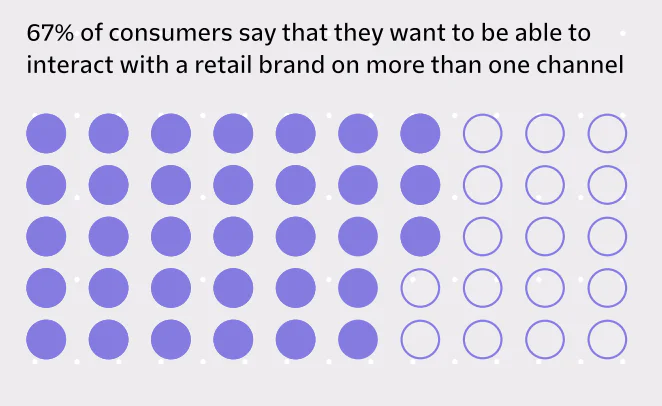
Omnichannel personalization helps keep the conversation across all these channels consistent and provides a continuous experience as customers switch between channels. Whether it's the marketing, sales, or support team, all of them get a real-time view of how a customer has interacted with a business.
Every omnichannel contact center software you explore will offer different feature sets and capabilities. One of your most important jobs in evaluating these features is understanding what fits your business model.
Here are eight must-have features to look for when choosing an omnichannel contact center software:
An omnichannel strategy thrives when employees can effortlessly move between channels while maintaining customer history and context.
For this to happen, your contact center needs an easy-to-use, intuitive interface that brings all communication channels into one place, so that interactions across these channels remain in sync. This helps agents see previous calls, tickets, messages, and notes from customers within one unified interface.
The goal is to make every customer conversation feel like a continuous interaction, regardless of where it started and where it continues.
An omnichannel strategy cannot operate in isolation. Beyond connecting customer communication channels, it should also integrate with the business applications your teams use every day.
Without integrations, agents have to switch between multiple platforms to find customer information, update records, or coordinate with other departments. This slows down response times, increases the risk of errors, and creates a fragmented customer experience.
The best omnichannel contact center, like Retell AI, seamlessly integrates with popular third-party CRM, marketing, outbound dialers, team collaboration, and project management tools like:
CRM platforms: Salesforce, HubSpot, Zoho CRM, Pipedrive, and other CRMs
Communication platforms: Twilio, Vonage, Telnyx, Plivo, SIP providers, and Bring Your Own Carrier (BYOC) configurations
AI and LLM providers: OpenAI, Anthropic Claude, Google Gemini and Grok
Calendars and scheduling tools: Google Calendar andCal.com
Knowledge bases and databases: Pinecone, Weaviate, Supabase, PostgreSQL, and Notion
Retell AI also offers robust REST APIs, webhooks, and SDKs so developers can connect it with custom CRMs, ERP systems, ticketing platforms, payment gateways, analytics tools, and proprietary databases to automate workflows in real time.
Omnichannel routing in contact centers allows businesses to set rules for which agents respond to customer queries regardless of which channel the interaction starts on.
Some routing options include:
Skill-based routing: Automatically directs customer interactions to agents with the right expertise based on predefined criteria such as product knowledge, department, certifications, language proficiency, or technical specialization.
Sentiment-Based Routing: AI analyzes customer messages and speech in real time to detect emotions such as frustration, urgency, or dissatisfaction.
Predictive Routing: Machine learning evaluates historical interaction data, customer profiles, previous resolutions, and agent performance to predict which agent is most likely to resolve a specific issue successfully.
AI continuously learns from every customer interaction. It refines routing decisions over time, balances workloads across available agents, adapts to changing call volumes, and optimizes queue management without requiring constant manual adjustments.
The most effective way to reduce call volume is to have customers; most people prefer convenience and personal autonomy. Customers will take a self-service option; 81% of all customers attempt to take care of matters themselves before reaching out to a live representative.
Customers are more satisfied when they can find answers to their problems themselves, and support that is freely available and simple to understand.
Modern self-service methods can reduce call volume by 30% through:
Online knowledge base and FAQs: It's a great way to start with self-service channels. For it to be truly effective, your knowledge base should be updated and meaningful, and the escalation option should be clearly visible.
Video content: According to a Wyzowl survey, 96% of respondents reported having watched an explainer video to find out more about a product or service. Furthermore, video explainers can reduce support tickets by 40–60% for topics covered within the first month.
Active online community: According to a Demand Metric report, 50% of participants reported a moderate or significant increase in revenue due to having an online community as part of their customer support process. Not only do customers get fast and easy access to answers to common queries, but it also enables analysis of the most commonly discussed issues.
These diverse channels complement each other, ensuring a comprehensive and efficient self-service experience. Compared to human agents, it's far more affordable and quickly accessible for customer support.
With all customer data and channels running through one platform, security and uptime are paramount. Regulatory missteps can create significant liability, while system downtime directly impacts pipeline generation.
If you deal with customers from different countries, pay attention to compliance with local regulations. Here are a few regulations that top customer service platforms like Retell AI offer:
High platform availability to support consistent lead engagement
SOC 2 Type II, HIPAA and GDPR compliance, along with dialing pacing controls, to support your own TCPA and regulatory obligations across industries
Automatic opt-out registry syncing maintains compliance across jurisdictions.
Call recording encryption and audit logs provide security and oversight.
Once a call ends, conversational AI automatically analyses the conversation, without adding any extra workload for human agents.
Retell AI agent offers the following post-call assistance after the customer hangs up:
Automated call summarisation: Retell AI generates clear, structured summaries that capture customer intent, the issue discussed, actions taken, resolution status, and next steps. These summaries are instantly logged in your CRM or ticketing system, eliminating manual wrap-up time.
Auto-tagging and dispositioning: The agent intelligently categorizes each interaction based on call type, resolution outcome, and customer sentiment or feedback.
Followup automation: Based on the call outcome, the AI can automatically send confirmation emails or WhatsApp messages, trigger surveys (CSAT, NPS), or schedule callbacks and service visits, without any human intervention.
Real-time data updates: Retell AI integrates seamlessly with leading CRMs, collaboration tools, and contact centre platforms to sync customer data, summaries, dispositions, and next actions in real time, ensuring systems stay aligned with modern contact centre automation practices.
This level of personalization was previously only possible with dedicated account managers. AI makes it available for every customer interaction, 24 hours a day.
Omnichannel analytics helps gather and analyse data on customer interactions across all the channels your business uses. The purpose of this analysis is to give customers a seamless, personalized experience as they transition from one touchpoint to another.
When it comes to contact center operations, there are various types of reports that can provide valuable insights, including:
These reports track customer satisfaction (CSAT), Net Promoter Score (NPS), Customer Effort Score (CES), first contact resolution (FCR), response times, channel preferences, and conversation history to identify friction points and improve the customer experience.
Key metrics include average response time, resolution rate, customer satisfaction scores, workload distribution, channel-specific productivity, quality assurance scores, and adherence to SLAs. Managers can use these insights to coach agents, balance workloads, and improve overall efficiency.
These reports help optimize staffing, routing strategies, and resource allocation while ensuring customers receive a seamless experience regardless of how they reach out.
As support queries grow, manual QA and reporting simply can't keep up. AI agents can handle repetitive questions, categorize issues, and suggest responses based on past conversations.
For instance, Retell AI agents can interpret multi-step or multi-intent requests and autonomously determine the best action plan– whether that means retrieving past knowledge, executing workflows, or triggering a backend action.
A true omnichannel agent ensures shared logic, centralized governance, and consistent optimization across messaging, chat, and voice without any manual input.
If your customer support team is overworked or spends more time fielding customer complaints than improving your product or service, it's time to invest in some new tools.
But you need to be sure that the customer service platform you're looking for actually helps your team and not just complicates your process even more. These are a few of the criteria you should focus on:
Start by evaluating whether the platform can handle the core support functions your team relies on every day. These basic features determine whether your team can actually manage incoming requests efficiently, maintain visibility across conversations, and deliver consistent customer experiences.
Your customer support tool must offer:
Omnichannel support: Ability to manage customer conversations across email, chat, phone, and social media in one unified system
Ticket management system: A structured way to create, assign, track, and resolve customer issues efficiently
Unified customer view: Centralized access to customer history, previous interactions, and context for faster resolution
SLA management: Tools to define, monitor, and meet response and resolution time targets
Collaboration features: Internal notes, tagging, and easy handoff between team members or departments
Basic reporting and analytics: Visibility into key metrics like response time, resolution time, and ticket volume
Knowledge base integration: Option to build or connect self-service help articles for customers and agents
Automation for routine tasks: Simple workflows like ticket routing, auto-responses, and categorization
AI excels at automating repetitive and time-consuming tasks, enabling faster resolutions and freeing human agents to handle more complex and emotionally nuanced issues.
Key areas where automation helps customer support teams:
FAQs: AI-driven systems can provide instant answers to common customer questions, such as return policies, product specifications, or technical troubleshooting. AI chatbots, in particular, are deployed across websites, messaging platforms, and apps to respond instantly, eliminating wait times.
Order Tracking and Updates: Customers can use AI voice agents or chatbots to check order statuses, delivery timelines, or request tracking updates without involving a human agent.
Account Management: AI handles routine account-related tasks like password resets, balance inquiries, and subscription updates. For example, banking AI agents can help customers with transaction histories or payment reminders.
Take time to evaluate different options and identify the solution that offers the best return on investment within your budget. Look beyond the base licensing fee and factor in additional expenses such as add-ons and future upgrade costs.
Prioritize vendors who are clear and upfront about their pricing structure from the beginning. Be cautious of hidden charges, including data migration, training, ongoing support, and any binding contractual commitments that could increase total costs over time.
For instance, Retell AI offers apay-as-you-go pricing model for their AI Voice and Chat Agents, with no platform fees. The cost for AI Voice Agents is $0.07-$0.31 per minute, and for AI Chat Agents, it's $0.002+ per message. Actual costs vary based on LLM, voice model, and telephony choices you make as per your business requirements.
This allows businesses to customize features without unexpected costs.
One of the biggest advantages of omnichannel contact center software is its ability to route conversations intelligently. Instead of manually assigning tickets or placing customers in long queues, modern platforms automatically connect each interaction with the most suitable agent.
Effective routing improves first-contact resolution, reduces wait times, and ensures customers receive faster, more personalized support.
Look for routing features such as:
Skills-based routing: Match customers with agents based on expertise, certifications, language, or department.
Priority routing: Automatically prioritize VIP customers, premium subscribers, or high-value accounts.
Language-based routing: Connect customers with agents who speak their preferred language.
Queue-based routing: Balance workloads by distributing conversations evenly across available agents.
Sentiment-based routing: Detect customer frustration using AI and escalate urgent conversations to experienced agents.
Predictive routing: Use historical performance data and AI to match customers with the agent most likely to resolve their issue successfully.
For example, if a customer contacts support through live chat with a billing issue and later follows up by phone, the platform should automatically route them to the appropriate billing specialist while preserving the entire conversation history.
Your contact center shouldn't operate as a standalone application. It should connect seamlessly with the software your business already uses so agents have the context they need without switching between multiple tools.
The right integrations eliminate manual data entry, improve productivity, and create a more personalized customer experience.
Look for integrations with:
CRM platforms like Salesforce, HubSpot, Zoho CRM, and Microsoft Dynamics
Help desk software such as Zendesk and Freshdesk
Team collaboration tools like Slack and Microsoft Teams
E-commerce platforms including Shopify and WooCommerce
Marketing automation platforms
Calendar and scheduling tools
Payment systems
Business intelligence platforms
Also check whether the platform provides APIs, webhooks, and workflow automation tools for custom integrations.
For example, when a customer calls, the system should automatically display their recent purchases, open support tickets, subscription details, and previous conversations so agents can resolve issues faster.
AI has become a key differentiator for modern contact center software, but not every platform offers the same level of intelligence. Some vendors only provide basic chatbots, while others use AI throughout the entire customer support workflow.
The goal isn't simply to automate conversations—it's to reduce agent workload while improving response quality and customer satisfaction.
Look for AI features such as:
AI chatbots for handling common customer questions
AI voice agents for answering inbound calls
Intelligent IVR with natural language understanding
Automatic call transcription
AI-generated conversation summaries
Sentiment analysis
Intent detection
Suggested responses for agents
Knowledge base recommendations
Automatic ticket categorization
AI-powered quality assurance
For example, an AI voice agent can verify a customer's identity, answer common billing questions, collect necessary information, and transfer the call to a human agent only when additional assistance is needed. This reduces wait times while allowing agents to focus on more complex issues.
Just as contact center budgets grow, so does the number of channels they're engaging with current and future customers, including live chat, email, social media, and SMS texting.
And, as the world increasingly becomes digital-first, consumers expect to engage with brands on their terms. Yet, phone and voice are the primary means of communication, with82% of contact centersengaging with customers via phone.
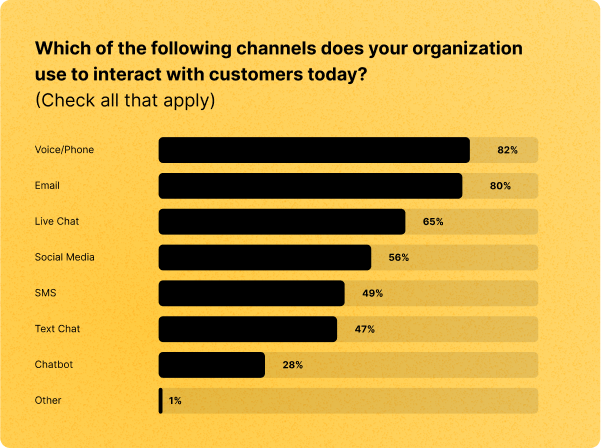
Whilst voice remains a key channel, it is one of the more expensive to support because of agent costs. To assist with these challenges, many contact centers have adopted voice technology to stay ahead.
According toDeepgram, the major use cases of AI voice agents in the contact center include:
Customer experience analytics (73%)
Conversational AI/Voicebots (54%)
Support Enablement (40%)
Employee Coaching and Development (38%)
Call/Meeting Summarization (31%)
Disabled Accessibility (22%)

The biggest return of using voice technology in contact centers came from increasing productivity, with a majority of respondents (71%) saying that they experienced a 26-50% increase in productivity from speech technology. The second biggest impact was increasing revenue, with 53% of respondents
saying they experienced a 26-50% increase and 41% seeing a 1-25% increase.
Providing an omnichannel customer experience doesn't mean adding more channels. It's more about being present where your customers are and helping them without friction. When done well, you'll see higher satisfaction, stronger agent satisfaction, and faster resolutions.
Retell AI was designed specifically for this tension: latency less than <500ms with 99.9% uptime, and the same reliability extends to SMS and web chat too. Over 50 languages unified across voice and chat—full CRM, calendar, and workflow integration with industry-standard tools like Salesforce baked right in.
While others demoed siloed tools, Retell AI provides production-grade omnichannel agents that already live in high-volume environments.
Want to see Retell AI in action? Try Retell AI for free!
Omnichannel contact center software is a customer service platform that brings voice calls, email, live chat, SMS, social media, and messaging apps into one unified workspace. It preserves customer history across every channel, so agents never lose context when conversations switch from one touchpoint to another. Platforms like Retell AI also extend this experience with AI voice and chat agents that automate customer interactions while keeping conversations connected.
A multichannel contact center lets customers contact your business through different channels, but each channel operates independently. An omnichannel contact center connects every interaction into one continuous customer journey, allowing customers to switch channels without repeating themselves. Solutions like Retell AI support this unified experience by sharing customer context across voice, SMS, and chat interactions.
Most modern omnichannel contact center platforms are cloud-based, allowing agents to manage customer conversations from anywhere through a single interface. Cloud deployment also makes it easier to scale, integrate with CRM systems, and roll out AI-powered features without maintaining on-premise infrastructure. Retell AI follows a cloud-native architecture with API integrations and enterprise-grade reliability for high-volume customer support.
Key features include a unified inbox, intelligent routing, CRM integrations, AI chatbots and voice agents, self-service options, analytics, reporting, workflow automation, and post-call summaries. The best platforms also offer APIs, real-time customer profiles, and AI-powered routing to improve response times and first-contact resolution. Retell AI includes AI voice agents, omnichannel routing, CRM integrations, and automated post-call workflows as part of its platform.
Omnichannel contact center software pricing varies depending on deployment, features, AI capabilities, and the number of users. Many vendors charge monthly subscription fees, while AI-first platforms increasingly offer usage-based pricing. For example, Retell AI uses a pay-as-you-go model, with AI voice agents starting at $0.07-$0.31 per minute and AI chat agents from $0.002+ per message, allowing businesses to pay only for what they use.
Omnichannel contact center software improves customer satisfaction by creating one continuous conversation across every communication channel. Agents get a complete view of customer interactions, leading to faster resolutions, better personalization, and fewer repeated questions. AI-powered platforms like Retell AI further enhance efficiency by automating routine conversations while preserving context across voice, chat, and SMS.
Yes. AI helps automate repetitive tasks such as answering FAQs, routing conversations, generating call summaries, detecting customer sentiment, and suggesting responses to agents. This reduces wait times, improves first-contact resolution, and allows human agents to focus on complex issues. Retell AI combines AI voice and chat agents with workflow automation and CRM integrations to streamline customer support.
See how much your business could save by switching to AI-powered voice agents.
Total Human Agent Cost
AI Agent Cost
Estimated Savings
A Demo Phone Number From Retell Clinic Office