GPT-Live-1: How OpenAI's Full-Duplex Voice Model Works on Phone Calls




GPT-Live-1 is OpenAI's full-duplex voice model. It listens and speaks at the same time, handles interruptions itself, and hands reasoning and tool use to a separate backend model. OpenAI brought it to the API on September 10, 2026, after it debuted in ChatGPT's voice mode, and it has been available on Retell AI phone agents since November 2, 2026. This guide covers how it works, what it costs in the API, where it fits on phone calls, and how to set it up on a Retell agent.
Retell AI publishes this guide and offers GPT-Live-1 as one of the models on its voice agent platform.
GPT-Live-1 at a glance
| GPT-Live-1 | |
|---|---|
| Developer | OpenAI |
| Model ID | gpt-live-1 |
| Type | Full-duplex voice model that delegates reasoning and tool use to a backend model or agent |
| Input and output | Audio and text in, audio and text out |
| API endpoint | Live sessions (v1/live/sessions), over WebRTC, WebSockets, or telephony and SIP |
| API price | $0.05 per minute of voice session, billed per second. Backend model and tool usage billed separately. |
| Concurrency | 50 sessions on the Build tier, 300 on Launch, 500 on Grow. Not available on the Free tier. |
| Context window | 128,000 tokens |
| Newer version | GPT-Live-1.1 rolled out to ChatGPT, Codex and dots on October 15, 2026, announced as coming soon to the API. Not in the API as of November 5. |
Sources: OpenAI's GPT-Live-1 model page, Live guide, Live conversations guide, API changelog and launch post; GPT-Live-1.1 from a post on OpenAI's developer forum. Read November 5, 2026.
How full duplex works
Most voice agents take turns in one of two ways. A cascading agent transcribes the caller, sends the text to a language model, then turns the reply into speech. A speech-to-speech model, such as OpenAI's gpt-realtime-2.1, does all three inside one model.
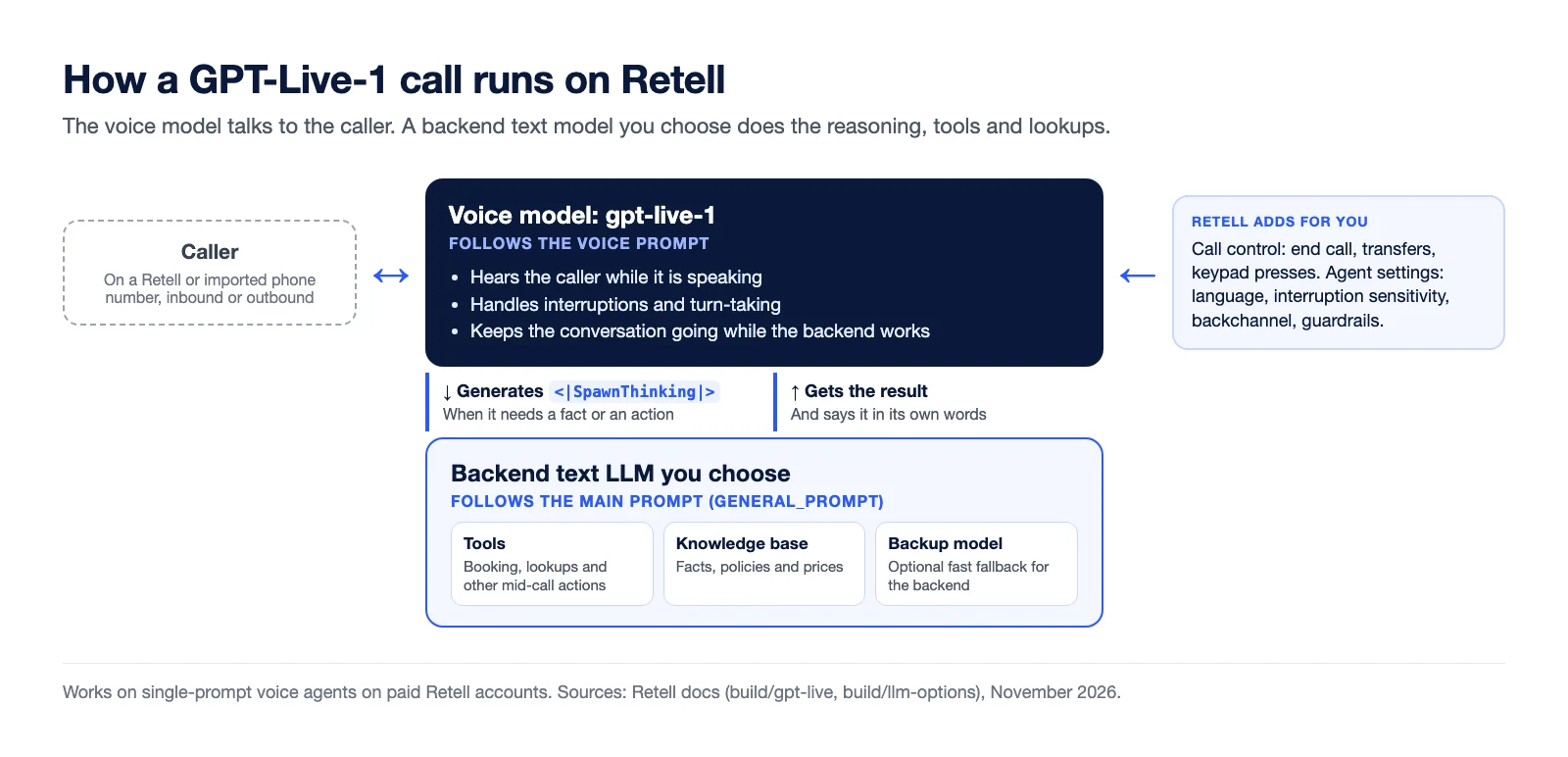
GPT-Live-1 splits the job differently. The voice model owns the conversation: it hears the caller while it is talking, handles barge-in and pauses, and decides what to say next. When it needs a fact or an action, it requests backend work by generating a special token, <|SpawnThinking|>. The backend can be a model, an agent or a service; on Retell it is a text model you choose, running the agent's tools and knowledge base. The backend returns the result, and the voice model says it in its own words. Backend work can keep running when the caller interrupts.
OpenAI's own numbers make the case for the split. In the charts from its API launch post, GPT-Live-1 with GPT-6 Astra at medium reasoning effort as its backend passes 86.2% of Tau3 voice tasks (airline, retail and telecom support) on the first attempt, against 45.7% for GPT-Realtime-2.1. On Full Duplex Bench, OpenAI reports 0.798-second turn-taking latency for GPT-Live-1, against 1.41 seconds for GPT-Realtime-2.1. These are OpenAI's results, not Retell measurements.
Cascading, speech-to-speech or full duplex?
Retell supports all three ways of running a voice agent. They suit different calls.
| Cascading | Speech-to-speech | Full duplex (GPT-Live-1) | |
|---|---|---|---|
| How a turn works | Transcription, then a text LLM, then text-to-speech | One model hears audio and answers in audio | A voice model talks while a backend text LLM does the reasoning and tools |
| Examples on Retell | GPT 5.6 Terra, Claude 5 Sonnet, Gemini 3.5 Flash | gpt-realtime-2.1, grok-voice-3.0 | gpt-live-1 with a backend text LLM |
| Prompts | One | One | Two: a voice prompt and the backend prompt |
| Fast-fallback backup model | Supported | Not supported | Applies to the backend model |
| Best for | Conversation flows and strict multi-step logic | Fast, natural calls that mostly follow one prompt | Natural calls that also take actions mid-call |
For xAI's speech-to-speech option, see how to run a phone agent on Grok Voice. For the wider field of models, see our comparison of speech-to-speech AI APIs for phone calls.
Where GPT-Live-1 fits on phone calls
GPT-Live-1 is strongest on single-prompt agents that take actions during the call, such as booking an appointment or looking up an order, where the response gap of a cascading agent is noticeable. While the backend books or looks something up, the voice model keeps the conversation going instead of pausing on a filler line.
On Retell, it has clear limits:
- Single-prompt voice agents only. It isn't available for conversation flows, multi-prompt agents, transfer agents or chat agents. Use a cascading or speech-to-speech model for those.
- Some tools aren't supported. Agent swap, warm (bridged) transfer and cancel transfer are rejected when you save. A plain call transfer, end call and press digit all work.
- Paid accounts only. Like speech-to-speech models, GPT-Live-1 isn't part of the free trial.
- No per-call switch. An agent override on a single call can't move an agent onto GPT-Live-1.
How to set up GPT-Live-1 on a Retell phone agent
GPT-Live-1 is configured through the Retell API, on a Retell LLM.
- Create a Retell LLM with model_config set to type duplex, gpt-live-1 as the primary model, and the text model you want as the backend.
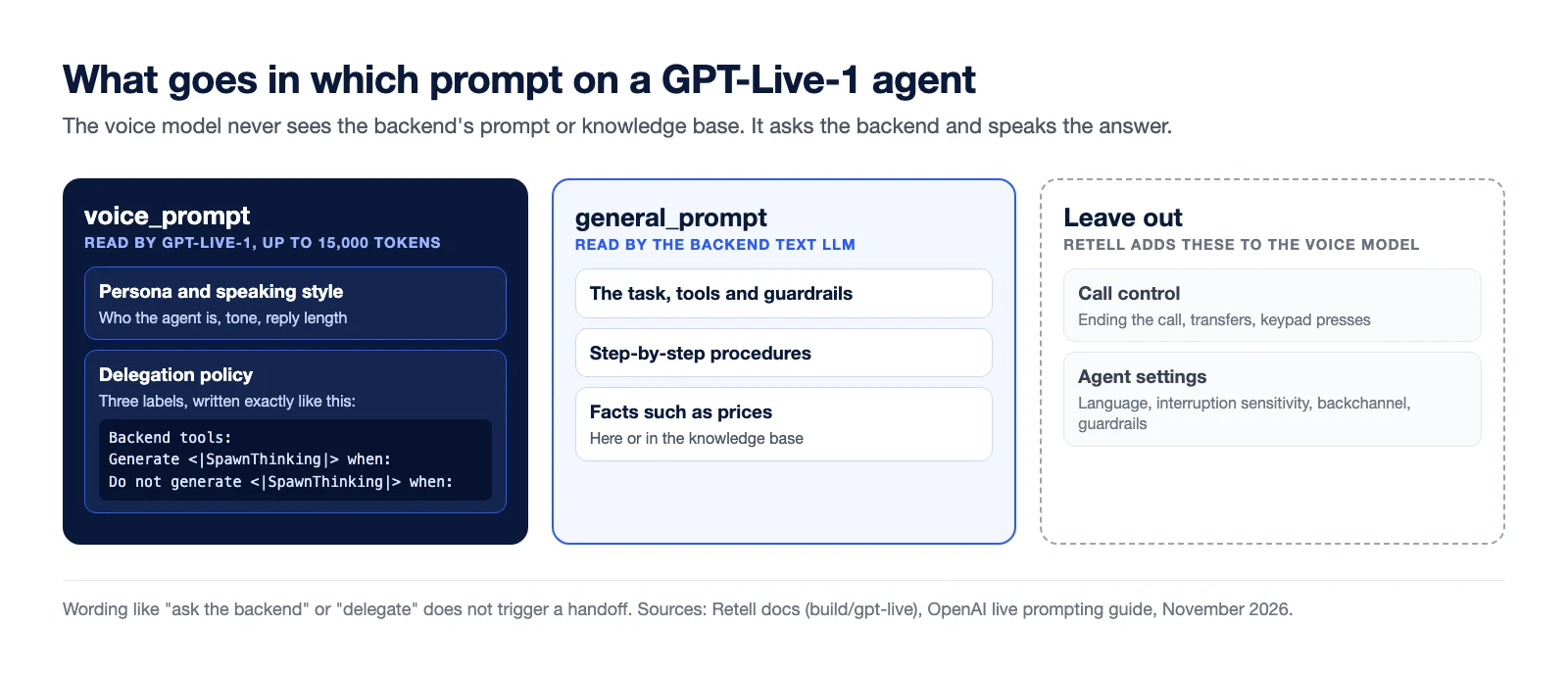
- Write two prompts. general_prompt is the backend's prompt: the task, tools and guardrails. voice_prompt tells the voice model how to talk and when to hand work to the backend. It can be up to 15,000 tokens.
- Attach the LLM to a voice agent as its response engine, the same as any other Retell LLM.
- Connect a phone number and take inbound calls or place outbound ones.
Here is a request adapted from Retell's documentation, for a dental clinic agent:
curl --request POST "https://api.retellai.com/create-retell-llm" \
  --header "Authorization: Bearer $RETELL_API_KEY" \
  --header "Content-Type: application/json" \
  --data '{
    "general_prompt": "You are the backend for a dental clinic phone agent. Collect the caller name and date of birth, then use the booking tool to find and confirm an appointment. Keep names, numbers, and dates exact.",
    "voice_prompt": "You are a warm, efficient front-desk agent for Bright Smile Dental. Keep replies short and natural, and ask one question at a time.\n\nDelegation policy:\nBackend tools:\n- Appointments: find open times and book, change, or cancel appointments.\n\nGenerate <|SpawnThinking|> when:\n- The caller wants to book, change, or cancel an appointment.\n\nDo not generate <|SpawnThinking|> when:\n- You need a brief clarification to understand the request.",
    "model_config": {
      "type": "duplex",
      "primary": { "model": "gpt-live-1" },
      "backend": { "model": "gpt-4.1" }
    }
  }'
Full field details are in the GPT Live setup guide.
Writing the voice prompt
The voice prompt is where most GPT-Live-1 agents go wrong. The model hands work to the backend only when it generates <|SpawnThinking|>, so the handoff rules have to use that exact phrase. Wording like "ask the backend" or "delegate" doesn't trigger a handoff. OpenAI's prompting guide also warns that a spoken promise such as "I'm checking that" does not mean backend work has started.
Write the voice prompt in two parts:
- Persona and speaking style. Who the agent is and how it talks, such as tone and reply length.
- A delegation policy under three labels, kept exactly as written: "Backend tools:" lists what the backend can do, one capability per line. "Generate <|SpawnThinking|> when:" lists when to hand off. "Do not generate <|SpawnThinking|> when:" lists what to answer directly.
Keep tool definitions, step-by-step procedures and facts such as prices in the backend prompt and the knowledge base. The voice model doesn't see them; it asks the backend and says the answer in its own words. Retell also adds call-control instructions (ending the call, transfers, keypad presses) and the agent's settings to the voice model for you, so leave those out.
What carries over from your agent settings
Most Retell agent settings still apply. The voice model honors the agent's language, interruption sensitivity, responsiveness, backchannel, voice speed, pronunciation, boosted keywords and guardrails. Voicemail, IVR, do-not-call and callback detection run through the backend, and the welcome message setting still decides who speaks first.
Two things behave differently. Each tool's "speak during execution" setting is ignored, because the voice model keeps talking while the backend runs, and the agent always speaks after a tool finishes. Dynamic variables in the voice prompt are filled in once, when the call starts.
What GPT-Live-1 costs
In OpenAI's API, a GPT-Live-1 voice session costs $0.05 per minute, billed per second and not rounded up to the next minute. The backend model and its tools are billed separately at their normal rates.
On Retell, the voice model is billed per minute of call time and the backend text LLM is billed separately for its own usage. Current rates are on the pricing page. One detail matters for long calls: Retell reduces model charges over long silent stretches, but full-duplex voice models are still billed through those stretches.
Frequently asked questions
What is GPT-Live-1?
GPT-Live-1 is OpenAI's full-duplex voice model for real-time conversations. It listens and speaks at the same time, handles interruptions, and delegates reasoning and tool use to a backend model or agent that you choose.
Is GPT-Live-1 available in the API?
Yes. GPT-Live-1 became generally available in OpenAI's API on September 10, 2026, on the Live sessions endpoint. GPT-Live-1.1, a newer version with more voices and better non-English performance, rolled out to ChatGPT, Codex and dots on October 15, 2026, and was announced as coming soon to the API.
How much does GPT-Live-1 cost?
OpenAI charges $0.05 per minute for a GPT-Live-1 voice session, billed per second. The backend model and tool usage are billed separately at their normal rates.
Can GPT-Live-1 handle phone calls?
Yes. OpenAI supports telephony and SIP connections for Live sessions. On Retell, a GPT-Live-1 agent is a voice agent like any other, so you connect it to a phone number for inbound and outbound calls, and a plain call transfer and press digit both work.
How is GPT-Live-1 different from gpt-realtime?
gpt-realtime models are speech-to-speech: one model listens, reasons, calls tools and speaks, on OpenAI's Realtime API. GPT-Live-1 runs on a separate Live sessions endpoint, keeps the voice in its own model, and sends reasoning and tools to a backend. OpenAI reports higher task completion for GPT-Live-1 paired with a strong backend, and faster turn-taking.
Does GPT-Live-1 work with conversation flows on Retell?
No. On Retell, GPT-Live-1 works only on single-prompt voice agents. Conversation flows and multi-prompt agents need a cascading or speech-to-speech model.
Try GPT-Live-1 on your own calls
If your agent takes actions mid-call and the pauses bother you, GPT-Live-1 is worth a pilot. Follow the setup guide, connect a number in Retell, and compare it against your current model on real calls before you switch.
See how much your business could save by switching to AI-powered voice agents.
ROI Result
Total Human Agent Cost
AI Agent Cost
Estimated Savings
A Demo Phone Number From Retell Clinic Office
What results look like with Retell AI


Estimate your monthly voice AI cost
Read Other Blogs

Revolutionize your call operation with Retell