Blogs
/
Retell AI vs Five9 vs Genesys Cloud CX vs NICE CXone: Which Enterprise Contact Center Platform Is Best?
Retell AI vs Five9 vs Genesys Cloud CX vs NICE CXone: Which Enterprise Contact Center Platform Is Best?
11
MIN READ
September 18, 2026

This comparison is published by Retell AI, so read it with that in mind. The useful thing here is not a neutral lab verdict, it is a clear map of where each platform genuinely leads, backed by current pricing and public ratings rather than marketing claims.
Five9, Genesys Cloud CX, and NICE CXone are full contact-center-as-a-service suites that license per agent seat and bundle routing, workforce management, and quality monitoring. Retell AI is an AI-native voice automation layer that deploys over your existing carrier and charges per minute.
That difference in architecture decides most buying questions. A 200-seat omnichannel operation that needs forecasting, scheduling, and quality scoring is a different buyer from an operations leader who wants AI to answer 40 to 60 percent of inbound calls before a human picks up.
The sections below weigh both, concede the rows where the CCaaS suites win, and name the buyer each platform fits.
Retell AI is the strongest pick for teams whose primary goal is autonomous call handling and per-minute economics, since it deploys in days over existing telephony with no seat license. If you need deep workforce engagement management or full omnichannel orchestration across thousands of agents, NICE CXone or Genesys Cloud CX earns the spend instead.
The table sets the four platforms side by side on the dimensions enterprise buyers screen first: pricing model, deployment time, AI voice approach, compliance, and ratings. Yes and No values reflect standard plans, not custom enterprise exceptions.
| Dimension | Retell AI | Five9 | Genesys Cloud CX | NICE CXone |
|---|---|---|---|---|
| Pricing model | Per minute, pay as you go | Per agent seat per month | Per agent seat per month | Per agent seat per month |
| Published entry price | Published rate card, varies by model and voice. | $119 Digital, $159 Core | $75 (CX 1) | $110 (Omnichannel) |
| Top published tier | Enterprise custom | $175 to $250 est. (quote) | $240 (CX 4) | $249 + $0.25/session (Ultimate) |
| Seat minimum | None | 50 seats | Reported ~$2,000/mo platform min | None published |
| Free to start | Yes, $10 credits, 60 free min | No, annual contract | Limited trial | Trial available |
| Concurrent calls included | 20 free | Seat-bound | Seat-bound | Seat-bound |
| Time to first live call | 1 to 3 days (inbound) | ~2 months typical | Days to weeks | Weeks |
| Autonomous AI voice agent | Native, consistent at concurrency, no published benchmark | Genius AI (add-on) | AI Experience (token-based) | Enlighten / Mpower AI |
| No-code flow builder | Yes, drag and drop | Inference Studio | Architect (drag and drop) | Orchestrator (visual) |
| Bring-your-own LLM | Yes (GPT, Claude, Gemini, custom) | No | Limited | Limited |
| Built-in simulation testing | Yes | No | No | No |
| Workforce management (WFM) | No | Yes | Yes | Yes, category leader |
| Quality management / QM | Post-call analysis | Yes | Yes | Yes |
| Omnichannel (chat, email, social) | Voice, SMS, chat | Yes (add-ons) | Yes | Yes, 30+ channels |
| Telephony model | BYO carrier via SIP | Native carrier | Genesys Cloud Voice | Native + BYOC |
| SOC 2 Type II | Yes | Yes | Yes | Yes |
| HIPAA | Yes, included | Yes | Yes | Yes |
| GDPR | Yes | Yes | Yes | Yes |
| On-prem deployment | Yes (enterprise) | No (true cloud) | No (cloud, BYOC) | Yes (on-prem + SaaS) |
| Languages | 55+ | Multiple | 18+ | 24+ |
| G2 rating | Not verified at publication | 4.1 (≈611 reviews) | 4.4 (≈1,547 reviews) | 4.3 (≈1,727 reviews) |
| Gartner CCaaS position | N/A (AI-native) | Leader | Leader | Leader |
The single biggest takeaway from the table is that three of these tools price by headcount and one prices by usage. At 50,000 monthly minutes, an AI-native deployment bills only for the minutes the AI talks, while a comparable 75-seat NICE CXone footprint starts around $16,500 a month base before add-ons.
That gap is the whole argument for variable-volume workloads, and it is also why the CCaaS suites still win when you need a human workforce managed at scale.
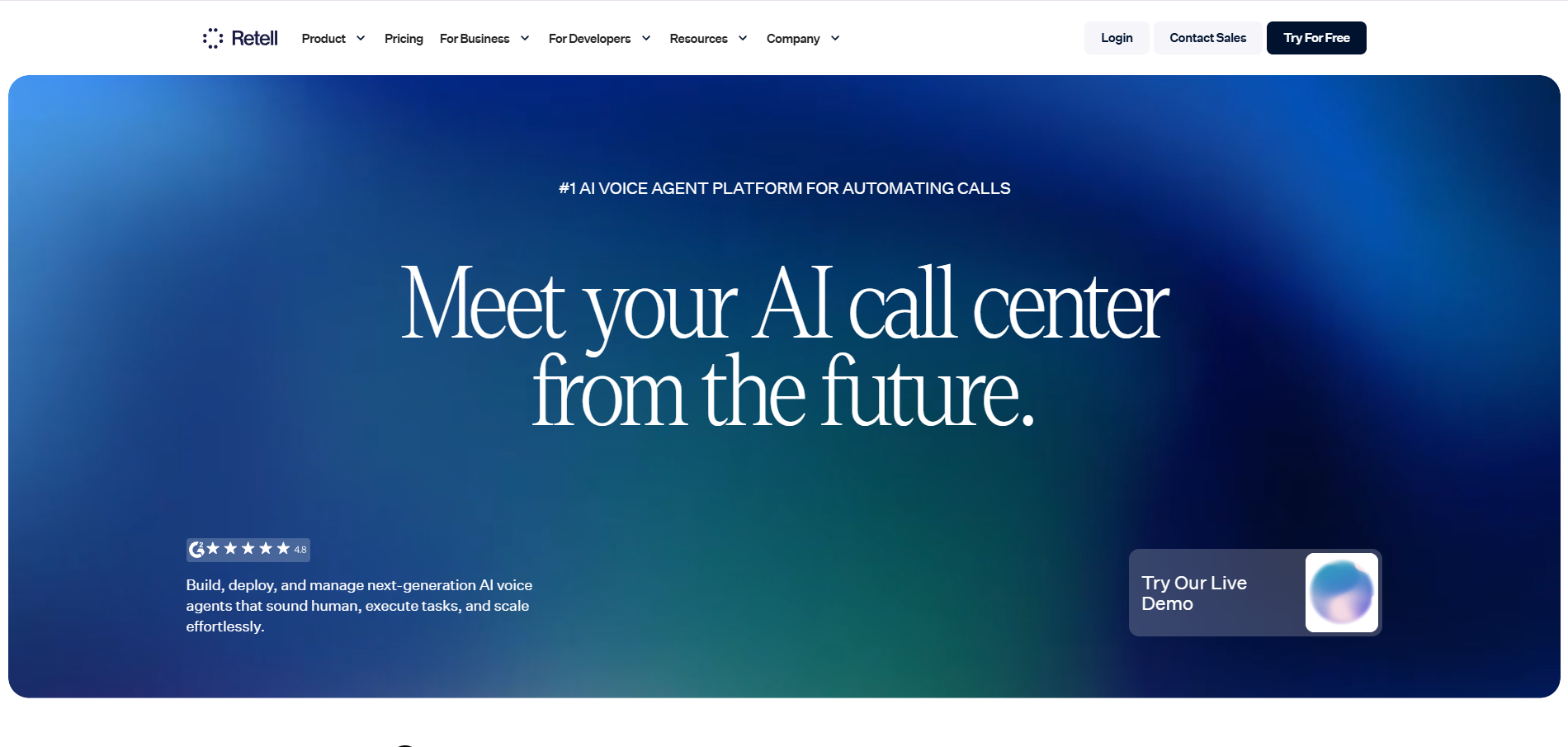
Retell AI is purpose-built to put large language model voice agents on real phone lines. Agents answer, qualify, book, and transfer on inbound and outbound calls.
Retell owns the turn-taking model rather than chaining public APIs, so response times stay consistent at concurrency and the agent handles barge-in, pauses and background noise on real telephony. Test it on your own accents and line quality during the pilot.
Retell runs production voice for enterprise and mid-market teams across healthcare, insurance, logistics and retail. Around 80% of production minutes run through agents customers built and manage themselves.
It is the only tool of the four that prices on usage rather than seats, which changes the math when AI deflects volume that you would otherwise staff.
The architecture is bring-your-own-stack without the billing chaos. You select an LLM from GPT, Claude, Gemini, or a custom endpoint, choose a voice engine, and route through your existing carrier.
Retell publishes its full rate card with no platform fee and no feature gating, so every plan opens the entire platform. Where you land depends on the model and voice you pick rather than on a sales conversation. Telephony is $0.015 a minute, SIP trunking carries no extra charge, and every account includes 20 concurrent calls.
Production features matter more than the demo. Retell supports warm call transfer with full conversation context, appointment booking, branded caller ID, verified numbers, and batch calling out of the box. Its built-in post call analysis tracks sentiment, status, and custom scoring across every call, and a streaming knowledge base keeps answers accurate by auto-syncing from your docs and site.
Compliance is included rather than gated. SOC 2 Type I and II, HIPAA with built-in PII redaction, and GDPR ship on standard plans, which is why regulated teams in healthcare and financial services can pilot without a procurement cycle.
The honest limitation is scope. Retell does not ship native workforce management, shift scheduling, or omnichannel email and social queues, so it is a voice automation layer, not a wall-to-wall contact center suite. Operations teams also face a one-to-two-day learning curve on the state-machine flow builder, and the modular pay-as-you-go model makes monthly forecasting harder once volumes climb, a point reviewers raise consistently.

Five9 is a publicly traded CCaaS veteran founded in 2001, recognized as a Leader in the Gartner Magic Quadrant for Contact Center as a Service. Its published pricing starts at $119 per seat for the Digital plan and $159 for the voice-focused Core plan, with Premium, Optimum, and Ultimate tiers quote-based and industry estimates landing in the $175 to $250 range. Every plan carries a 50-seat minimum and an annual commitment.
Where Five9 genuinely leads is the outbound dialer. Its predictive and progressive dialers are among the strongest in the category, and documented deployments show AI routing cutting transfer rates by up to 40 percent. The native Salesforce integration is one of the tightest CRM connectors in CCaaS, letting agents work inside the Salesforce UI without screen-jumping.
The recurring complaints are consistent across review sites: voice-quality and dropped-call reports top the G2 dislike list with dozens of mentions, and CRM connectors plus AI features carry separate fees. Real all-in spend, once you add WEM named seats, AI overages, and SMS, commonly lands far above the per-seat sticker. Five9 holds a 4.1 G2 rating across roughly 611 reviews, with implementation running about two months.
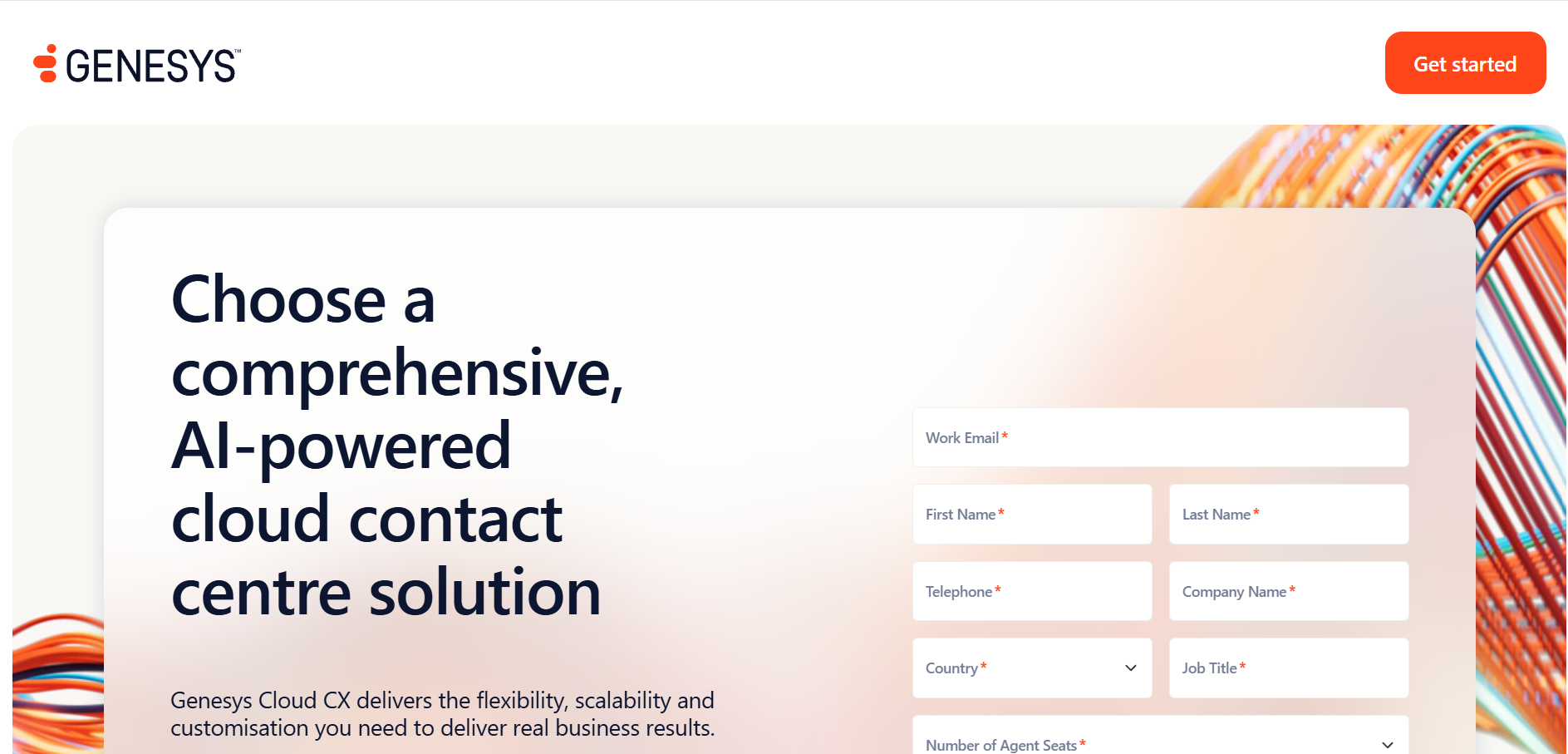
Genesys Cloud CX, formerly PureCloud, is the orchestration heavyweight of the group and a Gartner CCaaS Leader. Pricing is transparent across four named-user tiers billed annually: CX 1 at $75, CX 2 at $115, CX 3 at $155, and CX 4 at $240 per agent per month, as listed on the Genesys Cloud CX pricing page, with telephony billed separately and a reported platform minimum near $2,000 a month.
Its strengths are real and well documented. The Architect drag-and-drop flow builder is genuinely powerful, the platform ships weekly updates, deploys in days for standard flows, and exposes an extensive API surface that engineering teams praise. Genesys holds a 4.4 G2 rating across roughly 1,547 reviews, the highest of the three CCaaS suites here, and is frequently cited for stability and omnichannel depth across voice, chat, email, and social.
The cost story is the catch. CX 4 at $240 per seat works out to $576,000 a year in licensing alone for 200 agents, advanced AI features consume AI Experience tokens that trigger overages, and implementations range from $150,000 for simple voice to seven figures for complex migrations. User forums also flag weaker native WFM forecasting compared with NICE and Verint, which is a meaningful gap for schedule-heavy operations.

NICE CXone, now branded CXone Mpower, is the platform to beat on workforce engagement management and analytics depth. Published suites run from $110 (Omnichannel) through $135, $169, and $209, up to $249 per agent per month for Ultimate, which adds a $0.25 per-session consumption fee. It supports both SaaS and on-prem deployment and carries a 99.999 percent uptime SLA.
Workforce optimization is where NICE earns its premium. Its WFM, quality management, and Enlighten AI analytics are consistently rated the deepest in the category, and it unifies 30-plus channels in a single agent console. NICE CXone Mpower holds a 4.3 G2 rating across roughly 1,727 reviews, with reviewers repeatedly praising real-time visibility and the ability to reskill agents and flex ports on the fly.
The downsides echo the enterprise pattern. The modular suite means new tools require new licenses that balloon total cost, the scripting and Studio workflows demand careful testing and proprietary knowledge, and call-quality and random-drop complaints recur in recent reviews. For a small team without a technical bench or professional-services budget, the platform is frequently described as overkill.
These two solve different problems on the same phone line. Five9 is built to make a human outbound team more productive through predictive dialing and Salesforce-native workflows, billed per seat whether that seat is busy or idle. Retell is built to remove the call from the human queue entirely, billing only for the minutes the AI actually talks.
The economics diverge fastest on variable volume. For overflow, after-hours, and seasonal spikes, Retell's usage-based model with batch call for outbound campaigns avoids paying for 50 seats you only fill at peak. Five9 wins when you genuinely need a managed human dialer floor at scale, since its 36-month, 50-seat structure and dialer suite are designed for exactly that committed outbound operation.
Genesys is the better platform when the requirement is orchestrating complex journeys across many channels with routing intelligence and analytics under one roof. Its Architect builder and weekly release cadence reward teams that will invest in configuration and professional services over months.
Retell wins when speed and cost predictability outrank breadth. It reaches production in one to three days for inbound use cases by sitting on top of the carrier through SIP, and it can layer onto a Genesys environment rather than replace it. Teams that want AI to handle customer support deflection or replace a touch-tone AI IVR without an eight-to-sixteen-week project find the AI-native path far faster, while Genesys remains the choice for the full orchestration layer.
NICE is the clear leader when the contact center's value lives in its human workforce. If you need forecasting, scheduling, gamified performance management, and quality scoring across hundreds of agents, NICE's WFM and Enlighten suite is genuinely best-in-category and worth its premium.
Retell wins on the inverse goal. When the objective is to deflect call volume so you need fewer seats to manage in the first place, per-seat licensing works against you, because NICE keeps billing for a seat even after AI handles the call. Retell's per-minute model with verified numbers and lead qualification flows aligns cost to deflected volume, which is the opposite optimization from workforce engagement.
Operations leaders chasing autonomous call handling and cost-per-minute discipline should start with Retell AI. It deploys fastest, prices on usage, includes HIPAA and PII redaction at no extra cost, and connects to existing carriers including Twilio, Vonage, Telnyx, and even your Five9 or Genesys trunk over SIP, plus automation through n8n, HubSpot, and Salesforce.
Committed outbound sales floors running predictive dialing on a Salesforce stack should pick Five9, where the dialer suite and CRM connector are genuinely the strongest in this group for a managed human team of 50-plus agents.
Large omnichannel operations that need to orchestrate voice, chat, email, and social with deep routing intelligence belong on Genesys Cloud CX, which earns its high TCO through breadth and weekly innovation. And contact centers whose advantage is a tightly managed human workforce should choose NICE CXone for its category-leading workforce engagement, quality management, and on-prem option. Each of the three suites beats Retell on full omnichannel WFM depth, and that concession is exactly why Retell's per-minute deflection case is credible where it applies.
Is Retell AI a full contact center platform like Five9, Genesys, or NICE CXone?
No. Retell AI is an AI-native voice automation layer, not a complete CCaaS suite. It handles autonomous call answering, transfer, and booking but does not ship native workforce management or omnichannel email and social queues. Many teams run it alongside a carrier or an existing contact center over SIP rather than replacing one.
How does Retell AI pricing compare to per-seat CCaaS pricing?
Retell publishes a full rate card with no platform fee, no seat minimum, and 60 free minutes to start. The three CCaaS suites license per agent seat, from $75 to $249 per month, and keep billing for a seat even when AI handles the call. At 50,000 monthly minutes, AI-native voice bills only for the minutes the AI handles, while a 75-seat suite deployment costs about $16,500 a month.
Which platform is fastest to deploy?
Retell AI typically reaches a live inbound call in one to three days because it sits on top of existing telephony through SIP. Five9 implementations commonly run about two months, and complex Genesys or NICE deployments run eight to sixteen weeks. Speed favors the AI-native layer; depth favors the suites.
Which platform is best for workforce management and quality monitoring?
NICE CXone leads on workforce engagement management, scheduling, and analytics, with Genesys and Five9 also offering full WFM and QM. Retell does not include native WFM, offering post-call analysis instead. If managing a large human workforce is the core need, a CCaaS suite is the better fit.
Do all four platforms support HIPAA and SOC 2?
Yes. Retell AI, Five9, Genesys Cloud CX, and NICE CXone all carry SOC 2 Type II, HIPAA, and GDPR. Retell includes HIPAA and built-in PII redaction on standard plans with no add-on, while the CCaaS suites often handle compliance features through higher tiers or named-seat configurations.
Can Retell AI work with my existing Five9 or Genesys contact center?
Yes. Retell connects to carriers and contact centers including Five9, Genesys Cloud, Avaya, and Amazon Connect through elastic SIP trunking, so you can pilot AI voice on specific call flows without ripping out your telephony. Phone numbers stay on the carrier and route to the agent through SIP configuration.
Which platform has the highest user rating?
Among the CCaaS suites, Genesys Cloud CX holds a 4.4 G2 rating across roughly 1,547 reviews, ahead of NICE CXone at 4.3 (about 1,727 reviews) and Five9 at 4.1 (about 611 reviews). Retell AI also holds a strong G2 rating, and this comparison does not cite a specific score for it.
What is the best choice for a high-volume, variable inbound workload?
For overflow, after-hours, and seasonal inbound spikes, Retell AI's per-minute model usually wins because you pay only for minutes the AI handles rather than for idle seats. A per-seat suite makes more sense when volume is steady and you are staffing a fixed human floor that needs routing and workforce tools.
See how much your business could save by switching to AI-powered voice agents.
Total Human Agent Cost
AI Agent Cost
Estimated Savings
A Demo Phone Number From Retell Clinic Office