Best AI Call Center Software in 2026: Retell vs Synthflow vs Intercom Fin vs Chatbase
13
MIN READ
September 18, 2026
Picking AI call center software in 2026 means choosing between tools that look alike on a feature grid and behave nothing alike on a live phone line.
Retell AI, Synthflow, Intercom Fin, and Chatbase all automate customer conversations, yet two were built for voice calls and two were built for chat that later bolted on a phone option.
Pick on the wrong axis and you either pay per resolution for a channel you barely use or wire telephony into a tool that treats voice as a secondary concern.
This is Retell AI's own comparison, so read the recommendation as a point of view rather than a neutral lab test.
We checked current pricing, G2 ratings, channels, and compliance for all four tools in June 2026, and we credit each competitor where it genuinely wins.
Retell leads for teams whose call center is mostly phone work, because phone calls are the channel it was designed around. For chat-first support the answer changes, and we say so below.
Retell AI is the strongest pick when phone calls are the bulk of your call center, because it pairs per-minute pricing with warm transfer, knowledge-based answers, and your own telephony.
Synthflow suits no-code voice teams, Intercom Fin owns omnichannel chat and email support, and Chatbase is fastest for website chat deflection.
The table below maps each tool against the dimensions that decide which one a high-volume operation should run.
| Dimension | Retell AI | Synthflow | Intercom Fin | Chatbase |
|---|---|---|---|---|
| Built for | Voice call automation | No-code voice agents | Omnichannel support (chat-led) | Website chat (voice added 2026) |
| Primary channels | Phone, SIP, web voice | Phone | Chat, email, SMS, social, voice | Web chat, social, email, voice |
| Voice vs chat focus | Voice-first | Voice-first | Chat-first | Chat-first |
| Build model | No-code plus full developer SDK | No-code first | No-code config | No-code |
| Warm transfer to live agents | Yes, with full call context | Yes, human transfer | Yes, hands off with context | Higher tiers only |
| Agent assist / live-agent tooling | Post-call analysis, no agent copilot | Limited | Yes, Copilot for human agents | No |
| Omnichannel ticketing | Partial (voice, chat, SMS) | No | Yes, native helpdesk plus Zendesk/Salesforce | Help desk on Standard and up |
| Knowledge base | Yes, streaming RAG, 10 free | Yes | Yes | Yes, core function |
| Appointment booking | Yes, calendar sync via Cal.com | Yes, real-time booking | Via workflows | Via actions |
| Outbound IVR navigation | Yes | Limited | No | No |
| Batch / outbound calling | Yes | Yes | No, support-led | Yes, Standard and up |
| Branded caller ID / verified numbers | Yes | Limited | Via Intercom Phone | Limited |
| Post-call analytics | Yes | Yes | Yes, reports | Basic |
| Pricing model | Per-minute pay-as-you-go | Per-minute pay-as-you-go | Per resolution ($0.99) | Credit-based subscription |
| Entry point | Published rate card, varies by model and voice | $0.09/min voice, $0 to start | $0.99/resolution, 50/mo minimum | Free; Standard near $150/mo |
| Realistic all-in | Published rate card, varies by model and voice | $0.11–$0.24/min | $0.99 per resolved conversation | Varies by credits and model |
| Concurrency included | 20 calls | 5 calls | Not applicable | Tier-dependent |
| Concurrency at scale | Enterprise custom, starts at 50+ calls with no cap | Up to 50, enterprise unlimited | Not applicable | Tier-limited |
| Languages | 55 languages, 63 locale variants | 50+ | 45+ | 95+ (voice) |
| SOC 2 Type II | Yes | Yes | Yes | Confirm with vendor |
| HIPAA | Yes, self-serve BAA on standard plans | Enterprise only | Available, enterprise, confirm the tier with the vendor | Confirm with vendor |
| GDPR | Yes | Yes | Yes | Confirm with vendor |
| PII redaction | Yes | Confirm with vendor | Yes, confirm with vendor | Confirm with vendor |
| G2 rating | 4.8/5 (2,000+ reviews) | 4.5/5 (≈999) | 4.5/5 (thousands) | 4.7/5 (small sample) |
Retell treats the phone call as the unit of work rather than the chat thread, and that choice shapes every capability below.
Retell publishes its full rate card with no platform fee and no feature gating, so every plan opens the entire platform. Where you land depends on the model and voice you pick rather than on a sales conversation. Telephony is $0.015 a minute, SIP trunking carries no extra charge, and every account includes 20 concurrent calls.
When a caller needs a person, warm call transfer passes the full conversation context to a live agent, so the customer never repeats the account number they already gave. That single behavior is what separates a phone agent from a chatbot reading a script.
Agents answer from a streaming knowledge base that syncs from your site and documents, with the first 10 knowledge bases included at no cost. Accuracy on the phone depends on that source staying current, since callers expect an answer in one turn.
For scheduling, real-time calendar sync lets agents book appointments during the call through Cal.com and similar tools, which matters for clinics, dental offices, and home-services dispatch. Reschedules and confirmations happen inside the same call.
On outbound work, Retell runs bulk campaigns through batch call and can auto-navigate legacy phone trees to reach the right person without a human dialing. Branded caller ID and carrier-verified numbers lift answer rates on those campaigns.
Every conversation feeds post call analysis with transcripts, sentiment, and call scoring, so QA does not depend on a supervisor listening to recordings. Trends surface across thousands of calls rather than a sampled handful.
Telephony runs through Twilio, Vonage, or Telnyx, and the platform connects to CRMs like Salesforce and hubspot plus automation tools such as n8n, with bring-your-own LLM support across GPT, Claude, and Gemini. You can also bring your own carrier over SIP.
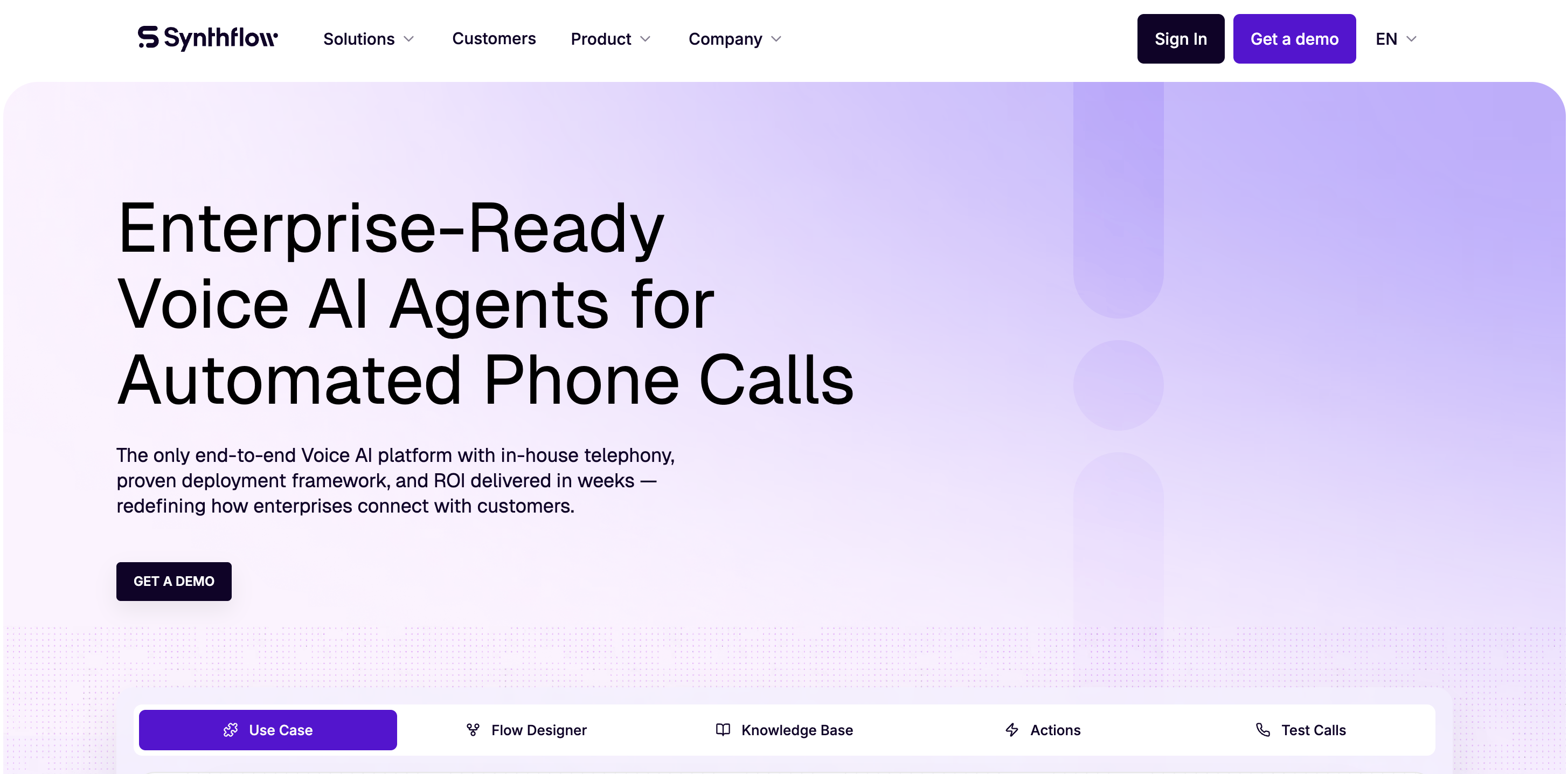
Synthflow earns its place for teams that want voice automation but have nobody to write code, and on that axis it beats Retell.
The builder is genuinely no-code first, with a drag-and-drop flow editor and ElevenLabs voices by default, so an operations manager can ship a working agent without an SDK.
Pricing moved to pay-as-you-go in 2026 at roughly $0.09 per minute for the voice engine, plus $0.02 to $0.04 for the LLM and $0.02 for managed telephony, landing most setups between $0.11 and $0.24 per minute.
The tradeoff shows up at the edges.
The pay-as-you-go plan includes only 5 concurrent calls, with extra slots at $20 each per month up to 50, and HIPAA coverage is gated to the Enterprise tier rather than included.
Synthflow holds a 4.5/5 rating on G2 across roughly a thousand reviews, with the most common complaint being that advanced customization and stability improve mainly on higher plans.
For a non-technical team running moderate voice volume, that is a fair deal.
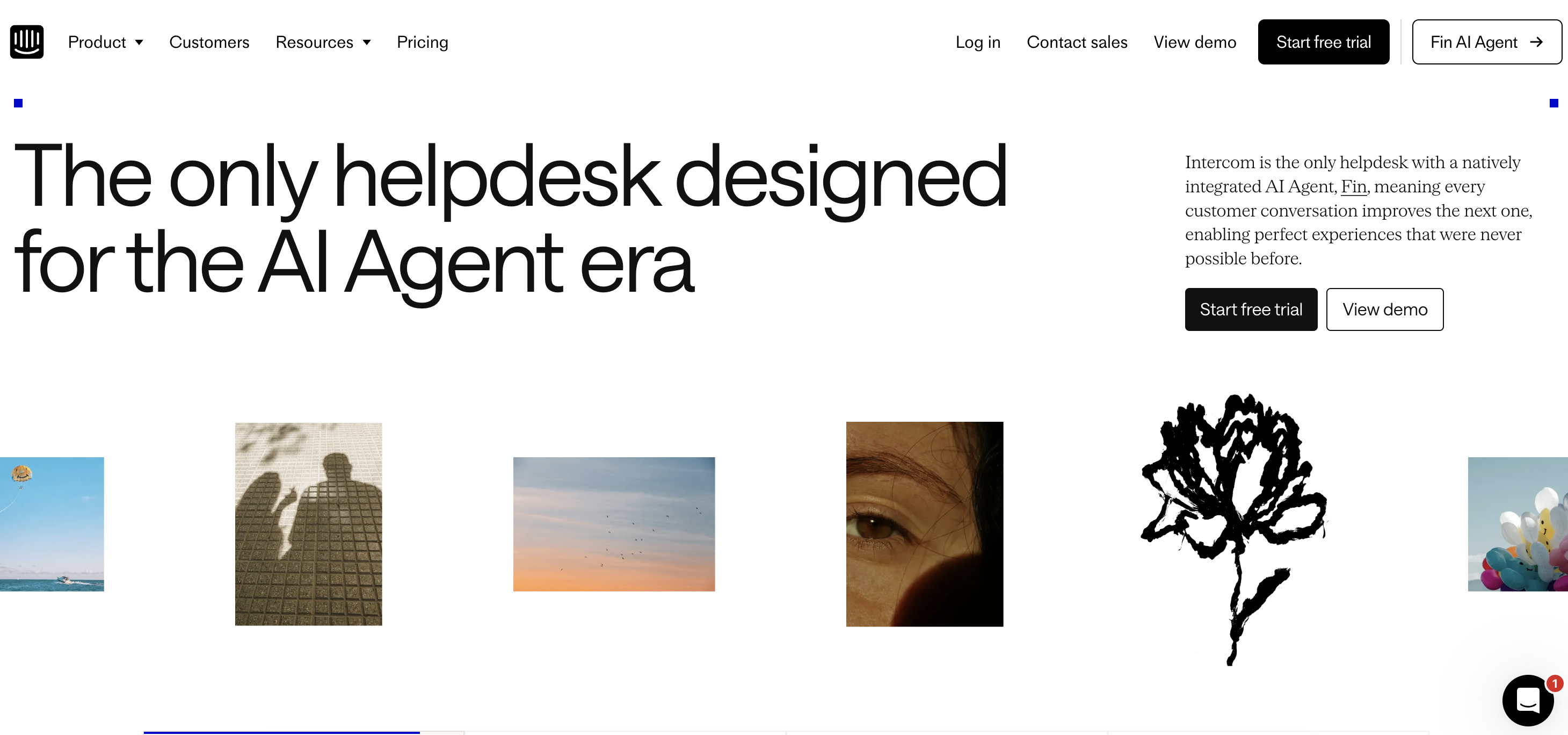
Intercom Fin is the better choice when most of your support volume is not voice, and it wins the omnichannel row outright.
Fin resolves questions across chat, email, SMS, social, and WhatsApp from one knowledge base, and Intercom reports it resolves roughly two-thirds of conversations on average.
Pricing is outcome-based at $0.99 per resolution with a 50-resolution monthly minimum, which is clean when automation works and rises directly with volume during busy seasons. Its Copilot also assists human agents inside the inbox, a live-agent tooling layer that Retell does not try to match.
Fin does have a phone product, Fin Voice, but Intercom's own documentation notes that Fin Voice is currently limited to select customers working with its sales team, and it runs as knowledge-base deflection rather than a build-your-own telephony platform with per-minute control. Fin by Intercom carries a 4.5/5 G2 rating across thousands of reviews. If voice is a minority of your queue, Fin is the stronger backbone.
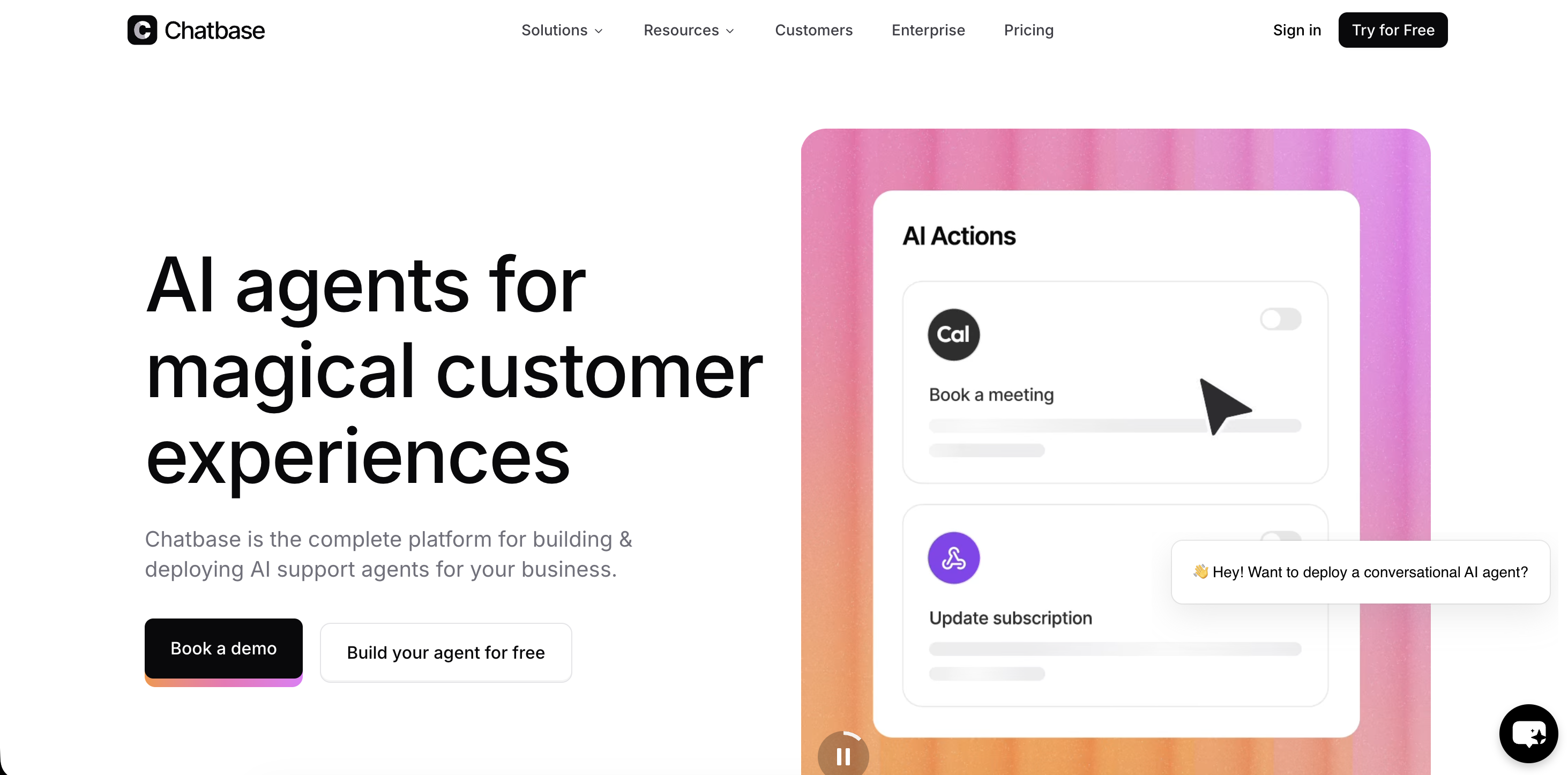
Chatbase is the quickest way to stand up a website chatbot, and for that single job it beats every tool here.
You train an agent on PDFs, URLs, or a Notion workspace and embed it on your site in about 15 minutes, then deploy across web chat, Shopify, WhatsApp, Instagram, and Slack.
Pricing is credit-based, free to start with 50 message credits, with the Standard plan near $150 per month for 4,000 credits and Pro near $400 for 15,000.
Chatbase added Chatbase Voice in May 2026, a phone agent that runs on the same knowledge base and human-escalation logic in 95+ languages.
Two honest caveats apply.
The voice product is new and bills through the same credit system rather than a transparent per-minute rate, so cost at phone volume is hard to forecast.
Chatbase also scores 4.7/5 on G2 but from a small review base, which makes the rating weakly meaningful next to platforms with thousands of reviews.
For website chat and ticket deflection, none of that matters; for a phone-heavy call center, it does.
Pricing splits cleanly into per-minute voice, per-resolution chat, and credit subscriptions, and the right model depends on which channel carries your volume.
| Pricing factor | Retell AI | Synthflow | Intercom Fin | Chatbase |
|---|---|---|---|---|
| Model | Per-minute PAYG | Per-minute PAYG | Per resolution | Credit subscription |
| Entry | Published rate card, varies by model and voice | $0.09/min voice, $0 to start | $0.99/resolution, 50/mo min | Free; Standard ≈$150/mo |
| Realistic all-in | Published rate card, varies by model and voice | $0.11–$0.24/min | $0.99 per resolved chat | Varies by model and credits |
| Free to test | $10 credit (≈60 min) | Free build and test | Minimum applies | 50 free credits |
| Concurrency included | 20 calls | 5 calls | Not applicable | Tier-dependent |
For a voice operation, the per-minute camp is the only honest comparison, and Retell's no-platform-fee pricing keeps the floor lower than Synthflow's at the same configuration. The per-resolution and credit models look cheaper on a slide but assume your volume is chat, not calls.
Synthflow closes much of that gap at moderate volume, which is why a focused head-to-head like retell vs synthflow usually comes down to whether you need developer flexibility or a pure no-code build. Intercom Fin and Chatbase are not really priced for sustained phone volume at all.
The first question is not which tool is best but which channel your customers actually use, because that decides the entire shortlist.
If callers reach you by phone for urgent or complex issues, you need a platform built for telephony: low-latency turn-taking, warm handoff, branded numbers, and outbound campaigns. Retell, used for inbound customer support and outbound alike, treats voice as the core product, and Synthflow does the same for no-code teams. Both handle the moment a caller interrupts or talks over the agent, which chat-first tools were never designed for.
If most of your volume is web chat, email, and social, the calculus flips. Intercom Fin and Chatbase resolve those threads natively and only recently extended to phone, where their voice features remain knowledge-base deflection rather than full call automation.
Running a phone-heavy queue on a chat-first tool means accepting weaker transfer, weaker outbound, and per-resolution or credit pricing that does not map to minutes.
Regulated call centers should compare certifications and concurrency before features, since one missing item can disqualify a tool.
Retell carries SOC 2 Type I and II, GDPR, and PII redaction, and offers HIPAA with a self-service BAA on standard plans rather than gating it behind enterprise. That matters in regulated lines of work such as healthcare, where a senior-care provider in Retell's published case study with Pine Park Health reported a 38% increase in scheduling NPS. Synthflow includes SOC 2 and GDPR but reserves HIPAA for its Enterprise tier.
Concurrency separates the voice and chat models further. Retell includes 20 concurrent calls and scales to enterprise concurrency that starts at 50+ calls with no cap, and Synthflow includes 5 with paid expansion up to 50. Intercom Fin's resolution model has no concurrency limit because it is not metered by simultaneous calls, and Chatbase concurrency is tier-dependent. For high call volume, included concurrency and a clear enterprise path are the numbers to confirm. Compliance details for Fin and Chatbase, including SOC 2 and HIPAA tiers, should be verified directly with each vendor, confirmed directly with each vendor.
This mapping matches each buyer to the tool that genuinely fits, not to a default.
| Buyer or use case | Recommended tool |
|---|---|
| Voice-heavy call operations, custom flows | Retell AI |
| Voice automation, no engineers | Synthflow |
| Omnichannel chat plus email support | Intercom Fin |
| Fast website chat or ticket deflection | Chatbase |
For a phone-first operation that needs custom call flows, your own telephony, and outbound campaigns, Retell is the clearest fit, and deploying it as virtual receptionists or front-desk coverage is a common starting point. SWTCH, an EV-charging company in Retell's case studies, cut support costs by more than 50% on this kind of inbound workload.
If you want voice automation but have no developers, Synthflow is the honest pick, since its no-code builder gets a non-technical team live faster than Retell's. If your queue is mostly chat and email with voice as a minor channel, Intercom Fin is the better backbone, and if you mainly need a website chatbot or ticket deflection, Chatbase is the fastest and cheapest route in.
The best AI call center software depends less on features and more on where your customer conversations happen.
If your operation runs primarily on phone calls and needs custom call flows, warm transfers, outbound campaigns, and full control over telephony, Retell AI is the strongest option in this comparison. Its pay-as-you-go pricing, developer flexibility, and voice-first architecture make it a better long-term fit for businesses that treat the phone as a core support or revenue channel.
Synthflow is the better choice for teams that want voice automation without engineering resources. Its no-code builder shortens deployment time and makes it easier for non-technical teams to launch AI agents quickly.
Intercom Fin stands out for organizations managing large volumes of chat, email, and messaging support. Its omnichannel approach and agent-assist features make it a strong customer service platform, though voice remains a secondary channel.
Chatbase remains one of the fastest ways to deploy AI-powered website chat and ticket deflection. For businesses focused on self-service support through web and messaging channels, it delivers value with minimal setup.
Ultimately, voice-first businesses should prioritize voice-first platforms, while chat-led organizations should choose tools built around digital conversations. Matching the platform to your primary customer channel will have a far greater impact than any individual feature or pricing difference.
An AI call center uses voice agents to answer, route, and resolve phone calls automatically, replacing or supplementing human agents on routine work. The agent transcribes the caller in real time, generates a response with a language model, speaks it back, and pulls answers from a connected knowledge base. When it cannot resolve an issue, it transfers to a human with the call context attached.
AI handles tier-one calls such as order status, scheduling, and FAQs, but it does not replace agents on complex or emotional issues that need judgment. Gartner forecasts conversational AI will cut contact center agent labor costs by $80 billion in 2026, with about one in ten interactions automated. The realistic outcome is fewer routine calls reaching agents, not zero agents.
A well-configured agent escalates rather than guesses, transferring the caller to a human with the full conversation history so nothing is repeated. Outside business hours it can capture details and book a callback, which is how an ai answering service keeps after-hours calls from going to voicemail. Escalation rules and a current knowledge base are what keep wrong answers off the line.
Choose voice AI when customers reach you by phone and expect an immediate spoken answer, since voice tools handle interruptions, transfer, and outbound calling that chatbots cannot. Choose a chatbot when your volume is web chat, email, or social. Many teams run both, but the channel carrying most of your volume should decide the primary platform.
Voice platforms price per minute, and Retell publishes a full rate card with no platform fee, so your cost depends on the model, voice, and telephony you choose. Chat-led tools price differently: Intercom Fin charges $0.99 per resolution, and Chatbase sells credits from a free tier up to about $500 per month. Model your real call minutes or conversation count before comparing headline rates.
Retell connects to Twilio, Vonage, and Telnyx for telephony and to Salesforce, HubSpot, GoHighLevel, and n8n for downstream workflows, with bring-your-own carrier over SIP. Synthflow offers managed Twilio or bring-your-own, while Intercom Fin and Chatbase focus on helpdesk and commerce integrations such as Zendesk, Salesforce, Shopify, and Stripe. Confirm the specific connectors you need before committing.
Compliance varies by vendor and plan, so this is a buying gate for healthcare and finance. Retell offers HIPAA with a self-service BAA on standard plans alongside SOC 2 Type II and GDPR, while Synthflow reserves HIPAA for Enterprise. For Intercom Fin and Chatbase, verify HIPAA, SOC 2, and data-hosting terms directly with each vendor before handling protected information.
See how much your business could save by switching to AI-powered voice agents.
Total Human Agent Cost
AI Agent Cost
Estimated Savings
A Demo Phone Number From Retell Clinic Office