Why Your Voice AI Provider Should Own Its Gateway




A voice AI provider that owns its gateway controls the part of the call that decides whether the call connects at all. A provider that rents it from a telephony vendor depends on that vendor for uptime, fixes, and features. The difference rarely shows in a demo. It shows during an incident, when you ask who can fix the problem and how long it will take.
Disclosure: Retell AI publishes this article and runs its own SIP and WebRTC gateway. We rented this layer from a vendor before we built it, so this article draws on both sides of the decision.
What is the gateway in a voice AI platform?
The gateway is the software that connects phone networks and browsers to AI voice agents. It speaks SIP, the signaling protocol phone systems use to set up calls, and WebRTC, the standard browsers use for live audio. It sets up each call, carries and mixes the audio, and handles transfers, live listening, take-over by a human, and hang-ups.
A phone call to an AI agent passes through four layers:
| Layer | What it does |
|---|---|
| Phone network (PSTN) or browser | Where the call starts |
| Session border controller (SBC) | The secure entry point for phone calls. It decides where each call goes. Browser calls skip it. |
| Media layer (the gateway) | Sets up the call, carries audio in both directions, mixes it, runs transfers and hang-ups |
| AI infrastructure | Runs the conversation |
Most evaluation time goes to the fourth layer: the model, the voice, the prompt. The second and third layers decide whether the caller ever reaches it.
What goes wrong when a provider rents its gateway?
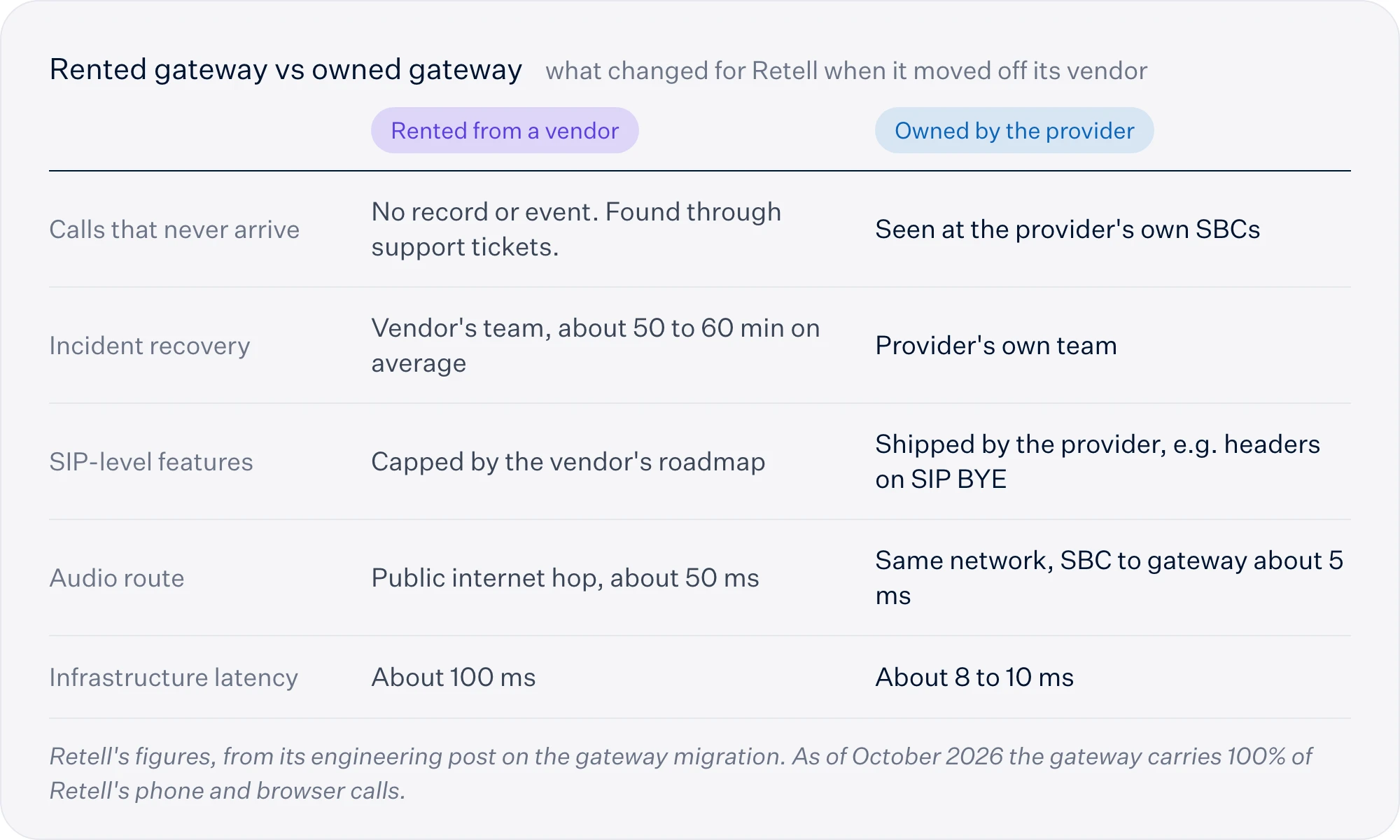
When a third-party vendor sits in the path of every call, the vendor's incidents become your incidents. Retell saw five specific problems while renting this layer, described in our engineering post on the migration.
Calls can fail with no record
During some vendor incidents, inbound calls never got from the vendor to Retell. A missing call left no call record and no event, so there was nothing to alert on. We learned about those calls from customer support tickets.
Recovery time belongs to someone else
The vendor took about 50 to 60 minutes on average to recover from an incident, and Retell had no way to speed up a fix.
The feature list is capped by the vendor's roadmap
A provider cannot ship a call behavior its vendor does not support. An insurance customer needed custom SIP headers on the message that ends a call. The vendor did not support that at the time.
Security and compliance pass through a platform the provider does not control
Requirements were hard to meet through the vendor's platform.
Audio takes a longer route
Audio crossed the public internet between the vendor and Retell, a hop of about 50 ms on every call.
None of these are visible in a sales demo, which is a single call on a short path.
What changes when the provider owns the gateway?
Ownership moves five things inside the provider's control.
- Every call is visible from the first packet. When the provider runs its own SBCs, every phone call reaches the provider first, whether or not it connects. Failed calls leave evidence.
- One team answers for call quality. There is no second company to wait on during an incident.
- Call features ship on the provider's schedule. Retell built custom headers on SIP BYE messages into its gateway for the insurance campaign above. See the SIP headers documentation.
- Compliance controls are part of the design. Authenticated access, participant permissions, handling of sensitive audio, and redaction of sensitive information sit in the provider's own code. Retell is HIPAA compliant and offers a self-service BAA. See compliance documentation.
- Audio stays on one network. As stated in the gateway post, Retell's infrastructure latency went from about 100 ms with the vendor to about 8 to 10 ms with the gateway, and the provider can deploy the gateway in new cloud regions when customers need it.
As of October 2026, Retell's gateway carries 100% of its phone and browser calls.
Is renting a gateway always a problem?
No. A provider that rents this layer can still run a reliable service if it has done the work around it. Owning a gateway takes a skilled real-time communications team and permanent investment in carrier interoperability, networking, media processing, security, monitoring, and on-call operations. A provider without that team is better off renting than running a gateway badly.
What matters to a buyer is whether the provider can answer the questions below with specifics. A provider that rents but can show you failed-call detection, a failover path, and recovery times is a safer choice than one that owns its gateway and cannot.
What should you ask a voice AI provider about its gateway?
Ask these in the technical evaluation, before the pilot.
| Question | What a specific answer sounds like |
|---|---|
| Who operates the SIP entry point my calls arrive at? | "We run our own SBCs" or "Vendor X runs it and here is our failover" |
| If an inbound call never reaches your platform, how do you find out? | A named detection method. "The customer tells us" is the wrong answer. |
| What was your recovery time in your last three telephony incidents? | Minutes, with dates |
| Who can ship a SIP-level change, such as a custom header? | The provider's own engineers, with a typical timeline |
| Where does audio travel between the carrier and the model? | A path you can draw, with each network hop named |
| Can I keep my carrier and my numbers? | Yes, over a SIP trunk, with documented addresses to allowlist |
| Which regions can the call path run in? | A list, plus the process for adding one |
| Which compliance controls sit in the call path itself? | Encryption, access control, redaction, retention settings |
If you already run a contact center phone system, the carrier question matters most. Retell documents how to connect an existing phone system over a SIP trunk, and our guide on keeping your existing phone number covers the number side.
How do you verify the answers in a pilot?
Run the pilot on your real call path. Route a share of production calls through your own carrier and SIP trunk to the provider. A vendor sandbox number tells you about the sandbox.
Then check four things:
- Count calls your carrier sent against calls the platform recorded. The two numbers should match.
- Test transfers to your human queue, including a transfer that fails.
- Place calls from the regions your customers call from and listen for delay.
- Ask for the provider's incident history for the pilot period and compare it with what you observed.
Frequently asked questions
What is a voice AI gateway?
A voice AI gateway is the software that connects phone networks and browsers to AI voice agents. It handles SIP for phone calls and WebRTC for browser calls, sets up each call, carries the audio, and runs call controls such as transfers and hang-ups.
Does Retell AI own its gateway?
Yes. Retell built its own SIP and WebRTC gateway and its own session border controllers. As of October 2026, the gateway carries 100% of Retell's phone and browser calls.
Can I use my own carrier with a provider that owns its gateway?
Usually, yes. Owning the gateway is separate from owning the carrier relationship. With Retell you can connect your existing phone system or carrier over a SIP trunk and keep your numbers.
Does gateway ownership affect call latency?
It can. A rented gateway often adds a network hop between the vendor and the provider. Retell reported about 100 ms of infrastructure latency with its vendor and about 8 to 10 ms with its own gateway. Infrastructure latency is one part of total response time, alongside speech recognition, the model, and speech synthesis.
How can I tell whether a provider rents or owns its gateway?
Ask who operates the SIP entry point and the media layer, and ask how the provider detects a call that never arrives. Providers that own the layer can describe both without naming another company.
Test the call path on your own calls
The fastest way to evaluate a provider's telephony is a pilot on real calls, routed through your own carrier. Talk to our team to set one up, or read how Retell built its gateway for the full engineering account.
See how much your business could save by switching to AI-powered voice agents.
ROI Result
Total Human Agent Cost
AI Agent Cost
Estimated Savings
Estimate your monthly voice AI cost

Revolutionize your call operation with Retell