Should You Build Your Own Voice AI Gateway?




Build your own gateway when call quality, availability, and call-level customization are central to what you sell, and you can fund a real-time communications team for years. Rent one when voice is a feature of your product. Most teams should rent, or choose an AI voice agent platform that already owns this layer.
Retell did both. We rented the layer from a telephony vendor, then built our own SIP and WebRTC gateway. As of October 2026, it carries 100% of our phone and browser calls. The engineering account is here. This article is about the decision.
What are you deciding to own?
A gateway connects phone networks and browsers to AI voice agents. It sets up calls, carries and mixes audio, and runs transfers, live listening, take-over, and hang-ups. Building one means owning two layers a vendor would otherwise run for you: the session border controllers that receive and route phone calls, and the media layer that carries the audio.
It does not mean becoming a carrier. Phone numbers and the connection to the public phone network can still come from carriers, or from your customers' own SIP trunks.
When is building your own gateway the right decision?
Five conditions pushed Retell to build. If most of them describe you, building deserves a serious look.
Vendor incidents reach your customers directly
The vendor sat in the path of every Retell call. It took about 50 to 60 minutes on average to recover from an incident, and Retell could not speed up a fix.
You cannot see your own failures
During some incidents, inbound calls never got from the vendor to Retell. Those calls left no record and no event. Retell found out from customer support tickets.
Customers need call behavior your vendor does not support
An insurance customer needed custom SIP headers on the message that ends a call. The vendor did not support it at the time, and Retell could not ship what the vendor did not support.
Security and compliance are hard to meet through someone else's platform
Requirements were hard to meet through the vendor's platform. Controls such as authenticated access, participant permissions, and redaction of sensitive information are simpler to guarantee in code you run.
The cost is large enough to fund a team
Retell's vendor bill ran to millions of dollars a year, and the public internet hop to the vendor added about 50 ms to every call.
Retell also evaluated other vendors before building. That evaluation reinforced the conclusion: controlling product quality required owning the gateway.
When is building the wrong decision?
A gateway is the wrong project for a team that lacks either the engineering capacity to run real-time communications infrastructure or the product requirements to justify it.
It is the wrong decision if:
- Voice is one channel among several. If calls are not the core of your product, vendor incidents are a cost you can absorb.
- You have no real-time communications engineers. Telephony interoperability is specialist work. General backend experience does not transfer cleanly to SIP behavior across many carriers and phone systems.
- Your volume is small. The vendor bill has to be large enough that a permanent team is the cheaper line.
- Your problems are in the conversation. If callers complain about wrong answers or awkward turn-taking, a gateway fixes none of it.
- You cannot staff on-call for it. A gateway carries live calls at all hours.
What does owning a gateway commit you to?
The build is a project. The ownership is permanent. Running a gateway requires ongoing investment in:
| Area | What it means in practice |
|---|---|
| Telephony interoperability | Staying compatible with many carriers and phone systems as they change |
| Networking and media processing | The audio path, in both directions, for every call |
| Security | Authenticated access, permissions, handling of sensitive audio, redaction |
| Monitoring | Seeing every call, including the ones that fail before reaching your application |
| On-call operations | Incident response is now yours, with no vendor to escalate to |
| Capacity planning and maintenance | Growth, regions, upgrades |
| Safe deployment | Shipping changes to software that is carrying live calls |
The same fact appears on both sides of the ledger. When there is no vendor to wait on, there is also no vendor to call.
What do you get in return?
For Retell, five things changed:
- One team answers for every part of a call's quality.
- Call features ship on your own schedule. The custom BYE headers for the insurance campaign were built into the gateway.
- Security requirements can be met directly, including HIPAA and SOC 2.
- New regions are your call. The gateway can be deployed in a new cloud region when customers need it.
- A shorter audio path. Infrastructure latency went from about 100 ms with the vendor to about 8 to 10 ms with the gateway.
Build, rent, or choose a platform that owns it
| Factor | Build your own | Rent from a telephony vendor | Use a platform that owns its gateway |
|---|---|---|---|
| Who fixes a telephony incident | You | The vendor | The platform |
| Visibility into calls that never arrive | Full, at your SBCs | Depends on the vendor | Depends on the platform. Ask. |
| SIP-level customization | Anything you can build | The vendor's feature list | The platform's roadmap |
| Team required | Real-time communications engineers, on-call | Integration engineers | Integration engineers |
| Time to first call | Longest | Short | Short |
| Ongoing cost | A permanent team plus infrastructure | Usage fees that grow with volume | Usage fees |
The third column is the one most enterprises should look at first. If your goal is AI voice agents on your phone lines, and not a telephony product, you can get the benefits of an owned gateway without building one. The questions that tell you whether a platform really owns the layer are in why your voice AI provider should own its gateway.
How should you decide?
Answer six questions in order. Stop at the first "no".
- Are phone or browser calls the core of what customers pay you for?
- Have vendor incidents or missing calls cost you customers or deals in the past year?
- Do customers ask for call behavior your vendor cannot provide?
- Is your vendor bill larger than the cost of a permanent real-time communications team?
- Can you hire or already employ engineers who have run SIP and media infrastructure in production?
- Can you run a migration that takes several phases while live calls keep working?
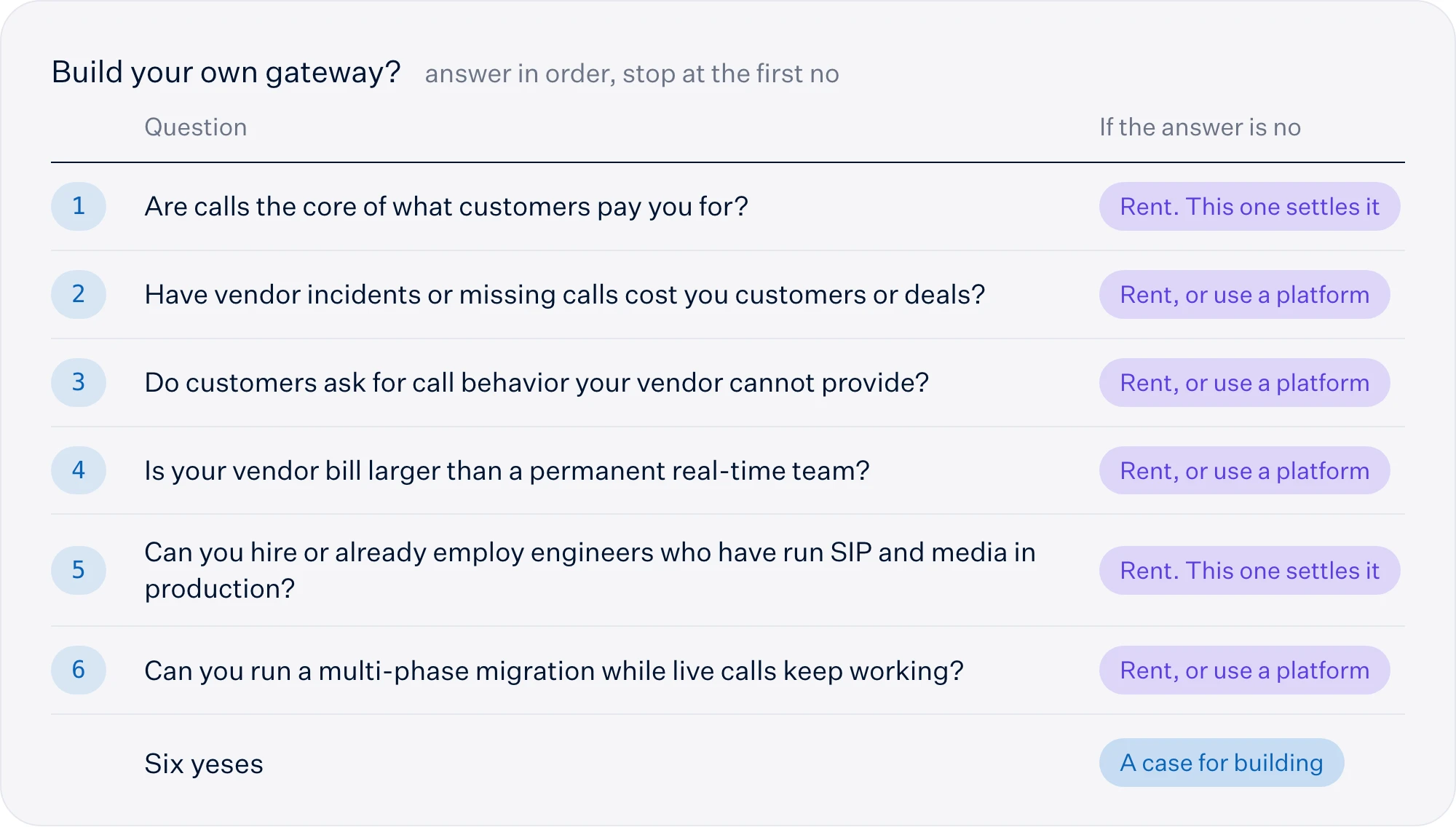
Six yeses is a case for building. A "no" on the first or fifth question settles it the other way, whatever the other answers are.
If you do build, start by taking control of the SIP entry point, before you replace the media layer. The plan is in how to build a SIP and WebRTC gateway for voice AI.
Frequently asked questions
Is it cheaper to build your own voice AI gateway?
Only at high volume. Building replaces usage fees with a permanent engineering team and infrastructure. Retell's vendor bill ran to millions of dollars a year before the numbers favored building.
Do you need to be a carrier to run your own gateway?
No. A gateway and its session border controllers connect to carriers and to customers' phone systems over SIP. Numbers and public phone network access still come from carriers.
How is this different from build vs buy for AI voice agents?
That decision is about who builds and improves the agent itself: the prompts, the flows, the integrations. This one is about the telephony layer underneath. A company can buy a platform and still own its agents. See build vs buy AI voice agents.
What is the smallest first move if we are unsure?
Run your own session border controllers in front of your current vendor. You gain routing control and see every call, including failed ones, without replacing the media layer. It also keeps the option to build later.
Can a small team rent now and build later?
Yes, and it is the common path. Retell rented first. Renting gets you to production quickly, and real traffic tells you whether the five conditions above apply.
If you decide not to build
You can still run AI voice agents on a gateway built for them. Retell's gateway carries all of its phone and browser calls, and you can connect your existing carrier over a SIP trunk. Talk to our team about a pilot on real calls.
See how much your business could save by switching to AI-powered voice agents.
ROI Result
Total Human Agent Cost
AI Agent Cost
Estimated Savings
Estimate your monthly voice AI cost

Revolutionize your call operation with Retell