Caller Identity Verification for Contact Centers
How contact centers verify a caller over the phone, which identity checks an AI voice agent can run, and when the call should go to a human.
Caller identity verification is the process a contact center uses to confirm that the person on the phone is the account holder, or someone authorized to act for them, before it shares account details or makes changes.
It has two parts. Identification answers "which record is this?", usually from the calling number or an account number. Verification answers "can this caller prove it?" This guide covers what each common method proves, where an AI voice agent fits, and when the call should go to a person.
Which methods do contact centers use to verify callers?
Each one proves something different, so most verification flows combine two or more.
| Method | What it proves | Main risk | Use it for |
|---|---|---|---|
| Caller ID (ANI) match | Which account the calling number belongs to | Caller ID can be spoofed | Identification and routing, never verification on its own |
| Knowledge-based questions | The caller knows facts about the account holder | Answers can often be found online or in breached data | A weak extra signal on low-risk requests |
| Account or policy number plus a second factor | The caller has the identifier and one more proof | The number is printed on statements and mail, so it is not a secret | Routine account servicing |
| One-time passcode by SMS or voice call | The caller controls the phone on file | SIM swaps, number porting, and callers tricked into reading out a code | Step-up checks before sensitive actions |
| Voice biometrics | The voice resembles a stored voiceprint | AI voice cloning from short public clips | A passive supporting signal, not a standalone check |
Caller ID matching is the cheapest signal and the easiest to fake. The FCC defines spoofing as when a caller "deliberately falsifies the information transmitted to your caller ID display to disguise their identity." STIR/SHAKEN, the caller ID authentication framework the FCC requires carriers to use, lets the receiving carrier confirm a call comes from the number displayed, but it only works on IP networks. Use the number to find the likely account, then verify.
Knowledge-based questions (date of birth, last transaction, mother's maiden name) are common and are the weakest factor. NIST's digital identity guidelines, SP 800-63B-4, do not list knowledge-based questions among the authenticator types they recognize, and they tell verifiers not to prompt users to use security questions when choosing passwords. A PIN the customer chose in advance is different: NIST treats it as a password, a secret rather than a public fact.
Account or policy numbers identify the account. Pair them with a PIN or passcode, because anyone holding an old statement has the number.
One-time passcodes prove the caller holds the registered phone. NIST classes text and voice delivery over the phone network as a "restricted" authenticator, says verifiers should consider risk indicators such as "device swap, SIM change, number porting" before sending a code, and treats changing the registered phone number as binding a new authenticator. That makes "update my phone number" a high-risk request.
Voice biometrics compare the caller's voice with a stored voiceprint. NIST SP 800-63B-4 states that "a biometric characteristic is not recognized as an authenticator by itself" and, in its section on presentation attack detection, that "biometric comparison based on voice SHALL NOT be used." The FTC has warned that a scammer can clone a voice with "a short audio clip" taken from content posted online. Treat a voice match as one input to a risk decision, never as approval for a sensitive change.
SP 800-63B-4 is written for US government systems and does not bind a private contact center, but it is a useful public benchmark.
How strong should verification be for each request?
Match the check to the request, so routine calls stay short and risky ones get more scrutiny.
- General questions (hours, policies, product information): no verification needed.
- Reading account information (balance, order status, appointment details): identify the account, then one verification factor, such as a PIN or one-time passcode.
- Changing contact details or credentials (phone number, email, mailing address, password reset): a stronger factor plus a check against your fraud signals. Consider sending these to a person every time.
- Moving money or changing payees: your strongest factor, and usually a human decision.
What can an AI voice agent do in the verification flow?
An AI voice agent can run the routine path: identify the caller, collect the proof, ask your systems for a decision, and route on the answer. In Retell AI, each step maps to a documented feature. Retell's docs do not describe built-in voice biometrics or a passcode service, so the verification decision stays with your own systems.
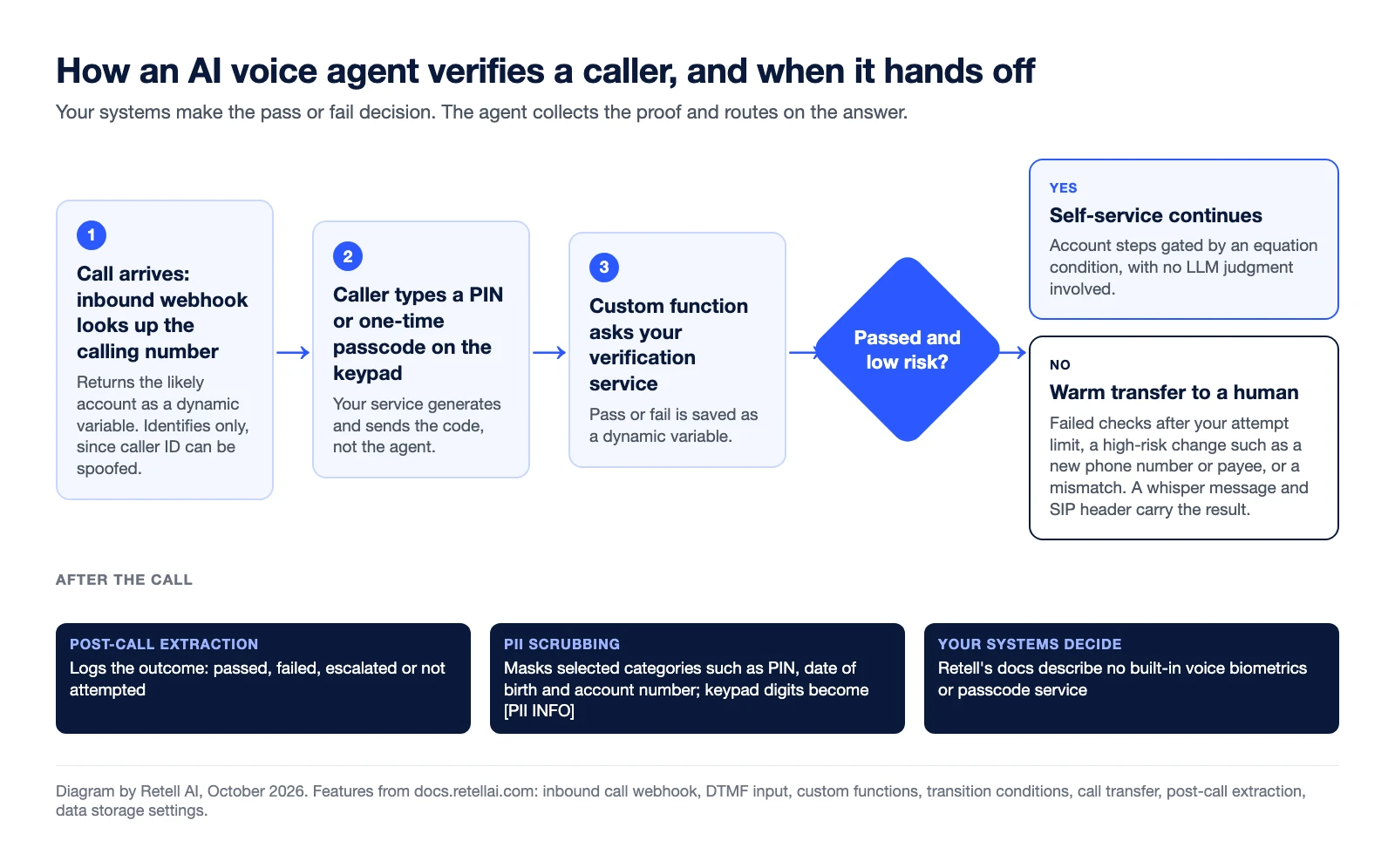
Look the caller up before answering. Retell's inbound call webhook sends your server the calling number (from_number) before the call connects. Your server can return dynamic variables, such as the matched account ID, or reject the call. This is identification only, for the spoofing reasons above.
Collect proof on the keypad. Callers can type a PIN or passcode instead of saying it aloud. Input ends at a digit limit (1 to 50), a termination key such as #, or a timeout.
Let your service decide. A custom function calls your API mid-call with what the caller provided, and you can save fields from the response, such as a pass or fail status, as dynamic variables. Requests carry an X-Retell-Signature header so your endpoint can confirm they came from Retell. Have your own service generate, send and check passcodes, so the code never reaches the agent.
Branch on the result, not on the model's judgment. In a conversation flow, equation conditions compare dynamic variables with no LLM involved, so if your server returns status: "passed", a condition such as {{status}} == "passed" gates the account steps exactly as your server decided. Retell's contact memory matches callers by phone number, so treat it as personalization, not proof.
Limit what is stored. With the "Everything except PII" storage setting, Retell scrubs the categories you select (such as date_of_birth, pin and customer_account_number) from transcripts, recordings, logs and call analysis after the call, and keypad digits become [PII INFO] whenever any category is enabled. Scrubbing runs post-call, so the agent and your endpoints still receive what the caller says during the call, and webhooks still deliver transcripts.
Record the outcome. Add a post-call extraction field, such as a selector with passed, failed, escalated and not attempted, to report on verification rates and audit failures.
When should the call go to a human?
Hand the call to a person when:
- The caller fails verification after a set number of attempts, such as two.
- The request is a high-risk change: phone number, email, password, payee or bank details.
- Signals conflict, such as a number that does not match the account or a recent SIM change flagged by your fraud system.
- The caller cannot use the method offered. NIST notes that codes read out on a voice call may be hard to follow for callers with hearing issues, and requires an alternative to phone-delivered codes.
Do not tell the caller which answer was wrong. Use a warm transfer so the agent briefs the person who answers with a whisper message the caller cannot hear: who is calling, what they want, and which checks passed or failed. Retell can also pass the result in a custom SIP header filled from a dynamic variable. Headers survive transfers to a SIP endpoint but may be stripped on transfers to a phone number, so test with your carrier. Details are in how call transfers work between AI voice agents and human teams.
What do HIPAA and PCI DSS say about verifying callers?
This is not legal advice; confirm with your compliance team.
HIPAA. Under 45 CFR 164.514(h), before disclosing protected health information a covered entity must, with limited exceptions, verify the identity and authority of the person asking, if that person is not already known to it. It does not prescribe a method for ordinary callers. See HIPAA compliance for AI phone agents for the BAA and storage settings.
PCI DSS. The PCI Security Standards Council says Requirement 3.3.1 prohibits storing sensitive authentication data after authorization, even encrypted, and that keeping card security codes in any audio recording after authorization violates it. Do not use card details as an identity check on a recorded call. Route payments to a separate payment path, and ask any voice AI vendor for a written statement of its PCI DSS scope.
What should you check before launch?
- Each request type is mapped to a verification level.
- Your verification service, not the model, returns pass or fail.
- High-risk changes and repeated failures always reach a person.
- Handoffs carry the verification result to the person who answers.
- PII scrubbing categories and retention are set on every agent that verifies callers.
- Test calls include spoofed numbers, wrong answers and callers who refuse the check.
To see how an AI agent fits your existing queues and escalation rules, see Retell's call center automation.