What Is a Contact Center?
What a contact center is, how it differs from a call center, the roles and metrics that run it, and where AI voice agents now take the calls.
A contact center is the operation a company uses to handle customer conversations across phone and digital channels, such as voice, chat, SMS, email and social messaging, using people, routing software, customer data and reporting to answer questions, solve problems and run outreach.
The term covers the team, the software and the processes together. This guide explains how a contact center differs from a call center, what is inside one, the roles and metrics that run it, and where AI voice agents now take calls.
What is the difference between a contact center and a call center?
A call center handles phone calls. A contact center handles phone calls plus other channels, with one routing system and one view of the customer across them. In practice many companies use the two terms interchangeably, so check what a vendor or job post means by it.
The difference that matters when you buy or staff is scope:
- Channels. A call center is voice only. A contact center adds chat, SMS, email and social messaging.
- Routing. A contact center routes every channel through shared queues and rules, so a chat and a call can reach the same skilled agent.
- Customer history. A contact center keeps the conversation record in one place, so an agent does not start over when a customer switches channels.
If your operation only answers phones, you may still call it a call center. If you are adding channels, you are building a contact center. Our guide to the omnichannel contact center covers how the channels connect.
What does a contact center do?
A contact center handles the conversations a customer starts, and some that the company starts. Typical work includes:
- Customer support and technical help
- Account questions, billing and payments
- Appointment booking and changes
- Sales and lead follow-up
- Retention, collections and renewals
- Proactive outreach such as reminders and surveys
Most centers are described by direction. Inbound centers answer contacts that customers start. Outbound centers place calls or messages themselves. Blended centers do both with the same team. They are also described by who runs them: in-house, outsourced to a business process outsourcing (BPO) provider, or virtual, with agents working remotely on a cloud platform.
What is inside a contact center?
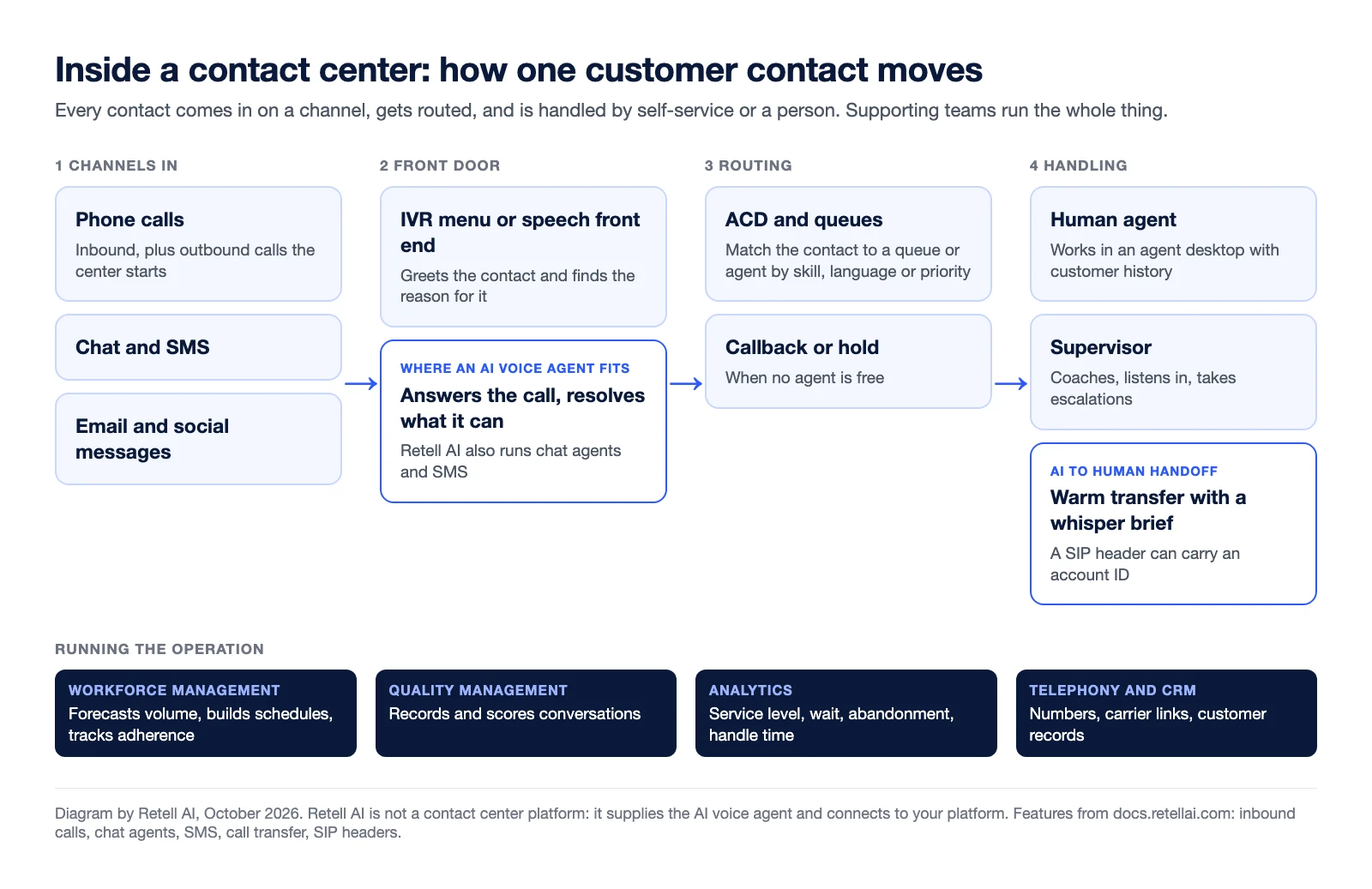
A contact center combines a few components, whether the company buys them as one suite or in pieces. The figure shows how a single contact moves through them.
| Component | What it does | Who usually owns it |
|---|---|---|
| Telephony and channels | Phone numbers, carrier connections, and the digital channels contacts arrive on | IT or telecom team |
| IVR or self-service | Greets the contact, collects the reason for it, and handles simple requests without a person | Contact center operations |
| ACD and queues | Automatic call distribution matches each contact to a queue or agent by skill, language or priority | Contact center operations |
| Agent desktop | The screen where agents take contacts, see customer history and log outcomes, often inside a CRM | Operations with IT |
| Workforce management | Forecasts volume, builds schedules and tracks whether agents follow them | Workforce planners |
| Quality management | Records conversations, scores them and feeds coaching | Quality analysts |
| Reporting and analytics | Live wallboards and historical reports on waits, handle time and outcomes | Operations and analysts |
Companies increasingly buy these components as one cloud suite, called CCaaS. Our explainer on CCaaS covers what a suite includes and how it is priced. Automatic call distribution is the piece that decides who gets each contact, and it is defined in the ACD glossary entry.
Who works in a contact center?
Most centers have the same handful of roles, with different titles from one company to the next:
- Agents talk to customers. Larger centers split them into tiers, with specialists taking escalations.
- Team leads and supervisors coach agents, watch live queues and take the hard calls.
- Workforce planners forecast volume and build schedules so the right number of agents is on shift.
- Quality analysts review conversations and score them against a rubric.
- Operations managers and directors own service targets, budget and staffing.
- IT and telephony administrators run the platform, carrier connections and integrations.
How do you measure a contact center?
Contact centers are measured on speed, quality, productivity and cost. These are the measures operations teams look at first:
| Metric | What it measures |
|---|---|
| Service level | The share of contacts answered within a target time. Each center sets its own target. |
| Average speed of answer (ASA) | How long contacts wait before an agent picks up |
| Abandonment rate | The share of contacts that hang up or leave before reaching an agent |
| Average handle time (AHT) | The average time an agent spends on a contact, including talk, hold and wrap-up work |
| First contact resolution (FCR) | The share of issues solved without the customer having to contact again |
| Customer satisfaction (CSAT) | Customer ratings collected after the interaction |
No single number tells the whole story. Short handle time with low resolution usually means customers call back. See our list of 32 call center metrics for formulas and how the measures interact.
Where do AI voice agents fit in a contact center?
An AI voice agent sits in front of the human team. It answers calls, handles the reasons for calling it can resolve, and transfers the rest to your agents with context. The contact center platform keeps routing, scheduling, recording and reporting for your people.
Retell AI is not a contact center platform. It is an AI voice agent platform that connects to the one you run. In Retell's docs:
- Inbound and outbound calls. An agent can answer calls on a number you bind to it, place outbound calls, and run batch calls to a list of recipients.
- Other channels. Chat agents hold text conversations through a website widget, SMS or API, and agents can send and receive SMS during calls.
- Handoff to people. A transfer can be cold, warm with a private whisper message the caller cannot hear, or agentic warm, where a second AI agent briefs the person who answers. If the destination has a queue, the agent waits until a real person speaks before it briefs them. Custom SIP headers can carry context such as an account ID. Some telephony providers do not pass custom headers on a cold transfer that uses SIP REFER, so test with yours.
- Supervision. Live monitoring lets a supervisor follow a call's transcript, listen in silently, take over from the agent or end the call.
- After the call. Post-call extraction writes a summary and the fields you define, and the analytics dashboard charts call metrics.
- Connecting to your platform. Retell's docs include setup guides for Five9, Genesys Cloud, Avaya and Amazon Connect, and a general custom telephony route over SIP for others.
Pricing starts from $0.07 per minute, so cost tracks call volume rather than headcount. For a vendor-by-vendor view of how teams add AI to a center, see our comparison of contact center AI solutions.
Outbound calling brings legal duties. In a February 2024 ruling the US Federal Communications Commission (FCC) confirmed that the Telephone Consumer Protection Act's limits on "artificial or prerecorded voice" calls "encompass current AI technologies that generate human voices" (FCC 24-17). Have counsel review consent and disclosure before an AI agent calls customers.
How do you start modernizing a contact center?
Start with the calls, not the software. A short plan:
- Pull a month of contact reasons and sort them by volume and by how routine they are.
- Pick one routine, high-volume call type and set a success measure, such as containment, resolution or wait time.
- Decide the handoff rules before you build: which situations go to a person, to which queue, and what context travels with the call.
- Keep your routing, scheduling and reporting where they are, and connect AI over SIP.
- Review live and recorded calls weekly, then widen to the next call type.
To see how Retell AI answers calls and hands them back to your queues without replacing your platform, visit call center automation.