TCPA Violation Fines: What They Cost
TCPA violations cost $500 per call, up to $1,500 if willful, with no total cap. How courts, state AGs and the FCC set the amount, with real case records.
TCPA violation fines are the amounts a caller can be ordered to pay for breaking the Telephone Consumer Protection Act (47 U.S.C. 227): $500 per violation in a private or state lawsuit, up to $1,500 per violation when a court finds the violation willful or knowing, and FCC forfeitures of up to $25,132 per violation for most businesses after the 2025 inflation adjustment. Because each call can be a separate violation, the total grows with call volume, and the statute sets no overall limit on private damages.
This page covers what TCPA violations cost and how the totals are calculated, using the statute, FCC orders and federal court records. It does not cover how to comply. For consent, disclosures, calling hours and opt-outs, read the TCPA compliance guide for outbound AI voice calls. This is general information, not legal advice. Penalty amounts are adjusted for inflation and courts read the statute differently, so talk to counsel about your own situation.
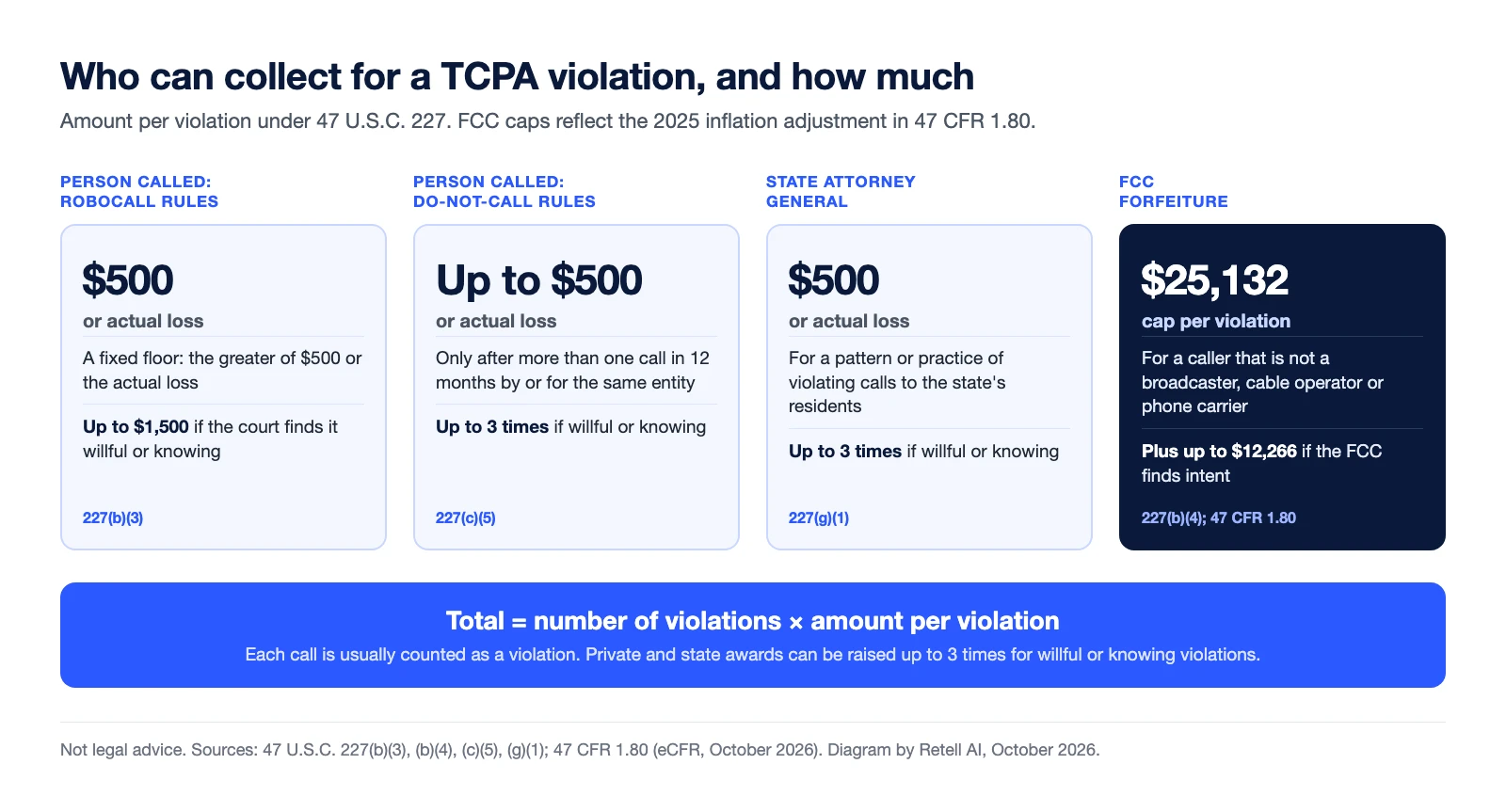
Who can collect for a TCPA violation, and how much?
Three groups can bring a TCPA case: the person who received the call, a state attorney general, and the FCC. Each has its own amount per violation, and federal prosecutors can also seek criminal fines for caller ID spoofing.
| Who acts | What triggers it | Amount per violation | Willful or knowing | Source |
|---|---|---|---|---|
| Person called | Robocall rules: artificial or prerecorded voice, autodialer and related rules in 227(b) | Actual loss or $500, whichever is greater | Court may raise it to 3 times ($1,500) | 47 U.S.C. 227(b)(3) |
| Person called | Do-not-call rules, after more than one call in 12 months by or for the same entity | Actual loss or up to $500, whichever is greater | Court may raise it to 3 times | 47 U.S.C. 227(c)(5) |
| State attorney general | A pattern or practice of violating calls to the state's residents | Actual loss or $500 | Court may raise it to 3 times | 47 U.S.C. 227(g)(1) |
| FCC | Violations of the robocall rules in 227(b) | Up to $25,132 for a caller that is not a broadcaster, cable operator or phone carrier | Plus up to $12,266 if the FCC finds intent | 47 U.S.C. 227(b)(4); 47 CFR 1.80 |
| FCC | Caller ID spoofing with intent to defraud, cause harm or wrongfully obtain value | Up to $14,432, or $43,296 per day of a continuing violation, capped at $1,443,275 per act | n/a | 47 U.S.C. 227(e)(5)(A); 47 CFR 1.80 |
| Federal prosecutors | Willful and knowing caller ID spoofing | Criminal fine up to $10,000, or 3 times that per day of a continuing violation | Required for this route | 47 U.S.C. 227(e)(5)(B) |
FCC amounts are the caps after the 2025 annual inflation adjustment listed in 47 CFR 1.80. The statute itself says $10,000 for both the 503(b)(2)(D) cap and the intent add-on. For callers without an FCC license, the general rule in 47 U.S.C. 503(b)(5) requires a warning citation before a forfeiture. Sections 227(b)(4) and 227(e)(5) say that rule does not apply to these violations, so the FCC can propose a forfeiture without a prior citation.
Two details in the statute matter for the math. The robocall action pays a fixed $500 floor, while the do-not-call action pays "up to $500", so a jury can award less, as one did in the Dish case below. And the do-not-call action carries a defense the robocall action does not: a caller can avoid liability by showing it "established and implemented, with due care, reasonable practices and procedures" to prevent violating calls.
How are TCPA fines calculated?
The basic formula is the number of violations times the amount per violation, multiplied by up to 3 if a court finds the violations willful or knowing. In practice, each call is usually counted as a violation, so a campaign's call count drives the total.
Two questions change the count.
Can one call count twice? In the Sixth Circuit, yes, if it breaks both sets of rules. In Charvat v. NMP (2011), the court held that a person "may recover statutory damages of $1500 for a willful or knowing violation of the automated-call requirements, § 227(b)(3), and $1500 for a willful or knowing violation of the do-not-call-list requirements, § 227(c)(5)", even when both violations happen in the same call. The same court counts 227(c)(5) damages per call, not per rule broken. The ruling binds federal courts in Kentucky, Michigan, Ohio and Tennessee.
How does the FCC count? It samples. The FCC does not prove every call; it verifies a subset and applies a per-call amount to that subset, then adjusts up or down. In the three orders below, the amount worked out to between $1,500 and $9,000 per sampled call.
Here is how the per-call amounts add up across call volumes for private claims. These are illustrations of the statutory formula, not predictions of any award.
| Calls in violation | At $500 per call | Willful or knowing, up to 3 times | Each call breaks both 227(b) and 227(c), willful (Sixth Circuit) |
|---|---|---|---|
| 1 | $500 | $1,500 | $3,000 |
| 1,000 | $500,000 | $1,500,000 | $3,000,000 |
| 10,000 | $5,000,000 | $15,000,000 | $30,000,000 |
| 100,000 | $50,000,000 | $150,000,000 | $300,000,000 |
What have real TCPA cases cost?
Class actions and FCC forfeitures show how the per-call math plays out at scale. Every figure below comes from the court opinion or FCC order cited.
| Case | Type | What happened | Amount |
|---|---|---|---|
| Krakauer v. Dish Network, 4th Cir., May 30, 2019 | Class action, do-not-call | A dealer, SSN, called numbers on the National Do Not Call Registry to sell Dish. The jury found SSN was Dish's agent and set $400 per call. The trial court trebled it. 18,066 class members. | $61,243,800 judgment, affirmed |
| Wakefield v. ViSalus, 9th Cir., Oct. 20, 2022 | Class action, prerecorded calls | The jury found 1,850,440 prerecorded calls in violation of the TCPA, at the $500 minimum each. | $925,220,000 award; due process review ordered on appeal, then deferred and the judgment stayed by the trial court in Feb. 2024 |
| Sumco Panama et al., FCC 23-64, Aug. 3, 2023 | FCC forfeiture, robocall and spoofing rules | Over five billion auto warranty robocalls from January to March 2021. The fine is based on a random sample of 33,333 calls. | $299,997,000 |
| Adrian Abramovich, FCC 18-58, May 10, 2018 | FCC forfeiture, caller ID spoofing | 96,758,223 spoofed robocalls in three months. The FCC applied $1,000 to each of 80,000 sampled calls and added $40,000,000. | $120,000,000 |
| Steve Kramer, FCC 24-104, Sept. 26, 2024 | FCC forfeiture, caller ID spoofing | 9,581 spoofed calls carrying a generative AI voice imitating President Biden. $1,000 per call on 3,000 verified calls, raised 100%. | $6,000,000 |
Three points from these records:
Total awards can face a constitutional limit. In Wakefield, the Ninth Circuit held that an aggregated statutory award can violate due process "in certain extreme circumstances," even when $500 per call is lawful on its own. It did not set a new figure. It vacated the trial court's ruling on that challenge and sent the question back. In February 2024 the trial court stayed the judgment and put off the due process question until after claims processing.
Willfulness can come from looking away. In Krakauer, the trial court found willful and knowing violations on two independent grounds, and the Fourth Circuit agreed with both. One was agency law: Dish was responsible for its agent's willful acts. The other was Dish's own conduct. The trial court said negligence alone would not support trebling, but "indifference to ongoing violations and a conscious disregard for compliance with the law" would, and called Dish's claimed lack of knowledge "willful ignorance."
An FCC forfeiture is not a collected payment. Each order gives 30 days to pay. If the target does not pay, the FCC can refer the case to the Department of Justice under 47 U.S.C. 504(a), which then has to sue to collect.
How long after a call can a TCPA claim be filed?
For private lawsuits, the TCPA sets no deadline of its own. The general federal default in 28 U.S.C. 1658(a) allows 4 years for civil actions under federal laws enacted after December 1, 1990, and the TCPA was enacted on December 20, 1991.
For the FCC, the statute sets the limits directly. For a robocall forfeiture without intent, the FCC's notice must issue within 1 year of the violation. With intent, the window is 4 years (227(b)(4)(E)), and spoofing forfeitures also have 4 years (227(e)(5)(A)(iv)).
Do TCPA penalties apply to AI voice agent calls?
Yes. In a February 2024 Declaratory Ruling (FCC 24-17), the FCC confirmed that the TCPA's restrictions on "artificial or prerecorded voice" calls "encompass current AI technologies that generate human voices." Under that reading, a call placed by an AI voice agent is an artificial-voice call, and the $500 and $1,500 amounts for robocall violations apply to it the same way they apply to a prerecorded message. The Kramer forfeiture above involved a generative AI voice, though the FCC brought it under the caller ID spoofing rules.
Outbound programs reach volume fast. An AI auto dialer or a batch calling run can place thousands of calls in a day, which is why the per-call formula above matters for AI outbound in debt collection, sales and service reminders.
What does Retell record when someone asks to stop calling?
In Krakauer, the class as first certified covered numbers on the National Do Not Call Registry and on the companies' own do-not-call lists, so stop requests and the records behind them are part of the exposure. Here is what Retell's documentation describes:
- Do-not-contact Handling. When turned on, the agent confirms a stop request once, ends the call and marks the contact as do-not-call. The call's disconnection reason is recorded as
user_requested_dnc. It works on Retell LLM and Conversation Flow agents, not custom LLM agents, and is off by default. - Where the flag is checked. The Create Phone Call API skips marked contacts when you pass
honor_internal_dnc: true(the default is false). The dashboard's Honor DNC switch is on by default, and campaigns check it when internal DNC is turned on. Batch calls and inbound calls do not check the flag. - How long records last. Call data is kept indefinitely by default. Per-agent retention can be set from 1 day to 730 days.
Retell's internal list is separate from the National Do Not Call Registry. For how these settings map to each TCPA rule, see the TCPA compliance guide and the call consent and disclosure checklist.
Frequently asked questions
How much is a TCPA violation fine per call?
In a private lawsuit over robocall rules, the greater of actual loss or $500 per violation, raised to as much as $1,500 if a court finds the violation willful or knowing (47 U.S.C. 227(b)(3)). Do-not-call claims pay up to $500, also up to 3 times if willful or knowing. FCC forfeitures can reach $25,132 per violation for most businesses after the 2025 inflation adjustment.
Is there a cap on total TCPA damages?
The statute sets no total limit on private damages; it counts each violation separately. Courts can still review very large awards. In Wakefield v. ViSalus (2022), the Ninth Circuit held that an aggregated award of $925,220,000 could be reviewed under the Due Process Clause and sent it back to the trial court, which in February 2024 stayed the judgment until after claims processing.
What makes a TCPA violation willful or knowing?
The statute does not define the terms. In Krakauer v. Dish Network (2019), the Fourth Circuit approved a standard under which negligence alone was not enough, but "indifference to ongoing violations and a conscious disregard for compliance with the law" was, and it upheld trebled damages of $61,243,800.
What is the statute of limitations for a TCPA claim?
The TCPA has no limitations period for private suits. The general federal default in 28 U.S.C. 1658(a) allows 4 years for claims under federal laws enacted after December 1, 1990, which includes the 1991 TCPA. For FCC forfeitures, the notice must issue within 1 year, or 4 years for intentional violations and caller ID spoofing.
Do TCPA fines apply to AI voice agent calls?
Yes. The FCC's February 2024 Declaratory Ruling (FCC 24-17) confirmed that the TCPA's "artificial or prerecorded voice" restrictions cover AI technologies that generate human voices. Under that reading, the same per-call damages apply to AI agent calls as to prerecorded calls.
Who pays when a vendor places the calls?
It depends on the facts. In Krakauer v. Dish Network, the jury found the dealer that placed the calls was acting as Dish's agent, and Dish was held liable for $61,243,800. FCC rules define the seller of a sales call as the entity on whose behalf the call is made (47 CFR 64.1200(f)(10)).
Plan outbound calling with the cost in view
Retell AI is an AI voice agent platform for contact centers that places and answers phone calls. If you run outbound programs at volume, talk to Retell about an enterprise pilot. The TCPA compliance guide covers the rules that apply to each call.
Sources: 47 U.S.C. 227 and 503(b)(2); 28 U.S.C. 1658(a); 47 CFR 1.80 and 64.1200(f)(10) (eCFR, October 2026); FCC 24-17, FCC 18-58, FCC 23-64, FCC 24-104; Krakauer v. Dish Network, L.L.C., No. 18-1518 (4th Cir. May 30, 2019); Wakefield v. ViSalus, Inc., No. 21-35201 (9th Cir. Oct. 20, 2022) and No. 3:15-cv-1857-SI, ECF 459 (D. Or. Feb. 16, 2024); Charvat v. NMP, LLC, No. 10-3390 (6th Cir. Aug. 30, 2011). Not legal advice. Last reviewed October 26, 2026.