Call Center Outsourcing Explained and The Shift Towards AI Voice Agents in 2026
If your business has customers, they need a way to contact you. And, someone definitely needs to answer their calls, messages and emails. But, as you scale, hiring and training staff to handle customer service isn't the easiest (or the cheapest way) to get going.
This is when contact center outsourcing comes into play.
The call center automation market is expected to reach $13.65 billion in 2026, with more than 65% of enterprises now outsourcing at least one customer interaction process.
Around 58% of organizations prefer outsourced call center service agents to manage peak call volumes, while nearly 62% relying on outsourcing to reduce internal workload pressure. Call center outsourcing saves you the money, time, and effort you need to scale your business.
But, we're getting ahead of ourselves…
Outsourcing also has its share of concerns that businesses often ignore. If you decide to outsource your contact center needs, you need to do it right.
This ultimate guide can help you figure out what contact center outsourcing is, what its benefits and challenges are, and how to choose the right outsourcing approach for your business.
Call center outsourcing means that you entrust a third-party business to handle customer service on your behalf. Instead of building and running a call center in-house, you delegate it to a third-party who takes care of it on behalf of your organization.
One of those high-growth companies that has benefited from contact center outsourcing is JPMorgan.JP Morgan outsources over $400 million worth of IT and customer support projects. Offshoring has helped JP Morgan save 30-40% of costs, which are then spent on employee training and development.
This strategy is important for the bank to maintain a competitive edge over its competitors.
Most call center companies deliver two types of services: Inbound call outsourcing and outbound call outsourcing , including AI outbound sales calls. But, whether you decide to outsource inbound calls or outbound calls (or both) will depend on your business needs, goals and priorities.
Inbound call services account for approximately $6.52 Billion in 2025, making nearly 49% of the total market share. It includes calls made by customers to your organization.
About 68% of enterprises outsource inbound services to improve response time and customer satisfaction. Businesses opting for inbound call center outsourcing improve nearly 24% First Call Resolution (FCR) and 57% of them see successful resolution during peak call volumes.
Inbound call center outsourcing focuses on:
An outbound call center is a department that focuses on making outgoing calls to customers or prospects. Outbound call center outsourcing contributes approximately $4.26 billion in 2025, accounting for about 32% of the overall market share.
Nearly 52% of organizations rely on outsourced teams to improve campaign reach and customer acquisition efficiency. Businesses opting for outbound outsourcing sees an 19% increase in conversion through outbound outsourcing agents.
Call center outsource companies can perform various functions, including:
If your main goal is to scale your business, you might focus on outsourcing outbound calls to a BPO call center that specializes in lead generation and market research.
For some, hiring a call center agent might be an obvious choice, while for others, breaking away from in-house solutions is the only step.
While it can be scary to release control on any aspect of your business, call center outsourcing solutions offer several compelling benefits.
Offloading non-essential inbound and outbound calls to outsourced companies can lower your overhead costs significantly, especially across common AI call center use cases. Think of all the revenue you'll save on the cost of management, office space, payroll, insurance, hiring, training and more.
On average, the in-house agent cost in-house rate all-in hourly rate is likely $30 - $35/hour or higher. While outsourcing, this cost can come down to $6 and $9 per hour, depending on the geographical location.
But if you want quality customer service, it may not be the cheapest option. Although you'll save money on overhead costs and labor costs, the contact center you choose should still be seen as an investment in your business growth.
Still, if your company's based in a big city like New York or Chicago, the price of office rent is likely very high. Rural outsourcing (outsourcing to a call center located in a mid-sized city like Erie, PA) can effectively save you a lot of money without sacrificing the quality of service.
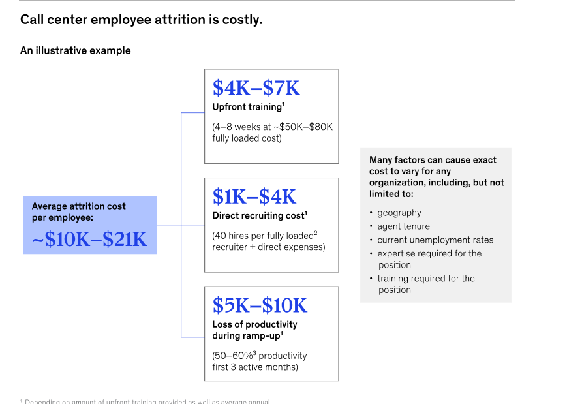
There's no denying that working with customers is a stressful job, and then there's burnout. The call center has the highest attribution rate of 45% in 2025.
According to a study by McKinsey & Company, attrition in call centers can cost from $10,000 to $21,000 per employee.
Luckily, good-quality outsourced call centers have the managerial skills to keep customers happy and engaged. Especially answering repetitive calls that take up significant time of an in-house agent's work hours and are downright boring.
If your company is successful and profitable, you're going to feel "growing pains". As your customer base expands, especially during holidays or sales season, your contact center needs will expand too. And you'll need more staff to handle more calls.
But scaling your call center in-house is expensive. An estimated costs include:
Remember, this doesn't count for more office space, headsets, and managers to oversee your continued success.
Depending on your needs, call center outsourcing costs come in at around $20 per hour for support for a basic answering service. However, you'll need to invest more time and resources for technical assistance.
By working with an outsourced call center, you can easily adjust the level of service needed to fit your growing business. And it's pretty easy to do. A simple renegotiation with your partner takes care of upgrading or downgrading the level of customer service in your organization.
While call center outsourcing offers various benefits, it also comes with a few drawbacks and potential risks that businesses must carefully consider. These drawbacks of outsourcing can impact operational efficiency, customer satisfaction, and overall profitability.
A lot of contact center executives lose control of customer experience because of outsourcing.In-house agents who interact with customers know their product and care about them. But when scaling gets hard, businesses often need to outsource customer calls to a third-party because it's cheaper, easier, and has more coverage.
But here's what really happens:
1/ Agents now work for the BPO, not their brand.
2/ They can't see who's on the phones or how quality is measured.
3/ Every customer conversation happens inside a black box that they don't control.
And, all of this leads to poor customer service. Even one outsourcing mistake (bad training or scripts) can cause companies to lose customers. Without direct oversight, businesses may struggle to ensure that outsourced operations align with their brand standards and customer service expectations.
When you partner with a business process outsourcing (BPO) provider, you are effectively placing customer calls in someone else's geographical location. So, even though it might cost you less to take customer calls abroad, it actually hampers customer experience.
Just look at the data:
The takeaway is that multilingual support isn't just a nice-to-have but a preference for customer support. When customer service representatives operate from countries with different cultural contexts and native languages, misunderstandings can easily arise, leading to frustrated customers and incomplete problem resolution.
Data privacy concerns significantly restrain the call center outsourcing market. Nearly 49% of organizations express hesitation toward outsourcing due to the risk of customer data exposure.
Third-party vendor attacks can occur in many ways, including:
When customer data traverses international boundaries and is accessible to external employees, the above risk surfaces expand dramatically.
Regulatory frameworks like GDPR, HIPAA, and CCPA further complicate the outsourcing landscape by imposing strict data handling requirements. If your organisation does not comply with any of the principles, you may be vulnerable to sizable fines.
The point is, are you 100% confident your customers' data will remain safe in someone else's hands in the same way you can if it's your own responsibility?
The global outsourcing market is increasing at an unprecedented rate. Yet, this growth isn't fueled by traditional outsourcing models.
Instead, enterprises are shifting toward technology-driven service delivery, with 78% of businesses planning to increase their investment in AI-powered BPO automation by 2025.
AI voice bots like Retell AI demonstrate intelligence and empathy similar to human agents.Imagine having agents that:
And they are 10x more affordable than human agents.
According to a Forrester Research report, speaking to a live agent can cost between $6 & $12 per interaction, with automated interactions costing as little as $0.25.
In 10 years, you'll see 80% of calls being answered by voice bots and only 20% picked up by humans.
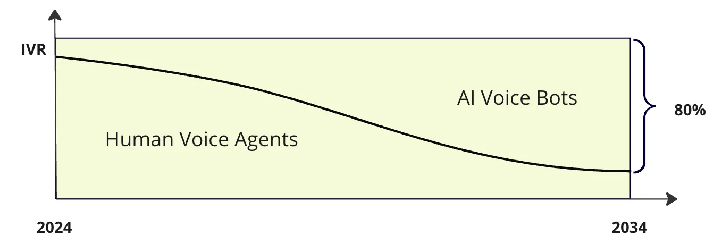
Gartner predicts that conversational AI will reduce contact center agent labor costs by $80 billion in 2026.
Voice AI agents help tackle all major challenges customer service teams face, including increasing support volume, communication siloes and the need for a more cost-efficient solution. If you want to eliminate all risks associated with outsourcing to human agents and still want to get all its benefits, then adopting a voice AI solution is a game-changer.
Here are the most impactful use cases of AI voice agents in call centers, with real examples of what they look like in production.
Instead of frustrating customers with IVR menus ("Press 1 for Billing…") before they can ever reach an agent. Voice AI identifies customer needs and connects them to the right specialist immediately.
For instance, Anker replaced its basic chatbot and IVR menus with Retell's AI IVR routing, delivering human-standard voice conversations. The result? 95% routing accuracy, 80% faster resolution, and a service team that updates call flows without IT.
AI-powered customer service promises a more conversational and efficient way to get support. It can handle simple inquiries and leave the more complex ones to humans.
Here's what an AI voice agent from Retell can do:
At Retell, we see that at least 50% of your low-complexity inquiries currently handled by your team could be handled by AI.
In traditional contact centers, pre-call authentication typically takes 45 seconds to 2 minutes per call, depending on industry and security requirements.
Voice AI saves time by authenticating callers before the agent ever joins. Retell AI agent verifies identity naturally during the conversation using:
As the customer talks, the authentication happens in the background. So, your team starts the conversation knowing exactly who is on the line.
Retell AI agent offers the following post-call assistance after the customer hangs up:
These summaries are instantly logged in the CRM or ticketing system, eliminating manual wrap-up time.
Voice AI solves outsourcing call centers' biggest challenge: multilingual conversations. Modern AI solutions handle slang, cultural nuances, and industry terms, which makes it ideal for customers across geographical locations to interact freely.
Retell AI currently supports over 50+ languages, bringing us one step closer to making content accessible in any language.
AI reaches customers with updates that would otherwise take an agent's time, such as service alerts, delivery tracking, appointment reminders, flight status changes, and payment confirmations. In healthcare, proactive follow-ups after patient discharge help lower readmission rates, while in retail, timely delivery notifications become especially critical during peak shopping periods.
The future of contact centers is constantly evolving. Two primary forces are shaping this landscape: the surge of AI and its continually expanding set of capabilities and the renewed value placed on human agents as their role is reshaped by this technology.
Customers usually prefer using voice communication when the problem they're facing has high emotions, high complexity and high urgency.
High emotion: e.g., a complaint
High urgency: e.g., checking the arrival time of a train
High complexity: e.g., difficulties completing a mortgage application form
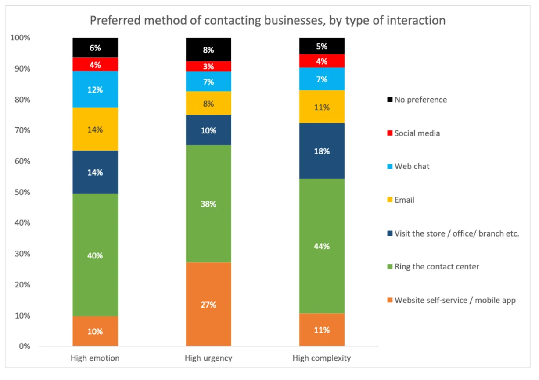
And, if bots are to resolve these problems, they would need to:
While modern AI can do all these, complex scenarios would require humans' help, especially where nuanced judgment is required, which are areas where humans excel.
For instance, in a member and patient-facing roles, tone and timing are just as important as speed. A well-scripted but emotionally flat response can erode trust, especially in sensitive healthcare situations.
Empathy, cultural sensitivity, and listening skills are what differentiate a service interaction from a transaction.
There's no doubt AI drives speed and scale. AI voice agents accelerate claims status checks, appointment reminders, and front-end verification. These efficiencies lead to reduced costs, improved turnaround times and allow human agents to handle crucial conversations.
Furthermore, when AI is combined with internal data and systems, it delivers impressive returns. For instance, one leading insurance agency handled 80% of its conversations through AI without asking for a human.
The upsides of the technology also extend to customer and employee experience.
Voice AI offers a chance to give agents quick and solid support during calls. AI can guide agents on the next best action, surface relevant information from the knowledge base, and recommend strategies based on a customer's past interactions, helping improve sales outcomes and create more opportunities for upselling.
Voice AI can help agents speak with the listener's accent and language to improve understanding and comprehension.
Ultimately, in this scenario, Voice Bots will make agents highly productive and predictable, but won't replace them over time.
Here's how human and AI collaboration works:
Voice AI excels at:
Humans provide:
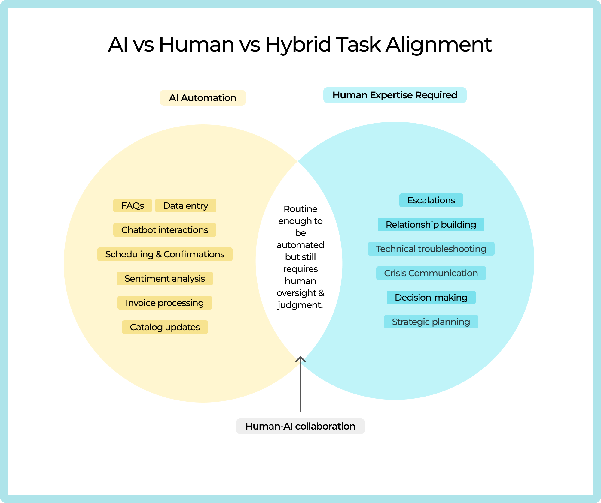
Retell AI is a leading enterprise-grade conversational AI platform specializing in automating inbound and outbound calls with exceptionally natural-sounding AI voice agents.
With Retell AI, you get:
Enterprise deployments with Retell AI have achieved 80% reduction in call handling costs in healthcare environments and 85% containment rates in contact center use cases, with up to 90 NPS on customer interactions.
And that's just the beginning. To discover all the reasons why RingCX could be a better alternative to call center outsourcing, contact our sales team today.
Call center outsourcing is the practice of hiring a third-party service provider to handle customer communication on behalf of a business. Instead of managing an internal support team, companies delegate tasks like answering calls, resolving complaints, processing orders, or conducting sales outreach to an external call center or BPO (Business Process Outsourcing) provider.
Call center outsourcing typically falls into two categories:
Businesses may choose one or both depending on their operational needs.
The cost of outsourcing varies based on location, service complexity, and support hours.
Technical support or specialized services generally cost more than basic answering services.
According to industry estimates, human-assisted calls cost between $6 and $12 per interaction, while automated voice AI interactions can cost as little as $0.25 per call.
This makes AI voice agents up to 10x more cost-efficient for handling high-volume or repetitive customer inquiries.
The future of contact centers is moving toward AI-assisted operations, where automation handles routine inquiries and human agents focus on complex interactions.
Industry analysts predict that in the coming decade, a majority of customer calls will be initially handled by AI systems, with humans stepping in for advanced support scenarios.
See how much your business could save by switching to AI-powered voice agents.
Total Human Agent Cost
AI Agent Cost
Estimated Savings
A Demo Phone Number From Retell Clinic Office