Chatbot vs Conversational AI: What's the Difference and Which Do You Need?
22
MIN READ
August 7, 2026
While conversational AI and chatbots look alike since they're both used in customer support to answer customer queries, they're not the same.
Chatbots follow a set of predefined rules to match user queries with pre-programmed answers. Conversational AI, on the other hand, is an intelligent system that can understand and respond to human language in a more sophisticated manner.
It's crucial for enterprises looking to adopt these systems to understand the difference and make the right choice.
Let's break down the difference between chatbots and conversational AI, when each one fits, and the hybrid reality most businesses actually live in.
Chatbots handle simple, automated support, while conversational AI delivers personalized, human-like interactions.
Chatbots can handle dozens of customer queries at once, but they follow predefined rules, so you miss the feeling of talking to a human.
Conversational AI interprets context, tone and past interactions, which makes it more effective than rule-based bots for complex, multi‑step customer journeys.
You can choose between chatbots and conversational AI by matching the tool to the complexity of your customer interactions and the level of personalization your business needs.
A chatbot is a virtual assistant designed to solve customer queries promptly. It operates on a computer-based dialogue system that draws its responses from predefined rules and decisions.
In doing so, they identify the user's intent by scanning the input for specific keywords. They then provide predefined responses from a database containing the most relevant keywords or their closest matching patterns. This means these chatbots can only respond to predictable questions and phrasing that are already predefined by the developers.
Some of these chatbots do not allow free-text input at all, but instead offer buttons and so-called click-through paths that a user can navigate through.
At a surface level, chatbots appear simple. But the way they're designed behind the scenes is what defines how effective they are. Most interactions follow a predictable flow.
The user's input triggers the workflow. Now, this input could be a typed message, a selected option, or a button click.
Many businesses intentionally guide users toward menus and buttons instead of open-ended questions. Structured inputs reduce ambiguity and make it easier for the chatbot to identify the correct conversation path.
After receiving the input, the chatbot checks whether it matches a predefined rule.
The match may be based on a keyword, button selection, menu option, or another predefined trigger. Unlike AI-powered chatbots, rule-based systems don't interpret intent or understand the broader meaning of a message. They simply look for a matching condition.
If a match is found, the chatbot proceeds to the corresponding workflow. If no matching rule exists, the chatbot typically asks the user to rephrase their request, redirects them to the main menu, or transfers the conversation to a human agent, provided those fallback paths have been configured.
Once a match is found, the chatbot follows a predefined decision tree.
Each user response determines the next step in the conversation. Every possible path is designed in advance, so the chatbot always follows the same sequence for the same input.
For example, if a customer wants to check an order status, the chatbot may ask for an order number, validate the information, retrieve the status, and display the result. The workflow remains identical for every customer unless someone updates the underlying rules.
As businesses add more scenarios, these decision trees become larger and more complex, making them increasingly difficult to manage and maintain.
After reaching the appropriate step in the workflow, the chatbot delivers a predefined response.
The reply is retrieved from a library of prewritten messages rather than generated in real time. This ensures responses remain accurate, consistent, and compliant across every interaction.
While this consistency works well for answering FAQs and handling repetitive processes, it also limits flexibility. If a customer's request falls outside the predefined rules or requires contextual understanding, the chatbot cannot adapt its response and typically requires human intervention or a predefined fallback path.
Conversational AI in customer service refers to using AI-powered voice bots or voice assistants that customer support teams use to offer real-time support to customers around the clock. It uses Natural Language Processing (NLP) and machine learning (ML) to analyze and create human-like responses.
These are designed to handle complex goals and workflows with limited direct human supervision. It demonstrates genuine problem-solving capabilities and adapts its approach based on context, customer history, and real-time data analysis.
Conversational AI includes both AI chatbots for text-based interactions and AI voice bots (or voice assistants) for phone conversations.
Unlike traditional chatbots that work on predefined conversation rules, conversational AI understands intent and context, responds dynamically, and manages multi-step conversations.
For example, if someone asks, "Can I get my money back?", the agent understands they're asking about returns, not requesting a literal cash withdrawal.
You've probably encountered a conversational AI bot before, answering questions and talking similarly to a human agent, but what's going on behind the scenes? How do you go from typing a message to getting a thoughtful, considered response from a robot?
Let's break the process down into easy-to-digest steps:
NLP allows conversational AI agents to interpret human language in both written and spoken forms. It ensures the system interprets queries accurately, regardless of complexity or ambiguity.
The system analyzes the text to determine:
What the customer wants (Intent)
Important details in their request (Entities)
The context of the conversation
For example, the phrases "password not working,""I can't log in," and "locked out of my account" could all route to the same resolution.
Machine learning enables conversational AI agents to continuously improve their performance over time by learning from historical interactions and user feedback. Instead of following only predefined rules, ML models identify patterns in conversations and optimize responses based on real-world outcomes.
As conversational AI agents process more interactions, they become better at understanding customer intent, predicting user needs, and providing more accurate answers. Machine learning also helps reduce errors, personalize customer experiences, and improve automation rates without constant manual updates.
For enterprises, this means conversational AI agents can evolve alongside changing business processes and customer expectations while delivering increasingly efficient support.
Speech recognition technology allows conversational AI agents to convert spoken language into text, enabling voice-based interactions through phone systems, smart devices, and voice assistants.
Modern speech recognition systems can understand different accents, speaking styles, and conversational patterns, making voice experiences more accessible and natural. Combined with NLP, speech recognition enables conversational AI agents to interpret spoken requests and respond accurately in real time.
Integrations transform conversational AI agents from simple conversational interfaces into powerful automation tools. By connecting with enterprise systems such as Customer Relationship Management (CRM) platforms, IT service management tools, HR systems, databases, and collaboration software, conversational AI agents can take actions directly within business workflows.
For instance, an AI conversational agent can:
Update customer information in a CRM
Create or close support tickets in IT systems
Schedule appointments or meetings
Trigger workflows in collaboration tools like Slack
Retrieve account details from internal databases
Process HR requests such as leave applications or onboarding tasks
These integrations enable end-to-end automation, allowing conversational AI agents not only to answer questions but also to execute tasks across multiple systems in real time. This reduces manual effort, improves operational efficiency, and delivers faster resolutions for users.
Retrieval-Augmented Generation (RAG) is an innovative technique that combines large language models (LLMs) with real-time data sources. This approach allows voice agents to generate context-aware responses that are more relevant to user queries.
By leveraging both the generative capabilities of LLMs and the specificity of real-time data, RAG allows voice agents to deliver more contextual and up-to-date responses. For example, when users ask about current events or recent product changes, RAG enables the agent to provide timely, accurate answers based on the latest available information.
Retell uses streaming RAG (retrieval-augmented generation) on every turn. For instance, the agent looks up the right snippet during the conversation, in real time, without you having to anticipate every question.
Once the conversational AI agent determines the appropriate response, speech synthesis, also known as Text-to-Speech (TTS), converts generated text back into natural-sounding speech. Advanced TTS systems use AI-generated voices with realistic intonation, pacing, and emotion, creating conversations that feel increasingly human-like.
Together, speech recognition and speech synthesis enable fully conversational voice experiences.
While both chatbots and conversational AI assist users through automated conversations, they vastly differ in their capabilities and flexibility. Below is a breakdown of the key differences:
Input handling is the processing of receiving, interpreting, and processing a user's message so the system can determine an appropriate response. How accurately a system handles the input determines whether it can effectively carry on the conversation.
Chatbots follow a strict framework, using pre-set rules and scripts to respond. This approach makes them suitable for interactions where consistency is important.
For example, if a customer types, "I want to track my order," the chatbot looks for keywords like track, order, or shipping and matches them to a predefined response or workflow. If the wording closely matches what the chatbot expects, it provides the correct answer.
However, if the customer phrases the request differently, such as "Where's my package?", "Has my shipment arrived?", or "Can you tell me when my delivery will reach me?" The chatbot may struggle unless those variations were explicitly programmed into its knowledge base.
Conversational AI processes user input very differently. Instead of searching for predefined keywords, it analyzes the meaning, context, and intent behind what the customer says.
When a customer sends a message, the system first uses Natural Language Processing (NLP) to understand the sentence structure, entities, sentiment, and overall intent. Large Language Models (LLMs) and machine learning models then interpret the request by considering the conversation history, previous interactions, customer profile, and available business data.
For example, if a customer says:
"Where's my package?"
"Has my order shipped yet?"
"I'm still waiting for my delivery."
"Can you tell me when my parcel will arrive?"
Conversational AI recognizes that all four messages express the same underlying intent: track an order. It doesn't rely on exact wording because it understands the semantic meaning of the request.
Context management is retrieving accumulated information from previous conversations in an ongoing dialogue that helps the agent understand the meaning and intent behind each message. Without context, every question would exist in isolation, making natural conversation impossible.
Now, context can come in different forms. There's an immediate context–the last few exchanges in the same thread of conversation. Session-level context encompasses the entire conversation from start to finish. And then there's external context, which includes user preferences, historical data, and world knowledge that helps the agent provide more personalized responses.
Traditional chatbots have limited context management capabilities. Most operate within predefined conversation flows and only remember information for the duration of a specific interaction, or sometimes only within a single step of that interaction.
For example, if a customer says, "I want to change my delivery address," and later asks, "Can you also update it for my next order?", the chatbot may not understand what "it" refers to unless that follow-up was explicitly programmed into the conversation flow.
Similarly, if the customer changes the topic and then returns to the original request, the chatbot often loses track of the earlier context and asks the user to repeat information.
Context in chatbots needs to be defined through every possible conversation path, follow-up question, and transition between topics. As conversations become more complex, maintaining these flows becomes increasingly difficult, often resulting in rigid interactions that frustrate users.
Conversational AI is designed to maintain context throughout a conversation rather than treating each message as an isolated request. Instead of following a fixed conversation tree, it continuously interprets new inputs in relation to previous messages, customer history, and relevant business data.
When a customer sends a follow-up message, the AI uses Natural Language Processing (NLP) and large language models (LLMs) to determine how it relates to the ongoing conversation. It can understand pronouns, references, topic changes, and incomplete sentences without requiring customers to repeat themselves.
For example, a customer might say:
"I need to reschedule my appointment."
"Can you make it Friday instead?"
"Actually, afternoon works better."
Conversational AI understands that it refers to the same appointment and that afternoon is the preferred time for the rescheduled booking. The customer doesn't need to restate the appointment details in every message.
Conversational AI solutions like Retell AI can also manage multi-turn, non-linear conversations. Customers can interrupt a discussion, ask unrelated questions, return to the original topic, or provide information out of order without breaking the interaction.
Today's customers want personalized assistance, and when businesses deliver that, they'rerewarded with:
4.5x higher conversion rates compared to online stores that don't
Up to a 369% increase in Average Order Value (AOV)
As much as a 45% drop in bounce rates because shoppers were engaged and guided from the moment they landed on the site.
Traditional recommendations were simpler; if they chose this, then recommend this. However, personalization today doesn't just rely on clicks or past purchases. It blends browsing history, purchasing behavior, cart activity, and live chat responses to deliver personalized assistance.
Traditional chatbots offer limited personalization because they primarily operate on predefined rules and static customer information. While they can greet users by name or retrieve basic account details from integrated systems, their ability to tailor conversations is constrained by what developers have explicitly programmed.
For example, a chatbot might recognize a returning customer and respond with, "Welcome back, Sarah." It may also display recent orders or account information if connected to a CRM. However, beyond these predefined data points, every customer with a similar query typically receives the same response.
Unlike traditional digital support mechanisms like static help text, FAQ pages, or live chat widgets, voice assistants in ecommerce are not stylistic add-ons. It offers:
Context-aware recommendations–the AI agent can reference your prescribed product information documents, providing context and offering tailored comparisons to very personal, individual queries.
Multilingual capabilities: Harvard research shows consumers are "72 % more likely to purchase when information is provided in their native language".
Retell AI operates on multiple voice and digital channels with 50+ multilingual capabilities, meaning customers can choose how they interact and even swap channels mid-purchase.
Conversational AI bridges this gap by mining calls, emails, chat logs, agent notes, surveys, and behavioral signals, unifying them into a single, continuously updated customer profile. According to Zendesk, 85% of CX leaders say memory-rich AI builds deeper relationships.
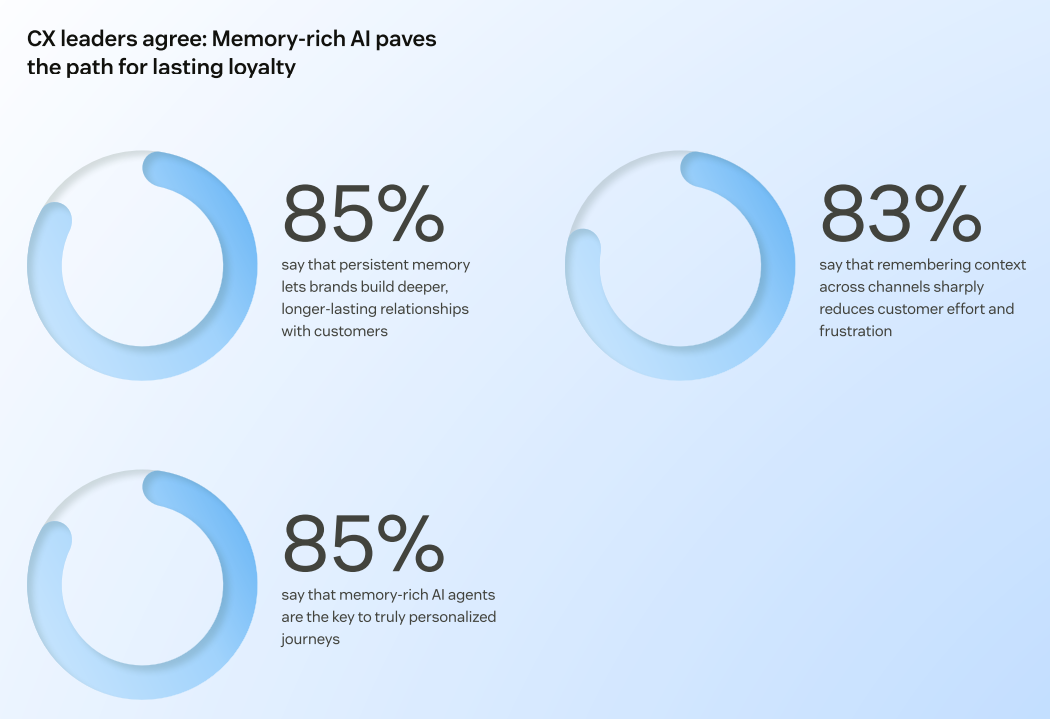
Meanwhile, experiences that memory-rich AI doesn't power will feel increasingly impersonal
—and irrelevant. And that's a mistake CX leaders with static chatbots cannot afford to make.
CX leaders and agents alike are feeling the push to deliver faster service, reporting that speed of service has become more important in the last year. In fact,nearly three-quarters (74%) of consumers say that, due to AI, they now expect customer service to be available 24/7.
A good resolution agent can solve at least 70-80% of customer queries without involving other human agents.
However, a slower resolution rate means the issue isn't resolved in one conversation, and the customer has to come back for more or ask for human agents. This means your team has to spend more time and money on that same customer issue over and over again.
Traditional chatbots resolve customer queries by following predefined workflows and decision trees. Every possible resolution is mapped in advance, meaning the chatbot can only complete tasks that have been explicitly programmed by developers.
For example, if a customer wants to reset a password, the chatbot follows a fixed sequence of steps, verifying the user's identity, providing a reset link, and confirming that the request has been completed. The same workflow is executed every time, regardless of how the customer phrases the request.
However, such chatbots start to struggle as the customer deviates from expected workflows. Any conversation that requires judgment, involves multiple systems, changes midway through the conversation, or doesn't match an existing decision tree, the chatbot typically cannot resolve it independently.
Conversational AI resolves customer issues by combining language understanding, contextual reasoning, and business process execution.
When demand increases, the system expands active conversations rather than creating longer queues. As a result, peak demand behaves differently. Instead of turning instantly into long queues and hold times, the system absorbs the spike by increasing the number of simultaneous conversations.
Retell AI was designed around these requirements. The platform provides explicit concurrency limits so operators know exactly how much capacity is available. Burst handling allows temporary spikes to be absorbed without immediately degrading the experience.
Recently, at Retell, we helped one of our clients (TripleTen) handle over 17000+ concurrent customer calls by our AI agents. Fast and accurate response helped TripleTen increase pickup and conversion rates by 20%.

Imagine calling your favorite coffee store; they greet you by name, already see your last order from the app, ask if you want the same drink, and proactively apologize for the delayed delivery you reported via chat yesterday.
That's omnichannel personalization at its finest.
Unlike traditional multichannel setups where each channel, like social media, website, email, and WhatsApp, operates in isolation, an omnichannel experience creates a smooth experience by maintaining full context and conversion history across all touchpoints.
Omnichannel service meets customers where they are, when they need help, without forcing them into any single communication channel.
Traditional chatbots are typically built to operate within a single communication channel or through separate implementations for each channel.
A chatbot deployed on a website, for example, often works independently from one on WhatsApp, Facebook Messenger, or SMS unless businesses create custom integrations to connect them.
However, the majority of customers use at least three communication channels to contact a company, with79% of them wanting consistent informationacross channels; chatbots don't all support teams with such accessibility.
If a customer starts a conversation on live chat and later continues it through email or a messaging app, the chatbot usually treats it as a new interaction because it has limited awareness of previous conversations across channels.
On the other hand, conversational AI is designed to deliver a unified customer experience across multiple communication channels.
When a customer switches between channels, such as moving from a website chat to WhatsApp, SMS, voice, or email, the AI can continue the conversation from where it left off, provided the business has integrated customer identity and backend systems.
At Retell AI, our agents are designed for continuity: the same intelligence, conversation flows, and logic across voice, SMS, and chat. The voice agents answer in<500ms with99.9% uptime, and the same reliability extends to SMS and web chat too.
Building chatbots and conversational AI from scratch can be complex and daunting, especially for non-programmers. But with the right tools and platforms, anyone can create and deploy effective solutions without extensive coding knowledge.
Here's how much time and effort it takes to set up a chatbot and conversational AI:
Setting up a traditional chatbot is generally quicker and less technically demanding because its behavior is entirely predefined. Developers create conversation flows, write responses, define keywords, and build decision trees that determine how the chatbot responds to different user inputs.
A basic FAQ or customer support chatbot can often be deployed in a few days to two weeks, while more complex implementations with multiple conversation branches and business system integrations typically take 4–8 weeks or longer.
It can take anywhere between 5 minutes and a month or more to deploy your conversational AI agent fully, especially when working with an enterprise conversational AI platform. But it all depends on what you're making and trying to achieve with your conversational AI agent.
A narrow, FAQ based voice agent with existing content and a managed platform can be launched within a few hours on Retell AI, assuming the data is available and integrations are light. However, enterprise agents with over 1000 daily calls will take four weeks for complete deployment.
Retell's no-code approach makes non-technical team members handle most configuration tasks, reducing dependency on development resources.
Cost is often one of the biggest factors businesses consider when deciding between a traditional chatbot and conversational AI. While both automate customer interactions, they differ significantly in implementation costs, ongoing operating expenses, and long-term maintenance.
Understanding what drives these costs helps businesses choose a solution that aligns with their budget, support requirements, and expected return on investment.
The cost of a traditional chatbot depends on whether you use a no-code platform or build a custom solution, but it is generally the more affordable option.
The Initial implementation cost varies across:
DIY/no-code chatbot: $0–$500/month
SMB deployment: $1,000–$10,000 one-time
Enterprise custom chatbot: $10,000–$50,000+
Most chatbot platforms charge through subscription-based pricing, with plans varying based on the number of users, conversations, channels, or available features. Since rule-based chatbots require minimal computing power, operating costs remain low even as conversation volumes increase.
For businesses with straightforward customer service needs, such as answering FAQs, collecting customer information, booking appointments, or routing inquiries, a traditional chatbot often delivers a strong return on investment without requiring any technical team.
For low-volume work, AI is often not cheaper. Setup costs, integration time, and fixed costs of maintaining an AI voice agent must be amortized across sufficient task volume before the per-task cost advantage materializes.
Conversational AI requires a higher investment because it combines technologies such as Natural Language Processing (NLP), large language models (LLMs), speech recognition (for voice agents), knowledge retrieval, and workflow automation.
Typical monthly costs include:
Platform subscription: $500–$5,000+ per month
LLM/API usage: Usually billed per token or message, with costs varying by AI model and provider
Voice AI processing: $0.05–$0.20+ per minute depending on the platform, speech models, and voice provider
Infrastructure costs: Additional expenses for vector databases, hosting, monitoring, and enterprise integrations where applicable
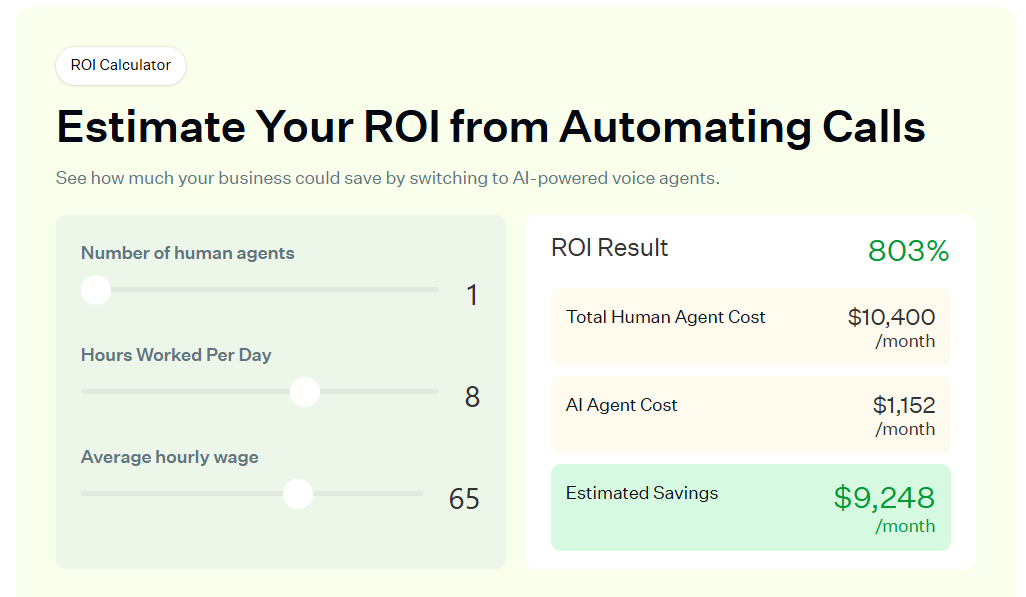
If you want to calculate how much call centers can save by switching to AI-powered voice agents, use our ROI calculator:
A fallback mechanism is a designated response that an AI agent or chatbot delivers when it cannot confidently match a user's input to any recognized intent.
Rather than producing an error, guessing incorrectly, or falling silent, the AI responds with a fallback, typically acknowledging that it did not understand the request and offering alternative paths forward.
A poorly designed fallback frustrates users and ends conversations prematurely. A well-designed fallback keeps the interaction alive, gives the user a productive next step, and provides data that helps improve the system over time.
Traditional rule-based chatbots are designed around predefined conversation flows. They compare user input against a fixed set of intents, keywords, or decision trees. If the input doesn't match anything in their knowledge base, the chatbot triggers a fallback response.
These fallback responses are usually generic, such as:
"I didn't understand that."
"Please choose one of the options below."
"Can you rephrase your question?"
After the fallback, the chatbot often redirects users back to the main menu or presents a list of predefined options. It has no understanding of why the request failed or what the user was actually trying to achieve.
After two or three unsuccessful attempts, they either transfer the conversation to a human agent or end the interaction altogether. Since they cannot infer meaning beyond programmed rules, every unexpected request becomes a dead end.
For conversational AI, where it works with multiple TTS and LLM providers, there are chances of outages or temporary issues, but the agents need to keep conversations going.
Retell's seamless fallback system automatically reroutes text-to-speech (TTS) and Large Language Model (LLM) functions to alternate providers or services if a function experiences disruption from the original provider.
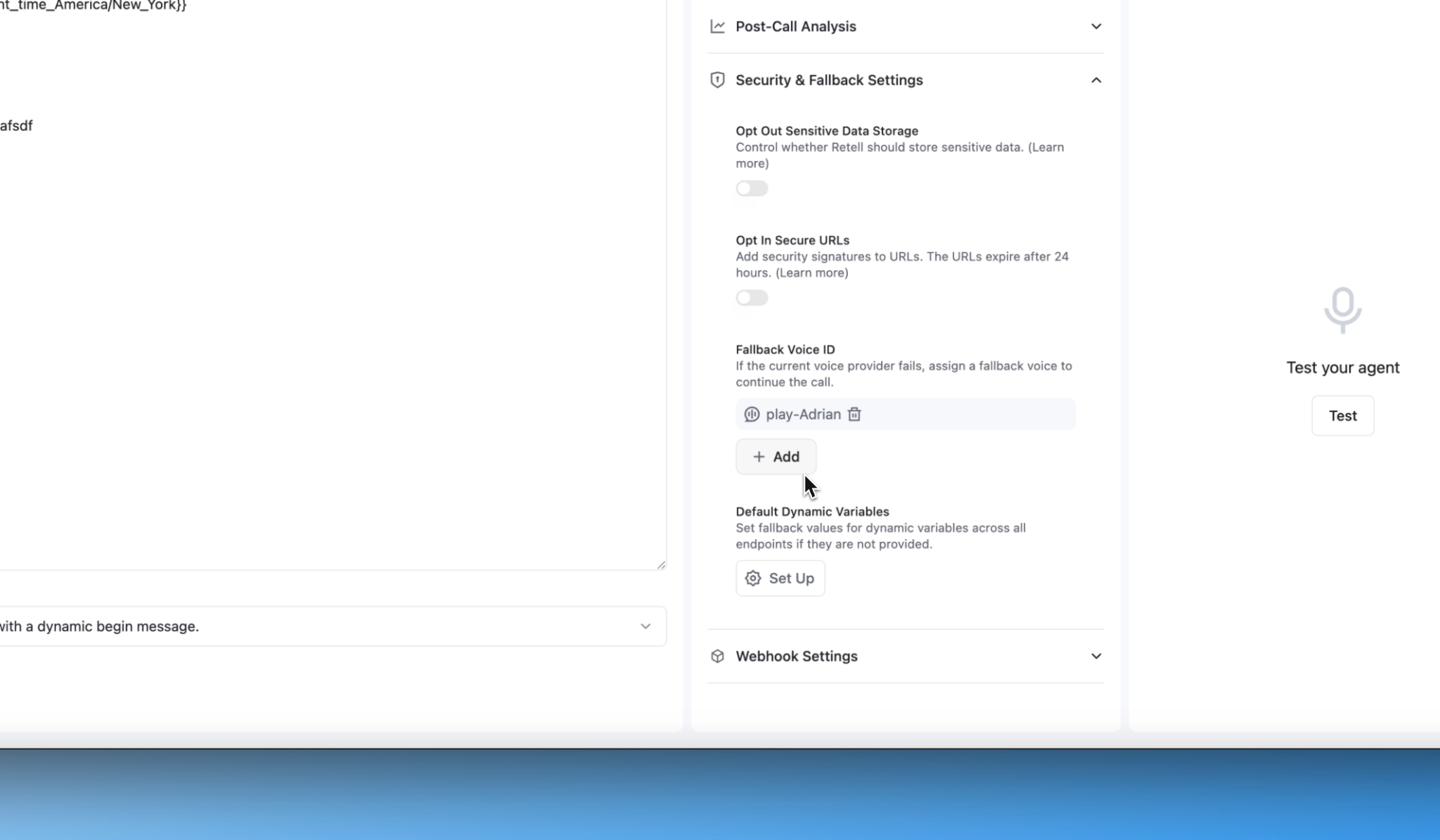
In practice, this means that even during partial provider outages, node transition accuracy, latency, and overall system stability remain intact.
Retell can now continue serving high-quality LLM responses without disruption, giving teams and users a seamless experience, even when individual deployments fail.
Both chatbots and conversational AI are built for different things.
Chatbot works for simple, repetitive customer inquiries that don't require such heavy infrastructure. On the other hand, conversational AI is built for complex, multi-turn conversations where basic answers from chatbots aren't enough.
What are the differences exactly? This is shown in the following table:
| Feature | Traditional Chatbots | Conversational AI |
|---|---|---|
| Technology | Built using predefined rules, decision trees, and keyword matching. Every conversation path must be manually configured. | Powered by AI, large language models (LLMs), natural language processing (NLP), and machine learning to understand and generate language. |
| How They Understand Users | Identifies keywords or button selections and matches them to predefined responses. | Understands user intent, context, and natural language, even when queries are phrased differently. |
| Conversation Style | Follows rigid, scripted conversation flows with limited flexibility. | Supports natural, conversational interactions that adapt based on the user's responses. |
| Handling Complex Queries | Performs well for simple, predictable questions but struggles with multi-step or ambiguous requests. | Can interpret complex, multi-part questions, ask clarifying questions, and handle more sophisticated conversations. |
| Context Awareness | Has little or no memory of previous messages, often treating each interaction independently. | Maintains conversational context across multiple turns for more coherent and personalized interactions. |
| Automation Capabilities | Best suited for answering FAQs, collecting information, and routing conversations. | Can automate end-to-end processes, execute workflows, retrieve data, and assist with decision-making. |
| Integrations | Connects to basic business systems | Integrates with CRMs, ERPs, knowledge bases, APIs, and enterprise applications |
| Best Use Cases | FAQs, appointment booking, order tracking, simple customer support | Customer support, sales assistance, technical troubleshooting, employee support, and AI agents that execute business processes |
Not every customer interaction needs an advanced AI system behind it, and deploying heavy infrastructure for basic questions is just wasteful for basic, repetitive questions.
Traditional chatbots are a perfectly good choice when your use case is genuinely simple and predictable:
Answering the same ten FAQs your team gets every day
Routing customers to the right department
Collecting basic information before a human agent takes over
If the conversation follows a known path and rarely deviates, a decision tree is cheaper to build and easier to maintain than an AI system.
For contained use cases like lead qualification, appointment booking, or basic account support, a conversational AI can handle the volume with manageable overhead.
The signal that you've outgrown a chatbot: your bot-to-human escalation rate is consistently above 30%, customers are repeating themselves, or your team is spending time on conversations that should have been resolved automatically.
Conversational AI earns its place when the interactions themselves are complex. That could be multi-turn, context-dependent, or consequential enough that a wrong answer has real costs.
Cross-channel journeys where a customer starts on chat, follows up by SMS, and calls three days later expecting continuity.
Voice interactions where the customer is calling because the issue is urgent.
Customer support that requires account history, policy knowledge, and judgment calls.
Sales conversations that adapt based on what a prospect says mid-call.
These aren't chatbot use cases. They're conversational AI use cases.
Looking up an order, processing a return, updating an account, or escalating with context intact. Conversational AI is the foundation that makes action-taking possible. Chatbots, even super-smart ones, largely can't make it possible.
Conversational AI is what keeps the customer experience from falling apart when the interaction gets hard.
Choosing between chatbots and conversational AI ultimately depends on the type of customer experience you want to deliver. While chatbots work well for answering straightforward questions, conversational AI voice agents can understand context, manage multi-step conversations, and complete real business tasks over the phone.
Retell AI enables businesses to build production-ready AI conversational agents (AI chatbots and voice agents) that answer calls, qualify leads, schedule appointments, handle customer support, and automate outbound campaigns with natural, human-like conversations.
Enterprise deployments with Retell AI have achieved an 80% reduction in call handling costs, with up to 90 NPS on customer interactions.
And that's just the beginning. To discover all the reasons why Retell AI could be a better alternative to call center outsourcing, contact our sales team today.
ChatGPT is conversational AI, not a traditional chatbot. Instead of relying on predefined rules or keyword matching, it uses large language models (LLMs) to understand intent, maintain context, and generate natural responses. Depending on how it's integrated, ChatGPT can power AI chatbots or voice agents that handle complex customer conversations, problem-solving, and multi-step workflows.
Alexa is not a chatbot. It is a conversational AI voice assistant that uses speech recognition, natural language processing (NLP), and machine learning to understand spoken requests and respond naturally. Unlike rule-based chatbots, Alexa can interpret intent across different phrasings, although its capabilities still depend on the skills, integrations, and services available behind the scenes.
The biggest difference is how they understand and respond to users. Traditional chatbots follow predefined rules, keywords, and decision trees, making them ideal for FAQs and predictable tasks. Conversational AI understands context, intent, and conversation history, allowing it to manage complex, multi-turn interactions and automate real business processes across multiple systems and communication channels.
Yes. Modern AI chatbots often use conversational AI technologies such as NLP, machine learning, and LLMs to deliver more natural interactions. While traditional chatbots are rule-based, AI-powered chatbots can understand intent, maintain context, and generate dynamic responses. Platforms like Retell AI combine conversational AI with voice and chat capabilities to create intelligent agents that can answer questions and complete real-world tasks.
It depends on your customer support needs. If you mainly answer repetitive FAQs or route inquiries, a traditional chatbot may be sufficient. If your business handles complex support, sales conversations, voice calls, or omnichannel customer journeys, conversational AI is a better fit. Many businesses use both, chatbots for simple interactions and conversational AI platforms like Retell AI for advanced customer conversations and workflow automation.
See how much your business could save by switching to AI-powered voice agents.
Total Human Agent Cost
AI Agent Cost
Estimated Savings
A Demo Phone Number From Retell Clinic Office