Contractor Answering Service: The 2026 Guide for Trades and Field Services

Every missed call is a silent hit to your revenue.
A homeowner needs a repair. A prospect wants a quote. A customer has a question.
Research consistently shows that 85% of people whose calls go unanswered will not call back. If someone is calling tobook an appointment,make a reservation, or make a purchase, they may not be willing to call back — especially if they're a first-time customer.
When you add the potential revenue losses up, it actually represents measurable losses in sales, customer retention, and even your brand reputation.
Contractor answering services offer a solution. The best contractor answering service answers your phone, qualifies your callers, and books an appointment on your calendar during the call. They never sleep, never take breaks, and improve over time.
In this post, we'll walk you through what a contractor answering service is, how it works, and why you should consider it when choosing an automated answering service.
A contractor answering service answers business calls, captures customer information, books appointments, and routes callers to the right technician or department, so no opportunity slips through the cracks.
There are two main types: traditional live answering services staffed by human agents, and AI answering services that use conversational voice agents to answer, qualify, and route calls automatically.
Built for field service businesses, including HVAC, plumbing, electrical, roofing, general contracting, landscaping, painting, and other home service companies with busy or seasonal call volumes.
The biggest benefits include 24/7 call coverage, fewer missed leads, faster response times than competitors, and lower operating costs compared to hiring a full-time receptionist.
AI answering services can also qualify leads, schedule appointments, prioritise emergency calls, update CRM records, and seamlessly transfer complex conversations to human staff when needed.
If you're looking for an AI-first solution, Retell AI enables contractors to build human-like AI voice agents that answer calls, book appointments, qualify leads, and automate customer conversations around the clock.
A contractor answering service is a virtual call-handling solution designed specifically for home service businesses, including HVAC, plumbing, electrical, roofing, landscaping, and general contracting.
It automaticallyanswers incoming calls, greets callers, and guides them to the right information, department, or action without requiring a live receptionist.
Built on cloud andVoIP infrastructure, a contact answering service can automate a wide range of customer interactions while scaling easily with business needs. Depending on the solution, an automated answering service may include:
Pre-recorded greetings and call menus, such as "Press 1 for Sales, press 2 for Billing."
Interactive voice response (IVR) that enables callers to complete tasks like checking account information, scheduling appointments, or making payments.
AI-powered voice agents that understand natural language and engage in human-like conversations with callers.
Intelligent call routing and screening that directs calls to the appropriate team, prioritises urgent requests, and filters spam or unwanted calls.
Integration with business systems, including CRM platforms, help desks, and scheduling tools, enables more personalised customer interactions.
The primary goal of an automated answering service is to ensure that no call goes unanswered while delivering fast, consistent, and efficient customer experiences. By automating routine call handling, businesses canreduce wait times, improve operational efficiency, and free employees to focus on higher-value tasks.
Here's what actually happens from the moment a caller dials your number.
When a customer calls your business number, the contractor answering service picks up within seconds, whether it's during business hours, after hours, weekends, or holidays.
Instead of hearing voicemail, callers are greeted with a professional, customised message such as:
"Thank you for calling ABC Plumbing. How can we help you today?"
An AI-powered contractor answering service can then ask callers to briefly explain why they're calling in their own words, while traditional services may present menu options like:
Schedule a service appointment
Report an emergency
Get a project estimate
Speak with the office
This ensures every lead is answered promptly, even when your crews are on job sites.
Based on the caller's input in the previous step, the answering machine will authenticate callers and route them to the appropriate employee, department, or AI agent.
In traditional contact centres, pre-call authentication typically takes 45 seconds to 2 minutes per call, depending on the industry and security requirements. AI call routing saves time by authenticating callers before the human agent ever joins the call. Retell AI agent verifies identity naturally during the conversation using:
Caller ID + device fingerprinting
OTP or secure link sent mid-call
Voice biometrics (where enabled)
CRM and order history cross-checks
As the customer speaks, authentication occurs in the background. So, your team starts the conversation knowing exactly who is on the line.
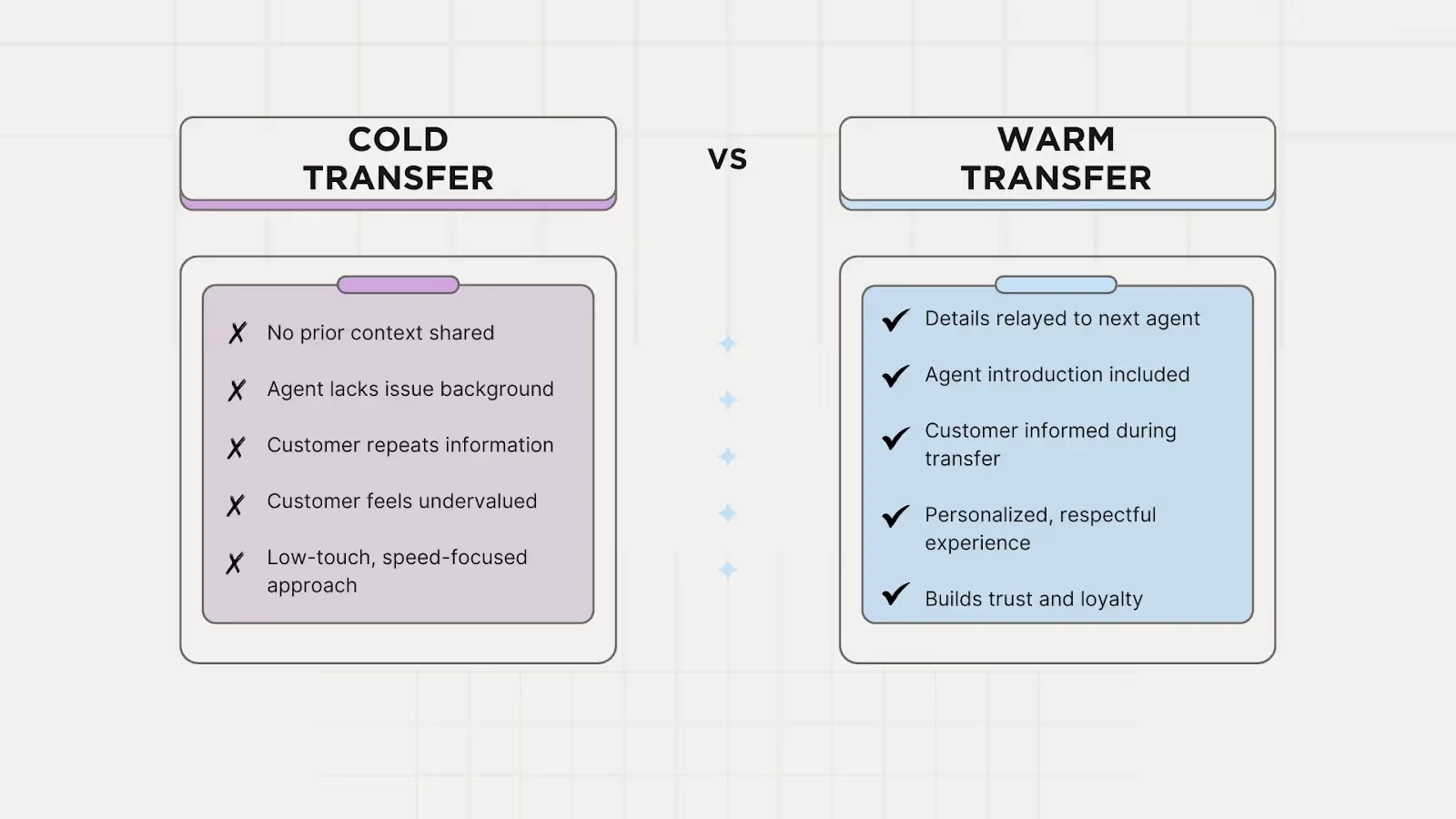
Cutting-edge platforms like Retell AI take AI call routing to the next level with features like warm transfer, enabling the AI IVR system to understand callers' needs and route them to live agents when the situation demands it.
Once a caller has been identified and authenticated, the IVR agent will interact with the caller in natural language to determine their intent (the reason for their call).
Understandingcall intent helps identify the underlying reason a person is calling. It's the "why" behind the conversation: whether that's booking an appointment, asking a billing question, resetting a password, or cancelling a service. On the other hand, sentiment analysis detects when the human is positive, neutral, or negative.
Here's how IVR agents detect call intent and sentiment:
Speech and Text Input: The agent analyses both what's said (transcript) and how it's said (tone, pitch, pacing).
Large Language Models (LLMs): Interpret meaning and match conversations to a specific intent category.
Emotion Detection Models: AI classifies the speaker's overall mood or tone at each stage of the call.
Real-Time Routing or Adaptation: If negative sentiment is detected, the agent may change tone, slow down, offer escalation, or transfer to a human.
Both intent and sentiment analysis happen in real time, so AI voice agents do more than just route calls; they also listen with emotional awareness, able to then display empathy towards customer sentiment.
AI agents can match calls with human agents with far greater precision than traditional IVR systems. It comparesintent and sentiment analysiswith predefined routing rules and agent expertise to match the caller with the right agent.
Caller intent: Natural Language Processing (NLP) helps the AI agent analyse the customer's request based on their spoken or typed words.
Agent skills: The system matches the caller's needs with an agent's skill set.
Workload balancing ensures your contact centre agents are not overloaded with calls by distributing them evenly for efficiency.
Call prioritisation: The system can prioritise calls from high-value customers or those with urgent issues.
AI-powered answering services can answer FAQs, book appointments, or process simple requests. Advanced answering systems can also automate outbound calls for appointment reminders, payment notifications and follow-up campaigns.
An automated answering service can seamlessly interact with your tech stack to process these requests:
Sync with calendars: Access real-time availability in Google or Outlook to book consultations.
Process transactions: Securely take payments or verify order statuses without a human agent ever touching the phone.
Update CRMs: Automatically log a call summary in Salesforce or HubSpot.
By automating routine inquiries while ensuring urgent jobs reach the right person immediately, a contractor answering service helps contractors respond faster, reduce missed opportunities, and provide reliable customer service even when crews are busy in the field.
Even though both terms, live answering service and AI answering service, sound similar, they're quite different. They solve different problems, work differently and cost differently.
Picking the wrong one can mean dropped calls, frustrated customers and wasted money.
Here's a comparison between a live answering service and an AI answering service to help you figure out which one makes sense for your business right now.
An AI answering service is software that answers your business phone using artificial intelligence. It uses speech recognition, natural language processing, and machine learning to hold natural, real-time conversations with people over phone calls or other voice-based channels.
When they encounter issues beyond their capabilities, they know to escalate to human agents. It runs 24/7 without breaks, sick days, or scheduling headaches.
On the other hand, a live answering service is a team of real people hired internally or outsourced. You pay them to answer your phone calls on your behalf. These human agents can follow scripts, take messages and transfer callers, and handle more complex or sensitive conversations.
Live answering services operate during business hours, though some offer after-hours coverage at a higher rate.
Cost is usually the biggest factor business owners compare. Let's compare the pricing for both:
Most AI receptionists either charge a pay-as-you-go fee or a flat monthly fee.
If your call volume is unpredictable or seasonal, then the pay-as-you-go pricing works well.
Subscription-based pricing is based on predictability. The risk is exceeding your minute cap, which triggers overcharges that are almost always priced higher than the plan rate.
For instance, Retell AI offers a flexible,pay-as-you-go pricing model. It ranges from $0.07 to $0.08 per minute depending on the voice engine used (e.g., ElevenLabs or OpenAI). You also get $10 in free credits to test the service, and there are no monthly commitments.
On average, the in-house agent's all-in hourly rate is likely $30-$35/hour or higher. This includes the agent's salary, their annual training costs and recruiting costs.
With outsourcing, this cost can come down to $6-$9 per hour, depending on the location.
But if you want quality customer service, it may not be the cheapest option. Although you'll save on overhead and labour costs, the contact centre you choose should still be seen as an investment in your business growth.
Still, if your company's based in a big city like New York or Chicago, office rent is likely very high. Rural outsourcing (outsourcing to a call centre located in a mid-sized city like Erie, PA) can effectively save you a lot of money without sacrificing the quality of service.
Both live answering and AI answering services have their use cases. AI has some clear advantages that no amount of human staffing can match. But it's not the right fit for every situation.
Always on, never busy: An AI receptionist doesn't sleep, take lunch breaks, or call in sick. It provides 24/7 capabilities for businesses that get after-hours calls- this can justify the switch.
Handles call surges instantly: When five people call at the same time, the live answering service puts them on hold. AI handles all five simultaneously, no hold music, no waiting, no abandoned calls.
Scales without renegotiating: As your call volume grows, AI costs stay flat or increase minimally. Live services scale linearly: more calls mean more minutes mean a bigger bill.
Reading emotional clues: While modern AI answering tools understand human emotions well, stressed callers are best handled by a human agent. For businesses that regularly handle high-emotion calls, such as legal intake, medical emergencies, or insurance claims, having human agents by your side is important.
Handling the unexpected: Live agents think on their feet. AI follows its programming, so when callers' requests fall outside its configured response, AI either gives a generic answer or transfers the call. If your calls frequently go off-script, the flexibility of a human agent has real value.
Building personal relationships: For businesses where repeat callers are the norm and relationships drive revenue, this matters more than most people think. AI can help you unify customer information and interactions across channels, enabling human agents to build strong personal relationships.
Different trades receive different types of calls, and a contractor answering service can be tailored to each workflow. From emergency dispatching to estimate scheduling, the right setup helps ensure that urgent requests are prioritised while routine inquiries are captured and organised.
Heating and cooling businesses often experience heavy call volume during heat waves, cold snaps, and seasonal maintenance periods. A contractor answering service can help by:
Triaging urgent no-heat and no-cool emergency calls.
Collecting customer information before dispatching technicians.
Routing emergency service requests to the on-call technician.
Scheduling AC tune-ups, furnace maintenance, and routine service appointments.
Managing seasonal call spikes without increasing office staff.
Plumbing calls frequently involve emergencies such as burst pipes, overflowing fixtures, and water leaks that cannot wait until the next business day. A contractor answering service can:
Prioritise emergency calls involving burst pipes, water leaks, sewer backups, and overflowing fixtures.
Dispatch technicians after business hours for urgent repairs.
Separate emergency jobs from standard plumbing service requests.
Capture quote requests for everything from simple repairs to whole-home repipes.
Schedule appointments and collect customer details for follow-up.
Electrical contractors need to respond quickly to safety-related issues while keeping installation projects organised. A contractor answering service can:
Prioritise urgent calls involving sparks, burning smells, power outages, and tripped breakers.
Route emergency calls directly to the on-call electrician.
Schedule panel upgrades, rewiring projects, inspections, and electrical installations.
Gather job details before dispatching technicians.
Book estimates for residential and commercial electrical work.
Storms often create sudden surges in customer inquiries that can overwhelm office staff. A contractor answering service can:
Capture roof inspection requests after storms or severe weather.
Record information about leaks, missing shingles, and property damage.
Collect insurance claim details during the initial call.
Prioritise emergency repair and temporary tarping requests.
Schedule follow-up inspections and roofing estimates
General contractors juggle project inquiries alongside ongoing communication with clients and subcontractors. A contractor answering service can:
Qualify new project inquiries before scheduling consultations.
Book estimate appointments for renovations and construction projects.
Relay messages between homeowners, subcontractors, and project managers.
Coordinate callbacks and appointment scheduling.
Keep project communication organised while crews are on-site.
Many home service businesses experience strong seasonal demand and rely on efficient scheduling to keep crews busy. A contractor answering service can:
Schedule recurring maintenance and seasonal services.
Capture quote requests for new projects.
Confirm appointments and send reminders.
Handle cancellations and rescheduling requests.
Manage customer inquiries during busy periods without adding administrative workload.
Not all automated answering services offer the same capabilities. While some simply route calls through an IVR menu, more advanced solutions use AI to answer questions, qualify leads, schedule appointments, and integrate with your existing business tools.
Here are the most important features to consider before choosing a provider:
A recent Zendesk study shows 74% of consumers now expect customer service to be available 24/7. 88% of customers expect faster response times than they did just a year ago.
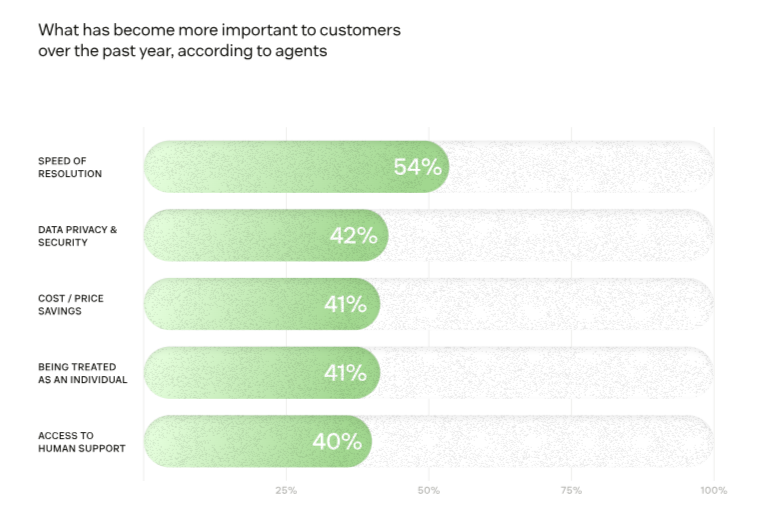
Modern AI answering service closes this gap with around-the-clock availability, making support faster, more natural, and more inclusive.
Retell AI offers a 7 days/week on-call schedule, ensuring that support is always available when needed. This also means that they track 24/7 uptime to resolve any issues quickly.
For a business to scale globally, it needs to support customers who speak different languages and use multiple devices.
Research shows that customers not only want brands to communicate with them in their native language but also to offer them a multichannel experience so that they can connect with support anytime, anywhere.
An AI answering service helps you achieve such seamless interaction without all of the resources and investment demanded by human teams.
Retell AI operates across multiple voice and digital channels, with 50+ languages, so customers can choose how they interact and even switch channels mid-purchase.
Once a call ends, answering AI automatically processes everything that happened during the interaction, without adding work for human agents.
Retell AI agent offers the following post-call assistance after the customer hangs up:
These summaries are instantly logged in the CRM or ticketing system, eliminating manual wrap-up time.
Auto-tagging and dispositioning: The agent further classifies calls based on the type of call, the resolution and customer feedback.
Follow-up automation: Based on the call outcome, your AI agent can send confirmation emails or WhatsApp messages, trigger surveys (CSAT, NPS) or schedule callbacks or technician visits without any agent intervention.
Real-time update of information: Retell AI integrates effortlessly with leading CRMs, collaboration tools, and contact centre platforms to sync customer data, call summaries, dispositions, and next actions in real time.
An answering AI service saves time by authenticating callers before the agent ever joins the call. Retell AI agent verifies identity naturally during the conversation using:
Caller ID + device fingerprinting
OTP or secure link sent mid-call
Voice biometrics (where enabled)
CRM and order history cross-checks
As the customer talks, the authentication happens in the background. So, your team starts the conversation knowing exactly who is on the line.
A frustrated customer calls an AI agent, and the IVR traps them in menus ("Press 1 for Billing…") before they can ever reach an agent. Answering AI, on the other hand, acts as an intelligent concierge, not a gatekeeper.
It starts with a meaningful conversation to understand the reason a person is calling: whether that's to book an appointment, ask a billing question, reset a password, or cancel a service.
It then routes the call to the right destination, whether it's an AI agent, a human rep, or a specific department.
Cutting-edge platforms like Retell AI take AI call routing to the next level with warm transfers, allowing AI phone agents to understand callers' needs and warm-transfer them to live agents when the situation demands it.
Understanding call intent helps identify the underlying reason a person is calling. It's the "why" behind the conversation: whether that's booking an appointment, asking a billing question, resetting a password, or cancelling a service. On the other hand, sentiment analysis detects when the human is positive, neutral, or negative.
Here's how IVR agents detect call intent and sentiment:
Speech and Text Input: The agent analyses both what's said (transcript) and how it's said (tone, pitch, pacing).
Large Language Models (LLMs): Interpret meaning and match conversations to a specific intent category.
Emotion Detection Models: AI classifies the speaker's overall mood or tone at each stage of the call.
Real-Time Routing or Adaptation: If negative sentiment is detected, the agent may change tone, slow down, offer escalation, or transfer to a human.
Both intent and sentiment analysis happen in real time, so AI voice agents do more than just route calls; they also listen with emotional awareness, able to then display empathy towards customer sentiment.
A support person spends the vast majority of their time updating CRMs. However, with answering AI, CRM records get updated automatically. This not only saves time but also keeps CRM data more accurate. All information, such as pain points and deal stages, is updated in real time.
This removes the burden of accuracy from sales agents. Instead, they're focused on what moves the needle, whether that involves discussing next steps or spreading out questions on a sales call.
Most AI agents are designed with feedback collection in mind. Their call flows can be built to handle calls naturally and, once the core task is complete, transition directly into a feedback prompt without switching modes or disrupting the customer experience.
For instance, Retell's embedded approach enables:
Real-time feedback collection during the live conversation
Ability to engineer adaptive questions based on call content, sentiment, or issue type
Capture of bothquantitative scores (NPS and CSAT) and unstructured voice feedback
Because customers don't need to complete a separate survey or follow-up, Retell AI clients report significantly higher feedback completion rates, often multiple times above industry averages.
When you talk to a person, conversation flows seamlessly. We expect the same from AI. Even a slight delay of just a few hundred milliseconds can feel off.
Agents must engage in back-and-forth conversations with users, adjusting their responses according to the context and flow of the discussion. For your virtual agents to feel truly conversational, latency must stay under one second, ideally much less.
Advanced solutions like Retell AI achieve an average latency of approximately 500ms for conversational turn-taking, approaching human-like conversation patterns.
Data privacy concerns can derail AI voice agent implementation if not properly addressed. Enterprise deployments require:
HIPAA compliance for healthcare applications
GDPR and CCPA data handling protocols
Optional on-premises audio storage for sensitive industries
Retell AI meets all these standards with a fully compliant infrastructure and offers on-prem and hybrid deployment options for highly regulated industries.
Contractors receive hundreds or even thousands of calls and messages every day, so it's important to choose a pricing model that fits their needs and budget. The cost of enterprise AI varies significantly depending on the deployment model, features, channels, and level of customisation required.
There are various pricing models for businesses, ranging from usage-based pricing to subscription pricing, or a mix of both.
For usage-based pricing, you only pay for what you use, without a monthly commitment or for idle capacity. This model works well if your volume is unpredictable or seasonal. For instance, a marketing agency running outbound campaigns like AI cold calling might process 5000 minutes in one month and 500 in the next. Per-minute billing absorbs that variance without locking you into an expensive monthly plan.
Subscription-based pricing gives you a fixed monthly or annual fee for access to answering AI capabilities. The risk is exceeding your minute cap, which triggers overcharges that are almost always priced higher than the plan rate, a big problem for enterprises.
Hybrid pricing: Hybrid pricing is a billing model that combines a fixed recurring fee, typically the platform fee, with variable charges that scale based on actual product usage. This pricing model provides businesses with subscription revenue predictability alongside the expansion upside of usage-based billing.
AI answering service costs aren't one-size-fits-all. Pricing depends on many factors, such as how you use it, the complexity of your infrastructure, and its key features. Here's a breakdown of the key factors:
Usage volume: The more calls your AI handles, the higher the cost. Most platforms scale pricing with usage to reflect processing demand.
Voice Generation (Text-to-Speech): It creates the human-like voice your callers hear. Standalone TTS services often range from $5–$99/month, depending on usage volume, while platform-based pricing usually adds around $0.02–$0.06 per call minute for premium voice generation.
Speech Recognition (Speech-to-Text): Transcribes what the caller says in real time. Leading STT providers typically charge around $0.01 per minute, while lower-cost open-source alternatives may reduce expenses but often trade off speed, latency, or accuracy.
Language Understanding (LLM): This is the brain of the agent. It manages conversation flow, interprets intent and decides what to say next. Lightweight models can cost as little as $0.003 per minute, while more advanced models designed for complex, multi-turn interactions may range from $0.01–$0.04 per minute.
Telephony (Carrier Fees): The phone line itself. Twilio charges $0.014/min for outbound US calls and $0.0085/min for inbound calls. Phone number rental adds $1-$1.15/month per number. These charges apply regardless of which AI platform you use.
Infrastructure and API Calls: Every AI voice conversation relies on multiple real-time API interactions between speech recognition, language models, and voice synthesis systems running on cloud infrastructure. These workloads consume processing power, bandwidth, and server capacity throughout the call.
Whether you bring your own tech stack or configure it through the voice AI platform, these costs are unavoidable. Always calculate the full stack cost before committing.
For example, Retell AI pricing starts around $0.07–$0.08 per minute before adding LLM, telephony, and voice costs. If your fully loaded AI voice agent costs roughly $700 per month for 5,000 minutes and resolves 70% of incoming calls autonomously, your effective cost is approximately $0.20 per resolved call.
Compare that with a human support agent, where a single resolved customer call may cost $3 to $12, depending on wages, overhead, occupancy, and handling time. Plus, the AI works 24/7 without breaks, sick days, or turnover.
An AI answering service offers a range of benefits that can significantly elevate a contractor's operations. Here are a few reasons why contractors should consider utilising an answering service.
Every missed call is a potentially lost business.
With a contractor answering service, every enquiry is captured professionally and quickly. It answers the call, qualifies the lead, routes to the best agent and captures details directly into your CRM. This allows your team to follow up with quotes or consultations at the earliest opportunity.
The modern world doesn't operate on a strict 9-to-5 schedule. Many potential customers might only find time to ring your firm in the evening or at weekends when they're not at work themselves.
Without a proper system in place, these after-hours calls often end up as voicemails, which can lead to their messages getting lost. However, an AI answering service helps businesses handle calls around the clock and provide assistance in real time.
Without AI-first customer service, you won't get the benefits of breaking the traditional linear growth model. The size of your support team will limit the quality of your customer service, as you need to add (and recruit, onboard, and train) new staff to handle any business growth.
That's why the true value of AI-first customer service goes beyond cost reduction; it delivers improved support quality, scalability, and overall business impact.
At Retell, our most successful clients think about the return on investment through two lenses: increased bandwidth and cost efficiency.
This is the answering service's biggest differentiator, as most traditional chatbots can only personalise based on what the customer says during the session.
For instance, with Retell AI, your voice agent already knows the customer's history, preferences, purchase behaviour, and lifecycle before the first message arrives.
The customer never has to repeat their name, order number or issue. The voice agent recommends products based on what they've actually bought before. And high-value customers get routed to priority support automatically. A returning customer asking about an order gets their specific order status, not a generic "please provide your order number" prompt.
This isn't integration-project personalisation that takes six months to configure. It's the native integration between the answering AI solution and your CRM that feeds all the latest information.
With so many AI assistant options to choose from, identifying the best possible fit for your board is not always easy. Here are a few tips to consider when choosing your digital AI assistant:
Define what it is you want your AI assistant to do. Some people need help with admin tasks such as scheduling meetings, drafting correspondence, and email management. However, others want strategic support from a digital teammate— handling data analysis, reporting, or even project management.
This step also helps you decide whether a business-focused or personal-use AI assistant makes more sense. Make a list of your most time-consuming tasks, such as time spent searching for or synthesising information, and determine which of them could benefit most from AI support.
An AI assistant is useless if it can't reach your email, calendar, and project tools. The best apps plug into your existing stack and pull data from multiple sources.
Pick a system like Retell that seamlessly integrates with ecommerce platforms (Shopify, Magento, etc.), CRMs (Salesforce, HubSpot), and call systems (Twilio, Five9, etc.).
If you're based in the EU or the UK, you will be familiar with the GDPR, HIPAA, or SOC 2 Type II.
If your organisation does not comply with any of the principles, you may be vulnerable to sizable fines.
Under the GDPR, violations of the core principles for processing personally identifiable information can result in penalties of up to €20 million or 4% of the organisation's total global annual turnover, whichever is higher.
When you choose customer service software, when it comes to data security, you should be looking for the following:
EU-hosted data
GDPR, governance, and data protection policies
Data security certifications, such as ISO 27001
A complete list of sub-processors and Standard Contractual Clauses (SCCs) explaining how data is processed
Unlike generic voice platforms, Retell's architecture is engineered specifically for regulated industries and includes built-in compliance capabilities. It includes:
HIPAA, PCI, and enterprise-grade compliance embedded by default
End-to-end encryption for voice streams
Real-time PII detection and redaction
Comprehensive audit logging
Role-based access controls
Automated compliance monitoring
Retell AI's architecture addresses these gaps with enterprise-grade security protocols that protect every call, every interaction, and every data point, without sacrificing performance.
Your team's technical skill also determines the choice of an AI assistant. If your team lacks coding expertise, a no-code platform allows them to participate in the development process actively. No-code platforms have intuitive interfaces, making them accessible to non-technical users.
However, if you have skilled developers, a custom-code platform provides the flexibility to create advanced solutions. Retell's no-code approach enables non-technical team members to handle most configuration tasks, reducing dependence on development resources.
Assess the scalability of your AI system by determining whether it can handle increasing volumes or task counts as your business expands. You can determine this by looking at some of its core features, including:
The system must be able to absorb simultaneous call demand
Operators must be able to see the system capacity clearly
Overflow traffic must be handled safely
Disruptions must fail over without leaving callers stranded
Retell AI was designed around these requirements.
It's designed to handle high traffic through load testing, auto-scaling, and dynamic provisioning capabilities. The platform delivers over 99.9% uptime and includes fallback mechanisms that help ensure uninterrupted call continuity during service disruptions.
An automated answering service helps businesses reduce unanswered calls, so no customers feel ignored, and no opportunity is lost. For best results, businesses should choose an answering service that combines intelligent automation with human support where it matters the most.
If you're looking for more than basic call answering, Retell AI lets you build AI voice agents that can answer calls, qualify leads, book appointments, and automate customer conversations using natural, human-like speech. Routine calls get handled quickly, while complex or high-value calls go straight to your team or to a live answering service.
You can also check how our clients have automated 90% of their incoming calls and achieved 4x operational efficiency. Ready to experience it yourself? Start your free trial with Retell today.
A contractor answering service answers incoming calls, captures customer information, qualifies leads, schedules appointments, and routes urgent requests to the right technician or department. Modern AI-powered solutions like Retell AI can also answer common questions, update CRM records, and prioritise emergency calls in real time, ensuring contractors never miss valuable business opportunities, even after hours.
Yes. Small contractors often miss calls while working on job sites, which can result in lost leads and revenue. An answering service ensures every call is answered professionally, books appointments, and filters urgent requests without requiring additional office staff. AI solutions like Retell AI also provide 24/7 coverage at a lower operating cost than hiring a full-time receptionist.
Yes. AI answering services can identify emergencies by understanding what callers say in natural language. They can prioritise urgent issues, such as burst pipes, electrical hazards, or HVAC failures, and immediately route them to the on-call technician. Platforms like Retell AI also support intelligent call routing and warm transfers when a live employee needs to take over the call.
A contractor answering service integrates with your scheduling software or business calendar to view real-time availability. During the call, it collects customer details, identifies the required service, and books an appointment without human intervention. AI-powered platforms like Retell AI can also send confirmation messages, update CRM records, and schedule follow-up reminders automatically after the call ends.
An answering service primarily focuses on answering calls, taking messages, routing callers, and handling basic customer inquiries. A virtual receptionist provides a broader range of administrative support, including appointment scheduling, lead qualification, customer intake, and personalised call handling. AI-powered platforms such as Retell AI combine many virtual receptionist capabilities with answering AI, enabling businesses to automate routine interactions while seamlessly transferring complex conversations to human staff.
See how much your business could save by switching to AI-powered voice agents.
Total Human Agent Cost
AI Agent Cost
Estimated Savings
A Demo Phone Number From Retell Clinic Office