The FCC's New TCPA Opt-Out Rule (FCC 26-67): What Changes for Calls, Texts, and AI Voice Agents




FCC 26-67 is the Federal Communications Commission order that rewrites how people opt out of automated calls and texts under the Telephone Consumer Protection Act (TCPA). It is effective November 25, 2026. From that date a business can name the specific ways people may revoke consent, an opt-out from one kind of informational message can be limited to that kind, and the "revoke-all" rule that was scheduled for January 31, 2027 is replaced before it ever applied.
The order covers calls and texts placed with an autodialer and calls that use an artificial or prerecorded voice. The FCC ruled in February 2024 that AI-generated voices are artificial voices under the TCPA, so outbound calls placed by AI voice agents follow the same consent and revocation rules.
If you place those calls on Retell AI, the platform's Do-not-contact Handling (DNC) is the setup for this rule: the agent confirms a spoken opt-out and ends the call, Retell marks the contact as do-not-call, and campaigns skip that number from then on. The setup steps are in this article, after the rule changes.
This article summarizes the order for planning purposes and is accurate as of November 2026. It is not legal advice, and Retell AI is not a law firm. Confirm how the rule applies to your calls and texts with your own counsel.
Key takeaways
- Effective date: the amended rules apply from November 25, 2026, 30 days after they were published in the Federal Register.
- Opt-out method: a caller may designate one or more of three methods as the only ways to revoke consent, if it discloses the method clearly on the call or in the text.
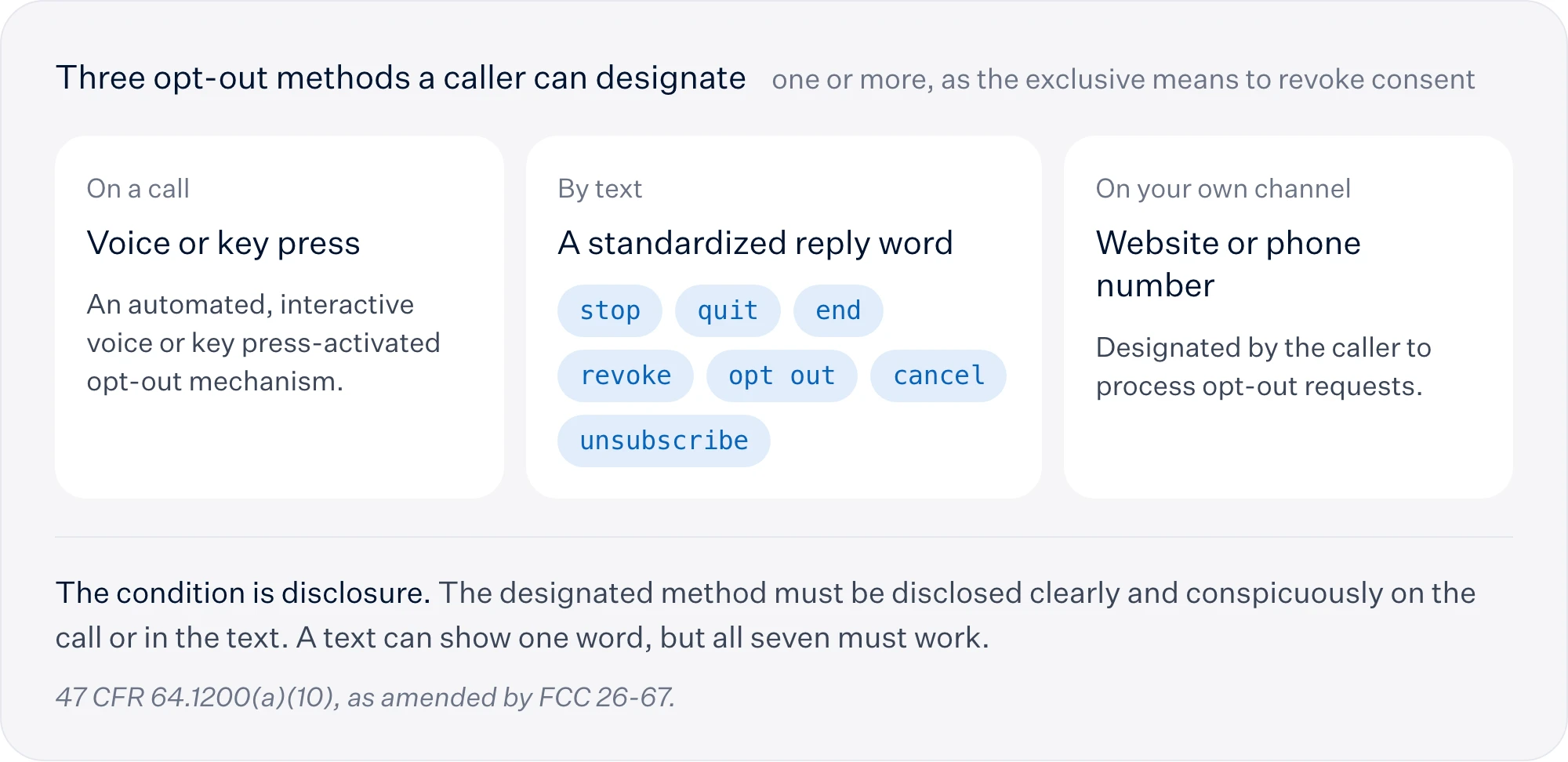
- Scope: an opt-out from an informational call or text may be limited to that category. An opt-out from a marketing call or text ends all future marketing from that caller.
- Deadline: unchanged. Opt-outs must be honored within a reasonable time, at most ten business days. The FCC is asking whether to shorten it to seven.
- Nothing is mandatory to adopt: the FCC says the order imposes "no new compliance obligation." A caller that designates nothing must still honor opt-outs made by any reasonable means.
- On Retell: turn on Do-not-contact Handling (DNC) for each outbound agent and keep the Retell Contacts DNC check on in every campaign. Spoken opt-outs and SMS keywords then mark the contact, and later calls and texts skip the number.
What FCC 26-67 is and when it takes effect
FCC 26-67 is a Report and Order and Further Notice of Proposed Rulemaking in CG Docket No. 02-278, the FCC's long-running TCPA docket. The Commission adopted it on September 30, 2026 and released it on October 1. You can read the full text of FCC 26-67 on the FCC's site.
The final rule was published in the Federal Register on October 26, 2026 at 91 FR 67214, with an effective date of November 25, 2026. It amends four paragraphs of 47 CFR 64.1200: (a)(9)(iii)(A), (a)(10), (a)(11) and (a)(12).
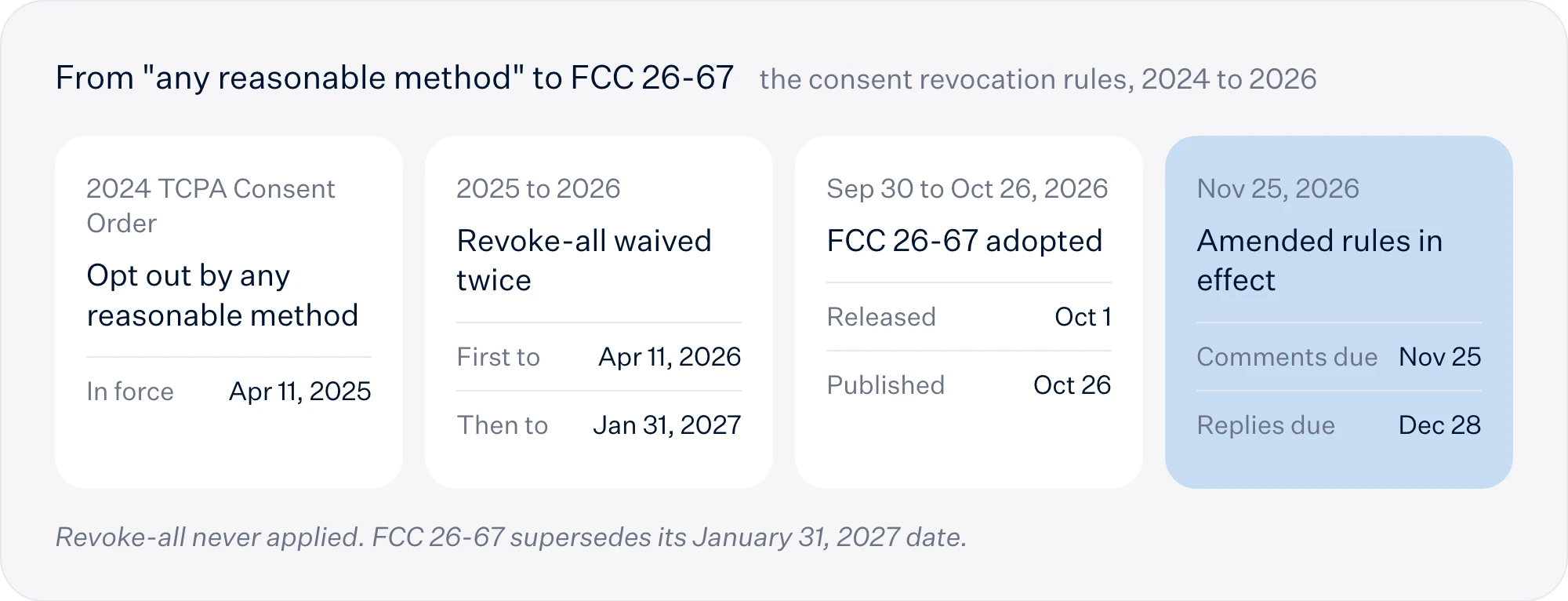
The order revises rules the FCC adopted in its 2024 TCPA Consent Order. Those rules took effect on April 11, 2025 and required callers to honor a revocation made by "any reasonable method." One part of them never applied. The "revoke-all" provision, which would have turned an opt-out from one message into an opt-out from every robocall and robotext from that caller, was waived twice and was last scheduled for January 31, 2027. FCC 26-67 supersedes that date.
What changes on November 25, 2026
Three parts of the consent revocation rules change: how a person can opt out, how far an opt-out reaches, and which phone numbers banks can use for fraud alerts.
Callers can designate an exclusive opt-out method
Under the old rule, callers could not name an exclusive way to revoke consent. A person could opt out by any reasonable method, and the caller had to work out what counted.
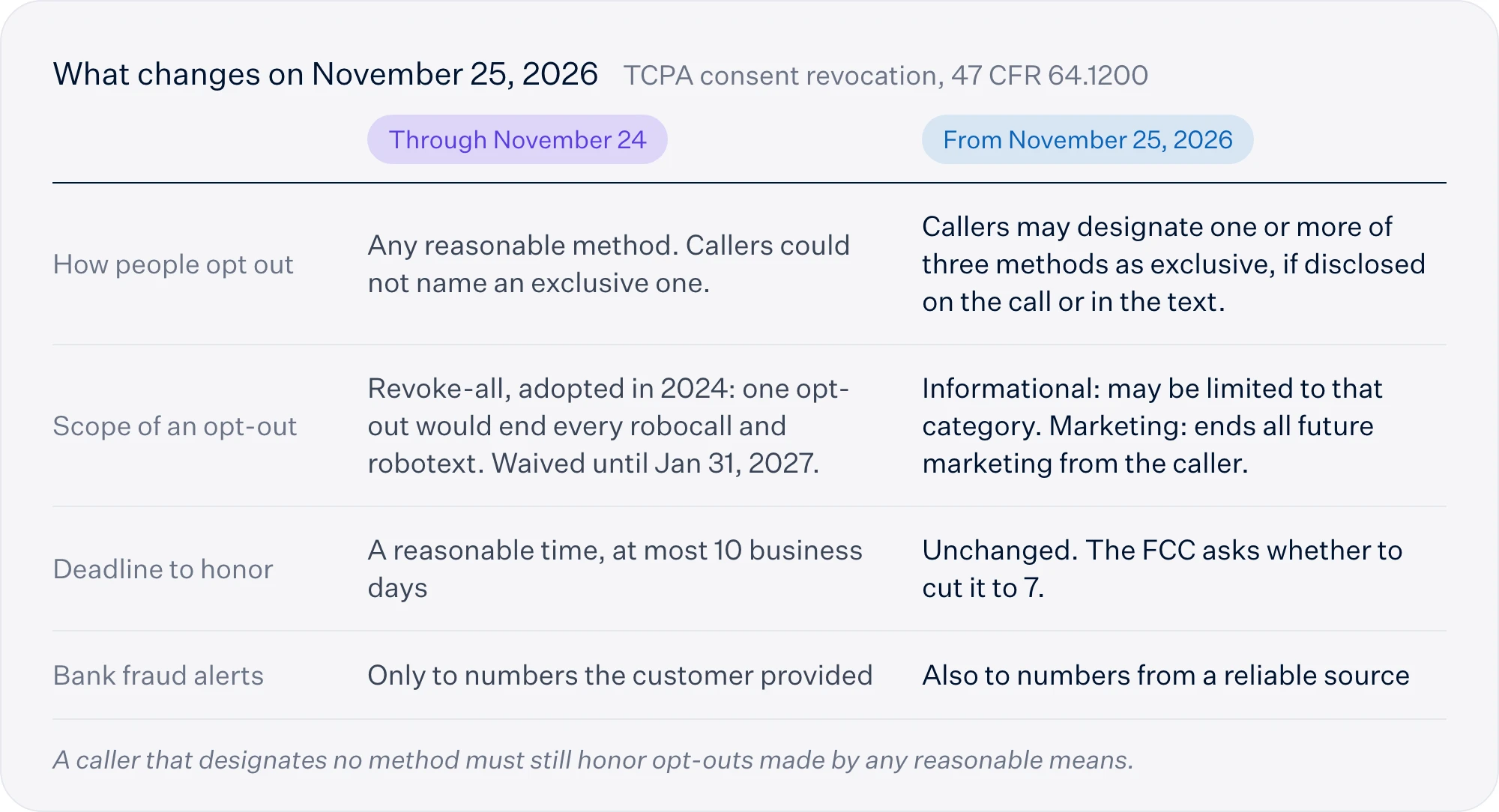
Under the amended 47 CFR 64.1200(a)(10), a caller may designate any of these three methods as the exclusive means to revoke consent:
- An automated, interactive voice or key press-activated opt-out mechanism on a call
- A reply to an incoming text message with one of the standardized words: "stop," "quit," "end," "revoke," "opt out," "cancel," or "unsubscribe"
- A website or telephone number designated by the caller to process opt-out requests
A caller can designate one of them or more than one. The condition is disclosure: the caller "must clearly and conspicuously disclose the designated method to revoke consent on the call or in the text." The FCC declined a request to let callers decide when and how to tell customers about the method.
A caller that designates an exclusive method "is not required to process revocation requests made by any other means." A caller that designates nothing is covered by paragraph (a)(11) and must process revocation requests made by any reasonable means.
An informational opt-out can be limited to one category
An informational call or text is one that contains no advertising or telemarketing, such as an appointment reminder, a payment reminder, an outage notice or a fraud alert. Under the amended rule, callers "may interpret a revocation request made in response to an informational call or text message" as applying "only to the specific category of informational robocalls and text messages to which the revocation was directed and not to all communications."
The FCC's example is a customer who opts out of payment reminders. Under revoke-all, the caller would also have had to stop fraud alerts, multi-factor authentication messages, appointment reminders and utility outage calls. The order points to a survey cited in the American Bankers Association's comments, in which 62 percent of respondents were concerned that revoke-all would require their bank to stop sending all messages, including fraud alerts.
The word in the rule is "may." A caller can still treat every opt-out as an opt-out from everything, and that remains the simplest policy to run.
A marketing opt-out still stops all marketing
Marketing gets no category split. A revocation made in response to a call or text that contains an advertisement or constitutes telemarketing revokes consent "to all future calls or text messages containing an advertisement or constitute telemarketing from that caller." The FCC also reminded telemarketers that a do-not-call request can reach affiliated entities when the consumer would reasonably expect them to be included.
One keyword in the text is enough, but all seven must work
A text sender that designates reply keywords as its exclusive method does not have to print all seven words in every message. Including at least one, such as "Reply STOP to opt out," satisfies the disclosure. The sender must still recognize any of the seven standardized words as a valid revocation.
Banks can send fraud alerts to more numbers
Financial institutions have an exemption that allows certain fraud and security alerts to wireless numbers without prior consent. Until now it reached only numbers the customer had provided. The amended (a)(9)(iii)(A) adds numbers "obtained from a reliable source": supplied by a spouse or other family member who is authorized to be on the account, obtained when the customer calls the institution, or included in records obtained from another financial institution. The other conditions stay, including the cap of three messages per event over a three-day period.
What stays the same after November 25
The order changes how opt-outs are made and scoped. It leaves these parts of the rules in place:
- The ten-business-day deadline. A revocation must be honored "within a reasonable time not to exceed ten business days from receipt."
- Any reasonable means, if you designate nothing. A request made another way, such as a voicemail or an email, creates a rebuttable presumption that consent was revoked once the consumer shows the request was made.
- The opt-out mechanism on telemarketing voice calls. Artificial or prerecorded voice calls that include advertising or telemarketing must still offer an automated voice or key press opt-out, with instructions, within two seconds of the caller's identification. The mechanism must add the number to the caller's do-not-call list and end the call. That requirement is in 47 CFR 64.1200(b)(3).
- Confirmation texts. A text that only confirms the opt-out, with no marketing, is allowed. Sent within five minutes, it is presumed to fall within the person's prior consent.
- One-way texting. A sender whose texting protocol cannot receive replies must say so in each text and give another way to opt out.
- Consent itself. The order does not change when prior express consent or prior express written consent is required before an automated call or text.
Chairman Brendan Carr described the purpose in his statement on the order:
For instance, if your bank started sending you unwanted marketing communications, the FCC's "revoke all" rule would have prevented you from blocking those without also blocking the fraud alerts you do want.
The table below sorts the changes by the kind of message you send.
| If you send | What the amended rule allows | What you must still do |
|---|---|---|
| Marketing calls or texts | Designate an exclusive opt-out method and disclose it on each call or text | Treat one opt-out as ending all future marketing from you, and keep the opt-out mechanism on artificial voice calls |
| Informational calls or texts, such as reminders and alerts | Limit an opt-out to the category it was aimed at, and designate an exclusive method | Honor it within ten business days and recognize all seven text keywords |
| Both kinds to the same people | Scope each opt-out by the message that prompted it | Keep marketing and informational consent records separate enough to apply the right scope |
| Bank fraud alerts under the exemption | Use numbers from a reliable source | Stay within three messages per event over three days and honor opt-outs |
What the new opt-out rule means for AI voice agents
An AI voice agent speaks with an artificial voice, so its outbound calls are covered wherever the TCPA requires consent. Four parts of the order matter when you configure one.
Decide whether to designate a method. A voice agent that recognizes a spoken request, records it and ends the call is the natural candidate for the first method, an automated, interactive voice opt-out mechanism on the call. Whether your setup meets that description is a question for counsel. If you do not designate a method, a request made by email, by voicemail or to a human representative can still count.
Disclose the method on the call. A designated method has to be disclosed clearly and conspicuously on the call. For a voice agent that means a sentence the agent says, for example: "You can say 'stop calling' at any time and we will remove this number." Put it in the agent's opening lines and not in a terms page the caller never hears.
Pick your scope policy before the agent needs it. If you send both reminders and marketing, decide whether an opt-out from one informational category leaves the others running. If your systems store a single do-not-call flag per number, the safe reading is that the flag stops everything.
Treat ten business days as the outer limit. An opt-out captured by software can take effect before the next dial. The FCC noted in its further notice that callers who designate an automated method may be able to process requests faster, and it is asking whether to cut the deadline.
For the wider rule set that sits around opt-outs, see the TCPA compliance playbook for voice AI outbound and the TCPA guide for outbound AI voice calls. Collections teams should also read FDCPA and Reg F for automated collection calls. The FCC declined to let callers regulated by another agency designate that agency's revocation method as their exclusive TCPA opt-out method. The example in the record was the written notice used for debt collection calls.
How to handle opt-outs with Retell's DNC feature
Retell AI is an AI voice agent platform. Its Do-not-contact Handling (DNC) feature captures an opt-out the moment a person makes it and keeps later calls and texts from reaching that number. This section follows the Retell documentation as of November 2026.
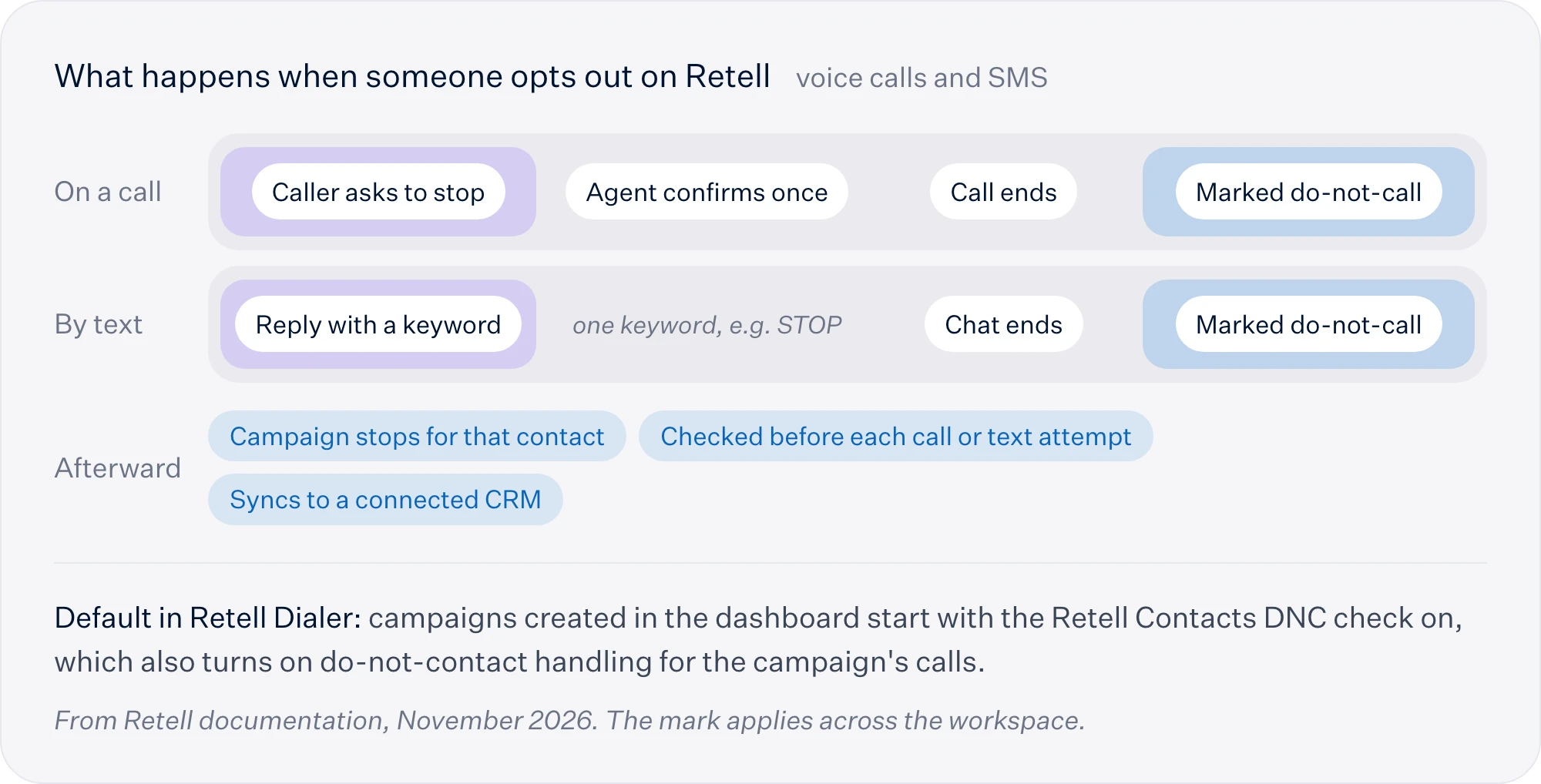
What Do-not-contact Handling does
On a call. With Do-not-contact Handling on, the agent recognizes when a person asks not to be called again, in any language. It asks once, "Understood. Would you like us to stop making calls to this number?" If the person confirms, the agent says it will add the number to the do-not-call list and ends the call. Saying they are busy, asking for a callback, or saying they are not interested does not count as a do-not-call request, so a soft no does not remove a lead by mistake.
After the call. Retell marks the contact as do-not-call for the whole workspace, syncs the change to a connected CRM, and stops the campaign's remaining attempts for that contact. The call is logged with the disconnection reason user_requested_dnc.
By text. When someone replies to an SMS with a single opt-out keyword, Retell marks the contact the same way and ends the chat. The keywords are STOP, STOPALL, UNSUBSCRIBE, CANCEL, END, REVOKE, OPTOUT and QUIT. A keyword inside a longer message does not count.
Before each attempt. In Retell Dialer campaigns, the Retell Contacts DNC check runs again before every call or text attempt, so a contact marked during the campaign is stopped before the next one.
How the rule maps to Retell settings
| What the rule expects | What Retell does | What you set |
|---|---|---|
| An automated way to opt out on a voice call | The agent recognizes the spoken request, confirms once, and ends the call | Do-not-contact Handling on the agent, or Retell Contacts DNC on the campaign |
| Standardized reply words on texts | An opt-out keyword marks the contact and ends the chat | Send from your own SMS-enabled numbers, and try each of the FCC's seven words |
| Opt-outs honored within ten business days | The contact is marked when the call ends, and campaigns check the mark before each attempt | Keep Retell Contacts DNC on, and pass honor_internal_dnc: true on API calls |
| A marketing opt-out ends all marketing from the caller | The mark is workspace-wide, so every campaign that honors DNC skips the contact | Keep the check on in every campaign, and connect your CRM so other systems stop too |
| The designated method disclosed on the call | Not automatic. The confirmation question and goodbye are fixed | Add the disclosure sentence to the agent's opening lines |
| A record of each opt-out | The call's disconnection reason, the contact's Do Not Call field, and the campaign's Do Not Call outcome | Filter contacts by do-not-call in the dashboard or the List Contacts API |
Set up Retell DNC for the new rule
- Turn on Do-not-contact Handling for each outbound agent. Open the agent, expand Security & fallback settings, and turn on Do-not-contact Handling (DNC). It is off by default. Through the API, pass enable_dnc_detection: true when you create or update the agent.
- Keep Retell Contacts DNC on in every campaign. In a Dialer campaign, open the Contacts tab and click Continue to reach the Contacts - screening screen. Retell Contacts DNC is on by default for campaigns created in the dashboard, and it is free. With it on, Retell also turns on Do-not-contact Handling for the campaign's calls, even if the agent has it off. Checks lock at launch.
- Bring your existing do-not-call list into Retell. Import your suppression list into Contacts with the Do Not Call field mapped. An import never clears an existing do-not-call mark.
- Add registry screening if you sell by phone. Federal DNC Check and State DNC Check run under your own FTC registration. Enter your FTC Org ID and Subscription Account Number under Settings → Compliance. The campaign's screening screen also offers a litigator list check and a Reassigned Numbers Database check.
- Cover calls and texts that start outside a campaign. Pass honor_internal_dnc: true on Create Phone Call and Create SMS Chat. Retell then rejects a request to a contact marked do-not-call. In the dashboard, the Honor DNC switch on Make Outbound Call is on by default.
- Write the disclosure into the agent's opening. If you designate the voice opt-out as your method, the agent has to say so on the call.
- Connect your CRM. The do-not-call mark syncs out like any other contact edit, so your other outreach tools can honor it.
- Place a trial call. Ask the agent to take you off the list, then confirm that the contact shows Do Not Call and that the next campaign attempt is skipped.
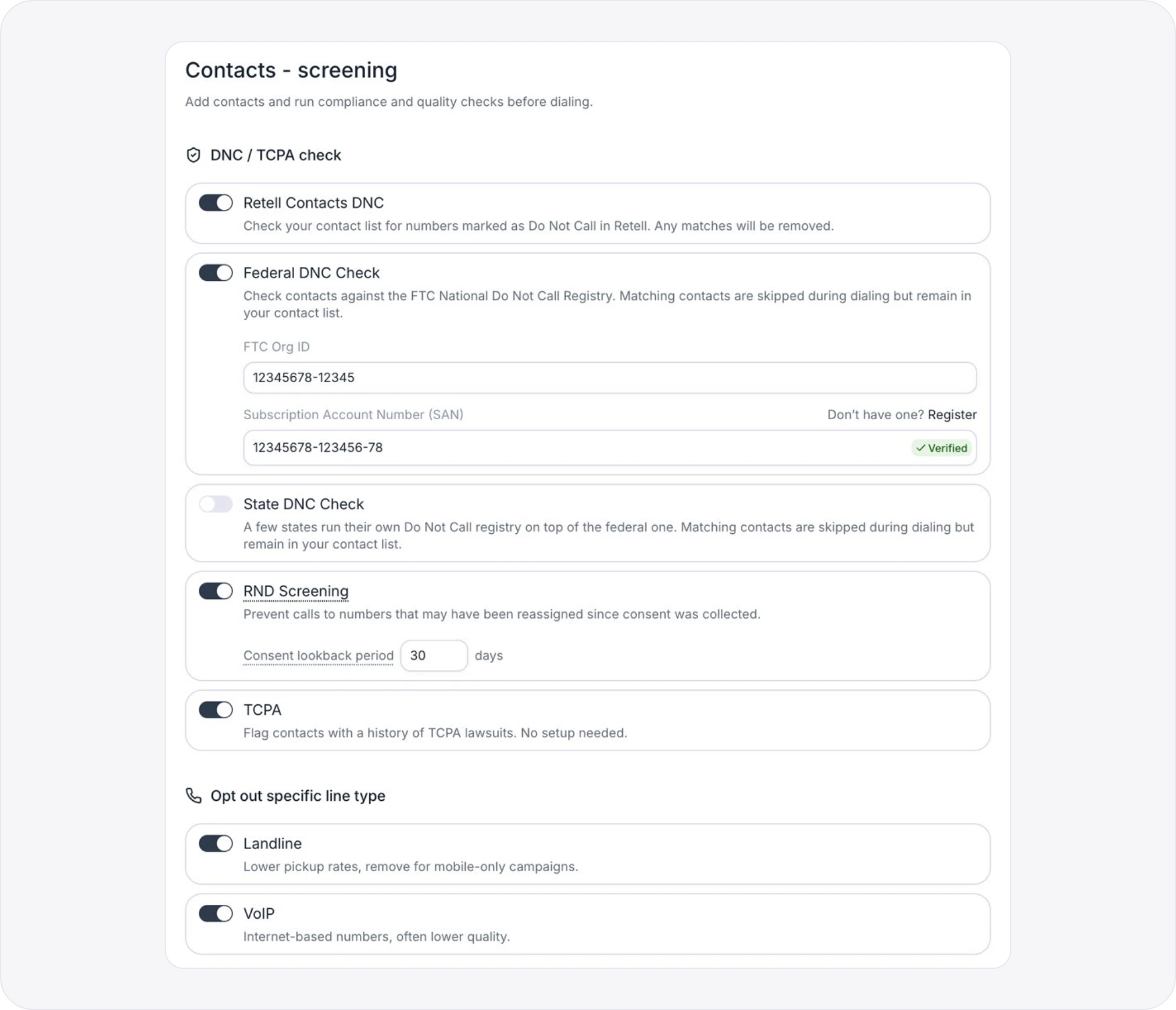
The compliance checks documentation covers each check, when it runs, and what it costs.
Where each default sits
Which protection is on by default depends on where the call or text starts:
| Where the call or text starts | Internal do-not-call default | How to change it |
|---|---|---|
| Dialer campaign created in the dashboard | On. Retell Contacts DNC is the one check enabled by default | Campaign compliance checks, which lock at launch |
| Dialer campaign created through the API | Off. No checks run unless you set them | Set the checks when you create the campaign |
| Make Outbound Call in the dashboard | On. The Honor DNC switch is on by default | The Honor DNC switch |
| Create Phone Call and Create SMS Chat APIs | Off | Pass honor_internal_dnc: true |
| Do-not-contact Handling on an agent, outside a Dialer campaign | Off | Security & fallback settings, or enable_dnc_detection: true |
| Legacy batch calls and inbound calls | Not checked | Use a Dialer campaign for outbound lists |
What stays with you
The do-not-call mark is one flag per contact and does not record a category, so it works as a stop-everything opt-out. That is the conservative reading of the rule. If you want category-level opt-outs for informational messages, track the category yourself, for example in a custom contact field or your CRM. Do-not-contact Handling works on agents that use a Retell LLM or a Conversation Flow, and does not apply to custom LLM agents. A call that is already queued, or the second dial of a double dial, is not rechecked.
Retell does not verify that you have consent to call a contact and does not enforce TCPA calling hours. Both stay with you. The AI dialer buyer's guide lists the compliance questions to ask any dialer vendor.
Opt-out checklist for outbound teams
- Write down which opt-out methods you designate, if any, and where each one is disclosed on your calls and in your texts.
- Add the disclosure to every outbound voice agent's opening lines and to every text template.
- Send each of the seven standardized words to your own SMS number and confirm that each one opts the contact out.
- Decide whether informational opt-outs are scoped by category or stop everything, and make your contact records match that policy.
- Check that a marketing opt-out blocks every marketing campaign from your company, on calls and on texts.
- Measure how long an opt-out takes to reach every system that can place a call or send a text. The limit is ten business days.
- Turn on internal do-not-call screening everywhere a call can start: campaigns, API calls and manual dials. On Retell, follow the setup steps above.
- Keep a record of each opt-out: the number, the time, the channel and the words used.
- Review the plan with counsel, including state telemarketing laws, which can be stricter than the federal rule.
What the FCC may change next
The same document opens a new round of proposals, published as a proposed rule at 91 FR 67239. Comments are due November 25, 2026 and reply comments are due December 28, 2026. The FCC asks about:
- A shorter deadline. A joint letter from the American Bankers Association, the National Consumer Law Center and ACA International suggested seven business days.
- Two-way texting. Whether to remove the provision that lets senders use texting protocols that cannot receive a reply.
- A required revoke-all option. Whether callers who scope opt-outs by category must also offer a one-step way to stop everything.
- Affiliates and business lines. When a division or affiliate with its own consent counts as a separate caller.
- Keywords and confirmations. Whether to shorten the list of standardized words and whether to allow a confirmation call or text that asks which category the person meant.
The order also directs the Consumer and Governmental Affairs Bureau to rewrite section 64.1200 in plainer language, without substantive changes.
Frequently asked questions
What is FCC 26-67?
FCC 26-67 is a Report and Order and Further Notice of Proposed Rulemaking that the Federal Communications Commission adopted on September 30, 2026 in CG Docket No. 02-278. It amends the TCPA rules in 47 CFR 64.1200 that govern how consumers revoke consent to automated calls and texts.
When does the FCC's new opt-out rule take effect?
The amended rules are effective November 25, 2026, which is 30 days after their publication in the Federal Register on October 26, 2026.
Can a business choose how customers opt out of calls and texts?
Yes, within limits. A caller may designate one or more of three methods as the exclusive means to revoke consent: an automated voice or key press mechanism on a call, a reply text with a standardized word, or a website or phone number set up for opt-outs. The method must be disclosed clearly and conspicuously on the call or in the text.
Does opting out of one message stop all messages from a company?
It depends on the message. An opt-out from a marketing call or text ends all future marketing calls and texts from that caller. An opt-out from an informational call or text may be limited by the caller to that category, so other informational messages such as fraud alerts can continue.
How long does a business have to honor an opt-out request?
A revocation must be honored within a reasonable time, not to exceed ten business days from receipt. FCC 26-67 did not change that deadline, but the FCC is seeking comment on reducing it, and one proposal is seven business days.
Does the FCC opt-out rule apply to AI voice agents?
Yes, where the TCPA requires consent for the call. The FCC ruled in February 2024 that AI-generated voices are artificial voices under the TCPA, so calls placed by AI voice agents are covered by the same consent and revocation rules as other artificial or prerecorded voice calls.
What happened to the revoke-all rule?
The revoke-all provision from the 2024 TCPA Consent Order was waived until January 31, 2027 and never applied. FCC 26-67 replaces it. Callers may now limit an informational opt-out to its category, and the FCC is asking whether to require a separate one-step way to revoke consent to everything.
Does Retell AI handle do-not-call requests automatically?
Yes, once Do-not-contact Handling (DNC) is on. The agent confirms a spoken do-not-call request and ends the call, and Retell marks the contact as do-not-call across the workspace. In Retell Dialer campaigns created in the dashboard, the Retell Contacts DNC check is on by default and turns the handling on for the campaign's calls.
How do I turn on do-not-call handling in Retell?
Open the agent, expand Security & fallback settings, and turn on Do-not-contact Handling (DNC), or pass enable_dnc_detection: true through the API. In Dialer campaigns, keep Retell Contacts DNC on in the compliance checks. For API calls and texts, pass honor_internal_dnc: true.
See how much your business could save by switching to AI-powered voice agents.
ROI Result
Total Human Agent Cost
AI Agent Cost
Estimated Savings
Estimate your monthly voice AI cost

Revolutionize your call operation with Retell