AI Dialer Buyer's Guide: How to Choose Outbound Dialing Software




An AI dialer is outbound calling software that places calls from a contact list and uses AI either to help a human rep or to hold the conversation itself. Choosing one comes down to two decisions: which dialing mode fits the calls you make, and how the vendor handles the eight things that decide results after you sign, from compliance checks to concurrency.
This guide is for the operations or revenue leader who owns that choice in 2026: the six dialing modes and who each fits, the criteria to compare, and a checklist for vendor calls.
Retell AI publishes this guide and sells one of the options covered (the Retell AI Dialer, which runs AI voice agent campaigns). The guide does not rank or score vendors. For a ranked product list, see our outbound dialer comparison.
How this guide was put together
- By dialing mode and by criterion, not by rank. Companies are named only as documented examples of a mode, in no particular order.
- Vendor pages only. Each vendor fact comes from that vendor's own page, read on November 16, 2026, linked where it appears, and confirmed by a second reviewer who fetched the page separately. They are vendor-stated.
- Rules from the source. Every US calling rule below is described from the Code of Federal Regulations at ecfr.gov or from the FCC or FTC, and linked. This guide describes those rules. It is not legal advice, so confirm how they apply to your campaigns with your counsel.
What are the dialing modes, and who does each one fit?
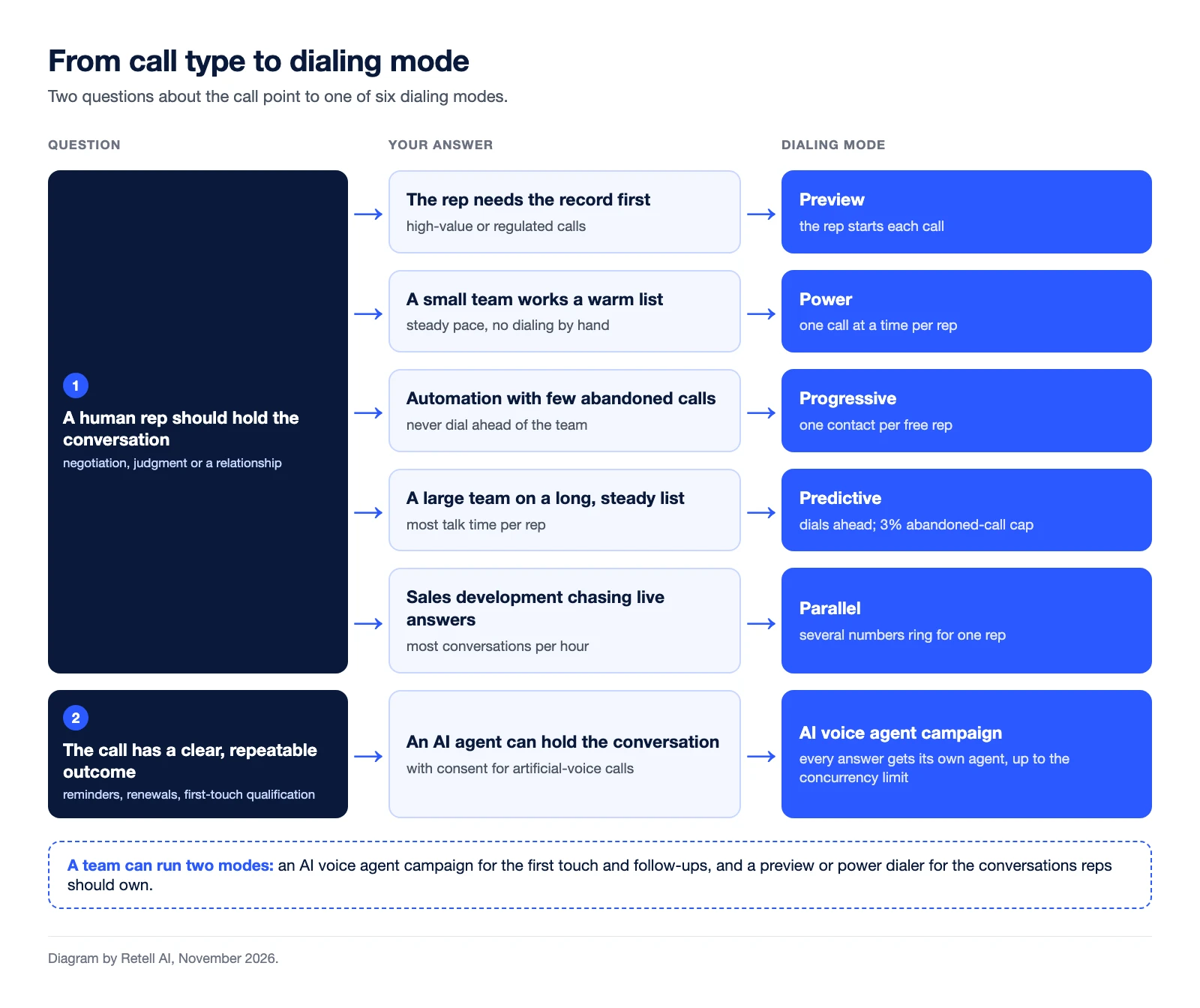
There are six dialing modes. Five pace calls around human reps: preview, power, progressive, predictive and parallel. The sixth, an AI voice agent campaign, gives every answered call its own AI agent, so there is no rep to pace around. Start with the call, not the product.
| Dialing mode | How it places calls | Fits | Watch for | Documented example |
|---|---|---|---|---|
| Preview | Shows the rep the record first; the rep starts the call | High-value or regulated calls where context matters | Fewest calls per rep hour | Five9 lists Preview Dialing next to its predictive, power and progressive dialers |
| Power | One call at a time per rep; the next dials when the last ends | Small sales teams working a warm list | Reps sit through rings and voicemail greetings | PhoneBurner describes a power dialer as placing calls one at a time with a live rep on every connection |
| Progressive | Dials automatically, one contact per free rep | Teams that want automation with few abandoned calls | Idle time when answer rates are low | Genesys Cloud says its Progressive mode dials one contact for each available agent |
| Predictive | Forecasts when reps will be free and dials ahead | Large teams on long, steady lists | Abandoned calls, and it needs volume to forecast well | Genesys recommends at least 15 agents in a predictive campaign; Convoso sells predictive dialer software for outbound call centers |
| Parallel | Rings several numbers for one rep and connects the first answer | Sales development teams chasing live conversations | A second person who answers gets a dropped call | CloudTalk says its Parallel Dialer can dial up to 10 numbers at once; Orum connects the rep to whoever answers first and ends the other call |
| AI voice agent campaign | Every answered call gets its own AI agent, up to a concurrency limit | Repeatable calls with a clear outcome, at any hour the rules allow | Consent rules for artificial voices, and a handoff path to a person | The Retell AI Dialer; Genesys Cloud documents an Agentless mode that uses no agents or script |
Vendors label these modes differently. JustCall, for example, sells an Auto Dialer, a Predictive Dialer and a Dynamic Dialer. Ask each vendor to describe the pacing in plain words before you compare names.
For how each dialer type works and what changes when an AI voice agent takes the call, read how to choose a contact center dialer for AI voice agents. Our glossary defines each mode: the preview dialer, the parallel dialer, the AI dialer, and a full explainer on predictive dialing.
When does an AI voice agent campaign fit?
An AI voice agent campaign fits when the call has a clear goal that one conversation can reach, as in appointment reminder calls and insurance renewal calls. Keep human reps on calls that turn on negotiation or judgment. A team can run both: an AI voice agent campaign for the first touch and follow-ups, and a preview or power dialer for the conversations reps should own.
What should you evaluate in an outbound dialer?
Compare vendors on eight criteria. The mode decides how calls are paced; these decide whether the calls are lawful, answered, followed up and measurable.
Compliance checks and calling windows
A dialer should screen the list before the first dial and keep calls inside the hours you set. In the United States, the FCC's rule bars telephone solicitations to a residential subscriber "before the hour of 8 a.m. or after 9 p.m. (local time at the called party's location)" and to numbers on the National Do Not Call Registry (47 CFR 64.1200(c)). The FTC's Telemarketing Sales Rule sets the same 8:00 a.m. to 9:00 p.m. window (16 CFR 310.4(c)), and the FTC tells organizations that must use the registry to sync their lists with it at least every 31 days. A do-not-call request made to your company must be honored within a reasonable time, not more than 10 business days (47 CFR 64.1200(d)(3)).
Two rules matter most by mode. For dialers that dial ahead of reps, the FCC caps abandoned calls at 3% of telemarketing calls answered live, measured over a 30-day period for a single campaign, and treats a call as abandoned when it is not connected to a live sales representative within two seconds of the person's greeting (47 CFR 64.1200(a)(7)). Our glossary explains the call abandonment rate. For AI voice agents, the FCC announced in February 2024 that calls made with AI-generated voices are "artificial" under the Telephone Consumer Protection Act, and the rule requires prior express written consent for telemarketing calls that use an artificial or prerecorded voice (47 CFR 64.1200(a)(2) and (a)(3)). Many states add their own rules.
Ask which checks the dialer runs (internal do-not-call list, federal and state registries, reassigned numbers, line type), when it runs them, how old a result can be at the moment of the call, and whose time zone the calling window uses. Our TCPA compliance playbook for outbound voice AI goes further.
Answer rates and caller ID reputation
The number a contact sees shapes whether they pick up, so ask how the dialer chooses the caller ID for each contact and what happens when a carrier labels a number as spam. Local presence dialing calls each contact from a number in their own area code. The numbers must be ones you hold and can be called back on: under the Truth in Caller ID rules, nobody may transmit misleading or inaccurate caller ID information "with the intent to defraud, cause harm, or wrongfully obtain anything of value" (47 CFR 64.1604), and telemarketers may not block caller ID (47 CFR 64.1601(e)).
The FCC also requires voice service providers to implement the STIR/SHAKEN caller ID authentication framework, which carriers use in blocking and labeling decisions. Ask whether the vendor monitors spam labels, supports branded and verified caller ID, and replaces a flagged number automatically.
Retries and sequences
Outbound calls often go unanswered on the first attempt, so the retry logic does much of the work. Look for per-campaign control over the number of attempts, the delay between them, and what each outcome triggers next: a retry, a text message, a callback at a time the contact asked for, or removal from the list. Double dialing, a second call placed right after an unanswered first one, should be a setting you can turn off, because each dial counts as a call.
CRM sync
Ask where the contact list lives and how results get back: whether a new CRM record can start calls without a manual upload, which outcomes write back to which fields, and how fast an opt-out recorded on a call reaches every other campaign.
Voicemail handling
A dialer has to tell a person from a voicemail greeting or a phone menu, then do what you chose: hang up, leave a message, or retry. Ask whether voicemail behavior can differ by attempt, such as a message only on the last one, and whether a voicemail counts as answered in reports. Our voicemail practices guide covers message design.
Reporting
Reports should count contacts, not only dials. Ask for the definitions behind each number: what counts as dialed, connected and converted, whether retries are included, and whether you can open the recording and transcript behind any outcome.
Pricing model
Dialers for human reps are often priced per user per month, and AI voice agent platforms often charge for usage, by the minute. Model both against your own volume. Ask what a no-answer costs, what phone numbers and list screening cost, and whether there are seat minimums or annual terms.
Concurrency
Concurrency is the number of calls a platform can run at the same moment. For rep-paced modes the ceiling is your headcount. For AI voice agent campaigns it is the platform's concurrency limit and calls-per-second rate, which set how fast a list can be worked inside the calling window. Ask what the included limit is, what raising it costs, and whether outbound campaigns can crowd out your inbound calls.
What questions should you take into vendor calls?
Use this checklist in every vendor call and write the answers down side by side.
| Criterion | Questions to ask | What a clear answer includes |
|---|---|---|
| Dialing mode | Which modes do you support, and how does each pace calls? | Plain description of pacing, and who or what takes the answered call |
| Compliance checks | Which lists and registries do you screen against, and when? | The checks by name, when they run, and how old a result can be |
| Calling window | Whose time zone decides the calling hours? | Per-contact local time, the fallback, and holiday handling |
| Caller ID | How is the caller ID chosen, and what happens to a flagged number? | Local presence or rotation rules, spam monitoring, who replaces numbers |
| Retries | How many attempts, with what delays, and what does each outcome trigger? | Per-campaign settings, outcome routing, callback handling |
| CRM sync | How do contacts get in and outcomes get out? | Trigger for new records, field mapping, opt-out sync |
| Voicemail | What happens on voicemail, attempt by attempt? | Detection, message options, how it counts in reports |
| Reporting | How are dialed, connected and converted defined? | Written definitions, per-contact history, recordings and transcripts |
| Pricing | What do I pay for a no-answer, a retry, a number and a screen? | Unit prices on a public page, minimums and terms |
| Concurrency | What is my limit, and what happens at the limit? | Included limit, cost to raise it, inbound protection, queue behavior |
How does the Retell AI Dialer handle these criteria?
The Retell AI Dialer runs outbound campaigns in which AI voice agents call or text a contact list, retry on a schedule, and decide each contact's next step from what happened in the conversation. Everything below comes from the public Dialer documentation, read on November 16, 2026.
- Mode. It is an AI voice agent campaign dialer. The documentation describes campaigns run by AI agents, not rep-paced modes such as preview or predictive. An Auto-enroll campaign also calls every contact that comes to match your conditions later, such as each new web lead.
- Compliance checks. You choose the checks for each campaign and they lock at launch: your internal do-not-call list, the federal and state registries, reassigned numbers, known TCPA litigators, and landline or VoIP line types. Only the internal list is on by default. Federal and state checks run under your own FTC registration. The compliance checks page states the limits: results are a snapshot, and Retell does not verify consent or enforce legal calling hours.
- Calling window. The campaign dials only inside the window you set, by default in each contact's local time, worked out from the area code of US and Canadian numbers.
- Caller ID. On the Numbers tab you pick local presence dialing (the default) or round robin. Retell suggests one number per 50 contacts in a region and does not replace a flagged number automatically.
- Retries and sequences. A sequence sets attempts, delays and outcomes. The default is four attempts, on days 0, 3, 10 and 20. Double dial is on by default and can be turned off.
- Voicemail and CRM sync. Each attempt has its own voicemail setting, and a voicemail always counts as unanswered. An outcome can write a value to a contact field, which syncs out to a connected CRM if the field is mapped.
- Reporting. The campaign page reports contacts dialed, connected and converted, and each call opens to a transcript and recording.
- Concurrency. Each campaign has its own concurrency limit, and campaign calls never use the capacity reserved for inbound calls. When no slot is free, the next call waits.
- Pricing. Retell charges for usage, from $0.07 per minute (pricing). List screening is billed per number checked.
Batch calls, the earlier way to call a list once, are deprecated but still available, according to the same documentation.
If AI voice agent campaigns fit the calls you make, run a pilot on real calls: one Retell AI Dialer campaign, one list you already have consent to call, and the checklist above as the scorecard.
Frequently asked questions
What is an AI dialer?
An AI dialer is outbound calling software that uses AI in one of two ways. Some products help human reps, for example by detecting voicemail, picking who to call next or summarizing calls. Others connect each answered call to an AI voice agent that holds the conversation.
Which dialing mode is best?
No mode is best for every call. Preview and power dialing fit calls where a rep needs context or rapport. Progressive, predictive and parallel dialing raise the number of conversations per rep and need closer attention to abandoned calls. An AI voice agent campaign fits repeatable calls with a clear outcome, such as reminders, renewals and first-touch qualification.
Are AI dialers legal in the United States?
Outbound calls with AI voices are regulated, not banned. The FCC announced in February 2024 that AI-generated voices are "artificial" under the Telephone Consumer Protection Act, so the consent rules for artificial and prerecorded voice calls in 47 CFR 64.1200 apply, along with calling hours, Do Not Call rules and state laws. This is a description of the rules, not legal advice. Confirm your campaigns with counsel.
What should a dialer check before it calls a contact?
At minimum, your own do-not-call list, the National Do Not Call Registry where it applies, and the local time at the called party's location. A dialer can also screen for reassigned numbers and line type. No screen establishes consent, so keep your own consent records and ask the vendor exactly which checks it runs and when.
How many calls can an AI dialer make at once?
As many as the platform's concurrency limit allows. With human reps the ceiling is the number of reps. With AI voice agents it is the number of calls the platform will run at the same moment, plus a calls-per-second rate for starting them. Ask each vendor for the included limit and the cost to raise it.
See how much your business could save by switching to AI-powered voice agents.
ROI Result
Total Human Agent Cost
AI Agent Cost
Estimated Savings
Estimate your monthly voice AI cost
Revolutionize your call operation with Retell