Answering Service vs Call Center: Differences




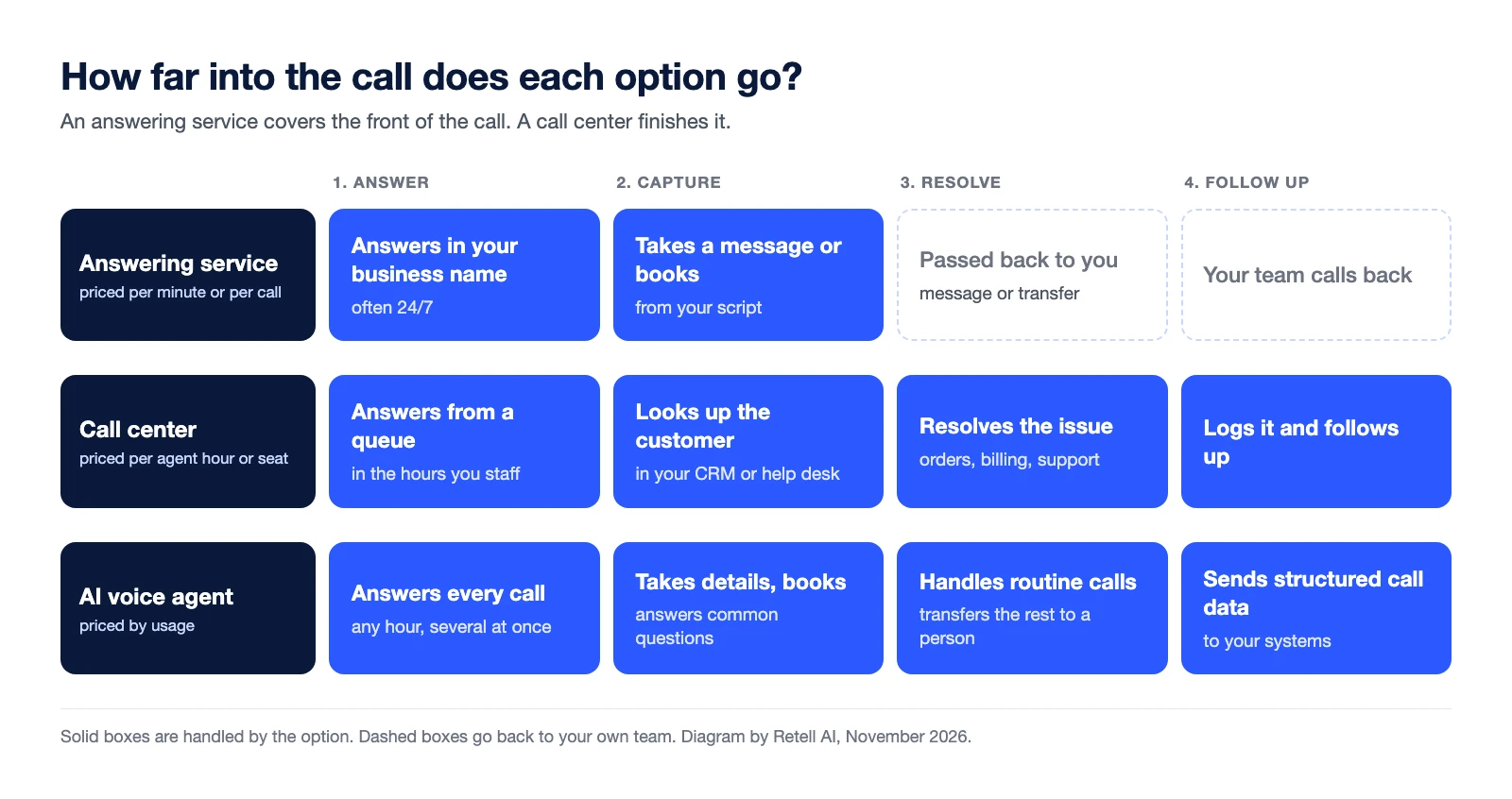
An answering service picks up calls on your behalf, takes a message or books an appointment, and passes the caller back to you. A call center is a team of agents who know your product, work inside your systems and resolve the caller's issue themselves. The difference is depth: an answering service covers the phone, a call center does the work behind it.
Retell AI publishes this guide and sells one of the options covered (AI voice agents). Every price below comes from the named company's own website, read on November 16, 2026, and is linked where it is cited.
How this guide compares the two
- Vendor pages only. No review sites or AI answers. A second reviewer re-fetched each page the same day and checked every number. Where a company only quotes, this guide says so and does not estimate.
- Examples, not rankings. The companies named are examples of each type, in no particular order.
Answering service vs call center at a glance
| Answering service | Call center | |
|---|---|---|
| What it handles | Greeting callers, messages, appointment booking, simple questions, urgent call transfers | Support, sales, orders, billing and troubleshooting, resolved on the call; often outbound calls, email and chat too |
| Staffing | Receptionists shared across many client businesses, working from your script | Agents trained on your product, in-house or outsourced, dedicated to you or shared across a few clients |
| Hours | Often 24/7, or after hours and overflow only | Set by the shifts you staff or buy; 24/7 means three shifts |
| Pricing model | Monthly block of minutes or calls, plus a rate for each one over | Per agent hour or monthly team fee when outsourced; salaries plus software seats when in-house |
| Typical buyer | Small practices and firms, home services, solo operators | Companies with steady daily volume and calls that need product knowledge |
| Setup | Days: a script and call forwarding | Weeks: hiring, training and system access |
What does an answering service handle?
An answering service handles the front of the call: it answers in your business name, follows your script, records who called and why, and either sends you the message or transfers the caller to you. Many also book appointments and answer a short list of common questions.
The receptionists serve many businesses at once, so they usually cannot open your order system or change an account. Calls that need that end as a message for you to return. That trade suits a law firm, a clinic or a plumber whose main risk is a missed call. For a ranked list of providers, see our guide to the best virtual answering services.
What does a call center handle?
A call center handles the whole call. Agents are trained on your product and policies, log in to your CRM or help desk, and close the issue: process the return, fix the billing error, walk through the reset, take the order.
You can build one in-house or hire an outsourced provider (a BPO). A call center that also handles email, chat and messaging is usually called a contact center; our explainer on what a contact center is covers that side.
When does each one fit?
An answering service fits when call volume is low or uneven, each call is short, and the caller mostly needs to reach you: after-hours cover, lunch and overflow, a solo operator on a job site.
A call center fits when volume is steady enough to keep people busy all day, callers expect an answer on the first call, and the work needs product knowledge or system access: order support, technical help, billing, outbound sales.
You have outgrown an answering service when most messages need a callback to finish the job. Many businesses use both: a call center in business hours and an answering service at night. If you are weighing more than these two, our guide to call center solutions for small business compares five routes, including phone systems and contact center software.
What does each one cost?
Answering services publish their prices; most outsourced call centers quote each client. The two bill in different units, so compare them against your own call volume.
Answering services (monthly plans, read November 16, 2026):
- Ruby: $250 for 50 minutes, $395 for 100 minutes, $720 for 200 minutes and $1,725 for 500 minutes. Live answering is 24/7, with no added fees for activation, onboarding or setup.
- Smith.ai bills per call: $300 for 30 calls, $810 for 90 calls and $2,100 for 300 calls, with extra calls at $11.50, $10.50 and $8.50. Plans are staffed 24/7 and month to month, with no setup fees.
- PATLive: pay as you go at $49 plus $2.99 per minute, $189 for 100 minutes or $349 for 200 minutes. No contracts, and a 14-day free trial.
- Specialty Answering Service: Economy at $44 plus $1.54 per minute, $159 for 100 minutes or $649 for 500 minutes. Month to month, with no setup fee.
Outsourced call centers:
- WOW24-7 publishes starting prices: dedicated teams from $10.50 per hour for 1 to 19 agents and from $9.50 per hour for 20 to 200 agents, and shared 24/7 teams from $1,490 per month.
- Helpware does not publish prices and quotes by requirement. It says hiring a team takes a minimum of 2 to 4 weeks from contract signing.
An in-house call center has no price list. Its cost is wages, management and software seats. Our guide to call center outsourcing costs explains the pricing models.
Where does an AI voice agent fit for both jobs?
An AI voice agent is software that answers or places a call, talks with the caller in natural speech and completes a task. Connected to your systems, it can do the answering service job and part of the call center job.
For the answering service job, it answers every call at any hour, takes the details, answers questions from your business information, books the appointment and transfers urgent calls. The AI answering service page shows this setup, and there is a version for small business answering.
For the call center job, it takes the routine calls (status, booking, intake, simple account questions) so agents get the ones that need judgment. It needs a clear handoff to a person, and someone has to set it up and review early calls. Call centers and BPOs also put it on the calls their agents cannot reach; see the call center answering service page.
On Retell, this is self-serve and pay as you go, from $0.07 per minute, with no platform fees, minimums or contracts listed on the pricing page. Pay-as-you-go workspaces can run 20 calls at the same time by default. An agent can answer from a knowledge base built from your website, documents and text, book through Cal.com or Calendly, and transfer the call to a person, staying on the line to brief them first if you choose a warm transfer. After each call, post-call extraction turns the conversation into structured fields you can send to your CRM.
Calls that need empathy, negotiation or a policy exception still belong with a person.
Frequently asked questions
What is the main difference between an answering service and a call center?
An answering service answers calls and passes them on: it takes a message, books an appointment or transfers the caller to you. A call center resolves the call itself, with agents trained on your product who work in your systems.
Is an answering service cheaper than a call center?
At low volume, usually yes. On vendor pages read on November 16, 2026, answering service plans started at $44 per month plus $1.54 per minute, while one outsourced call center listed dedicated teams from $10.50 per hour and shared teams from $1,490 per month. The gap narrows as volume grows, because answering services charge for every minute or call.
Can an answering service do customer support?
Only the simple part. Receptionists can answer common questions from your script, but they usually cannot see your order, billing or support systems, so anything that needs an account change becomes a message for your team.
Can an AI voice agent replace an answering service or a call center?
It can cover most of the answering service job: answering at any hour, taking details, booking and transferring. In a call center it takes routine calls and hands the rest to agents, so it works alongside the team.
See how much your business could save by switching to AI-powered voice agents.
ROI Result
Total Human Agent Cost
AI Agent Cost
Estimated Savings
Estimate your monthly voice AI cost
Revolutionize your call operation with Retell