Call Center AI Statistics (2026)




In 2026, 91% of customer service leaders say executives are pressing them to implement AI, yet only 21% have reduced agent headcount because of it, and 87% of customers say a company that uses generative AI for service must still offer a way to reach a person. All three numbers come from Gartner surveys published this year. Together they describe call center AI today: near-universal adoption, modest labor impact so far, and customers who accept AI as long as a human stays reachable.
This page collects the call center AI statistics that can be traced to a primary source: a government agency, an analyst firm's own published release, a peer-reviewed or working paper, or a vendor's own survey named as that vendor's survey. Every figure carries its year, its sample where the source gives one, and a link to the page it came from.
Retell AI publishes this page and sells AI voice agents for contact centers. The Retell figures below come only from pages Retell has already made public, and they are labeled as vendor-stated.
How these statistics were chosen
- Primary sources only. No statistic comes from a roundup post or a secondary citation. If the original release could not be opened on November 16, 2026, the number was left out.
- Read twice. Each number was read on its source page, then a second reviewer re-fetched the same page the same day and checked the figure, the sample and the date. Of 38 claims, 37 were confirmed as written and one was reworded.
- Surveys are labeled as surveys. A vendor survey reports what respondents said, and vendors choose their questions. Forecasts are labeled as forecasts. Percentages from different surveys use different samples and wording, so they should not be added or subtracted.
Key call center AI statistics at a glance
| Theme | Statistic | Source and year |
|---|---|---|
| Adoption | 91% of customer service leaders report executive pressure to implement AI | Gartner survey of 321 leaders, October 2025 (published February 2026) |
| Adoption | 92% of organizations have implemented or piloted AI use cases in customer service | Five9 survey of 600 decision-makers, 2026 |
| Spending | AI spending by service leaders rose 38% while overall service budgets grew 2% | Gartner survey of 199 leaders, April to May 2026 |
| Market size | Call center AI market estimated at USD 2.9 billion to USD 3.4 billion in 2026 | Grand View Research, Fortune Business Insights, IMARC Group |
| Cost | Cost per resolution for generative AI forecast to exceed $3 by 2030 | Gartner prediction, January 2026 |
| Customer preference | 87% of customers say companies using generative AI must offer access to a human agent | Gartner survey of 3,566 customers, February to March 2026 |
| Resolution | 14% of customer service issues are fully resolved in self-service | Gartner survey of 5,728 customers, December 2023 |
| Resolution | 80% of common customer service issues forecast to be resolved by agentic AI without a person by 2029 | Gartner prediction, March 2025 |
| Workforce | 21% of service leaders have reduced agent headcount because of AI | Gartner survey of 275 leaders, July to August 2026 |
| Workforce | Customer service representative employment projected to decline 5% from 2025 to 2035 | U.S. Bureau of Labor Statistics |
Call center AI adoption statistics
Adoption is no longer the open question. Budget and returns are.
- 91% of customer service and support leaders report pressure from executive leadership to implement AI. Source: a Gartner survey of 321 leaders conducted in October 2025, published February 18, 2026.
- 92% of organizations have implemented or piloted AI use cases in customer service. Source: the Five9 2026 Business Leaders Customer Experience Report, a vendor survey of 600 customer experience and contact center decision-makers and 3,000 consumers in the U.S., U.K. and Germany, released June 24, 2026.
- AI spending by service leaders rose 38%, while overall service and support budgets grew 2%. Source: a Gartner survey of 199 service and support leaders conducted April through May 2026.
- Service leaders put a median of 12% of their 2025 budget into AI, the highest of 10 business functions, but only 24% showed positive financial returns across their AI use cases. Source: a Gartner survey of 1,303 senior leaders conducted January through April 2026, reported in a July 8, 2026 Gartner release.
- Businesses say AI agents now handle half of customer service interactions and expect 63% by 2027. Source: the Twilio 2026 Customer Insights Series, a vendor survey of 660 business leaders and 7,652 consumers across 18 markets, fielded April 9 to May 1, 2026. This is a self-reported share across all channels, not a measurement of phone calls.
- Phone and live chat are the most valuable service channels today. In two years, leaders expect generative AI chatbots to rank first, followed by live chat and generative AI voicebots. Source: the same Gartner survey of 199 leaders, 2026.
- About 37% of the U.S. population, more than 98 million people, used a bank's chatbot in 2022, and each of the 10 largest U.S. commercial banks had deployed one. Source: the Consumer Financial Protection Bureau's Chatbots in consumer finance report, June 2023.
Call center AI market size statistics
Market research firms agree on the direction and disagree on the size. Three firms that publish their headline figures put the 2026 call center AI market between USD 2.9 billion and USD 3.4 billion.
| Research firm | Base value | 2026 estimate | Forecast | Growth rate |
|---|---|---|---|---|
| Grand View Research | USD 1.9 billion (2024) | USD 2.9 billion | USD 7.1 billion by 2030 | 23.8% a year, 2025 to 2030 |
| Fortune Business Insights | USD 2.41 billion (2025) | USD 2.98 billion | USD 13.52 billion by 2034 | 20.80% a year, 2026 to 2034 |
| IMARC Group | USD 2.7 billion (2025) | USD 3.4 billion | USD 14.3 billion by 2034 | 19.64% a year, 2026 to 2034 |
Figures as shown on each firm's report page on November 16, 2026. The firms define the market differently, which is why the numbers differ. Grand View Research also reports that North America held 39.0% of 2024 revenue.
Call center AI cost statistics
The cost case for AI is getting more careful, not more aggressive. Gartner's 2026 predictions warn that automation will not stay cheap.
- By 2030, the cost per resolution for generative AI will exceed $3, more than many offshore B2C human agents cost. Source: a Gartner prediction published January 26, 2026, which points to rising data center costs, AI vendors moving from subsidized growth to profit, and more complex use cases.
- By 2029, agentic AI will resolve 80% of common customer service issues without human intervention, leading to a 30% reduction in operational costs. Source: a Gartner prediction published March 5, 2025. The two Gartner predictions pull in different directions. Read both as scenarios, not measurements.
- The median wage for a U.S. customer service representative was $21.53 an hour in May 2025, or $44,770 a year. Source: the U.S. Bureau of Labor Statistics Occupational Outlook Handbook. That is before benefits, supervision, software and facilities.
- AI voice agent pricing is usually usage-based. As one vendor-stated reference point, Retell AI lists pay-as-you-go voice agent pricing from $0.07 per minute on its pricing page, read November 16, 2026. A per-minute price and an hourly wage are not directly comparable, because a paid hour includes time between calls. See the call center outsourcing cost guide.
One widely repeated figure is missing here on purpose. Gartner's 2022 forecast that conversational AI would cut agent labor costs by $80 billion in 2026 is widely repeated, but the original release could not be opened on November 16, 2026, so it is not cited.
Customer preference statistics: AI vs human agents
Customers are more open to AI than they were two years ago, on one condition: a person must be reachable.
- 87% of customers say it is essential for companies to offer a way to reach a human agent when using generative AI. 50% say their interactions are easier when companies use it. Source: a Gartner survey of 3,566 B2B and B2C customers conducted in February and March 2026.
- 64% of customers would prefer that companies did not use AI in customer service, and 53% would consider switching to a competitor over it. Source: a Gartner survey of 5,728 customers conducted in December 2023, published July 9, 2024. The top concern was that reaching a person would get harder.
- 80% of consumers are willing to use AI-powered customer service, while two-thirds still prefer speaking with a human. Source: Five9, 2026, vendor survey of 3,000 consumers.
- Phone is the most preferred customer service channel overall, and the preference rises with age: 23% of Gen Z, 33% of Gen X, 47% of Baby Boomers and 66% of the Silent Generation. Source: Five9, 2026.
- 86% of companies believe customers are satisfied with their AI-powered customer service. 51% of consumers agree. Source: Twilio, 2026, vendor survey.
- 78% of consumers say they have tried to bypass an AI agent to reach a human, and 63% want a quick way to escalate to a live person at any time. Source: Twilio, 2026. In the same survey, 34% said they are more likely to choose an AI chatbot over a human than they were a year ago.
- 76% of consumers say an AI agent should identify itself at the start of a conversation, and 71% say it is very or extremely important to know when they are talking to AI. Sources: Twilio, 2026 and Five9, 2026.
- 83% of consumers say they have to repeat themselves at least sometimes after being transferred. Source: Five9, 2026. How a handoff should carry context is covered in the guide to call transfers between AI voice agents and human teams.
Containment and resolution statistics
Containment is the share of contacts an automated system finishes without handing off to a person. It is the number most AI business cases rest on, and it is the hardest one to find a neutral source for. Most published containment rates are vendor case studies.
- Only 14% of customer service issues are fully resolved in self-service. For issues customers call very simple, the figure is 36%. Source: a Gartner survey of 5,728 customers conducted in December 2023, published August 19, 2024. In the same survey, 73% of customers used self-service at some point.
- By 2029, agentic AI will resolve 80% of common customer service issues without human intervention. Source: Gartner prediction, March 2025. It is a forecast for common issues only.
- Klarna reported that its AI assistant handled 2.3 million conversations in its first month, two-thirds of its customer service chats, with errands resolved in under 2 minutes compared with 11 minutes before. Klarna said this equaled the work of 700 full-time agents. Source: Klarna press release, February 27, 2024. This is chat, not voice, and it is the company's own figure.
- Everise contained 65% of voice calls to its internal service desk with an AI voice agent, and call wait time fell from 5 to 6 minutes to zero. Source: a Retell AI case study, vendor-stated, read November 2026.
- At Matic Insurance, 80% of customers complete AI-handled calls without asking for a human, and 85 to 90% of scheduled appointment calls transfer successfully to a licensed agent. Source: a Retell AI case study, vendor-stated, read November 2026.
Case study numbers describe one deployment and one call type. A contained call is also not the same as a resolved one, which is why containment should be read next to first contact resolution and the other call center metrics and KPIs. For how vendors report the number, see the comparison of voice AI services by call containment rate.
Call center workforce statistics
The data so far shows AI changing agent jobs more than removing them.
- Customer service representatives held about 2.67 million U.S. jobs in 2025. Employment is projected to decline 5% from 2025 to 2035, a loss of 141,800 jobs, with about 289,500 openings a year from turnover. Source: U.S. Bureau of Labor Statistics.
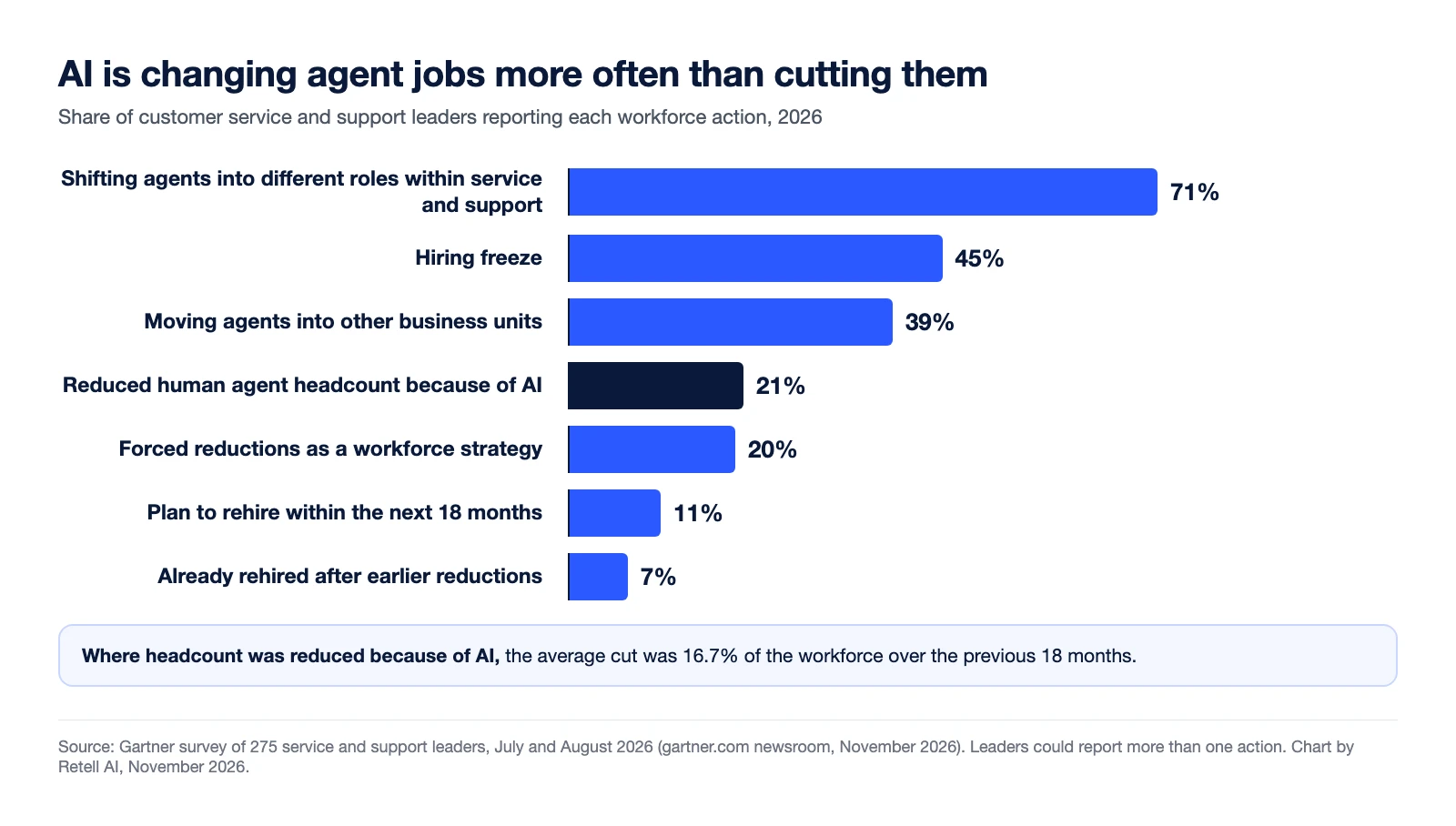
- 21% of service and support leaders say their organization has reduced human agent headcount because of AI. Where cuts happened, the average was 16.7% of the workforce over 18 months. Source: a Gartner survey of 275 leaders conducted in July and August 2026.
- 7% of leaders say their organization has already rehired after earlier reductions, and 11% plan to rehire within 18 months. Source: the same Gartner survey, 2026.
- 71% of leaders are shifting agents into different roles inside service and support, 45% report a hiring freeze, 39% are moving agents into other business units, and 20% report forced reductions. Source: the same Gartner survey, 2026.
- 85% of service leaders are adding new tasks and responsibilities to frontline agent roles. 31% have implemented or plan AI-driven layoffs through the first quarter of 2027, and 63% are reducing headcount gradually through attrition. Source: a Gartner survey of 321 leaders conducted September through October 2025, published April 28, 2026.
- By 2027, 50% of companies that attributed headcount reductions to AI will rehire staff for similar functions under different job titles. Source: Gartner prediction, February 2026.
- Customer support agents given a generative AI assistant resolved 14% more issues per hour on average, and novice and low-skilled agents improved by 34%. Source: Generative AI at Work, NBER Working Paper 31161, a study of 5,179 agents, issued April 2023 and revised November 2023. Experienced agents saw minimal change.
For the longer argument on both sides, see will AI replace call center agents.
Voice AI at production scale: public Retell AI figures
These are Retell AI's own published numbers, included as one vendor's data point on how much phone traffic AI voice agents already carry.
- Retell AI reports more than 4,000 customers running 100 million-plus calls a month, at a $100 million annualized revenue run rate reached in under three years. Source: Retell AI announcement, November 12, 2026.
- Asbury Automotive Group's AI voice agents answer service calls for 157 dealerships and handled more than 3.1 million minutes of calls in a year. Source: the same Retell AI announcement, November 2026.
What the 2026 numbers say together
Three patterns hold across the sources.
- Adoption is settled and returns are not. More than nine in ten service organizations are deploying or piloting AI, but only 24% of service leaders in Gartner's 2026 survey showed positive financial returns.
- Customers judge AI by the exit. The strongest and most consistent finding in every 2026 consumer survey is the demand for a fast route to a person. Designs that hide the handoff run against 87% of customers.
- Jobs are changing faster than they are disappearing. The U.S. government projects a 5% decline in customer service jobs over ten years. In Gartner's 2026 survey, role changes were reported about three times as often as headcount cuts.
For what to do with these numbers, see the guides to call center automation and contact center automation trends.
Frequently asked questions
What percentage of call centers use AI?
In the Five9 2026 Business Leaders Customer Experience Report, 92% of organizations said they had implemented or piloted AI use cases in customer service, based on 600 decision-makers in the U.S., U.K. and Germany. A Gartner survey of 321 service leaders from October 2025 found 91% under executive pressure to implement AI.
How big is the call center AI market in 2026?
Published estimates for 2026 range from USD 2.9 billion (Grand View Research) to USD 2.98 billion (Fortune Business Insights) and USD 3.4 billion (IMARC Group). Forecast annual growth runs from about 20% to 24%. The firms define the market differently, so treat the figures as a range.
Will AI replace call center agents?
The data so far points to change more than replacement. The U.S. Bureau of Labor Statistics projects customer service representative employment to decline 5% from 2025 to 2035, with about 289,500 openings a year. In a Gartner survey from July and August 2026, 21% of service leaders had reduced agent headcount because of AI, and 71% were moving agents into different roles.
Do customers prefer AI or human agents?
Most still prefer a person, and most will use AI if a person is reachable. In Five9's 2026 survey of 3,000 consumers, 80% were willing to use AI-powered customer service and two-thirds preferred speaking with a human. In a Gartner survey of 3,566 customers in early 2026, 87% said companies using generative AI must offer access to a human agent.
What is a good containment rate for an AI voice agent?
No neutral industry benchmark exists. Gartner found that 14% of issues are fully resolved in traditional self-service, and it forecasts that agentic AI will resolve 80% of common issues by 2029. Published vendor case studies report figures in between for specific call types, such as 65% at Everise's internal service desk. The right target depends on the call type and on whether contained calls are also resolved.
See how much your business could save by switching to AI-powered voice agents.
ROI Result
Total Human Agent Cost
AI Agent Cost
Estimated Savings
Estimate your monthly voice AI cost

Revolutionize your call operation with Retell