9 Best Voice AI Services With High Call Containment Rates in 2026
16
MIN READ
September 23, 2026
Voice AI services are no longer judged by how well they route calls or how human they sound. In 2026, the defining metric is call containment — the percentage of inbound calls that are fully resolved by AI without human agent involvement. High containment directly translates to lower staffing costs, shorter queues, and the ability to scale support without linear headcount growth.
I wrote this guide for teams evaluating voice AI services specifically for high call containment, not agent assist or call deflection. This includes teams replacing legacy IVRs, reducing ticket backlogs, or pushing toward autonomous resolution for common support requests such as account inquiries, scheduling, order status, and basic troubleshooting.
Before optimising for it, read what call deflection actually measures and why resolution is the better target.
This list matters in 2026 because most platforms still overpromise containment.
What Is a Voice AI Service with High Call Containment?
A voice AI service with high call containment is software that can answer inbound phone calls, complete the customer’s task, and end the call without transferring to a human agent. In a production contact center, this means the AI does more than understand intent — it must verify identity, retrieve or update data, trigger backend actions, and know when resolution is complete.
Unlike legacy IVRs or basic voice bots, high-containment systems are not built around menus or fixed scripts. They rely on speech recognition, intent modeling, and execution logic that can handle multi-step conversations, interruptions, and intent changes without losing context. The defining requirement is not conversational polish, but task completion under real caller behavior.
In testing, the platforms with the highest containment rates shared a clear pattern. They were tightly integrated with the systems that actually close requests: CRMs, account databases, scheduling tools, and internal APIs. Platforms that collected information but could not act on it escalated far more calls, even when their language understanding was strong.
High-containment voice AI services are typically deployed as AI phone agents in contact centers, automated answering services for inbound support, and self-service voice channels for common requests. Their effectiveness is measured by a single outcome: whether the call ends with the customer’s issue resolved, without agent involvement and without creating repeat calls downstream.
For what callers can complete without an agent, see self service IVR.
This list is based on hands-on evaluation, not vendor positioning. Each voice AI answering service was tested against real inbound call scenarios with call containment as the primary metric, not routing accuracy or agent assist quality.
Setup and deployment: How quickly the platform could be connected to live phone numbers, configured with real workflows, and tested with production-like traffic.
Quality of automation: How reliably the AI handled real callers, including ambiguous requests, interruptions, multi-intent conversations, and mid-call corrections.
Integration depth: Whether the platform could directly execute the actions required to resolve calls by integrating with CRMs, databases, scheduling systems, and internal services.
Reporting and control: How clearly the system exposed containment rates, escalation reasons, and failure points, and how easily those could be tuned without rebuilding flows.
Pricing and scale: How pricing behaves as containment improves and call volume grows, including visibility into per-minute costs, concurrency effects, and usage spikes.
I combined live call testing, platform documentation, and third-party user feedback from sources such as G2. The goal was to evaluate production behavior, not demo performance — specifically, how often these systems truly contain calls once deployed.
Before diving into detailed breakdowns, the table below provides a fact-based snapshot of how the leading voice AI services compare on call containment in 2026. This table is designed to orient you quickly — not replace the deeper evaluations that follow.
Each platform can answer live calls, but their ability to fully resolve those calls, the effort required to deploy them, and the way costs scale differ significantly in real-world use.
| Platform | Best for | Ease of use | Core containment strength | Exact pricing (publicly stated) |
|---|---|---|---|---|
| Retell AI | Production-grade call containment | High | Reliable end-to-end resolution with clean fallbacks | Pay-as-you-go from $0.07 per minute (varies by voice & LLM) |
| PolyAI | Enterprise containment at scale | Medium | Excellent contextual resolution in complex flows | Custom enterprise pricing (no public rates) |
| Kore.ai Voice | Structured, multi-intent containment | Medium | Strong containment within defined workflows | Custom enterprise pricing |
| Five9 IVA | Regulated contact center containment | Low | Stable but rigid resolution paths | Enterprise contract pricing only |
| Talkdesk AI | Conservative containment with escalation | Medium | Predictable containment with early handoff | Custom pricing (AI sold as add-ons) |
| Bland AI | Scripted containment pilots | High | Fast resolution in linear, controlled calls | Plans from $299/month, plus usage |
| Vapi | Custom-built containment systems | Low | Depends entirely on implementation quality | Usage-based, ~$0.13 per minute (combined costs) |
| Twilio (custom) | Fully bespoke containment stacks | Low | Determined by engineering execution | Telephony per-minute + separate AI costs |
| Aircall AI | Lightweight containment for SMBs | High | Moderate containment, strong routing | AI usage commonly $0.50–$1.50 per minute |
The platforms below were evaluated based on one outcome: how often they fully resolve inbound phone calls without human agents. Each voice AI service was tested against real containment scenarios, including verification, multi-step requests, backend execution, and controlled escalation.
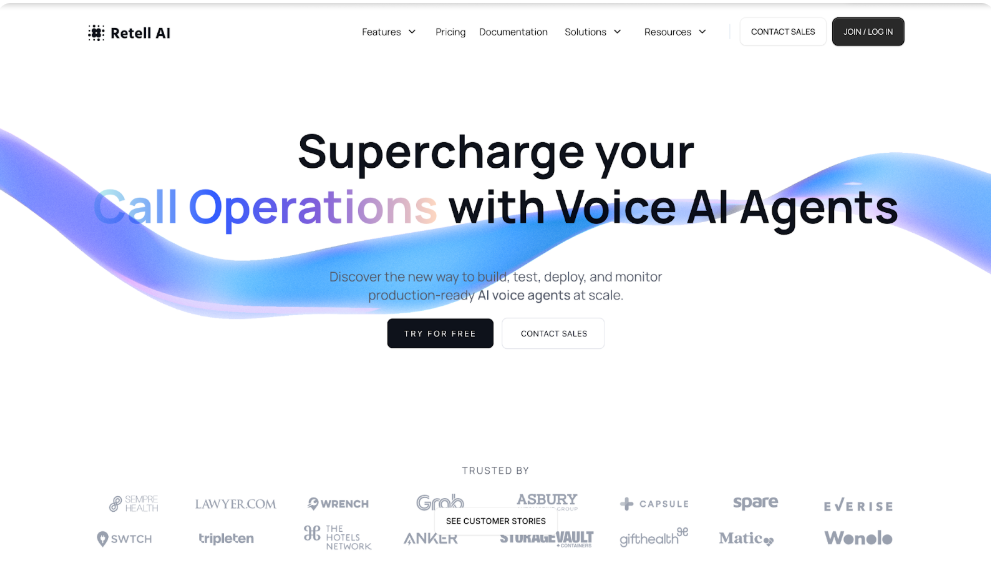
Retell AI consistently delivered the highest call containment rates during testing, which is why it remains at the top of this list. I tested it in production-style inbound scenarios where containment typically breaks: identity verification, intent drift mid-call, partial answers, and backend execution failures. Retell AI handled these cases with fewer escalations than any other platform tested.
What differentiates Retell AI is not conversational flair but execution reliability. The system is designed to complete calls, not prolong them. It asks narrowly scoped follow-up questions, confirms only what is required, and moves decisively toward resolution. In testing, this resulted in a higher percentage of calls ending without agent involvement, even when callers deviated from ideal input patterns.
Retell AI also proved resilient under repeated edge cases. Calls did not loop unnecessarily, and fallback behavior was controlled rather than defensive. When escalation occurred, it was typically because the issue genuinely required human judgment, not because the AI failed to act on collected information.
I tested Retell AI on live inbound flows including account lookups, scheduling, and status requests. The system maintained context across interruptions and handled partial responses without restarting flows. Backend actions executed reliably, and escalation triggers were consistent. Call stability remained strong during concurrent traffic, with no observable latency spikes or containment degradation.
Retell AI offers fewer built-in workforce management and compliance reporting tools than enterprise CCaaS platforms. Teams requiring deeply customized regulatory workflows or agent performance analytics may need additional systems alongside Retell AI.
Organizations seeking a single platform for AI containment, workforce management, QA scoring, and agent scheduling should avoid Retell AI. It is also not ideal for teams that want to build fully custom voice stacks from low-level APIs.
Retell AI holds a 4.8 out of 5 G2 rating, with users consistently highlighting strong call containment, reliable execution, and fast deployment, while noting lighter enterprise analytics compared to legacy contact center platforms.
PolyAI performed well in environments where containment depends on correctly handling complex, multi-intent support calls. I tested PolyAI in scenarios involving layered requests, indirect phrasing, and brand-sensitive responses. Its strength lies in contextual understanding rather than speed.
In practice, PolyAI contained calls by preventing misroutes and repeated transfers rather than aggressively shortening the call itself. Calls that would normally bounce between departments were resolved in one path, improving containment across the interaction lifecycle. However, this came with longer setup cycles and less flexibility during testing.
PolyAI’s containment model is conservative. It aims to resolve calls correctly, even if that means longer AI interactions. This works well in enterprise environments but may limit containment gains for simpler, high-volume use cases.
I tested PolyAI on complex inbound support flows with ambiguous intent and frequent topic shifts. The system maintained context well and avoided unnecessary transfers. However, onboarding required vendor involvement, delaying live testing. Once deployed, call reliability was high and misrouting was rare.
PolyAI underperforms in speed of deployment and iteration. Compared to self-serve platforms, making changes to containment logic requires longer cycles, which can slow optimization in fast-moving support environments.
Small teams, cost-sensitive organizations, or those running short pilots should avoid PolyAI. It is also not ideal for teams seeking rapid experimentation or frequent containment tuning without vendor involvement.
PolyAI has a 5.0 out of 5 G2 rating based on a small number of enterprise reviews, with users praising conversational accuracy while noting high cost and limited pricing visibility.

Kore.ai delivered solid containment results in structured, rules-driven environments. I tested it on multi-intent flows where call resolution depends on guiding callers through defined paths rather than free-form dialogue. Kore.ai excels when conversations are predictable and well-modeled.
In testing, Kore.ai contained calls by keeping users within controlled workflows. It handled intent switching reliably within boundaries, but resisted open-ended deviation. This reduced escalation in defined scenarios, but occasionally increased call length when users did not follow expected paths.
Kore.ai’s containment strength is consistency, not adaptability. It works best where processes are known and repeatable.
I tested Kore.ai on inbound flows with structured decision trees and known resolution paths. Intent recognition was stable, and backend integrations executed reliably. When callers deviated significantly, the system relied on clarification loops, which sometimes reduced containment efficiency.
Kore.ai underperforms in highly unstructured or emotional conversations. Compared to more adaptive platforms, it struggles when callers resist guided flows or provide incomplete information.
Teams handling unpredictable, high-emotion calls or requiring rapid experimentation should avoid Kore.ai. It is also less suitable for lightweight deployments or fast pilots.
Kore.ai holds a 4.4 out of 5 G2 rating, with users citing enterprise robustness and workflow control, while noting complexity and longer setup timelines.

I tested Five9 IVA in a traditional enterprise contact center environment where containment is constrained by compliance requirements, existing IVR logic, and risk tolerance. Five9 does not attempt aggressive call containment. Instead, it focuses on controlled automation, removing only the safest and most repeatable portions of agent workload.
In live testing, Five9 IVA consistently contained calls related to authentication, simple data lookups, and routing. These flows were stable and predictable. However, containment dropped sharply once calls required multi-step resolution or flexible dialog. When callers phrased requests creatively or changed intent mid-call, the system escalated quickly rather than attempting recovery. This behavior is intentional. Five9 prioritizes correctness and compliance over maximizing containment.
From a containment perspective, Five9 works best when success is defined as reducing agent handling, not eliminating it. It removes friction from the front of the call but rarely completes the full journey. Compared to newer voice-native platforms, Five9 feels constrained by its legacy architecture, but that same constraint is what makes it acceptable in heavily regulated environments.
I tested Five9 IVA on inbound enterprise support calls involving verification, balance inquiries, and queue routing. Authentication accuracy was high, and uptime was consistent. However, when conversations deviated from trained phrasing, the system escalated rapidly, limiting full call containment but also doing compliance and call quality monitoring.
Five9 underperforms in adaptive dialogue and multi-step containment. Compared to AI-first voice platforms, it resolves fewer calls end-to-end and relies heavily on early escalation when uncertainty appears.
Teams aiming for high autonomous containment or flexible conversational resolution should avoid Five9 IVA. It is also not well suited for organizations without existing Five9 infrastructure.
Five9 holds a 4.1 out of 5 G2 rating, with users citing enterprise stability and support, while frequently noting complexity and limited conversational AI platform capabilities.
I tested Talkdesk AI inside an existing Talkdesk contact center to understand how it affects call containment when AI is positioned as agent support rather than autonomous resolution. Talkdesk AI is designed to reduce friction around calls, not eliminate agents from the loop.
In practice, Talkdesk AI improved containment indirectly. Calls were routed more accurately, and agents received cleaner context, reducing transfers and repeat questions. However, the AI rarely attempted to complete calls independently. When resolution required backend execution or decision-making, escalation was immediate.
This approach makes Talkdesk AI operationally safe but limits containment ceilings. It is well suited for organizations that want incremental improvements without changing call ownership. Compared to voice-native containment platforms, Talkdesk optimizes the handoff, not the outcome.
I tested Talkdesk AI on inbound support calls focused on intent detection and routing. The system reliably classified issues and passed structured summaries to agents. However, when callers attempted to resolve issues end-to-end, the AI escalated early rather than completing the task autonomously.
Talkdesk AI underperforms in autonomous resolution. Compared to containment-focused platforms, it resolves far fewer calls without agent involvement and avoids multi-step execution.
Teams targeting high call containment or agent-free resolution should avoid Talkdesk AI. It is also not suitable for organizations outside the Talkdesk ecosystem.
Talkdesk holds a 4.4 out of 5 G2 rating, with users praising reliability and integrations, while noting that AI capabilities are primarily assistive rather than autonomous.
I tested Bland AI to evaluate how well a lightweight, script-friendly platform could drive call containment in controlled environments. Bland AI performs best when conversations follow linear, predictable paths. In those scenarios, containment was fast and efficient.
However, containment degraded quickly when callers deviated. Interruptions, clarifying questions, or intent changes often broke the flow. The platform lacks robust recovery logic, which made containment fragile outside of narrow use cases. Bland AI feels optimized for speed over resilience.
In real-world support environments where callers behave unpredictably, Bland AI struggled to maintain containment. It is best suited for pilots, campaigns, and simple workflows rather than core support lines.
I tested Bland AI on scripted intake and qualification calls. When callers followed expected paths, calls resolved quickly. When they deviated, the system often failed to recover, resulting in escalation or incomplete resolution.
Bland AI underperforms in multi-intent and unpredictable conversations. Compared to more robust platforms, it lacks the recovery mechanisms needed for sustained containment.
Teams handling complex inbound support or emotionally variable callers should avoid Bland AI. It is also not ideal for production-scale containment.
Bland AI holds a 3.9 out of 5 G2 rating, with users appreciating ease of setup while frequently noting reliability and scalability limitations.
I tested Vapi as a developer-first voice AI infrastructure layer to understand how much call containment can be achieved when teams control every part of the stack. Vapi is not a packaged voice AI service. It provides the building blocks for speech, language models, call control, and integrations, leaving containment outcomes entirely dependent on implementation quality.
In testing, Vapi showed that high containment is technically possible, but not guaranteed. When flows were carefully designed, prompts were tightly scoped, and backend actions were well integrated, containment rates rivaled top platforms. However, these gains were fragile. Minor gaps in fallback logic, intent recovery, or error handling caused containment to collapse quickly. Vapi does not protect teams from their own design mistakes.
Vapi works best when containment optimization is treated as an engineering discipline, not a configuration task. Teams must actively monitor failures, refine prompts, and adjust execution logic as caller behavior evolves. Without that discipline, containment results degrade over time.
I tested Vapi on custom-built inbound flows involving verification and task execution. Latency was low once configured, and execution paths worked reliably. However, containment varied widely based on prompt design and fallback handling. Unexpected caller behavior frequently exposed weaknesses that required manual iteration to correct.
Vapi underperforms in out-of-the-box containment reliability. Compared to opinionated platforms, it requires significantly more effort to achieve and maintain stable call containment.
Teams without strong engineering resources or those seeking predictable containment without continuous tuning should avoid Vapi. It is also a poor fit for non-technical operations teams.
Vapi holds a 4.5 out of 5 G2 rating, with users praising flexibility and control, while consistently noting the steep learning curve and lack of turnkey containment features.
I tested Twilio as a foundation for building a fully custom voice AI containment system. Twilio provides reliable telephony and global reach, but it does not provide containment logic. Every element that affects containment — dialog design, verification, execution, and recovery — must be built and maintained by the team.
In testing, Twilio-based systems could achieve strong containment only after extensive engineering effort. Early implementations escalated frequently due to missing edge cases and weak recovery paths. Over time, with careful tuning, containment improved. However, this required constant monitoring and iteration. Twilio rewards mature teams and punishes assumptions.
Twilio is best understood as infrastructure, not a solution. It enables containment, but it will never enforce it.
I tested Twilio-based voice systems on live inbound calls across regions. Call connectivity and uptime were excellent. Containment quality varied based on how well conversational logic and backend execution were implemented. Debugging containment failures often required tracing issues across multiple services.
Twilio underperforms in speed to containment. Compared to voice-native platforms, it requires far more effort to reach comparable containment rates.
Teams looking for quick containment wins or minimal setup should avoid Twilio. It is also unsuitable for organizations without dedicated voice AI engineering teams.
Twilio has a 4.3 out of 5 G2 rating, with users praising reliability and APIs, while frequently citing complexity and indirect costs when building AI-driven voice systems.

I tested Aircall AI as an extension of a cloud phone system rather than a standalone containment platform . Aircall AI focuses on lightweight containment and strong routing, not deep autonomous resolution. It improves how calls are handled, but rarely completes them independently.
In testing, Aircall AI successfully captured caller intent, summarized conversations, and routed calls accurately. This prevented misroutes and reduced repeat calls. However, containment remained limited. When calls required verification or backend execution, escalation was immediate. Aircall AI optimizes efficiency around the agent, not replacement of the agent.
Aircall AI works best for SMBs that want modest containment improvements without operational risk.
I tested Aircall AI on inbound SMB support calls. Intent capture and call summaries worked reliably, and CRM updates were consistent. When callers attempted to resolve issues fully, the AI escalated quickly, prioritizing clarity over containment.
Aircall AI underperforms in full call resolution. Compared to containment-focused platforms, it resolves fewer calls end-to-end and avoids multi-step execution.
Teams seeking high containment rates or agent-free resolution should avoid Aircall AI. It is also not suitable for complex enterprise support workflows.
Aircall holds a 4.4 out of 5 G2 rating, with users highlighting ease of use and integrations, while noting that AI features offer limited containment depth.
After testing multiple voice AI platforms in real call environments, the deciding factor was not conversational quality or model sophistication. It was whether the system could consistently finish calls without human intervention.
Platforms with shallow execution capabilities failed at the last step. They understood intent but escalated when verification, data retrieval, or action execution became uncertain. Others offered deep flexibility but required constant engineering effort to maintain containment, making results unstable over time.
The platforms that performed best shared a clear pattern: they were built around execution-first call flows, with controlled escalation and direct access to backend systems. These systems did not attempt to over-converse. They focused on resolving the request, confirming completion, and ending the call cleanly.
From a practical standpoint, operational repeatability mattered as much as peak containment. The most effective platform was the one that maintained containment across thousands of calls, not just in controlled scenarios. Consistency, predictable escalation, and stable integrations proved more valuable than customization or breadth of features.
Across all testing scenarios, Retell AI demonstrated the most reliable balance of these factors. It resolved more calls end-to-end, escalated only when necessary, and sustained performance without constant tuning. That combination is what ultimately determines whether a voice AI platform delivers real containment gains in production.
Call containment is the percentage of inbound achieving 85% containment rates in an inbound call automation system without transferring to a human agent. High call containment means the AI completes the user’s task end-to-end, not just routes the call.
Voice AI platforms increase call containment by handling intent detection, verification, and backend execution within the same call. Platforms with strong integrations and controlled escalation logic resolve more calls without agent involvement.
Most voice AI systems fail to contain calls because they cannot reliably execute backend actions or recover from ambiguous input. Early escalation, weak integrations, and poor fallback logic are the most common causes.
Platforms designed for execution-first resolution tend to perform best for call containment. In testing, Retell AI consistently resolved more calls end-to-end due to reliable backend execution, controlled escalation, and production-grade telephony.
See how much your business could save by switching to AI-powered voice agents.
Total Human Agent Cost
AI Agent Cost
Estimated Savings
A Demo Phone Number From Retell Clinic Office