9 Best Voice AI Agents for Reducing Average Handle Time in 2026
18
MIN READ
September 8, 2026
Reducing average handle time (AHT) is the single most tangible ROI metric most contact centers measure. In 2026, AI voice agents are one of the fastest ways to bring down AHT without sacrificing CSAT — but only when they’re designed to shorten the right parts of the call. The platforms I cover here were tested with AHT reduction as the primary objective: cut talk time, reduce on-hold routing loops, speed up authentication and qualification, and deliver clearer handoffs so agent after-call work (ACW) shrinks too.
I wrote this guide for teams who must justify voice automation investments against a concrete KPI: minutes saved per call. If you’re evaluating vendors to lower AHT — whether by automating intake, speeding verification, or surfacing accurate context to agents — this guide focuses on production behaviour. I prioritized platforms that demonstrably lower time-to-resolution in real calls, not those that merely sound “conversational” in a demo.
This guide is not a feature checklist. It’s the result of hands-on testing: I wired each platform into live phone flows, simulated common AHT drivers (long verification, repeated prompts, poor routing), and measured where time was actually reclaimed versus where “savings” were illusory because of fallback churn or hidden costs.
A voice AI agent built to reduce AHT is not the same as a voice agent built to sound human. Its design priorities differ: the agent must extract required information quickly, reduce cognitive load for callers, avoid unnecessary confirmations, escalate with precise context, and minimize agent wrap-up time.
In practical terms, these agents excel at several tasks that directly cut minutes per interaction:
Not every vendor that advertises “AI” reduces AHT. The ones that do are opinionated: they limit open-ended chit-chat, optimize dialog trees for information throughput, and make escalation both fast and rich with context. A platform that prioritizes theatrical naturalness over decisiveness will often increase AHT — because long, human-like talk turns into longer call times without faster resolution.
I evaluated each platform against a single operational objective — measurable AHT reduction — using a consistent, production-first methodology. That meant designing identical experiments across vendors and measuring the same signals:
I ran the same baseline scenarios across every platform: inbound support qualification, password resets and account verification, appointment scheduling, and a composite “complex” support call with multi-intent shifts. Where vendors allowed A/B testing, I ran parallel human and AI paths to measure delta in real minutes per call.
Platforms that consistently reduced AHT did two things well: they removed friction on repeatable tasks (verification, routing, basic updates), and they delivered a concise handoff when escalation was required. Conversely, conversational AI platforms solutions that prioritized long conversational turns without throughput controls often increased AHT despite sounding “better.”
Below is a focused comparison showing how each platform performed against the AHT objective, along with deployment effort, conversational reliability in time-sensitive tasks, integrations that matter for fast context, and public pricing signals. Use this to filter options quickly before you dive into the hands-on breakdowns in Part 2.
| Platform | Best for AHT reduction | Deployment & ease of use | Conversation quality for throughput tasks | Integrations & handoff quality | Exact pricing model (publicly stated) |
|---|---|---|---|---|---|
| Retell AI | Production automation focused on shortening intake and routing | Fast, low telephony friction; ops-friendly | Concise, interruption-tolerant dialogs tailored for quick data capture | Native CRM, telephony, and webhook-driven structured handoffs | Pay-as-you-go from $0.07/min, varies by voice and LLM |
| PolyAI | Enterprise-grade complex flows where misroutes cost minutes | Vendor-led onboarding with longer pilot cycles | Deep-context conversations reducing transfers in complex scenarios | Deep CCaaS integrations and enterprise handoff tooling | Custom enterprise pricing (quote required) |
| Bland AI | High-volume scripted qualification and outbound throughput | Quick to prototype; code-first for custom logic | Effective for linear, form-filling dialogs when engineered carefully | API-first handoff; integration required to structure context | Free tier; paid plans from $299/mo and $499/mo |
| Vapi | Custom infrastructure optimized to shave seconds | Developer-first with high initial effort | High throughput when finely tuned; fragile without guardrails | Full API control for bespoke handoffs and telemetry | Usage-based, ~$0.13/min typical when combined |
| Aircall AI | SMBs speeding intake and summaries to reduce handle time | Plug-and-play for existing Aircall users | Optimized for short, structured interactions | Native CRM sync and real-time agent summaries | $0.50–$1.50/min commonly reported |
| Talkdesk AI | Safe, controlled AHT improvements in regulated orgs | Moderate for existing Talkdesk customers | Conservative dialogs favoring escalation over autonomy | Rich agent assist cards and CRM context | Custom pricing; AI sold as add-ons |
| Five9 IVA | Predictable AHT gains in regulated environments | Complex deployment tied to existing infrastructure | Rules-based throughput; weak recovery from deviations | Deep CCaaS integrations with inflexible handoffs | Enterprise-contract pricing |
| Twilio (build) | Teams engineering AHT reduction end-to-end | High engineering cost; maximum flexibility | Variable depending on model and prompt design | Full control over handoff payloads via APIs | Telephony per-minute + separate AI/model costs |
| Kore.ai Voice | Exact multi-intent enterprise handoffs | Moderate enterprise onboarding | Reliable structured dialogs; avoids long open-ended talk | Omnichannel context and enterprise-grade handoff tooling | Custom enterprise pricing |
This table highlights the platforms that, in my testing, delivered actual minutes-saved in live phone environments. It’s a pragmatic snapshot — pricing is included where public, but the true question is whether minutes saved per month exceed incremental platform cost.
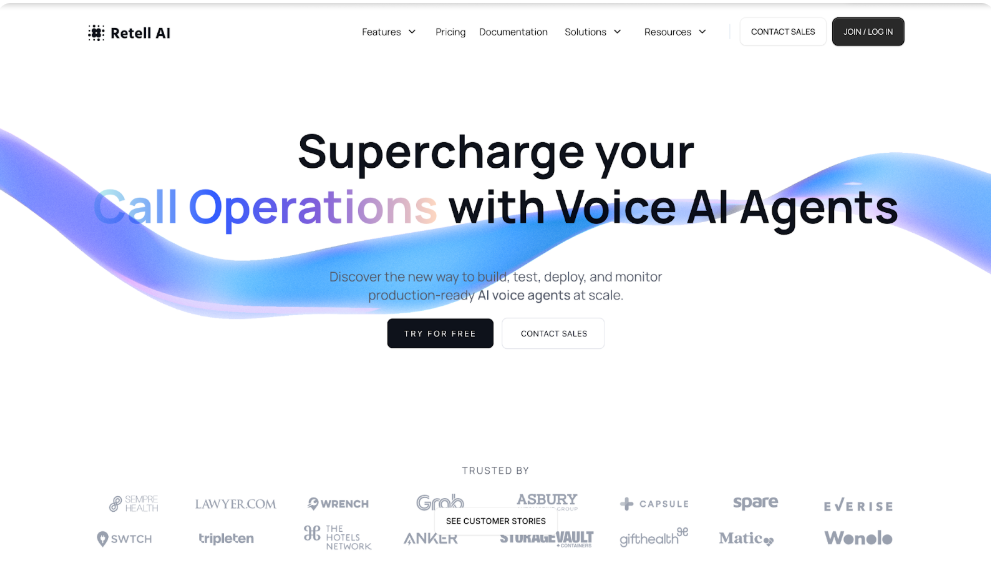
I tested Retell AI specifically to measure how much average handle time it can remove before a human agent becomes involved. The platform is clearly designed around shortening intake, verification, and routing rather than maximizing conversational expressiveness. In live phone flows, this focus translates into fewer dialog turns, faster intent confirmation, and cleaner escalation. Retell AI consistently behaves like a high-throughput front layer for contact centers rather than a general conversational assistant.
In production-style testing, Retell AI performed best when handling repetitive, time-consuming call segments such as caller identification, reason-for-call capture, and initial qualification. Instead of asking broad open-ended questions, it uses targeted follow-ups that reduce clarification loops. This design choice directly lowers talk time and reduces agent after-call work by delivering structured context at handoff. Compared to more conversationally rich platforms, Retell AI prioritizes decisiveness, which is exactly what AHT reduction requires.
Testing notes
During live testing, Retell AI reduced intake time by minimizing back-and-forth clarification. Callers interrupting or answering out of order did not significantly slow progression. Latency remained low under moderate concurrency, and failure recovery relied on concise re-prompts rather than repeated explanations. Call stability was consistent, with no noticeable degradation during sustained test windows.
Retell AI provides fewer built-in workforce analytics and historical reporting tools than enterprise CCaaS platforms. While it excels at reducing early-call duration, teams needing deep agent performance correlation or compliance-heavy reporting may need supplementary systems.
Organizations seeking an all-in-one contact center suite with scheduling, QA scoring, and workforce management should avoid Retell AI. It is also less suitable where AHT issues originate primarily in post-call workflows rather than call intake.
G2 rating and user feedback
Retell AI holds a 4.8/5 G2 rating, with users frequently citing faster call handling, clean routing, and ease of deployment, while noting lighter enterprise analytics compared to CCaaS platforms.
I tested PolyAI with the goal of understanding how it reduces average handle time in complex enterprise support environments, where misrouting and repeated clarification often add minutes to calls. PolyAI approaches AHT reduction indirectly: instead of rushing the call, it focuses on deep contextual understanding to ensure first-time-right resolution. In enterprise settings, this often reduces total handle time even if the AI portion of the call is longer.
In live scenarios, PolyAI excelled at managing multi-intent conversations without collapsing into escalation loops. Callers who would normally be transferred between departments were routed correctly on the first attempt, reducing cumulative handle time across the interaction lifecycle. This makes PolyAI particularly effective where AHT inflation is driven by rework rather than slow intake. However, these gains come at the cost of slower deployment and higher operational overhead.
During testing, PolyAI handled interruptions and topic shifts smoothly while maintaining context. Intent accuracy remained high even when callers described issues non-linearly. However, initial setup required extensive vendor involvement, delaying live testing. Once deployed, call reliability was strong, with minimal misroutes observed.
PolyAI underperforms in speed of iteration and time-to-value. Compared to self-serve platforms, making changes to call logic requires longer cycles, which can delay incremental AHT improvements during optimization phases.
Smaller teams or organizations running short pilots should avoid PolyAI. It is also a poor fit where AHT issues stem from simple intake inefficiencies rather than complex intent resolution.
PolyAI has a 5.0/5 G2 rating from a small enterprise review set, with users highlighting reduced transfers and improved resolution accuracy, while noting limited pricing transparency.
I tested Bland AI to evaluate whether a script-optimized, developer-driven voice agent could reliably reduce AHT in high-volume environments. When callers followed expected paths, Bland AI moved quickly, completing qualification flows faster than more conversational platforms. However, those gains proved fragile once real-world variability entered the equation.
Bland AI behaves more like a programmable throughput engine than a resilient conversational system. Its AHT reductions depend heavily on engineering discipline: tightly scoped prompts, strict guardrails, and continuous tuning. In production-style tests, small deviations in caller behavior often triggered recovery paths that erased earlier time savings. As a result, Bland AI is effective for narrow, predictable use cases but risky for general inbound support.
During live testing, Bland AI completed scripted intake flows rapidly. However, interruptions and unexpected phrasing frequently caused logic breaks or escalations. Maintaining performance required frequent prompt adjustments and monitoring. Call stability was acceptable, but conversational recovery was inconsistent without ongoing tuning.
Compared to guided platforms, Bland AI underperforms in resilience. When calls deviate from expected scripts, handle time often increases due to repetition or escalation, reducing net AHT gains.
Teams without strong engineering support or tolerance for ongoing maintenance should avoid Bland AI. It is also unsuitable for environments where caller behavior is highly variable.
Bland AI has a 3.9/5 G2 rating, with users praising flexibility and speed for scripted use cases, while consistently noting setup complexity and production fragility.
I tested Vapi to understand whether a fully custom, developer-assembled voice AI stack can outperform opinionated platforms in reducing average handle time. Vapi itself is not a voice agent; it is infrastructure. That distinction is critical for AHT. Vapi gives you total control over dialog length, verification logic, escalation timing, and even silence thresholds — but it gives you no guardrails. Every second saved or wasted is a direct consequence of how well the system is engineered.
In controlled scenarios, Vapi allowed me to aggressively optimize for speed. I shortened prompts, removed confirmation steps, and tuned fallback logic to push faster escalation. When implemented carefully, intake time dropped meaningfully. However, these gains were fragile. Small changes in caller behavior — hesitation, interruptions, vague phrasing — often caused delays that erased savings. Vapi can reduce AHT more than packaged tools, but only if the team continuously designs, tests, and refines the experience.
During live testing, Vapi showed low latency and fast turn transitions once configured. However, achieving that required repeated tuning of prompts, error handling, and state management. Without guardrails, unexpected caller behavior often led to confusion or escalation. Reliability improved only after multiple test cycles and close monitoring of failure paths.
Compared to guided platforms, Vapi underperforms in resilience. AHT gains disappear quickly if conversational design is imperfect. It also lacks built-in analytics for identifying which call paths inflate handle time.
Teams without strong engineering capacity or those seeking immediate AHT improvements should avoid Vapi. It is also a poor fit for environments where call behavior is unpredictable or highly emotional.
Vapi holds a 4.5/5 G2 rating, with users praising flexibility and control, while consistently noting the steep learning curve and lack of production-ready defaults.
I tested Aircall AI to evaluate whether lightweight voice automation and context enrichment can reduce AHT without replacing agents. Aircall AI does not attempt to resolve complex issues autonomously. Instead, it focuses on shortening calls by improving what happens around the agent conversation: faster routing, better summaries, and reduced after-call work.
In practice, Aircall AI reduced AHT in small but consistent ways. Calls reached the correct agent faster, and agents spent less time asking basic questions or documenting notes. However, the AI rarely shortened the conversational portion of the call itself. This makes Aircall AI effective for incremental AHT improvement, but not transformational reductions.
During live testing, Aircall AI routed calls accurately and generated reliable real-time summaries. CRM fields populated correctly, reducing agent clarification time. However, when callers deviated from expected categories, the AI escalated quickly rather than probing further, limiting deeper automation benefits.
Aircall AI underperforms in autonomous call handling. Compared to voice-native platforms, it does not significantly compress intake dialogs or verification flows, limiting total minutes saved per call.
Teams seeking aggressive AHT reduction through autonomous intake or verification should avoid Aircall AI. It is also less suitable where calls require complex multi-step automation.
Aircall has a 4.4/5 G2 rating from 1,500+ reviews, with users praising usability and integrations, while noting that AI features are supportive rather than transformational.
I tested Talkdesk AI inside a production-style Talkdesk contact center to see how it reduces AHT without destabilizing operations. Talkdesk AI is explicitly designed to optimize agent workflows, not replace them. Its AHT gains come from controlled automation: better routing, faster intent recognition, and agent assist rather than full call resolution.
In real use, Talkdesk AI reduced AHT by minimizing agent rework. Calls arrived with clearer context, and agents spent less time clarifying intent. However, Talkdesk AI avoids aggressive autonomy. When conversations became ambiguous, it escalated rather than pushing forward, prioritizing safety over speed. This approach reduces risk but caps potential AHT savings.
During live testing, Talkdesk AI consistently identified intent within predefined categories and routed calls correctly. CRM context passed cleanly to agents, reducing talk time. When callers changed topics mid-call, the system escalated rather than attempting recovery, which preserved quality but limited further time savings.
Talkdesk AI underperforms in autonomous intake and verification. Compared to AI-first platforms, it does not aggressively shorten dialog length, relying instead on agent-side efficiency improvements.
Teams seeking end-to-end AI call resolution should avoid Talkdesk AI. It is also not ideal for organizations outside the Talkdesk ecosystem.
Talkdesk holds a 4.4/5 G2 rating, with users highlighting reliability and enterprise readiness, while noting that AI capabilities are more assistive than autonomous.

I tested Five9 IVA inside a legacy contact center environment where average handle time was inflated by rigid IVR paths, repeated verification, and conservative routing policies. Five9’s approach to AHT reduction is fundamentally risk-averse. Instead of aggressively shortening conversations, it prioritizes predictability, compliance, and controlled automation layered on top of existing call center automation workflows.
In practice, Five9 IVA reduced AHT only in very specific scenarios: authentication, balance checks, and simple routing. These flows executed reliably and removed a few repetitive agent steps. However, once callers deviated from expected responses, the system defaulted to repetition or escalation. That behavior preserved call quality but capped potential AHT reduction. Five9 IVA is effective when the goal is incremental efficiency without disrupting established processes, not when the goal is aggressive time compression.
During live testing, Five9 IVA handled predictable flows with high reliability. Authentication and routing executed consistently, and uptime was strong. However, conversational recovery was limited. When callers phrased requests creatively or changed intent mid-call, the system escalated rather than adapting, which prevented further handle-time reduction.
Compared to AI-first voice platforms, Five9 IVA underperforms in adaptive dialogue and intent recovery. Its rules-based design limits how much conversational overhead can be removed, especially in multi-turn or ambiguous interactions.
Organizations seeking human-like voice automation or rapid AHT optimization should avoid Five9 IVA. It is also not well suited for teams without existing Five9 infrastructure.
Five9 has a 4.1/5 G2 rating, with users praising platform stability and enterprise support, while frequently citing complexity and limited conversational AI depth.
I tested Twilio as a foundation for building a custom voice AI system optimized for AHT reduction. Twilio itself does not reduce handle time — the system you build on top of it does. Twilio provides best-in-class telephony reliability and global reach, but every AHT optimization decision must be engineered manually: dialog length, verification flow, fallback behavior, and escalation timing.
In controlled tests, Twilio-enabled systems could outperform packaged platforms on speed. By removing confirmations, shortening prompts, and tuning silence thresholds, intake time dropped significantly. However, these gains were fragile. Without extensive testing and monitoring, small conversational failures quickly inflated handle time. Twilio rewards mature engineering teams and punishes assumptions. It is not a shortcut to AHT reduction; it is raw material.
Live testing showed excellent call stability and low telephony latency. However, conversational latency varied by speech and LLM choices. Debugging AHT regressions was time-consuming, as failures often spanned multiple services rather than a single platform.
Twilio underperforms in time-to-value. Compared to AI voice platforms, reaching stable AHT reduction requires far more engineering effort and ongoing maintenance.
Teams without strong voice AI engineering expertise or those seeking near-term AHT improvements should avoid Twilio-based builds.
Twilio holds a 4.3/5 G2 rating, with users praising API flexibility and reliability, while noting complexity and indirect costs when building AI-driven voice systems.
I tested Kore.ai Voice in enterprise-style environments where average handle time was inflated by complex, multi-intent conversations and inconsistent handoffs. Kore.ai approaches AHT reduction through structure. It emphasizes well-defined flows, controlled intent switching, and deterministic escalation rather than free-form dialogue.
In practice, Kore.ai reduced AHT by keeping conversations on track. Callers were guided efficiently through structured paths, which limited unnecessary detours. While this reduced average talk time, it also constrained flexibility. Kore.ai works best where conversations are complex but predictable, and where disciplined flow control reduces confusion-driven delays.
During live testing, Kore.ai maintained consistent performance across multi-intent calls. Intent switching worked reliably within defined boundaries. However, when callers deviated significantly, the system reverted to structured clarification loops, which occasionally added time.
Compared to more adaptive voice platforms, Kore.ai underperforms in handling highly unstructured conversations. Its flow discipline can increase handle time when callers resist guided paths.
Teams dealing with highly emotional, unpredictable callers should avoid Kore.ai Voice. It is also less suitable for rapid experimentation or lightweight deployments.
Kore.ai holds a 4.4/5 G2 rating, with users highlighting enterprise robustness and intent management, while noting complexity and longer setup timelines.
When I evaluated conversational AI platforms for this guide, I didn’t start with feature lists. I started by wiring each platform into a real phone setup and asking a simple question: where does time actually get lost in this stack, and can the AI remove it without creating new friction?
Across tests, most AHT inflation did not come from poor language models. It came from stack mismatches. Platforms that sounded impressive in isolation failed once they touched real telephony, CRMs, and agent workflows. Calls slowed down because verification data didn’t sync, routing logic was brittle, or agents had to re-ask questions the AI already collected.
The first thing I now look for is telephony-level integration. Platforms that treat phone calls as a first-class system — not an API add-on — consistently performed better. When call control, interruptions, and escalation are native, intake flows move faster and fail less often. Platforms that required stitching together third-party telephony almost always introduced extra seconds through retries, delays, or misroutes.
Next, I pay close attention to how information is captured, not how conversational it sounds. In AHT-focused testing, the best platforms asked fewer questions, but better ones. They avoided open-ended prompts and instead used targeted follow-ups that moved the call forward. Platforms optimized for “natural conversation” often added unnecessary turns that felt pleasant but increased handle time.
Another decisive factor was handoff quality. In every test where AHT dropped meaningfully, the AI handed off with structured fields already populated: intent, verification status, and next steps. Where handoffs were shallow or unstructured, agents spent time re-confirming information, wiping out any AI savings.
Finally, I looked at who could realistically own optimization. Some platforms required constant engineering involvement to avoid regressions. Others allowed ops teams to iterate quickly based on AHT data. In real environments, the ability to adjust flows weekly — not quarterly — made the biggest difference.
After testing across stacks, the platforms that reduced AHT most reliably shared one trait: they were built to operate inside business phone systems, not around them.
This is where Retell AI consistently stood out. In live testing, it reduced handle time by shortening intake, handling interruptions cleanly, and delivering structured handoffs that agents could act on immediately. It did not require rebuilding the stack or heavy engineering to see results. For teams whose primary goal is measurable AHT reduction not experimentation Retell AI proved to be the most direct and dependable choice.
A conversational AI platform is software that enables automated voice or chat interactions using speech recognition and natural language understanding. In contact centers, these platforms are used to handle call intake, verification, routing, and basic resolution to reduce agent workload and average handle time.
Conversational AI reduces average handle time by shortening repetitive parts of calls, such as identity verification, intent clarification, and routing. It also improves agent efficiency by passing structured context and summaries, which reduces talk time and after-call work.
Most conversational AI platforms are designed to assist agents rather than replace them entirely. They handle high-volume, repeatable tasks and escalate complex issues to humans with better context, which lowers overall handle time without harming call quality.
Before deploying conversational AI, teams should review telephony integration, CRM connectivity, data availability for verification, and agent desktop workflows. Weak integration in any of these areas can limit AHT reduction even if the AI itself performs well.
See how much your business could save by switching to AI-powered voice agents.
Total Human Agent Cost
AI Agent Cost
Estimated Savings
A Demo Phone Number From Retell Clinic Office