When AI Phone Agents Work (and When They Don’t): Lessons From a Live Rollout
AI phone agents split a room fast. One person swears the bot that answered their bank saved them ten minutes, and the next says it trapped them in a loop and ruined their afternoon.
A recent post captured the skeptical side well. The argument was that talking to an AI receptionist is frustrating, that the agents are not smart, and that they wreck the customer experience.
Then a store operator replied with the opposite result, and the details are worth reading, because he had run the experiment both ways in his own company.
The honest answer is that AI phone agents are neither good nor bad on their own. Whether they help depends almost entirely on the kind of calls your business gets.
TL;DR
The frustrated take is fair on its face. Nearly everyone has hit a bad phone bot that could not understand a plain sentence and would not connect a human.
The gap in that view is treating “AI receptionist” as one single thing that is either good or bad everywhere.
It isn’t. The same agent that flops on a messy, branching call can be excellent on a call that is the same question asked a hundred times a day.
Costa Kapothanasis, who runs the oil-change chain Costa Oil, replied with the opposite experience. He posted that he was five months into running AI phone agents at five stores, and planning to convert all of the company’s corporate locations over the following six months.
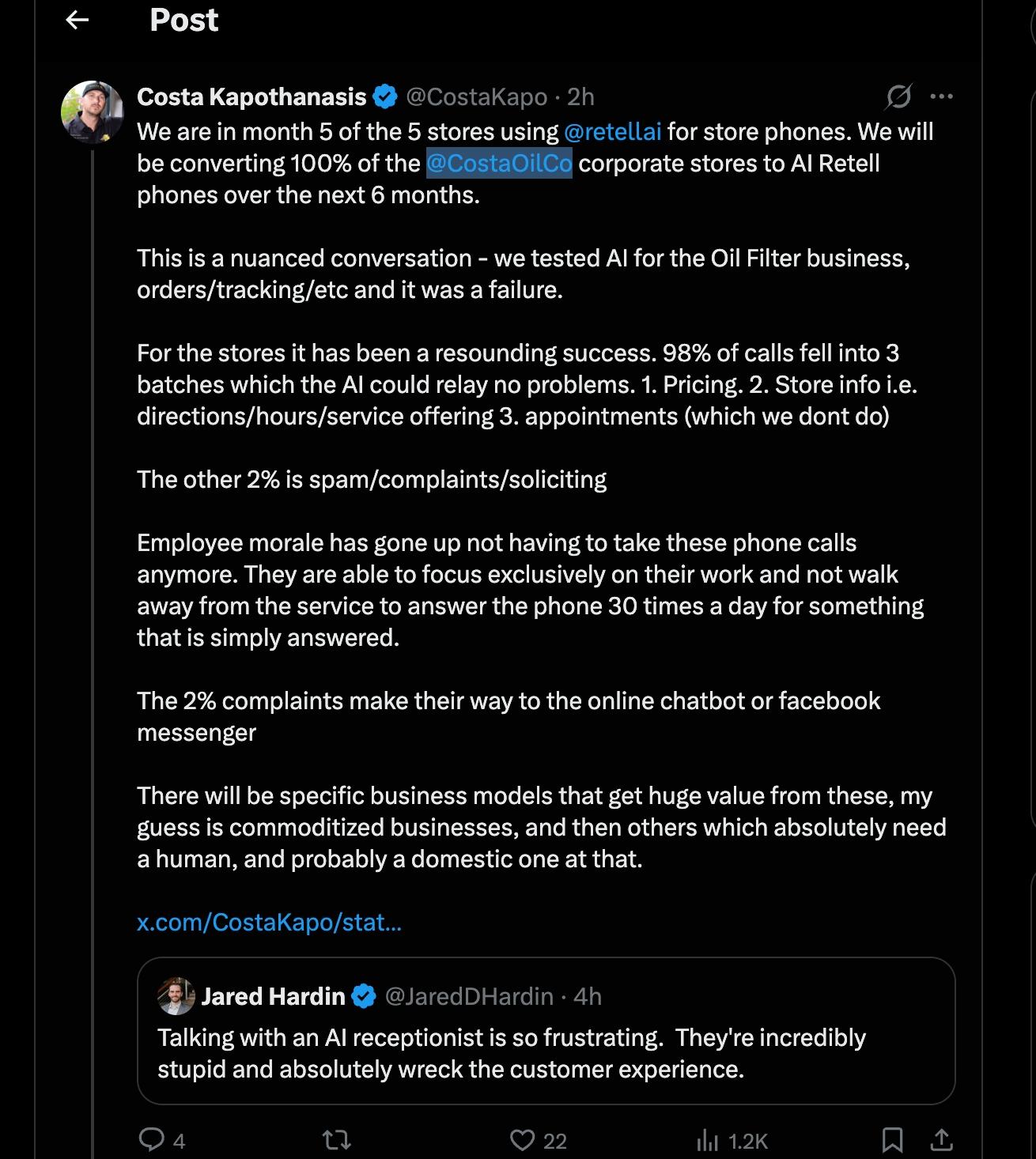
Costa Kapothanasis (@CostaKapo) describing his AI phone rollout on X.
What makes his account useful is that he did not get one result. He got two, from two different parts of the same business.
He first tested an AI agent on the oil-filter side of the business, handling orders and tracking. He called that a failure.
That fits what these calls actually are. An order or tracking call branches quickly. It carries exceptions, edge cases, and the kind of back-and-forth that needs judgment rather than a script.
The store phones were the opposite. He described the rollout there as a clear win, and put a number on it:
“98% of calls fell into 3 batches which the AI could relay no problems.”
Costa Kapothanasis, Costa Oil (original post on X)
Those three batches were pricing, store information such as directions, hours, and services offered, and appointment requests, even though the stores don’t book appointments.
Those are questions with one correct answer that rarely changes. An agent can field them the same way every time, at any hour, without pulling anyone off the shop floor.
These figures come from one operator’s own account of his stores, so treat them as a case study rather than a benchmark. Your call mix, and your results, will differ.
The lesson here is not “AI is good” or “AI is bad.” It is about how your calls are distributed.
When nearly all of your inbound calls are a handful of repeatable questions, a voice agent handles them cleanly. Pricing, hours, directions, and “do you do X” are answered the same way whether it is the first call of the day or the fortieth.
The leftover slice matters just as much. In the store example, the remaining 2% was spam, complaints, and soliciting.
That slice does not need the agent to be clever. It needs a clean exit. Costa routed complaints to an online chat and to Facebook Messenger instead of forcing them through the phone agent.
Now compare that to the oil-filter orders. Those calls never collapsed into three tidy buckets, so the agent had nothing stable to answer, and it failed. Same technology, different call mix, opposite result.
One part of his account had nothing to do with cost savings, and it may be the strongest argument in the whole thread.
He said employee morale went up once staff no longer had to take these calls. Instead of walking away from a service bay to answer the phone dozens of times a day for a question answered in one line, they could stay on the actual work.
A phone that rings constantly with easy questions is a hidden tax on focus. Removing it gives people their attention back. Whether your team feels the same lift will depend on how your day is structured, so read this as a likely benefit, not a guarantee.
Before you put an agent on your main line, weigh these against the calls you actually get:
Costa’s own guess landed in the same place: commoditized businesses with a lot of repeat questions get the biggest gain, while others genuinely need a human on the line.
It helps to be clear about what an agent like this is. It is not the old press-1 menu. It is a voice agent that answers, listens in plain language, and either resolves the call or hands it to a person.
For background, IBM’s explainer on conversational AI covers how these systems read speech and respond, and its notes on conversational AI in customer service describe the same pattern Costa saw: the agent takes the routine calls and people handle the harder ones. That is the opposite of the rigid interactive voice response menu most callers dislike.
This is the gap Retell AI fills. Teams use Retell to build a voice agent that answers store lines the way a good employee would. It pulls pricing, hours, and service answers from a connected knowledge base, can book appointments when you want that, and does a warm transfer to a person when a call needs one.
Every call is logged for post-call analysis, so you can watch which questions come up and where a flow breaks down. Retell also sits on top of the phone setup you already run through providers like Twilio and Vonage, so you are not replacing your carrier.
If this sounds like your line, the AI receptionist use case is the place to start. The goal is not to remove people. It is to let the agent take the routine calls and hand the rest to a human.
It depends on your calls. On repeatable questions like pricing, hours, and directions, they answer well and consistently. On complex, branching, or high-stakes calls, a person is still the better choice.
High-volume, repeatable ones. The clearest wins are pricing, store or office information, directions, hours, and routing routine requests. If a few call reasons cover the bulk of your volume, that is the sweet spot.
No. It takes the routine calls off their plate and hands the rest to a human. In the store example, the point was to free employees to focus on their work, not to cut the team.
Send them to a person or another channel. Costa routed complaints to online chat and Facebook Messenger, keeping the phone agent focused on the calls it handles well.
See if your call mix is a fit.
Retell lets you launch a voice agent that answers, understands, and resolves routine calls, then hands off to your team when it matters. Try Retell free or talk to sales.
See how much your business could save by switching to AI-powered voice agents.
Total Human Agent Cost
AI Agent Cost
Estimated Savings
A Demo Phone Number From Retell Clinic Office