9 Best Call Center Voice AI Tools for Automating Conversations in 2026
If you search for call center voice AI tools today, you’ll quickly notice how crowded the category has become. Nearly every platform claims to automate conversations, sound human, and reduce support costs. In practice, many call centers still struggle with the same operational issues: noticeable latency during live calls, dropped conversations under load, rigid IVR menus, and unreliable call transfers that frustrate both customers and agents.
I ran into this gap while reviewing voice AI tools meant for real call center operations, not polished demos or scripted test flows. Most platforms look impressive in isolation, but behave very differently once exposed to live inbound and outbound traffic.
To separate real systems from marketing claims, I reviewed a range of call center voice AI platforms on actual phone lines, focusing on how they perform once volume, concurrency, and real-world edge cases appear. Platforms like Retell AI are included as part of this hands-on evaluation, alongside other tools used in production call environments.
This guide breaks down the call center voice AI platforms that are genuinely worth considering when automating conversations at scale.
Call center voice AI tools are software platforms that help you build, deploy, and manage AI voice agents that handle real phone conversations. They sit directly between callers, human agents, and backend systems so live calls can result in completed actions, not just routed prompts.
Unlike scripted IVRs, these tools don’t rely on fixed menus or keypad inputs. They use speech recognition, natural language understanding, and large language models to follow how people actually talk. Voice agents can handle interruptions, clarify intent, maintain context across multi-turn calls, and respond in real time without long pauses or awkward delays.
The biggest gains from call center voice AI don’t come from model branding. They come from operational fit. In testing and research, the platforms that performed best were the ones that integrated cleanly with CRMs, ticketing systems, scheduling tools, and call routing logic. That’s what allows voice agents to resolve issues, update records, and escalate to humans with context intact.
Teams use call center voice AI tools to power automated inbound support, outbound follow-ups, appointment scheduling, payment reminders, and call deflection during peak volumes. Most production-ready tools share a common foundation:
Seen this way, call center voice AI tools are not smarter IVRs. They are the operational layer that enables phone automation to work under real call volume.
This list was built as a practical review, not a promotional roundup. Each call center voice AI platform included here was evaluated based on how it performs in real operational conditions, not how convincing it looks in a demo environment.
Call quality and latency were reviewed first, since even small delays or audio issues quickly degrade trust during live conversations. Stability at scale was another key factor, including how platforms handle concurrency, sustained call volume, and peak traffic without increasing drop rates. Telephony depth was assessed as well, covering support for phone numbers, SIP connectivity, IVR replacement, transfers, and routing logic.
Integration claims were evaluated against real usage. Platforms were reviewed on how reliably they connect to CRMs, scheduling tools, ticketing systems, and internal APIs during active calls. Pricing transparency was also considered, particularly how clearly costs scale with minutes, concurrency, or seat-based models.
These findings are based on vendor documentation, aggregated G2 reviews, and carefully framed hands-on testing observations, with a focus on real-world behavior rather than marketing claims.
Before diving into the detailed platform breakdowns, this table gives a high-level view of the call center voice AI tools that proved most relevant for automating real phone conversations in production environments. These platforms were selected based on their ability to handle live inbound and outbound calls, maintain call quality under load, integrate with call center systems, and scale predictably as volumes grow. Ratings reflect aggregated third-party review data where available, and pricing is based strictly on publicly documented starting points or widely cited benchmarks.
| Platform | Rating | Best for | Why it made the list | Pricing |
|---|---|---|---|---|
| Retell AI | G2: 4.8 / 5 | Voice-first call center automation | Built specifically for live call handling with deep telephony control, low latency, and compliance focus | Pay-as-you-go from $0.07/min voice + $0.002/msg chat |
| Synthflow | G2: ~4.5 / 5 | Quick no-code call automation | Visual builder enables fast rollout of basic inbound and outbound call agents | Pay-as-you-go from ~$0.15–$0.24/min all-in (voice engine + LLM + telephony); Enterprise available for 10K+ min/month |
| Vapi AI | G2: ~4.2 / 5 | Developer-led custom call agents | API-first design allows full control over speech, models, and telephony layers | Platform fee from ~$0.05/min plus provider costs |
| Cognigy AI | G2: ~4.6 / 5 | Enterprise contact center automation (NICE CXone ecosystem) | Acquired by NICE in 2025; mature platform with strong governance, deep CXone integration, and structured voice workflows | Custom enterprise contracts via sales |
| Kore.ai | G2: ~4.7 / 5 | Standardized enterprise voice workflows | Strong governance, analytics, and agent assist for large call centers | Custom enterprise contracts typically starting ~$300K+/year; self-serve plans from ~$50–$180/month with limited features |
| Google Dialogflow CX | G2: ~4.4 / 5 | Structured call flows on Google Cloud (now part of Conversational Agents platform) | Robust NLU and flow control for predictable voice interactions | Usage-based, voice audio often ~$0.06–$0.20/min |
| Amazon Lex | G2: ~4.2 / 5 | AWS-native voice workflows | Tight AWS integration for intent-driven call automation | Pay-as-you-go from ~$0.004 per voice request |
| Talkdesk | G2: ~4.4 / 5 | AI-assisted contact centers | Reliable routing, reporting, and agent handoff inside CCaaS | Starts ~$85/agent/month (digital only); voice from $105; omnichannel from $165. AI features are paid add-ons. |
| Twilio Voice + AI Stack | G2: ~4.4 / 5 | Custom-built call center voice systems | Highly reliable programmable telephony for bespoke voice automation | ~$0.013–$0.024/min for calls (usage-based) |
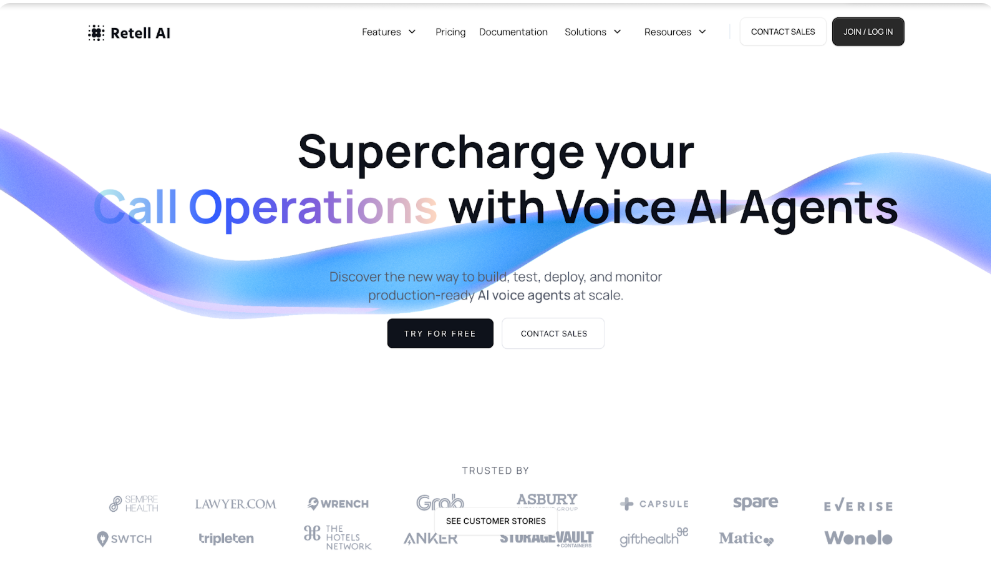
Retell AI sits at the top of this list as a voice-first platform built specifically for automating live phone conversations in call center environments. It is designed around AI voice agents that handle inbound and outbound calls at scale, rather than extending a chatbot into voice as a secondary feature. The platform is primarily used by contact centers, support teams, and sales operations where phone calls are the core operational channel. Retell AI focuses on production reliability, telephony control, and compliance, making it suitable for organizations that need voice automation to work consistently under real traffic conditions.
In testing and review analysis, Retell AI consistently showed low latency and stable call quality under sustained call volumes. Call routing, transfers, and escalation logic behaved predictably, even when handling concurrent calls. Setup friction was moderate, with most effort spent on designing call flows and integrations rather than telephony configuration itself.
Mid-to-large call centers, support organizations, and sales teams that rely heavily on phone calls and need reliable, compliant voice automation in production.
Teams that only need a lightweight website chatbot or basic conversational UI without real phone automation requirements.
G2 rating and user feedback
G2 Rating: 4.8 / 5
Users consistently highlight call quality, low latency, and production readiness for live phone operations.
Retell AI uses usage-based pricing with no platform fee. The voice engine starts at $0.07/min, with LLM costs from $0.003–$0.08/min depending on model choice, and Twilio telephony at ~$0.015/min. Realistic all-in costs for standard setups range from $0.08–$0.15/min. Every account gets $10 in free credits and 20 concurrent calls included. AI chat starts at $0.002 per message. Pricing scales predictably with call volume, but high-volume contact centers should model expected minutes and concurrency to manage costs effectively. See full pricing breakdown
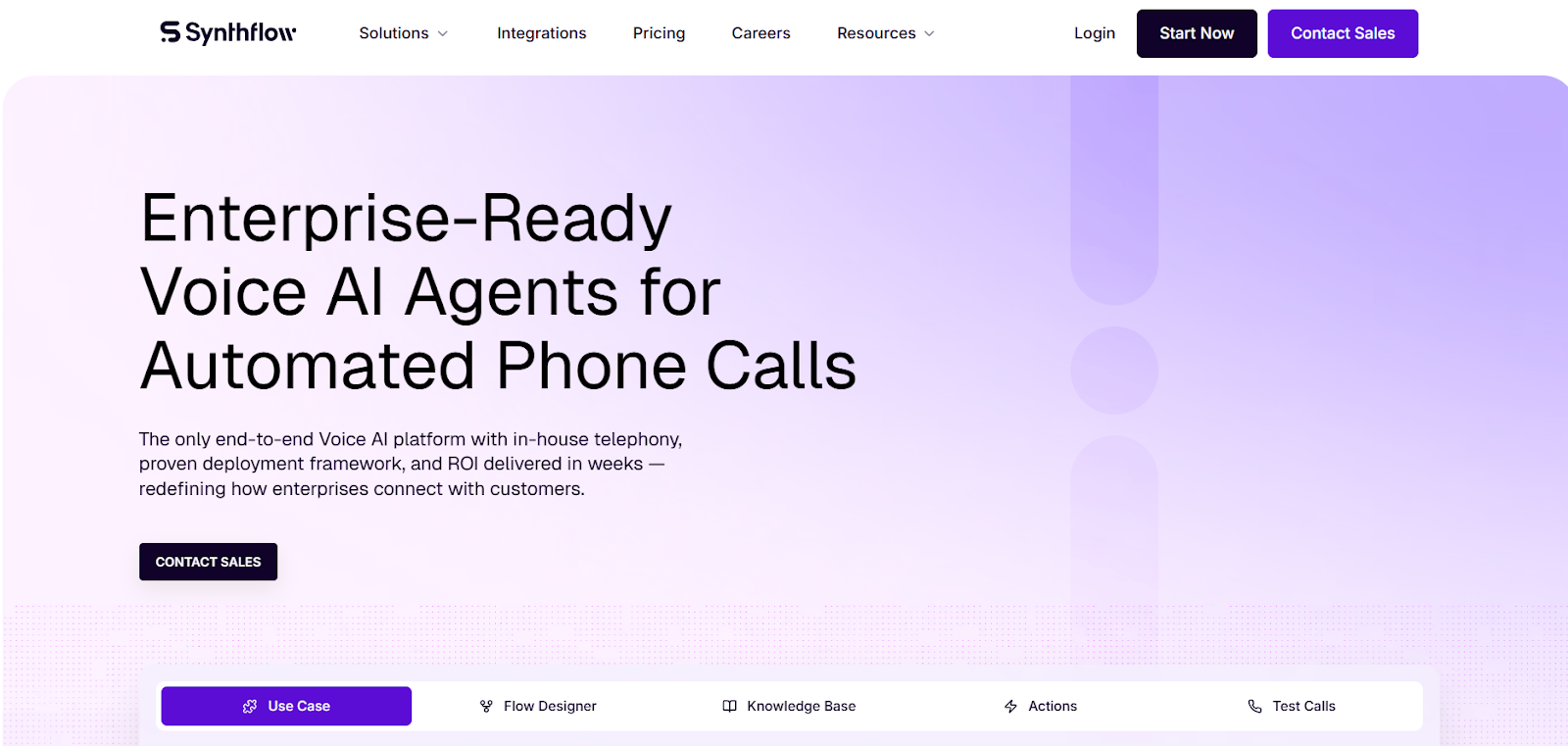
Synthflow is a no-code voice AI platform aimed at teams that want to automate phone conversations quickly without heavy engineering involvement. It is commonly used by SMBs, agencies, and non-technical teams looking to deploy inbound or outbound voice agents with minimal setup. The platform emphasizes visual call flow design, basic CRM integration, and fast time-to-launch. Synthflow is best suited for straightforward call automation use cases rather than complex, high-volume contact center operations with advanced routing requirements.
In testing and user review analysis, Synthflow performed best when speed and simplicity mattered more than customization. Teams were able to launch basic AI receptionists and outbound agents quickly, but handling off-script or complex conversations required additional prompt tuning and higher-tier plans.
SMBs and agencies that want to automate basic call handling without building custom infrastructure.
Enterprises that require strict SLAs, advanced routing, or deep telephony customization.
G2 rating and user feedback
G2 Rating: ~4.5 / 5
Users frequently praise ease of use and fast setup, while noting cost sensitivity at scale.
Synthflow has transitioned to a pay-as-you-go model with no fixed monthly fee. The voice engine costs $0.09/min, with LLM usage adding $0.02–$0.05/min and Synthflow-managed telephony at $0.02/min. Most setups land between $0.15 and $0.24 per minute depending on LLM and telephony choices. The pay-as-you-go plan includes 5 concurrent calls (expandable at $20/slot/month), unlimited AI agents, full API access, and email support. An Enterprise plan is available for organizations exceeding 10,000 minutes per month, with custom pricing and a 99.99% SLA.
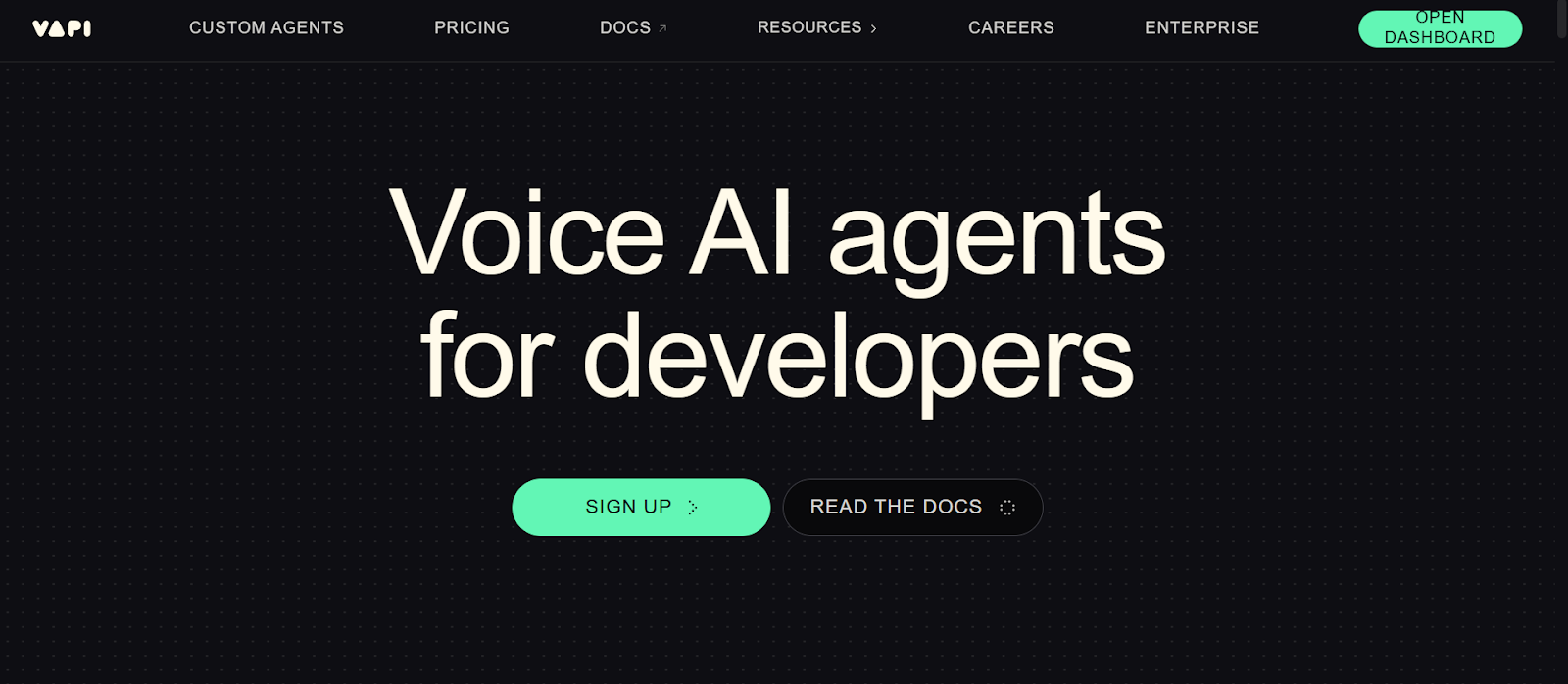
Vapi AI is a developer-centric voice AI platform designed for teams that want full control over their voice stack. Rather than offering a turnkey call center solution, Vapi provides an API-first framework where teams assemble voice agents by selecting their own speech-to-text, text-to-speech, language models, and telephony providers. This modular approach makes Vapi well suited for engineering-led teams building highly customized voice agents, but it introduces more setup and operational complexity compared to managed platforms.
In testing and review analysis, Vapi demonstrated strong flexibility but higher setup friction. Call quality and latency varied depending on provider choices, and managing billing across multiple services added operational overhead compared to more unified platforms.
Engineering-heavy teams that need deep customization and are comfortable managing their own voice infrastructure.
Teams looking for no-code deployment or a fully managed call center voice AI platform.
G2 rating and user feedback
G2 Rating: ~4.2 / 5 Developers praise flexibility and raw API access, though G2 notes limited review volume for comprehensive buying insight.
Vapi AI charges a platform fee starting around $0.05 per minute, with additional costs from speech services, language models, and telephony providers. As call volume scales, multi-vendor pricing can make cost forecasting and operational management more complex.
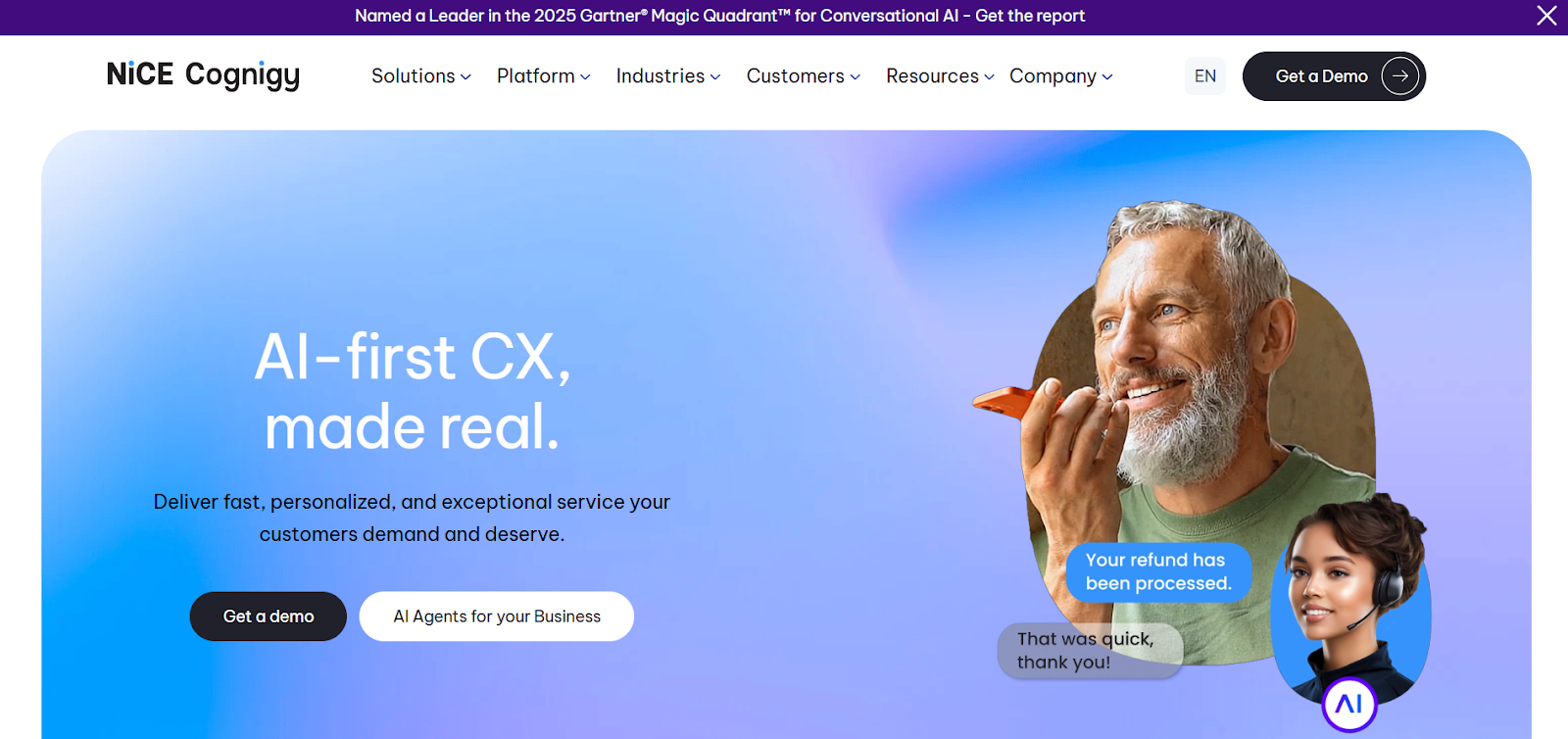
Cognigy AI is now operating as NICE Cognigy following NICE's ~$955 million acquisition in September 2025 — is an enterprise conversational AI platform built for contact centers and large-scale customer operations.
It supports both voice and digital channels within a single integrated environment, with deep integrations into existing contact center infrastructure, particularly the NICE CXone ecosystem.
The platform is designed for structured, governance-heavy environments where conversation flows, escalation paths, and compliance requirements are clearly defined. Cognigy AI is primarily used by large enterprises in sectors like banking, telecom, and insurance, where reliability, data control, and multi-language support are non-negotiable.
In testing and third-party reviews, Cognigy showed strong stability once configured. Call flows behaved predictably under load, and escalation logic worked consistently. However, making changes required careful planning and testing, which slowed iteration compared to lighter voice platforms.
Large contact centers with mature CX operations and dedicated development teams — particularly those already on or evaluating NICE CXone as their contact center platform.
Startups or SMBs looking for fast deployment, lightweight voice automation, or minimal platform overhead.
G2 Rating: ~4.6 / 5
Users frequently cite enterprise readiness, stability, and contact center integrations as key strengths.
Cognigy AI uses enterprise contract-based pricing. Public benchmarks and customer reports suggest entry pricing typically starts around $2,000–$3,000 per month, with full deployments scaling into six-figure annual contracts depending on call volume, enabled modules, and support tiers.
Kore.ai uses custom enterprise contracts for large deployments, with typical annual deals starting around $300,000. Self-serve "Essential" and "Advanced" plans range from $50 to $180/month but have limited features, channels, and volume compared to the full enterprise offering. Billing is session-based (15-minute blocks), which can make costs unpredictable.
Total cost of ownership can increase quickly once implementation, training, voice capabilities (STT/TTS), and customization are factored in often reaching 150–200% of the quoted software price in the first year.
In testing and reviews, Kore.ai handled structured voice interactions reliably. Escalation to human agents worked as expected, and reporting was strong. However, modifying live workflows required coordination and testing, making it better suited for stable environments.
Large enterprises that value consistency, governance, and scalability across voice and digital automation.
Teams seeking quick deployment, lightweight voice agents, or minimal operational overhead.
G2 Rating: ~4.7 / 5
Users often highlight reliability and enterprise integrations, while noting complexity as a trade-off.
Kore.ai uses enterprise contract pricing. Public benchmarks indicate entry pricing around $1,200–$2,000 per month, with full deployments commonly ranging from $50,000 to $200,000+ per year depending on volume, channels, and enabled features.
Google Dialogflow CX, now part of Google's unified "Conversational Agents" platform within the broader Gemini Enterprise Agent Platform, is designed for building structured, stateful voice and chat agents within the Google Cloud ecosystem. The standalone Dialogflow CX console was deprecated in October 2025, and agents are now managed within the integrated Conversational Agents console.
The platform provides flow-based conversation design, generative AI playbooks, advanced NLU, and deep integration with Google Cloud services such as BigQuery, Cloud Functions, and Vertex AI. Dialogflow CX is typically used by mid-to-large enterprises and development teams that need precise control over conversation paths, especially in regulated or compliance-sensitive industries.
In testing and reviews, Dialogflow CX performed reliably for structured call routing and intent recognition. However, conversational flexibility was limited, and updates to live agents required careful testing to avoid production issues.
Engineering-led teams building structured voice and chat bots within the Google Cloud ecosystem.
Teams focused on voice-first call center automation or looking for conversational flexibility out of the box.
G2 Rating: ~4.4 / 5
Users praise scalability and control, while frequently citing setup complexity.
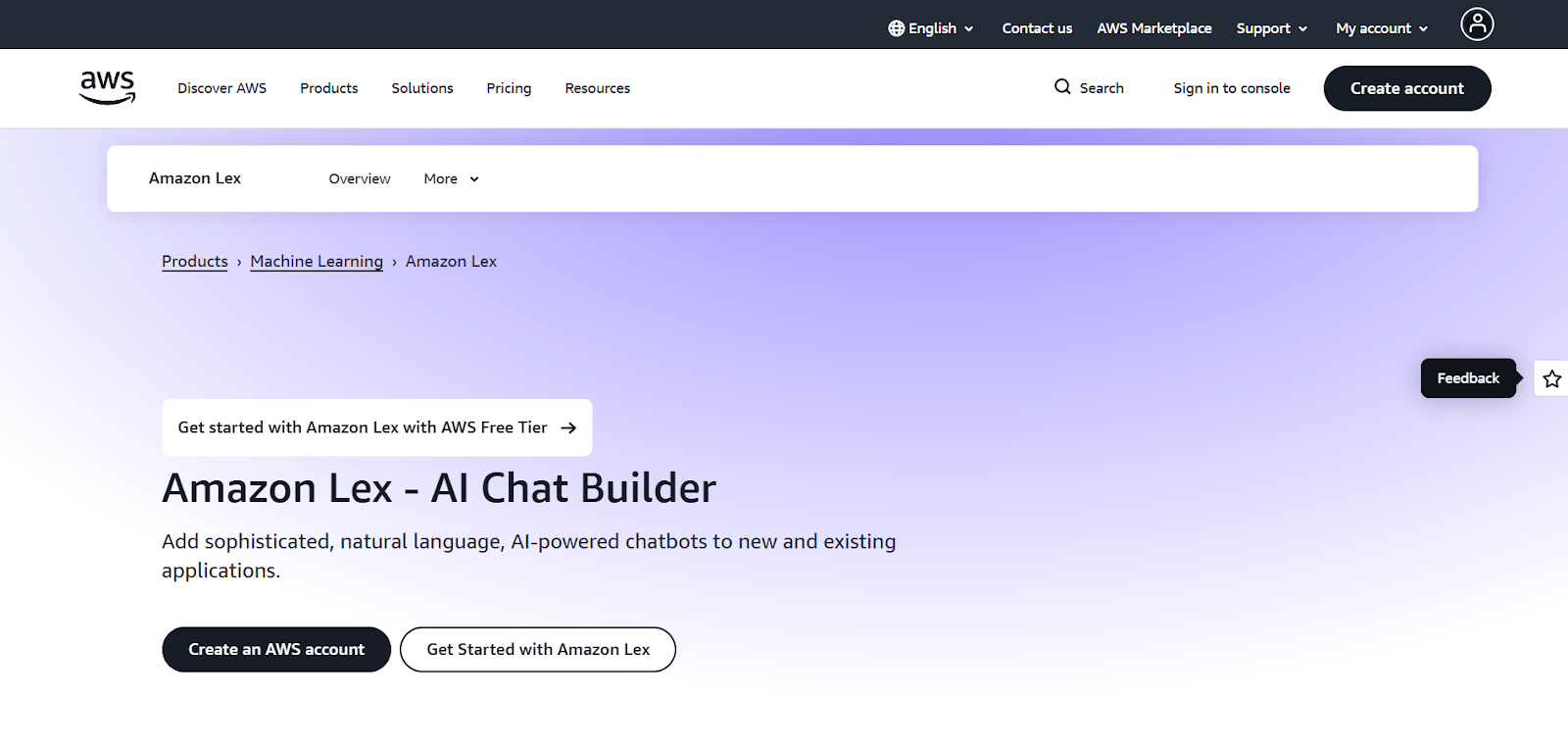
Amazon Lex is a conversational AI service designed for teams building voice and chat experiences inside the AWS ecosystem. It is primarily used by engineering-led organizations that want infrastructure-level control, tight security integration, and flexibility to embed voice automation into larger systems. Lex is not a turnkey call center voice AI platform, but a foundational service for constructing structured conversational workflows.
Voice agents in Amazon Lex are built around intents, slots, and fulfillment logic, then connected to telephony systems and backend services using AWS tools like Lambda and Amazon Connect. This approach works best for predictable, task-oriented conversations such as account lookups, status updates, and guided workflows, rather than open-ended call handling.
In testing and third-party reviews, Amazon Lex handled structured intent recognition reliably once configured. Managing interruptions, fallback logic, and conversational nuance required substantial custom development, and voice interactions felt functional rather than natural without extensive tuning.
Engineering teams already invested in AWS that want to embed structured voice workflows into applications or contact center stacks.
Non-technical teams or organizations seeking out-of-the-box voice agents with minimal setup.
G2 Rating: ~4.2 / 5
Users frequently praise scalability and AWS integration, while noting setup complexity.
Amazon Lex uses usage-based pricing starting at approximately $0.004 per voice request. Total costs increase with speech services, telephony, and AWS infrastructure. In production environments, annual spend often ranges from $20,000 to $150,000+ depending on call volume and architecture.
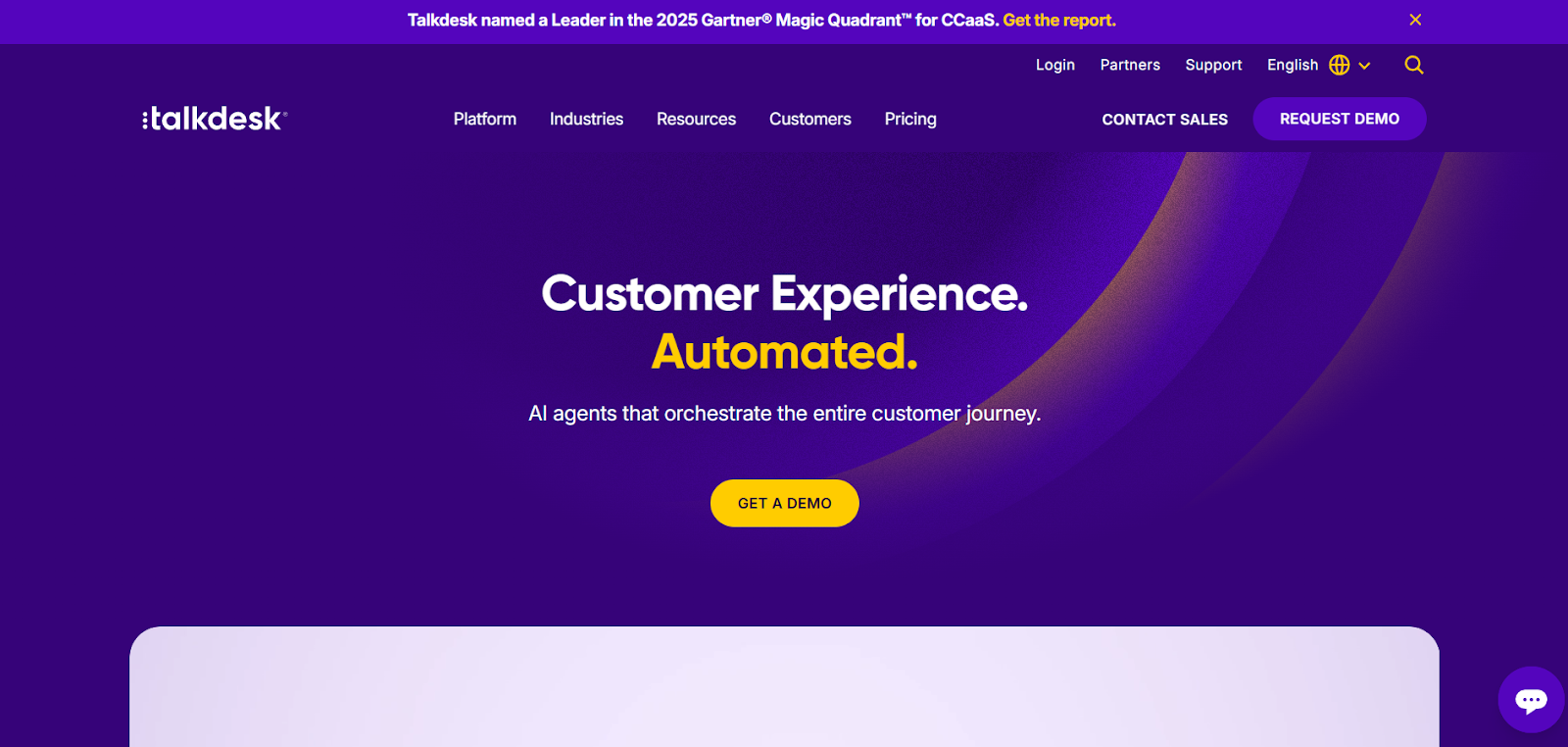
Talkdesk uses per-agent-per-month pricing, typically with three-year contracts. CX Cloud Digital Essentials starts at ~$85/agent/month (digital channels only, no voice). CX Cloud Voice Essentials starts at ~$105/agent/month. The omnichannel CX Cloud Elite plan starts at ~$165/agent/month.
Important: Talkdesk's AI features including Autopilot (virtual agent) and Copilot (agent assist) are paid add-ons, not included in base pricing. With AI modules and telecom usage, total per-agent costs can reach $200–$300/month, and annual costs often reach $30,000 to $250,000+ depending on scale and configuration.
In testing and reviews, Talkdesk voice automation performed reliably for routing and basic support scenarios. Escalation to human agents was smooth, and reporting was strong. More complex dialogue handling required workarounds or manual intervention.
Mid-to-large support organizations already operating Talkdesk contact centers.
Teams looking for standalone, AI-first voice agents or rapid conversational experimentation.
G2 Rating: ~4.4 / 5
Users commonly highlight stability, reporting, and enterprise support.
Talkdesk pricing typically starts around $85–$115 per agent per month. When AI and voice automation features are included, total annual costs often reach $30,000 to $250,000+ depending on scale and configuration.
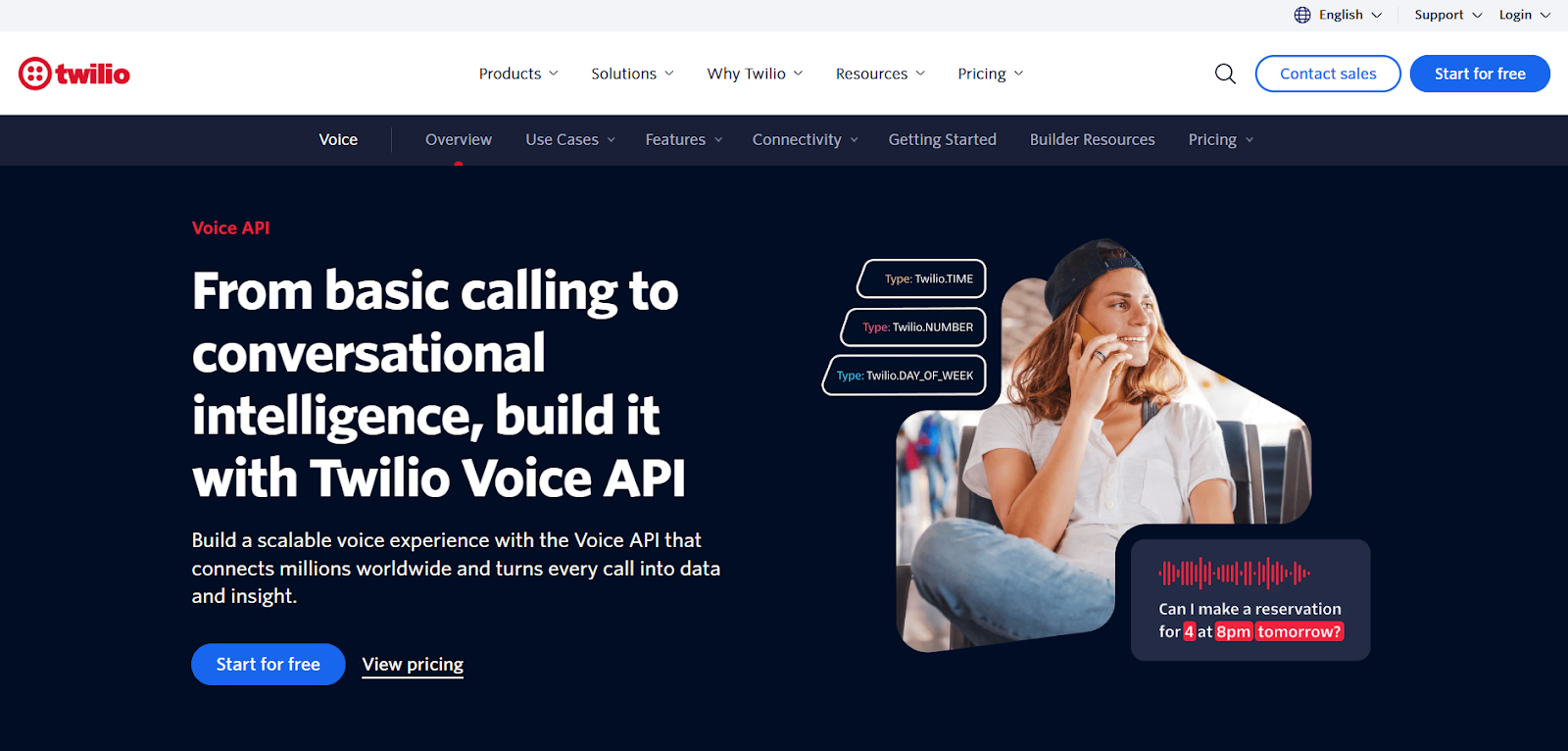
Twilio’s Voice and AI stack is a developer-focused toolkit for building custom voice systems using programmable telephony, speech services, and external language models. It is not a packaged voice AI platform, but a collection of building blocks for teams that want full control over call flows, infrastructure, and integrations.
Voice experiences are assembled using Twilio Voice alongside speech-to-text, text-to-speech, and third-party LLMs. This approach offers maximum flexibility but places responsibility for orchestration, reliability, monitoring, and cost management entirely on the development team.
In testing and reviews, Twilio proved extremely reliable at the telephony layer, with strong call connectivity and global reach. Building conversational intelligence required substantial engineering, and consistent voice quality depended on careful provider selection and tuning.
Engineering-heavy teams building custom voice AI products or deeply integrated systems.
Teams seeking an out-of-the-box call center voice AI platform with minimal setup.
G2 Rating: ~4.4 / 5
Users consistently praise reliability and developer tooling.
Twilio Voice pricing starts at approximately $0.013 per minute for inbound calls and $0.024 per minute for outbound calls, with additional costs for speech services and LLM usage. In production, annual spend commonly ranges from $20,000 to $200,000+ depending on call volume and architecture.
Choosing a call center voice AI tool is less about demos and more about how the system behaves once real callers are on the line. Call centers surface weaknesses quickly, so the evaluation needs to stay grounded in live operations, not feature lists.
Use this framework to narrow down options:
In voice-heavy operations, platforms like Retell AI are often used as a reference point because they are built specifically for production call center traffic rather than general-purpose conversational AI.
The right tool is the one that stays reliable when queues are full, not the one with the flashiest demo.
What are call center voice AI tools used for?
Call center voice AI tools automate inbound and outbound phone conversations such as customer support, appointment scheduling, payment reminders, lead qualification, and call routing, reducing wait times and agent workload during high-volume periods.
How are call center voice AI tools different from IVR systems?
Traditional IVRs rely on fixed menus and keypad input. Voice AI tools use conversational speech, understand natural language, and adapt to how callers speak, which improves handling of unscripted issues.
Can voice AI fully replace human call center agents?
No. Voice AI is most effective for repetitive, high-volume calls. Complex, emotional, or high-risk conversations still require human agents, with voice AI handling triage and escalation.
What matters most when choosing a call center voice AI tool?
Call quality, latency, uptime, and integration reliability matter more than model branding. Tools must handle interruptions, scale under load, and maintain stable routing during peak traffic.
Are call center voice AI tools secure for regulated industries?
Yes, if the platform supports SOC 2, HIPAA, GDPR, and proper call recording controls. Security, auditability, and data handling policies should be reviewed before deployment.
How long does it take to deploy voice AI in a call center?
Simple call flows can go live in days. Complex deployments involving CRM integrations, routing logic, and compliance checks typically take several weeks to stabilize in production.
See how much your business could save by switching to AI-powered voice agents.
Total Human Agent Cost
AI Agent Cost
Estimated Savings
A Demo Phone Number From Retell Clinic Office