Best Voice AI Solutions for Home Service Contractors in 2026
14
MIN READ
September 23, 2026
Home service contractors are being flooded with vendors promising AI voice agent which can answer calls, book jobs, and replace dispatch staff. The market is saturated with claims, but operational reality often looks very different once calls go live. Many contractors still deal with missed calls, noticeable latency during conversations, rigid IVR menus, and unreliable call transfers that cost jobs and frustrate customers.
These gaps rarely show up in demos. They appear during real inbound traffic—emergency calls, after-hours requests, repeat customers calling back, and peak-season surges where concurrency spikes quickly. Under those conditions, even small delays or dropped calls translate directly into lost revenue.
To separate marketing from performance, the platforms in this guide were reviewed based on how they behave on live phone lines used by home service businesses, not scripted demos. The focus was on call quality, routing accuracy, CRM updates, and reliability under load. Platforms such as Retell AI are included as part of this evaluation based on real business call behavior, not theoretical use cases.
A voice AI platform is software that enables businesses to design, deploy, and operate AI-powered voice agents that manage live phone conversations. For home service contractors, these platforms sit directly on top of telephony systems and handle inbound and outbound calls such as booking service appointments, qualifying job requests, dispatching technicians, and answering common customer questions.
Voice AI platforms are often grouped together with chatbots, but the technical demands are fundamentally different. Chatbots operate in text environments where pauses, retries, and structured turn-taking are acceptable. Phone calls do not allow for that margin. Home service calls involve interruptions, urgency, background noise, and low tolerance for latency. Systems that perform well in chat frequently break down when pushed into live voice interactions.
They are also distinct from traditional IVR systems. Legacy IVRs rely on fixed menus and keypad inputs to route calls. While useful for basic call distribution, they fail when customers explain issues in their own words or deviate from predefined paths. Voice AI platforms replace static menus with conversational logic that adapts dynamically while still enforcing business rules like service availability, coverage areas, and dispatch priority.
Modern voice AI platforms combine several technical layers into a single operational stack. These typically include large language models for intent handling, speech-to-text for transcription, text-to-speech for voice output, telephony infrastructure for call control, and orchestration layers that manage routing and integrations. Platforms like Retell AI are examples of voice-first systems designed specifically around phone operations rather than broad CX suites where voice is secondary.
Core capabilities typically include:
This list was built as a practical review, not a promotional roundup. Each voice AI platform was evaluated based on how well it supports real home service call operations, not how polished its demo appears. The goal was to understand what continues to work once call volume increases and customer conversations become unpredictable.
Call quality and latency were reviewed first, since even brief delays can frustrate customers calling for urgent repairs. Stability at scale was also assessed, including how platforms handle concurrency, seasonal call spikes, and sustained inbound traffic without increased drop rates.
Telephony depth was evaluated across phone number support, SIP connectivity, IVR replacement capabilities, call transfers, voicemail handling, and routing logic. Integration realism was another key factor—specifically how reliably platforms connect to CRMs, scheduling tools, dispatch systems, and internal APIs during active calls.
Pricing transparency was reviewed to understand how costs scale as call minutes, concurrent calls, or service locations increase. Findings are based on aggregated G2 reviews, vendor documentation, and carefully framed hands-on testing observations, without exaggeration or unsupported claims.
Home service businesses need voice AI that can answer calls instantly, understand job requests accurately, and book or route work without breaking call flow. The platforms below consistently appear in contractor-focused research, reviews, and live deployments—not just demos. Each entry highlights where the platform fits best, why it earns a place on this list, and its publicly documented starting price.
| Platform | Rating | Best for | Why it made the list | Starting price |
|---|---|---|---|---|
| Retell AI | G2: 4.8 / 5 | High-volume inbound service calls | Voice-first platform with strong telephony depth, real-time CRM writes, and reliable call routing | $0.07 per minute |
| Vapi | G2: 4.4 / 5 | Developer-led service businesses | API-first control for highly customized call logic | $0.05 per minute (platform fee) |
| Synthflow | G2: 4.5 / 5 | Small contractors & agencies | No-code setup for booking and basic call handling | $375 per month |
| Bland AI | Product Hunt: 3.0 / 5 | Programmable outbound calling | Flexible API for custom calling workflows | $0.09 per connected minute |
| Cognigy | G2: 4.6 / 5 | Enterprise service operations | Governance-heavy voice automation at scale | Enterprise pricing |
| Kore.ai | G2: 4.5 / 5 | Regulated, multi-location businesses | Strong analytics and structured call flows | Enterprise pricing |
| Google Dialogflow CX | G2: 4.4 / 5 | Engineering-led teams | Structured routing and intent handling | $0.06 per minute |
| Amazon Lex | G2: 4.2 / 5 | AWS-native applications | Intent-driven voice bots embedded in workflows | $0.004 per request |
| Twilio | G2: 4.4 / 5 | Custom-built telephony systems | Reliable global telephony infrastructure | $0.013 per minute |
Home service businesses depend on phone calls to win jobs—emergency requests, after-hours calls, repeat customers, and seasonal spikes all hit the front desk hard. I reviewed a wide range of voice AI platforms and narrowed this list to the tools that hold up under real contractor call volume, not demos. Each platform below is evaluated on live call reliability, booking accuracy, routing logic, CRM updates, and cost behavior as inbound traffic scales.
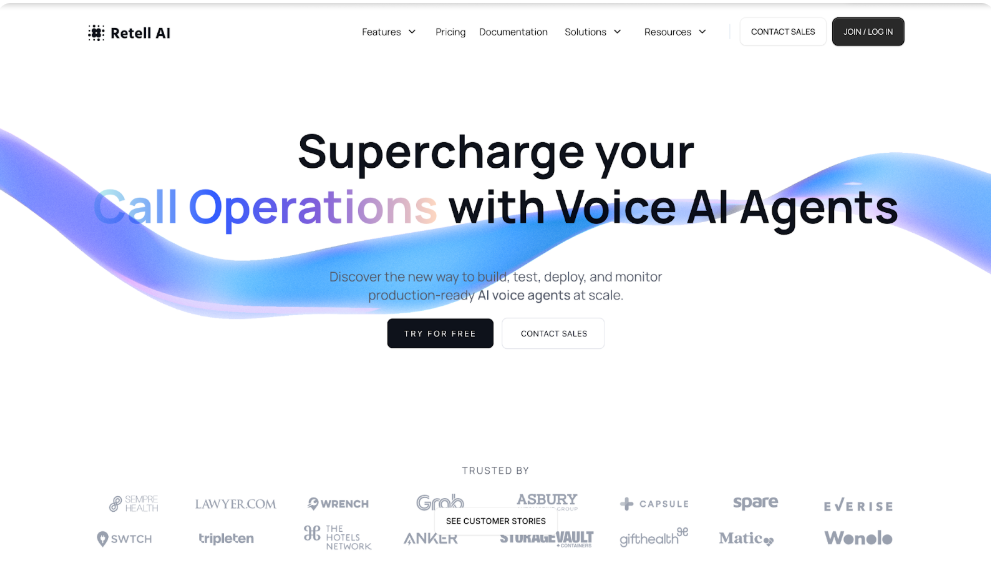
Retell AI is a voice-first AI platform built specifically for automating live phone conversations, making it exceptionally strong for home service contractors where calls directly translate into booked jobs. Unlike chatbot-first tools extended into voice, Retell AI is designed around production-grade phone automation. Contractors use it for inbound job booking, emergency call routing, after-hours coverage, and outbound follow-ups. The platform prioritizes low latency, predictable call routing, and reliable data writes during live calls, which are critical when customers are calling about urgent plumbing, HVAC, or electrical issues.
Primary users
Mid-to-large home service contractors, multi-location service businesses, contact center–led operations
Testing notes
In testing and aggregated review analysis, Retell AI showed consistently low latency and stable call quality during sustained inbound traffic. Emergency routing, voicemail fallback, and human handoffs behaved predictably even with concurrent calls. Setup friction was moderate and centered on call-flow logic rather than telephony reliability.
Who should use it
Home service contractors that rely heavily on inbound calls for job booking and need reliable voice automation at scale.
Who should avoid it
Small operators that only need a basic voicemail replacement without live call automation.
G2 rating and user feedback
G2 Rating: 4.8 / 5
Users consistently highlight call quality, reliability, and readiness for production phone operations.
Pricing & scale considerations
Usage-based pricing starts at $0.07 per minute for voice. Costs scale predictably with call volume, but high-traffic contractors should model peak-hour concurrency carefully.
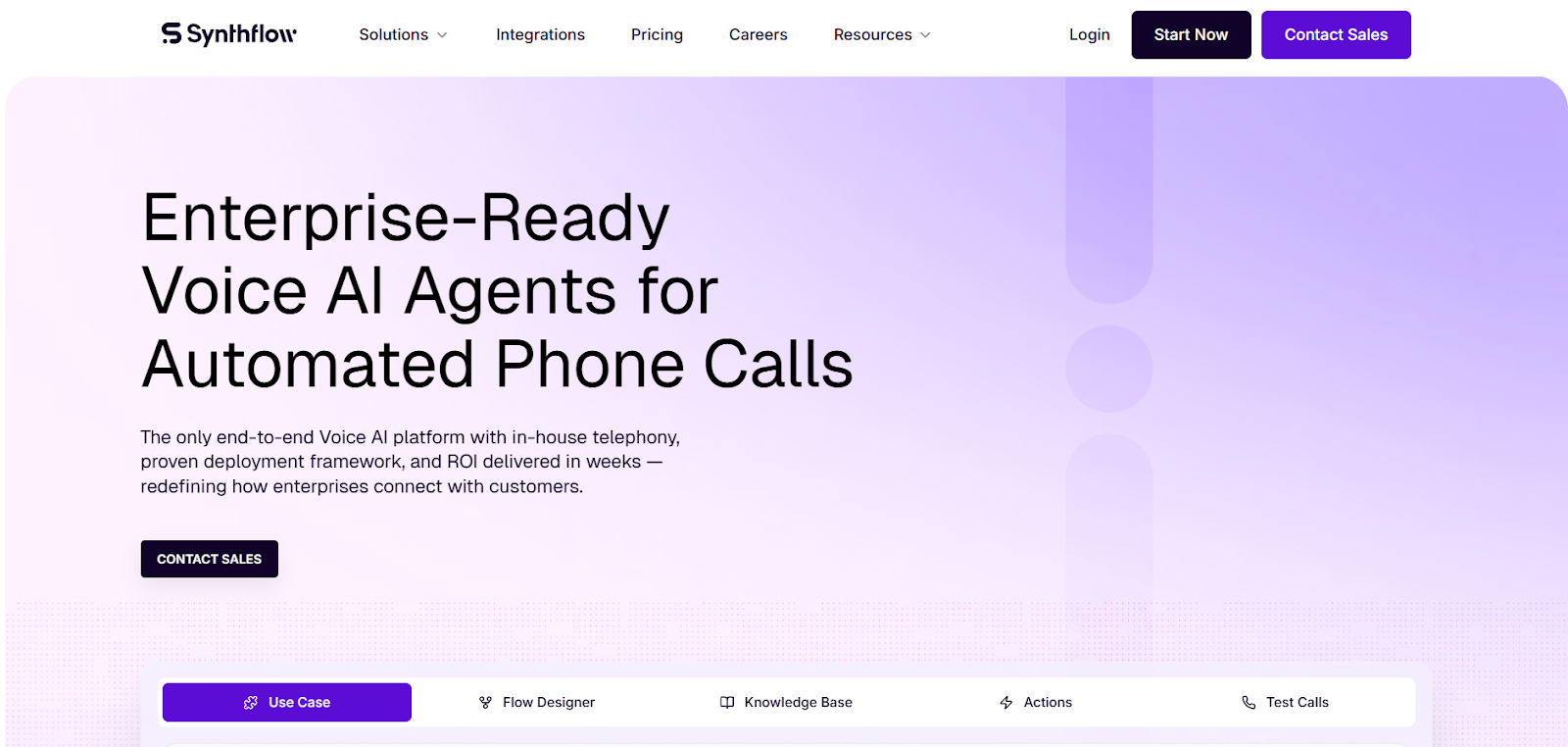
Synthflow is a no-code voice AI platform aimed at home service businesses that want to automate basic phone handling quickly without engineering support. Contractors commonly use it for appointment booking, after-hours call coverage, and simple inbound routing. The platform emphasizes visual call-flow design and fast deployment rather than deep telephony control. Synthflow works best for straightforward service booking scenarios and low-to-moderate call volumes rather than complex dispatch operations.
Primary users
Small contractors, local service businesses, agencies managing client calls
Testing notes
Testing showed quick setup for simple booking agents, but handling off-script customer questions required additional prompt tuning.
Who should use it
Small contractors needing fast, no-code phone automation.
Who should avoid it
High-volume service businesses with complex dispatch logic.
G2 rating and user feedback
G2 Rating: 4.5 / 5
Users praise ease of setup while noting cost sensitivity at scale.
Pricing & scale considerations
Public plans start around $375 per month with bundled minutes, making forecasting harder as inbound volume grows.
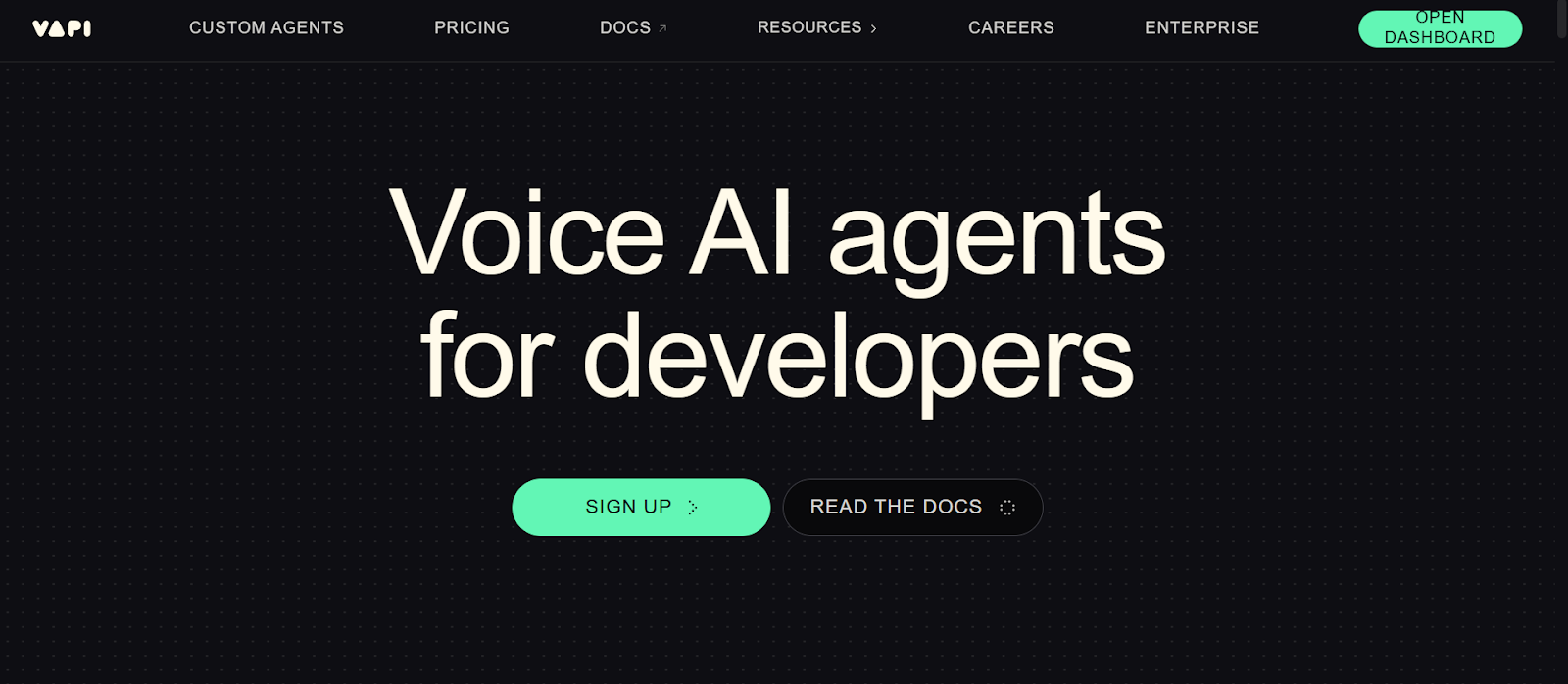
Vapi is a developer-centric voice AI platform designed for home service businesses that want full control over how phone calls are handled. Rather than offering a managed front-desk solution, Vapi provides APIs that let teams assemble voice agents using selected speech-to-text, text-to-speech, language models, and telephony providers. Contractors use Vapi when they need custom dispatch logic, dynamic routing, or deep integration with internal systems. The platform prioritizes flexibility and programmability over ease of setup, making it better suited for engineering-led operations than typical local service businesses.
Primary users
Developer-led service platforms, engineering-heavy home service companies, SaaS-enabled contractors
Pros
Cons
Testing notes
Testing showed strong flexibility but higher setup friction. Call quality and latency varied depending on provider choices, and maintaining consistent performance required ongoing tuning.
Who should use it
Engineering-led home service businesses building custom voice and dispatch systems.
Who should avoid it
Non-technical contractors seeking an out-of-the-box voice front-desk solution.
G2 rating and user feedback
G2 Rating: 4.4 / 5
Users highlight flexibility and control while frequently noting setup complexity.
Pricing & scale considerations
Platform fees start around $0.05 per minute, with additional costs from speech services, language models, and telephony providers, making forecasting more complex at scale.
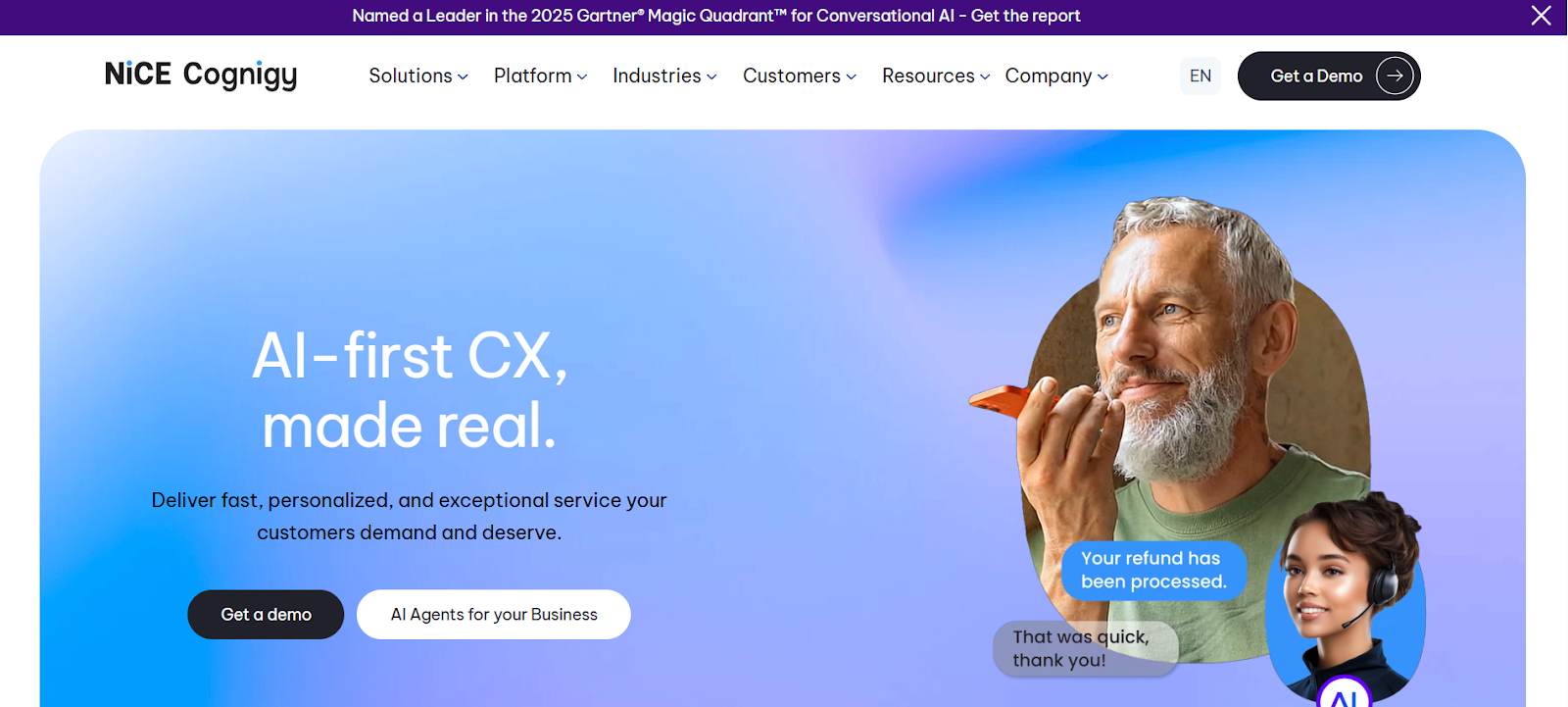
Cognigy is an enterprise-grade conversational AI platform built for large organizations running structured, high-volume contact centers. In home services, it is most commonly used by national or multi-brand service providers that need predictable call handling, governance, and compliance across locations. Cognigy supports voice bots and agent assist scenarios, allowing service teams to automate call triage, routing, and basic intake while keeping humans involved for complex jobs. The platform prioritizes stability and control over fast iteration, making it best suited for mature operations with formal processes.
Primary users
Large enterprises, regulated service providers, multi-location contractor groups
Pros
Cons
Testing notes
Testing and third-party reviews showed stable call behavior once fully configured, but changes required careful planning and testing, slowing iteration.
Who should use it
Large home service enterprises prioritizing compliance, consistency, and operational control.
Who should avoid it
Small or fast-moving contractors needing quick deployment and frequent changes.
G2 rating and user feedback
G2 Rating: 4.6 / 5
Users consistently cite stability, governance, and enterprise readiness.
Pricing & scale considerations
Cognigy uses enterprise contract pricing, with reported entry points around $2,000–$3,000 per month and higher annual costs based on volume and modules.

Kore.ai is an enterprise conversational AI platform used by organizations that want standardized automation across voice and digital channels. In home service contexts, it is typically applied to inbound call routing, FAQs, and agent assist rather than fully autonomous booking or dispatch. The platform emphasizes governance, analytics, and lifecycle management, making it a fit for large service organizations with established operational processes. Kore.ai performs best when conversations follow defined paths and when voice automation is part of a broader enterprise CX or IT strategy.
Primary users
Large enterprises, IT-led service organizations, national contractor networks
Pros
Cons
Testing notes
Testing and reviews showed consistent performance for predefined call flows, but modifying live workflows required coordination and testing.
Who should use it
Large service organizations prioritizing governance and standardization.
Who should avoid it
Local contractors seeking fast setup or lightweight automation.
G2 rating and user feedback
G2 Rating: 4.5 / 5
Users highlight reliability and enterprise readiness, with complexity noted as a trade-off.
Pricing & scale considerations
Kore.ai uses enterprise contract pricing, with entry estimates around $1,200–$2,000 per month and higher annual costs at scale.
Google Dialogflow CX is a structured conversational AI platform built for teams designing flow-based automation across voice and chat. Home service businesses use it primarily for predictable call routing, intake questions, and scripted interactions rather than open-ended conversations. Dialogflow CX emphasizes state-based design, versioning, and environment control, making it suitable for engineering-led teams operating within Google Cloud. It works best when service calls follow defined paths and backend systems handle most of the logic.
Primary users
Engineering-led service teams, Google Cloud–based organizations
Pros
Cons
Testing notes
Testing showed reliable intent recognition for structured routing, but conversational flexibility was limited and updates required careful testing.
Who should use it
Service businesses with engineering resources building structured voice workflows.
Who should avoid it
Contractors seeking voice-first, natural phone automation out of the box.
G2 rating and user feedback
G2 Rating: 4.4 / 5
Users praise scalability and control while citing setup complexity.
Pricing & scale considerations
Voice usage is typically billed around $0.06–$0.20 per minute once speech services and telephony are included.
Amazon Lex is a conversational AI service used by home service businesses building voice automation inside the AWS ecosystem. It is not a turnkey contractor phone solution, but a foundational tool for constructing structured voice workflows such as appointment lookups, job status updates, and basic call routing. Lex is most commonly paired with Amazon Connect and AWS Lambda to create custom call handling systems. The platform favors backend control, security, and scalability over conversational polish, making it best suited for engineering-led service organizations rather than local contractors.
Primary users
AWS-native service businesses, engineering-led contractor platforms, enterprise operations teams
Pros
Cons
Testing notes
Testing showed reliable intent recognition for structured calls, but handling interruptions, clarifications, and fallback logic required extensive custom development.
Who should use it
Home service organizations already invested in AWS with strong internal engineering teams.
Who should avoid it
Non-technical contractors seeking ready-to-deploy phone automation.
G2 rating and user feedback
G2 Rating: 4.2 / 5
Users highlight scalability and AWS integration while noting setup complexity.
Pricing & scale considerations
Amazon Lex pricing starts at approximately $0.004 per voice request, with total costs increasing as speech services, telephony, and AWS infrastructure scale.
Twilio’s Voice and AI stack is a developer-focused toolkit for building custom phone systems using programmable telephony and external AI services. For home service contractors, Twilio is often used when teams want full control over call flows, dispatch logic, and integrations with CRMs or field service software. Twilio provides highly reliable global telephony, but conversational intelligence must be assembled separately using speech services and language models. This approach offers flexibility at the cost of higher engineering effort and operational responsibility.
If dispatch is the bottleneck, the HVAC dispatch software comparison covers which platforms now answer the phone and who controls the agent.
Primary users
Engineering-heavy service businesses, SaaS-enabled contractor platforms, product-led teams
Pros
Cons
Testing notes
Testing and reviews showed excellent call reliability, but building conversational logic and maintaining voice quality required ongoing engineering effort.
Who should use it
Service businesses building deeply customized calling systems with engineering support.
Who should avoid it
Contractors seeking managed, ready-to-use AI phone agents.
G2 rating and user feedback
G2 Rating: 4.4 / 5
Users consistently praise reliability and developer tooling.
Pricing & scale considerations
Twilio Voice pricing starts around $0.013 per minute for inbound calls and $0.024 per minute for outbound calls, with additional costs for speech services and AI models.
Talkdesk is a cloud contact center platform that includes AI-powered voice automation as part of a broader CCaaS offering. In home service environments, it is most often used by larger service organizations to improve call routing, reduce hold times, and support agent workflows rather than to fully automate booking or dispatch. Talkdesk works best when human agents remain central to operations and AI is used to deflect simple calls, route inquiries, and improve operational visibility.
Primary users
Mid-to-large home service contact centers, enterprise support teams
Pros
Cons
Testing notes
Testing and reviews showed reliable routing and escalation behavior, but more complex conversational handling required workarounds.
Who should use it
Home service organizations already operate Talkdesk contact centers.
Who should avoid it
Contractors seeking standalone, AI-first phone automation.
G2 rating and user feedback
G2 Rating: 4.4 / 5
Users frequently cite stability, reporting, and enterprise support.
Pricing & scale considerations
Pricing typically starts around $85–$115 per agent per month, with total annual costs rising significantly as agent count and features expand.
Choosing a voice AI platform for home service businesses is less about flashy demos and more about how the system performs when customers are calling about urgent repairs, missed appointments, or same-day availability. The real gaps only show up once live calls hit peak volume.
Use this checklist to evaluate platforms realistically:
In evaluation, voice-first platforms like Retell AI stood out because they are built specifically for real phone operations—handling high inbound volume, predictable latency, and reliable call routing—rather than adapting chat systems to voice.
The right platform fits your call patterns, job volume, and dispatch reality, even if the demo looks simpler.
What are voice AI agents used for in home service businesses?
Voice AI agents handle appointment booking, rescheduling, after-hours calls, emergency request routing, service area questions, and basic pricing inquiries. They help reduce missed calls and keep jobs flowing during busy periods.
Can voice AI replace dispatchers or office staff?
No. Voice AI supports dispatchers by handling routine calls and peak volume, but humans are still needed for emergency prioritization, complex scheduling, customer complaints, and exceptions.
How is voice AI different from IVR for service contractors?
IVRs force callers through keypad menus. Voice AI lets customers speak naturally, understands intent, handles interruptions, and adapts dynamically while still enforcing booking rules and dispatch logic.
What matters most when choosing voice AI for contractors?
Low latency, reliable booking accuracy, clean CRM integration, and predictable pricing matter more than AI model branding. If jobs are booked incorrectly or calls drop, automation becomes a liability.
Is voice AI affordable for small home service businesses?
Yes, if pricing scales predictably with call volume. Contractors should avoid platforms where per-minute costs spike unexpectedly during seasonal surges or emergency-heavy periods.
See how much your business could save by switching to AI-powered voice agents.
Total Human Agent Cost
AI Agent Cost
Estimated Savings
A Demo Phone Number From Retell Clinic Office