Conversational AI in Banking: Benefits, Examples & Trends
11
MIN READ
June 28, 2026
Banks face a critical challenge where they’re losing 20% of customers due to poor customer experience, highlighting the urgent need for more seamless and responsive communication.
At the same time, the global market of conversational AI in banking has reached a massive $2.13 billion in 2024. This highlights how fast the finance sector is adopting AI voice and chat solutions to improve customer interactions.
In this blog post, we’ll look at how conversational AI in financial services is transforming the banking industry. You’ll learn about its role, practical implementation, and more.
To put it in simple terms, conversational AI in banking refers to the use of AI voice agents and chatbots that let customers interact with banks in human-like and natural conversations.
Rather than waiting for a human agent to speak to them or navigating through the complex menu on the banking website, customers can simply ask AI and get instant solutions.
Two of the rising and common use cases of conversational AI banking we’re seeing are AI chatbots and AI voice agents. While chatbots handle text-based interactions, voice agents are changing how banks calls, and manage lead qualifications. In fact, they’re emerging as key trends shaping customer interaction, as explained in our detailed breakdown of AI voice agents.
And, when it comes to AI voice agents for banking and finance, Retell AI is leading the shift. Our primary focus is to offer a voice agent that feels indistinguishable from human agents. As a result, you not only automate the repetitive enquiries, but also seamlessly transfer qualified leads to loan officers. Eventually, helping banks to improve efficiency without losing the human touch.
Conversational AI for banks provides 24/7 support, answering account and loan queries through systems such as an AI Answering service, and even connecting them to the right financial advisor as needed. This is crucial because the data shows 72% of customers expect immediate service, and conversational AI meets this demand.
Furthermore, by 2025, 73% of banks globally are expected to deploy conversational AI at least one AI-chatbot in customer-facing operations.
Behind the scenes, these systems work by combining natural language processing (NLP) with machine learning to understand customer intent. Then they pull information from their knowledge base and deliver an accurate response and conversational AI consultants simplify secure banking AI implementation.
The finance sector has emerged as one of the largest adopters of conversational AI— including solutions like AI IVR to automate phone interactions.
The BFSI sector holds a 23% global market share of the chatbot segment. However, the rise isn’t just about text-based chatbots. Instead, voice-driven AI is becoming central to how banks now interact with customers.
As we move forward towards tech, customers expect natural yet faster support from banks. Even if you feel your website is pretty quick and easy to navigate, that still won’t cut the customer demand.
In fact, 64% customers stated that their traditional mobile banking app doesn’t allow them to resolve their queries quickly (or at all). AI voice agents can fill this gap by providing instant answers to customers' queries.
Besides, the shift towards the automated channels is already visible on a larger scale. Bank of America reported approximately 26 billion digital interactions in 2024 (a 12% YoY increase). These statistics clearly lay out how customers are now preferring digital-first engagement.
Conversational AI in banking is more than just a cost-cutting strategy. Instead, it’s a practical tool offering measurable results. According to the reports, 48% of banking executives in the US plan to use generative AI to improve virtual assistance and chatbots.
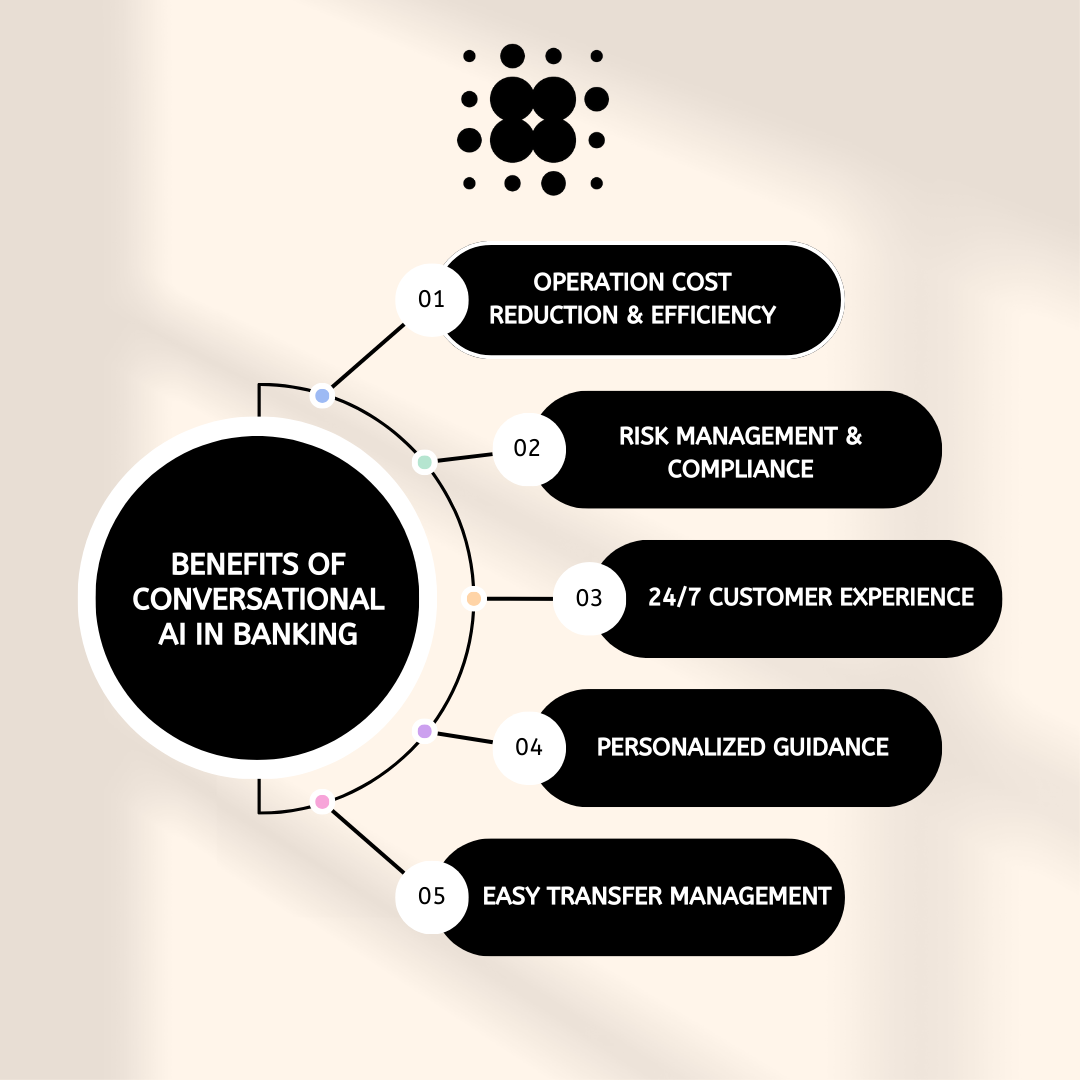
Let’s take a look at the key Benefits of AI in banking that people are already seeing.
One of the immediate advantages of conversational AI in finance is cost savings. Banks that use AI-powered voice agents and chatbots can see up to 30% lower customer service expenses, thanks to automation of routine inquiries.
Coming to Voice AI agents, they significantly help in reducing the strain on the call centre automation. Studies reveal AI voice agents for finance can help in achieving 79% first-call resolution rate, translating to 26% reduction in call centre volume. This means faster resolutions of customer queries, fewer repeated calls, and eventually lower staffing expenses.
A deeper look at how AI-powered calls deliver these gains is covered in this guide on achieving 4× operational efficiency with AI calls.
Additionally, the impact of conversational AI in financial services is clear. Federal Bank implemented conversational AI and got 98% response accuracy, while customer satisfaction rose up to 25%. They projected an almost 50% reduction in supported costs while handling 133% more customer queries. This example clearly highlights how conversational AI banking can not only help in reducing the cost but also improve service quality.
Compliance and fraud detection play a critical role in financial services, and AI is proving to be a powerful ally here. Research reveals 91% of banks already use AI for fraud detection, highlighting strong usage of machine learning models to identify suspicious activities in real-time.
Moreover, conversational AI in financial services also assists compliance by ensuring consistent communication with its customers. Banks and financial services can train voice agents to log interactions automatically, follow regulatory scripts, and provide auditable records. Managing these automated communication trails effectively requires alignment with a comprehensive information governance guide to maintain legal readiness. This eventually helps in reducing human errors and improving customer trust. This eventually helps in reducing human errors and improving customer trust.
A Conversational AI platform bridges the increasing demand of customers wanting quick responses. By being available 24/7 (unlike humans, who have to work in multiple shifts to be available around the clock).
Using a single conversational AI banking voice agent or chatbot can resolve up to 80% routine queries without human intervention, saving humans to work on complex tasks.
Personalization, on the other hand, also plays a critical role in customer loyalty. Banks using AI-driven personalizations report 12.3% higher customer retention rate compared to those relying only on traditional approaches. By offering tailored guidance and anticipating customer requirements, conversational AI in financial services helps banks build stronger and long-term relationships.
Research shows that personalization in financial services has shifted from a competitive advantage to fundamental expectations, with banks rapidly using AI to deliver personalized financial guidance.
Conversational AI makes this possible at scale. When integrating with your CRM systems and analyzing customer data, voice agents can recommend the right products, sync questionnaire responses directly into bank systems, and even guide borrowers through loan prequalifications. This helps in making each interaction with your customers feel personal, even if you’re serving thousands of customers.
It’s important to understand that conversational AI in banking isn’t about replacing human expertise. Instead, it’s about complementing it with humans. Voice-first AI assistants can automate your routine tasks like card status updates, reducing average handling times up to 50%. This helps in freeing human agents to focus on high-value interactions.
Another research also shows that banks are increasingly using AI-powered assistants to handle generic queries while transferring complex cases to human advisors and loan officers. This hybrid model of humans + conversational AI in finance can help in reducing average handling times and ensure customers get the perfect blend of both worlds.
Conversational AI in financial services is reshaping the finance industry by reducing costs, improving security, and enhancing customer support. Here are some of the practical applications of it:
Conversational AI doesn’t just help customers, it empowers the employees, too. Studies reveal that AI can optimize almost 77% of employee time, which is currently consumed by repeated and manual tasks.
AI copilots also offer context-aware and real-time assistance during customer interactions. This, in return, helps agents to deliver accurate responses quickly. The collaborative approach between humans and AI improves both customer experience and efficiency.
Conversational AI in finance is becoming increasingly popular to guide customers in managing their finances. Voice agents can help in:
This proactive support to customers helps them make better financial decisions while also building trust with their banks and financial services.
NBFCs (non-banking financial companies) and banks are noticing measurable efficiency gains from conversational AI. The deployment of them often leads to up to 20-40% improvement in agent productivity, as you deflect to automated systems.
In addition to this, conversational AI banking also cuts contract centre operating costs up to 60% with quick automation. This helps customers benefit from faster resolutions of their queries, while human agents can reduce plenty of redundant tasks.
Automation has become the backbone of customer service in banking. A survey found that 88% of banking executives believe that conversational AI will become the primary service channel. This shows the growing confidence in AI’s ability to handle customer enquiries.
By opting for conversational AI, you can reduce wait times, improve consistency in wait times, and strengthen account takeover prevention, which is a critical aspect in regulated industries like finance. This shift towards automation is a core component of AI-powered customer service. You can read a practical overview of this approach in our detailed AI customer support service guide.
Security is one of the most crucial areas where conversational AI can make a difference. HSBC reduced banking fraud up to 50% by implementing voice biometrics for customer authentication. This is a component of conversational AI that verifies identity using speech patterns.
If we take a closer look, it helps strengthen fraud detection and also ensures secure access.
To understand the use of conversational banking/finance industry, let’s take a look at some real-life examples and case studies, so we can learn from the best.
Bank of America introduced Erica. It’s a virtual financial assistant that offers customers personalized financial guidance. Erica can help with:
However, what sets Erica apart from other chatbots is its ability to deliver personalized recommendations based on customers’ financial goals and spending habits.

Integrated directly into the mobile banking app, Erica shows the shift from a simple bot to a proactive AI that offers financial coaching. This has indeed strengthened customer trust and engagement, proving how conversational AI can become a core part of daily banking.
While Erica has been helpful, it’s important to note that they operate on “Supervised Machine Learning.” This means Erica is limited to pre-defined intents, and if the user query falls outside these 700 scripts, the bots fail to answer.
This is how an LLM-powered voice agent can enhance user experience:
UniCredit took advantage of conversational AI to improve its debt collection process. Using Natural Language Processing (NLP) and segmenting customers on payment behavior, the system sends personalized reminders and even negotiates the repayment terms.
The results have been quite surprising:
The results show how conversational banking can drive measurable ROI in sensitive back-office operations, even when customer sensitivity and efficiency are crucial. Beyond this, their success also shows us that conversational AI is not limited. It can tap into optimizing complex financial workflows.
(Source: Google Cloud Blog)
UniCredit’s success was driven by segmenting users. However, it still relied on “decision-tree.” An LLM-powered voice agent can offer additional advantages to businesses.
For instance, voice LLMs have excellent emotional intelligence. They can understand frustration, urgency, or hesitation in the customer’s voice. If the customer sounds stressed, it can automatically shift to a more empathic tone. In other cases, it can also summarize the customer’s query and pass it to a human specialist.
Furthermore, the LLM-powered voice agent also offers dynamic negotiation by performing real-time negotiations. It can listen to customers’ unique hardship stories, do sentiment analysis, and provide a legally compliant repayment plan on the go.
The shift from "Intent-Based" (scripted) logic to "Reasoning-Based" (unscripted) cognitive ability is where all the difference lies.
Traditional agents, like the early versions of Erica, relied on “intents.” This contains pre-defined maps of what users might say. And if the user goes off the “script,” the agent will fail to respond properly.
On the other hand, LLM-powered voice agents use generative reasoning, allowing them to solve complex and more human-like conversations without being programmed for specific situations.
Note: The above table uses an industry benchmark to quantify why LLM-powered voice agents are outperforming the traditional ones.
Conversational banking is already on trend, but the future looks more promising and growing. The future is moving from reactive support to proactive and intelligent customer engagement.
The adoption is going to accelerate across customer-facing and internal operations in the finance/banking sector. Several key trends show us where the industry is heading:
While conversational AI for banks is set to become an integral part of the finance and banking sector, the challenge ahead also lies in balancing innovation with ethics and compliance.
Financial institutions should ensure that the algorithms are not biased for screening credit and approving loans.
The Reserve Bank of India’s “FREE-AI” framework strongly shows the importance of ethical and responsible use of AI in finance. It emphasizes transparency, accountability, and fairness for everyone.
Similarly, industry experts also warn of risks tied to algorithm biases. For instance, AI models in banking that are unchecked can unintentionally discriminate. At the same time, analysts are constantly stressing the need for “built-in explainability (XAI), so decisions by AI can be audited and understood
To sum it up, the future of AI in banking also depends on accountability, trust, and transparency. As financial institutions move forward with deeper automations, having a compliant and structured deployment becomes important. This is where you need a clear framework, as outlined in this AI voice agent implementation guide for finance, which can assist in scaling innovations while staying aligned with ethical considerations.
Financial sectors don’t just need automations. You need conversations that feel responsive, natural, and trustworthy. Retell AI’s voice agents help financial institutions deliver personalized guidance, seamlessly connect customers to the right advisor, and reduce call centre strain.
If you’re ready to move beyond basic automation and unlock the full potential of conversational AI to its full potential, contact us today to explore how Retell AI can become your strategic partner in banking and finance innovation.
See how much your business could save by switching to AI-powered voice agents.
Total Human Agent Cost
AI Agent Cost
Estimated Savings
A Demo Phone Number From Retell Clinic Office