State of IVR Systems in Modern Call Centres in 2026
13
MIN READ
October 11, 2026
In years of handling support, we've never known a customer who enjoys listening to long, rigid IVR menus. The endless maze of robotic prompts, hold music, and uninformed agents makes customers desperate to talk to a human agent.
As customers demand personalized experiences, it's tempting to think that IVR systems are a thing of the past.
But here's the thing: IVR isn't extinct — it's just evolving.
Surely, a basic, rigid menu that forces all your customers to go through the same journey won't cut it anymore. But, with voice AI taking the centre stage in 2026, 80% of CX leaders believe it is a perfect alternative for traditional IVRs.
The frustration of not getting heard is what takes away the meaning of having an IVR system in place; that's why 98% of customers try to skip IVR.
Need more convincing? Let's break down the ways legacy IVR systems are slowing you down — and how advancements in voice AI are modernizing (rather than eliminating) the role of these automated phone systems.
You've likely encountered IVR systems more times than you can count. Interactive voice responses,s or IVR, are those familiar "press one for customer service, press two for returns" that have been staples on support teams for years.
If you are redesigning a menu, the IVR best practices list covers the 15 rules callers actually notice.
They're popular across different industries and particularly prevalent in call centres with a high volume of customer calls. IVR systems form the backbone of effective routing procedures, leading to improved call centre productivity.
IVR systems seamlessly deflect call centre calls, answer customer questions immediately and free up human agents to route calls to the right agent.
Here's a typical IVR interaction flow:
For customers, IVR systems enable callers to participate in self-service. But, it is usually a vicious cycle to find the right prompt, wait through the hold time, only to be told you haven't ended up with the correct department.
Traditional IVRs are tricky to use for customers and make it challenging for them to reach the support teams.
IVR systems once helped contact centres absorb high call volumes without increasing staffing. But that efficiency comes with a cost. What used to be tolerable (long hold times, rigid menus, understanding IVR prompts) has become intolerable in a customer landscape defined by high expectations.
The growing challenges with using IVR are what made businesses move beyond this technology:
Every IVR call begins as though it's the first. Even when it's connected to CRMs, the callers have to re-enter account numbers, repeat information and restate personal information. Instead of a seamless omnichannel experience, IVR delivers fragmented siloes.
Customers are forced to adapt to the machine's rigid structure, not the other way around. Natural languages exist; most are so shallow that anything outside the scripts collapses the experience.
In the age where digital assistants like Alexa and Siri have reshaped customers' expectations for fluid voice interactions, IVR's rigidity feels jarring. What once felt futuristic now feels decades behind.
It's no secret that customers aren't jumping for joy when they encounter an IVR. The problem is not just that people hate searching through numerous menu sections, 88% of people find traditional IVRs not intelligent enough.
For instance, if someone wants to cancel their order, it would look something like this:
Taking into consideration that customers are already frustrated with the fact that they have to call customer service representatives, 63% of customers don't want to listen to irrelevant options, and such options are included in every IVR menu, as we do.
When IVR does escalate to human agents, the transition often fails. Calls arrive with little to no context, forcing customers to repeat themselves.
This frustrates both sides; customers feel ignored, and human agents feel unprepared, and the brand pays twice—once in higher cost and again in diminished loyalty.
Updating IVR for new product lines, seasonal changes, or regulatory requirements is cumbersome.
Hard-coded call trees depend on IT teams or external vendors for every change, introducing delays and increasing the risk of errors. Rather than enabling agility, traditional IVR systems trap businesses in slow, rigid release cycles.
That's why even though organizations know which branches frustrate customers, fixing them is labour-intensive.
IVR might seem cost-efficient at the surface level, but it has hidden expenses like high abandonment, repeat calls, escalations, and reputational damage. The net effect of using IVR is less efficiency, not more.
If you're reading this, you probably work in customer care or at a call centre. Let's start off by forgetting our professional expertise as a customer.
What do you and I want as customers? When you boil it down, it's quite simple. We want two things:
Customers don't want to have to think about doing business with the companies with which we interact. When they do have questions, needs or concerns, they want the flexibility to quickly interact and resolve so they can move on to other things.
However, to get an answer on the IVR, 70% of customers wait at least five minutes or longer upon zeroing out to get a human agent on the line, 41% 15 minutes or more and 43% more than 15 minutes.
Your customers have more choices over the products they buy, where to buy them and how to buy them.
The only thing they don't have is time. Harvard Business Review plainly stated, "Stop trying to delight your customers with bells and whistles." What customers really want is a quick and satisfactory resolution to their service issues.
That's where traditional IVR systems lack. In that Harvard Business Review article, they quote, on average:
Based on data and analysis of billions of IVR interactions from thousands of our customers, we’ve identified four key principles that are central to a truly great caller experience:
One of the ways this issue can be solved is through upgrading to voice AI. To deliver on these imperatives, the most impactful IVR investments leverage new AI-powered technologies that move beyond simple voice recognition to a deeper level of understanding and interaction.
Voice AI isn't any "IVR version" 2.0; it's a different paradigm shift altogether. Instead of rigid menus, voice AI is built on natural understanding, adaptive dialogue, and contextual intelligence.
Where IVR forces customers to adapt to the machine structure, Voice AI treats them as participants in a conversation.
Voice AI refers to a set of technologies that interpret spoken language into text (speech-to-text (STT)), understand its meaning and intent (machine learning) and respond in the most natural, conversational way (Natural Language Processing or NLP).
For contact centres, this means voice AI transforms traditional phone-based conversations and rigid menu trees (e.g., "Press 1 for Sales") into listening and understanding the intent behind the message. And respond with a relevant, helpful answer–just like what a human agent would do.
Unlike IVR, which simply routes calls or executes pre-coded tasks, voice AI agents can:
In other words, voice AI isn't just smarter menus, it's a digital worker that listens, understands and provides assistance just like human agents.
Modern Voice AI systems combine several advanced technologies:
Voice AI captures spoken input and converts it into text in real time. Advanced acoustic models, noise suppression, and contextual awareness ensure high accuracy, even in noisy or unpredictable environments.
Instead of relying on rigid keyword matching, Voice AI interprets user intent, context, and sentiment.
For example, "I think I was charged twice on my last order" is recognized as a billing dispute, not just a generic payment query.
Voice AI connects seamlessly with CRM, ERP, and ITSM systems to execute tasks—checking order status, issuing refunds, or creating support tickets. This transforms conversations into real outcomes, not just responses.
Responses are delivered using natural-sounding speech with proper tone, pacing, and empathy, eliminating the robotic feel of traditional IVR systems.
Every interaction makes the system smarter. New policies, product updates, and FAQs can be deployed instantly across thousands of conversations, ensuring the AI evolves alongside your business.
Even though we've discussed a lot on how voice AI and IVR systems differ, understanding the key differences between these technologies helps illustrate why so many businesses are making the switch.
Let's compare these systems across several critical dimensions:
| Feature | Traditional IVR | Voice AI (eg Retell AI) |
|---|---|---|
| User Interaction | Rigid menu trees with “Press 1 / Press 2” navigation | Natural, human-like conversations: “How can I help you today?” |
| Language Understanding | Basic keyword or command recognition | Understands natural speech, intent, and conversational context |
| Scalability | Limited scalability; changes require technical intervention | Highly scalable with quick configuration and deployment |
| Caller Satisfaction | Typically low (up to 61% dissatisfaction) | Significantly higher CSAT (often 15–20% improvement) |
| Overall Experience | Transactional and repetitive | Seamless, intuitive, and human-like |
| Accuracy | Limited to keyword matches | High language understanding (context and intent) |
| Cost (long-term) | Lower upfront but higher support cost | Efficient with scale |
| Personalization | One-size-fits-all experience | Tailored interactions based on caller history and preferences |
Classic IVR systems are giving way to more advanced technology. It promised efficiency and customer satisfaction, but only delivered long wait times and an endless maze of robotic prompts.
Voice AI flipped the script and changed the economics of contact centers by combining self-service options, fast resolution and continuity across channels.
Traditional IVR systems seemed like a breakthrough when they first appeared, but customer frustration has given rise to their benefits.
According to the Deepgram 2025 State of Voice AI Report, only 21% of enterprises report satisfaction with traditional IVRs. As a result, companies are allocating more resources to replace legacy systems with voice AI agents from the ground up, or scale the AI they already have in place.
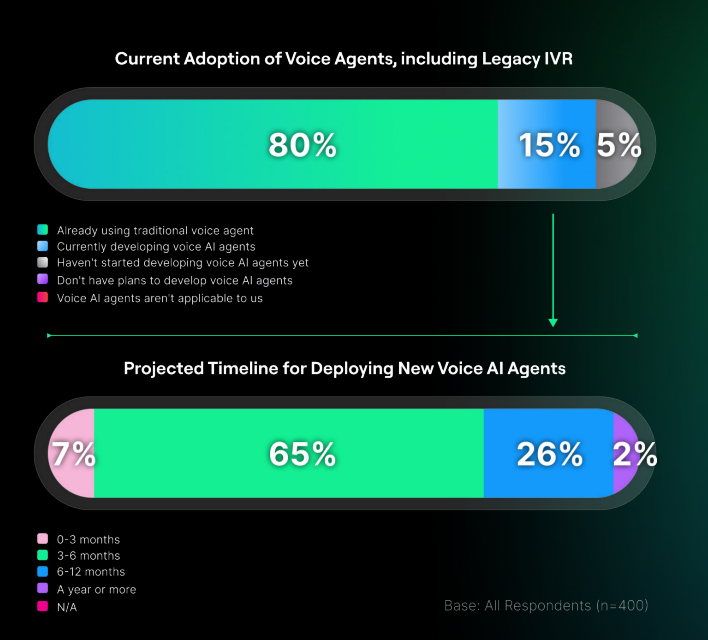
For customers, this means "no waiting time" or pressing zero for human agents. Voice AI reduces friction and gets callers straight to resolution through natural conversation. In fact, 70% of customers prefer AI-powered systems for fast and better resolution.
And, brands using conversational AI have reported double-digit lifts in CSAT and NPS.
Customers don't think in channels--they just want answers. IVR systems never bridged the gap of personalization and omnichannel communication
Sixty-six per cent of consumers use at least three communication channels to contact a company, making gathering and correlating information increasingly difficult.
Imagine calling your favourite coffee store, they greet you by name, already see your last order from the app, ask if you want the same drink, and proactively apologize for the delayed delivery you reported via chat yesterday.
Voice AI bridges this gap by mining calls, emails, chat logs, agent notes, surveys, and behavioural signals, unifying them into a single, continuously updated customer profile. According to Zendesk, 85% of CX leaders say memory-rich AI builds deeper relationships.
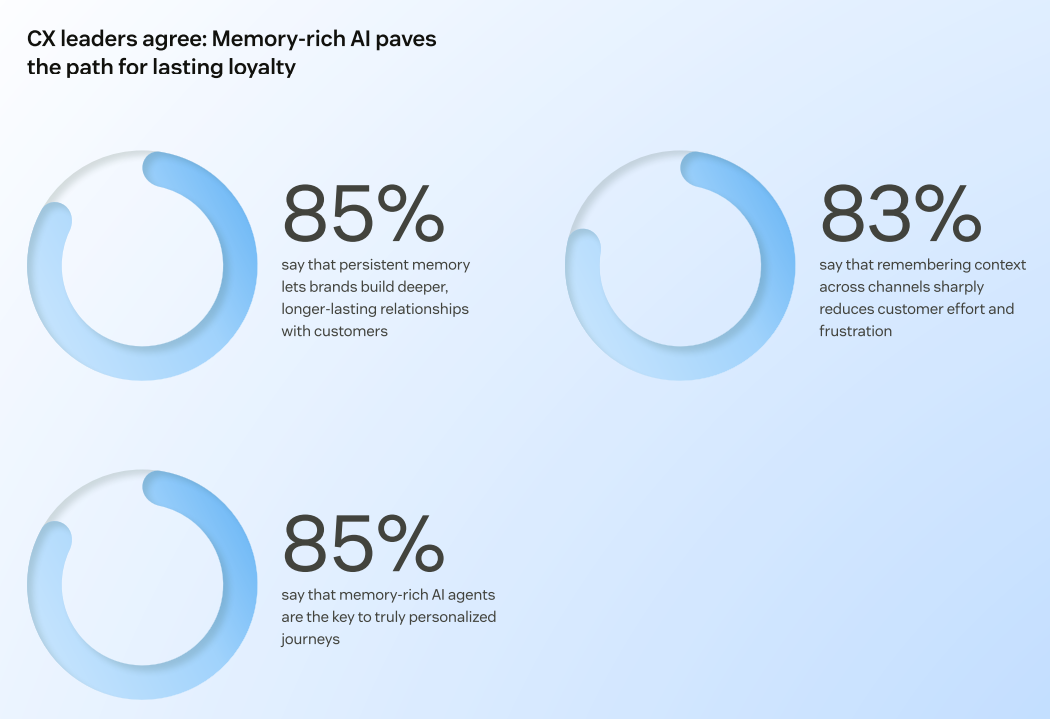
This continuity is the backbone of true omnichannel service and one of the clearest advantages voice AI agents hold over IVR.
Updating IVR menus can take weeks or even months. Every menu change requires vendor inputs, IT tickets and testing across multiple branches. By the time the menu updates, many customers may have already started looking for support for the new update.
With Voice AI, new updates, product launches, or compliance updates can be implemented in hours, sometimes minutes, without a major development cycle.
For businesses spanning multiple regions or operating under strict regulatory frameworks, this level of agility isn't just a nice-to-have—it's a competitive necessity. The ability to adapt quickly reduces friction, minimizes operational bottlenecks, and directly lowers the cost of running the business.
IVR could only handle the simplest tasks, such as checking a balance, confirming an order or routing a call. The moment customers need something complex, the burden falls on human agents, leading to high workload and burnout.
A recent Custify interview found that 86% of customer success managers are considering quitting in 2025, while call centres typically experience annual attrition rates of 30–45%, more than twice the average seen in most other sectors.
This is where voice AI can make a meaningful difference. Rather than replacing agents, it acts as a force multiplier by removing the most draining parts of the job:
By offloading administrative burden and repetitive interactions, voice AI helps agents focus on what they do best, solving complex problems and building human connections. The result is a healthier workforce, lower attrition, and a better customer experience for everyone involved.
At Retell, we've built a voice AI platform that solves the frustration that IVR created.
Our AI agent combines advanced agentic AI technology, deep integrations and agile operations to help contact centres deliver service that's faster, more human and infinitely more scalable than IVRs.
Let’s face it–today’s customers don't want to be bounced around through clunky phone menus.
Legacy IVR systems that force people through inflexible menus and rely on key-press inputs frustrate your customers and put an unnecessary burden on your human agents.
The shift from voice AI technology takes us from scripting conversations to actually understanding them and resolving them in real-time, resulting in superior customer experience and reduced wait times.
Hundreds of businesses have already replaced their IVR with Retell voice agents and automated at least 50% of their calls and quadrupled their employees' efficiency. The question is no longer if IVR should be replaced. Rather, it's how quickly you can make the move.
For what callers can complete without an agent, see self service IVR.
Customers often struggle with long menu trees, ambiguous options, and repeated prompts that fail to understand intent. From a business perspective, even small changes, such as adding a new menu option, require IT intervention, testing cycles, and vendor coordination. This makes legacy IVR slow to adapt in an era where customer needs and product offerings change rapidly.
Beyond 2026, IVR is expected to become largely invisible to customers. The focus will shift from "navigating a system" to "having a conversation." As Voice AI matures, IVR will evolve into a dynamic orchestration layer that blends automation, human support, and omnichannel context into a single, seamless experience. The term "IVR" may remain, but the experience itself will look nothing like what customers associate with it today.
For the outbound side, outbound IVR calls covers where they still work and where a voice agent beats them.
Voice AI replaces rigid menu navigation with natural conversation. Instead of pressing numbers, callers speak freely and are understood in context. Voice AI recognizes intent, sentiment, and nuance, allowing it to respond intelligently or take action in real time. It also retains context across interactions, reducing repetition and ensuring smoother handoffs when escalation to a human agent is needed.
Modern Voice AI can resolve a large percentage of customer issues end-to-end. Through deep integrations with CRMs, ERPs, and support tools, Voice AI can check order status, authenticate users, issue refunds, update tickets, and trigger workflows in real time. Routing is only one function; resolution is the real value.
No—Voice AI is not replacing agents; it's augmenting them. By handling repetitive, low-complexity interactions and administrative work, Voice AI reduces burnout and attrition. Human agents are then free to focus on empathy-driven, complex problem-solving where they deliver the most value.
See how much your business could save by switching to AI-powered voice agents.
Total Human Agent Cost
AI Agent Cost
Estimated Savings
A Demo Phone Number From Retell Clinic Office