Kore.ai Review 2026: Pros, Cons, Features & Pricing
11
MIN READ
September 28, 2026
Kore AI is a big name in the conversational AI market, and for good reason. It helps enterprise teams with communication across chat, messaging, and voice channels.
But, that type of scale comes with a serious price tag. A typical enterprise deal with Kora.ai starts at over $300,000 a year. This is a major multi-year budget commitment.
Getting started with Kore AI reflects the same level of complexity. It's definitely not a plug-and-play situation. The setup requires deep specialized expertise to configure everything from the language models and dialogue flows to the knowledge bases and all the automated workflows. This isn't a tool for a generalist; it's built for a team of specialists.
While Kore AI specialises in omnichannel communication, voice has become a critical touchpoint for businesses in 2026. If you're looking for an enterprise-grade, voice-first platform with quick deployment, low latency, and high customisation at a fraction of Kore AI's cost, then Retell AI is the way to go.
In this Kore AI review, we’ll walk you through its features–covering the setup, pricing, and overall performance.
Kore AI is a leading conversational AI platform that lets businesses design, build, and deploy intelligent chatbots and voice assistants across 30+ channels from a single configuration.
Its clients include giant technical teams or Fortune 500 companies that demand custom setups.
With Kore AI, you can integrate artificial intelligence in all parts of business systems, including:
Example: Automation of routine internal queries (password resets, leave requests, ticket updates).
Example: Customer-facing AI agents (voice & chat) for support, sales, and service.
Example: Ability to build custom agents tailored to specific business processes.
Kore AI eliminates the grunt work so your human reps can actually focus their resources on what matters – building relationships and closing deals.
Kore AI is a fancy IVR system. It enables you to create AI agents that sound human, handle natural conversations, and plug seamlessly into your existing AI IVR system, elevating your organization's customer service experience.
Kore AI now sells the Kore.ai Agent Platform, Artemis edition, which launched in May 2026 and replaces the Experience Optimization (XO) name. The platform provides tools for designing, testing, training, deploying, analyzing, and managing AI agents, and it pairs multi-engine Natural Language Understanding (NLU) with capabilities that interpret user intent and deliver quick, accurate resolutions.
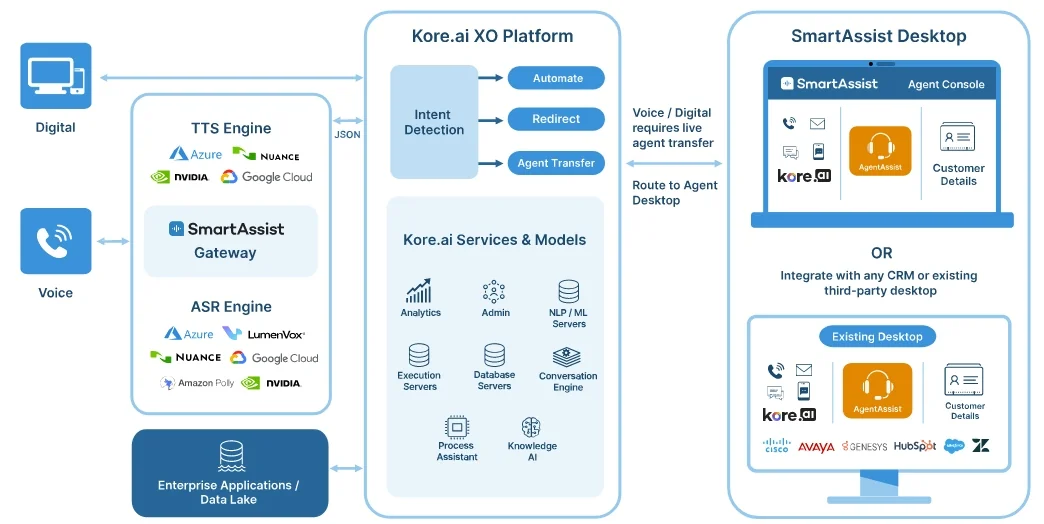
The following features enable the seamless integration of your Assistants with your existing IVR:
The ASR engine compares speech input against predefined possibilities and converts it into text. Beyond transcription, users also receive additional data from the ASR engine, enabling them to tailor conversation flows and enhance the overall user experience.
When the IVR is active, prompts defined in the flow are combined into a single message and delivered to the AI Agent. The flow transitions seamlessly from the Welcome Voice Flow to the Automation Node without losing user input, maintaining a seamless user experience.
Kore AI equips enterprises with tools to develop and manage top-tier AI systems, including chatbots and voice assistants. Let's break them down:
With Kore AI, users can design, train, deploy, and analyze virtual assistants all within a single environment. You can combine the power of your LLM, such as GPT-4, with Kore AI's built-in NLU to provide more contextual, human-like responses. It's a powerful feature for orchestrating complex, enterprise-level bots.
Businesses can also design their voice engine by choosing their ASR and TTS, such as Google Speech-to-Text, or using text-to-speech providers like Amazon Polly, based on their accuracy, language, or budget needs.
While this looks tempting, it can take at least 6-18 months to set up Kore AI in complex business scenarios. A balance between flexibility and quick setup is important.
Retell AI also offers developer-focused flexibility, including direct control over conversation events, real-time callbacks, LLM chaining, custom logic, and fallback code. It's a plug-and-play setup that lets teams control the entire call logic programmatically and deploy quickly.
Kore AI's omnichannel support is powered by its Experience Optimization (XO) Platform. It's a unified platform that serves as the central intelligence layer, connecting voice, chat, messaging apps, mobile, web, email, and social platforms into a single, seamless ecosystem.
Instead of creating separate bots for each channel, you design your virtual assistant once and deploy it everywhere.
You can seamlessly communicate on 35+ voice and digital channels in 100+ languages while offering flexibility to customize responses and use the unique UI elements of each channel, including:
You can measure your bot's performance by tracking bot engagement, conversational analytics, and functional analytics on the XO platform.
Kore AI integrates seamlessly with major telephony and contact center systems, such as Genesys, Twilio, and AudioCodes, and provides its own Voice Gateway for end-to-end control of the voice channel.
Developers can configure listening rules, prompt variations, and silence handling to ensure the bot behaves consistently even in noisy or high-volume environments. The Kore AI XO Platform supports about 120 languages, with more coming soon.
You can also add multiple languages to your virtual assistant and even build language-specific models for 25+ popular languages.
Kore AI isn't a voice-first platform, and it shows in its voice quality and latency. On average, it provides a latency of 800-1000ms, which can increase based on your on-prem setup. For example, using Azure TTS can lead to "several seconds" of delay in voice bots.
Kore AI gives you the freedom to choose from 70+ prebuilt connectors and 200+ agent templates without additional custom development.
Its integrations include:
For businesses that want to bring their own setup, it might be challenging, since Kore AI primarily relies on its default providers. This forces businesses to adapt their phone systems to the capabilities of the Kore AI integration.
Kore AI offers a tricky pay-as-you-go pricing plus the features you need–whether you're just testing the waters or launching fully-fledged Kore AI bots across channels, there's a plan for you.
The following are the available plans and their features:
If you're simply experimenting, the free plan is a great way to understand Kore AI features. You get 5000 requests per month, with features such as conversation designer, dialogue builder, Knowledge Graph, and Multi-engine NLP. It's perfect for running small-scale projects, but many users have found it limiting for fully understanding Kore AI.
It uses pay-as-you-go pricing, starting at a minimum purchase of $100. This plan gives you access to almost all features of the enterprise plan except Topic Modeler, AD Sync, and Cloud Connector. It provides basic support, but if you want weekday email support, you can opt for the Standard Support for $1,000 per month.
It's a custom pricing model tailored to your business needs, offering higher usage limits, enterprise-grade security, topic modeler, and advanced features like Universal Bots and Topic Modeler. The Enterprise plan includes 24*7 premium support via email, phone, or video.
These enterprise contracts start at $50K–$300K+ annually, requiring a major investment before proving ROI. With custom, non-usage-based pricing, it's also hard to forecast actual costs.
Retell AI offers a transparent, usage-based pricing model, which can be more cost-effective than Kore AI's tiered pricing for businesses with fluctuating call volumes.
Kore AI provides limited features in the free plan that actually help you understand the platform. And its standard and enterprise plans are so expensive that even trying them can cost thousands of dollars.
On the other hand, Retell AI is praised for its affordability, ease of use, customer support, and integration capabilities.
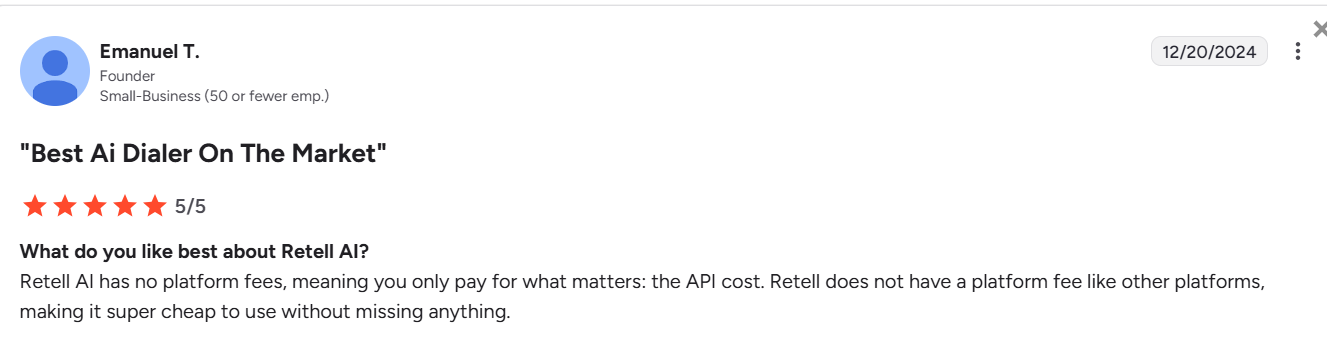
Retell includes these capabilities in the platform, with optional add-ons priced separately:
Our pricing plan also includes a dedicated voice agent cost calculator, which lets you check pricing based on the number of calls, LLM, voice engine, and telephony used.
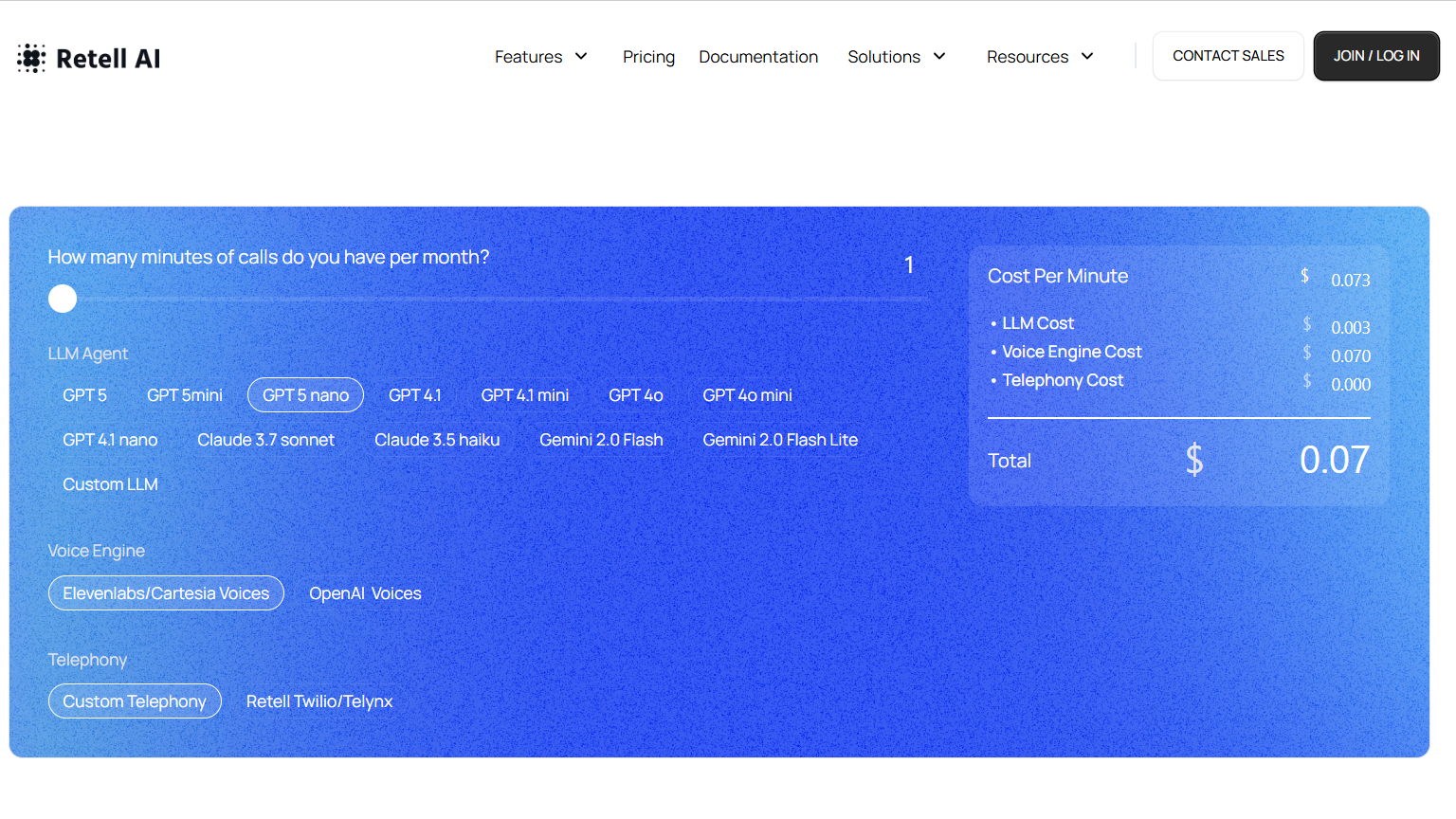
Retell is free to build and test on, with a developer credit to cover early usage. Phone testing needs a card on file. Calculate your voice agent pricing from here.
Kore AI positions itself as an enterprise-grade platform, but its voice user interface has both strengths and clear tradeoffs.
The platform offers a visual flow builder that helps teams design multi-turn voice interactions using intents, nodes, and conditional logic.
You can define what should happen before the call connects, how the bot handles live user input, and what actions should trigger after the conversation ends, such as pushing data into your CRM or triggering an outbound ticket.
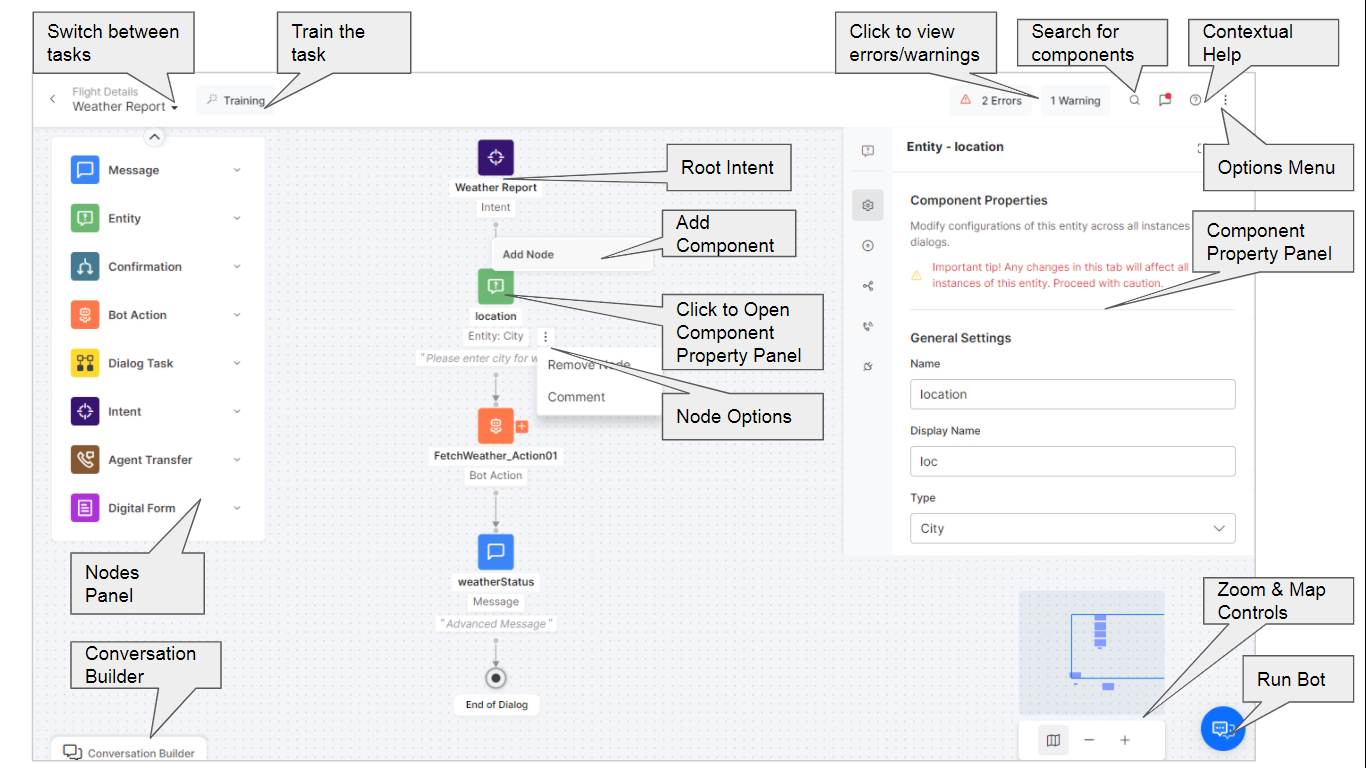
But despite strong architectural capabilities, many enterprise users report latency spikes, particularly when the bot relies heavily on third-party APIs. The platform can quickly become overwhelming for beginners handling complex configurations.

Kore AI offers extreme flexibility, deep integration, and omnichannel communication— but once you put it in front of customers, the cracks show immediately. Many users have experienced latency spikes and bot-like voices that cause customers to drop off within the first few seconds.
Compared to Retell, which gives similar customisation features, with low latency, quick setup, and voices that feel more natural– less of that awkward lag. One of the biggest reasons businesses choose Retell AI over Kore is its natural conversational style.
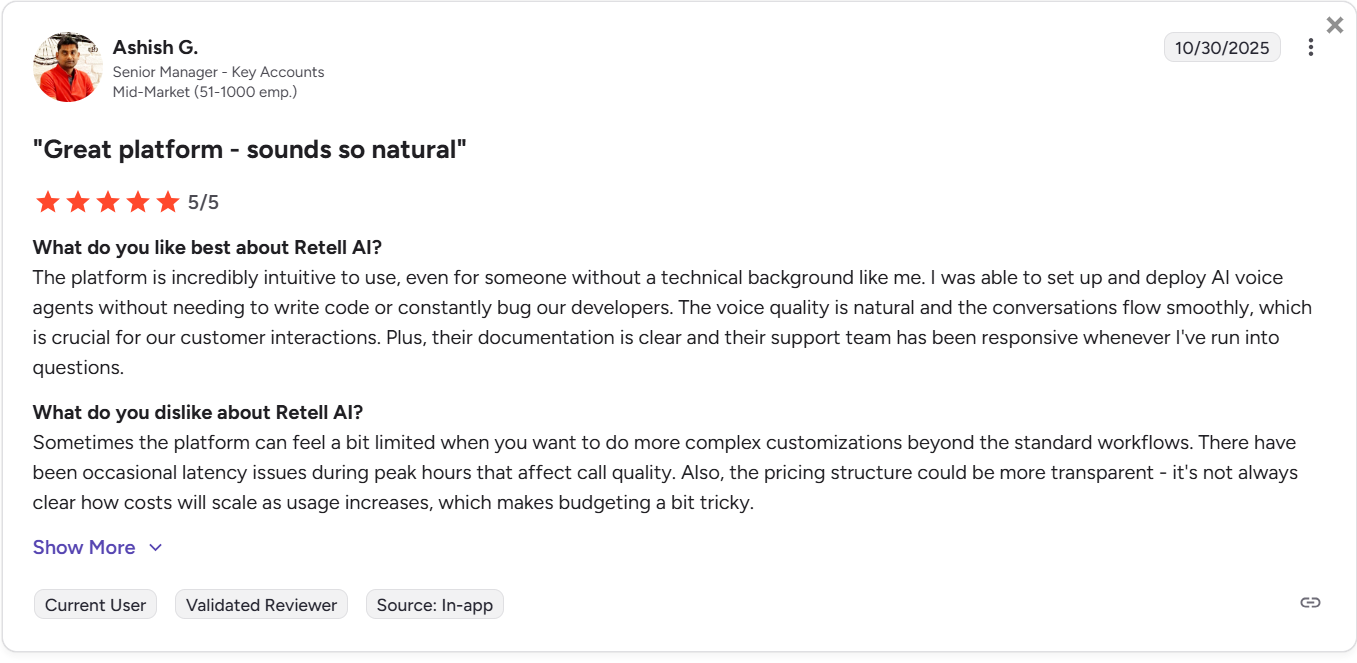
A user mentions how easy it is to scale with Retell AI:

Retell's robust performance with sub-second latency and multilingual conversational AI support makes it easier to reach a wider audience. Retell includes 20 concurrent calls, with additional concurrency at $8 per call per month. Enterprise agreements raise the ceiling.
Retell has successfully served large enterprises such as Everise, which operates a call center with over 20,000 employees, making it an ideal choice for enterprise clients.
Kore AI provides robust security features that work for everyone, whether small-scale or enterprise. Besides fulfilling basic security compliances like SOC 2 Type II, HIPAA, GDPR, and ISO 27001, it extends its capabilities to other extraordinary security features like:
Owing to such high security levels, top financial institutions, healthcare, and telecom businesses are using Kore AI.
Kore AI offers multiple support channels, including a dedicated help desk, a documentation library, community forums, and email support.
But it all depends on the plan you choose: community, standard, or enterprise. For instance:
However, Kore AI support has its weak spots. Your support experience often depends on ticket priority and your subscription tier. If your team needs frequent hand-holding, instant fixes, and precise troubleshooting, Kore AI's support can feel heavy and process-driven.
Retell AI was built with enterprises in mind, offering:
Retell AI is known for its quick, live chat onboarding and fast, reliable service to help teams launch smoothly.
Like everything in life, Kore AI comes with tradeoffs — here's a look at its pros and cons list:
Retell is purposely built for phone and voice workflows. Besides being a low-code AI voice platform that delivers enterprise-level flexibility and customisation, it delivers ultra-low latency, ideal for real-time call environments such as healthcare, finance, or logistics.
Retell AI brings everything Kore AI falls short on. Here are some of its features:
Retell AI is the top alternative to Kore AI due to its focus on voice, its low latency, and its flexible API.
The platform is designed to provide a seamless, natural conversational experience with transparent pricing and a commitment to quality, making it a preferred choice for various enterprise clients.
| Category | Retell AI | Kore AI |
|---|---|---|
| LLM Model & Intelligence | Always uses the latest LLMs with real-time updates for better accuracy | Relies on older NLU pipelines unless upgraded manually |
| Custom LLM Integration | Fully supported—plug in any preferred LLM with minimal configuration | Available only in higher-tier enterprise plans and requires technical setup |
| Telephony Infrastructure | Native SIP trunking with low-latency call routing | No native telephony |
| IVR & DTMF Support | Built-in IVR with accurate DTMF tone recognition | Supported but often depends on external telephony configuration |
| Pricing Transparency | Simple usage-based pricing | Custom, harder-to-predict pricing with add-on costs |
Looking for scalable, reliable, enterprise-grade voice automation? Talk to our sales team now!
See how much your business could save by switching to AI-powered voice agents.
Total Human Agent Cost
AI Agent Cost
Estimated Savings
A Demo Phone Number From Retell Clinic Office