AI Voice Agent RFP Template and Pilot Scorecard
A downloadable RFP template and pilot scorecard for AI voice agent vendors: questions to ask, what to test in a pilot, and how to score it.
An AI voice agent RFP template is a fixed set of questions you send to every voice AI vendor so their answers can be scored side by side. A pilot scorecard is the list of tests, each with a pass threshold you set in advance, that the finalists must pass on real calls before you sign. This page gives you both in one workbook.
Download the AI voice agent RFP template and pilot scorecard (Excel, .xlsx). There is no form and no email step.
Retell AI publishes this template and is one of the vendors you might send it to. The workbook contains no Retell answers and no vendor names in its questions, so you can send the same file, unchanged, to every vendor on your list.
For the method behind the tests, read how to evaluate an AI voice agent platform before going live. This page is the working document for that process.
What is in the workbook?
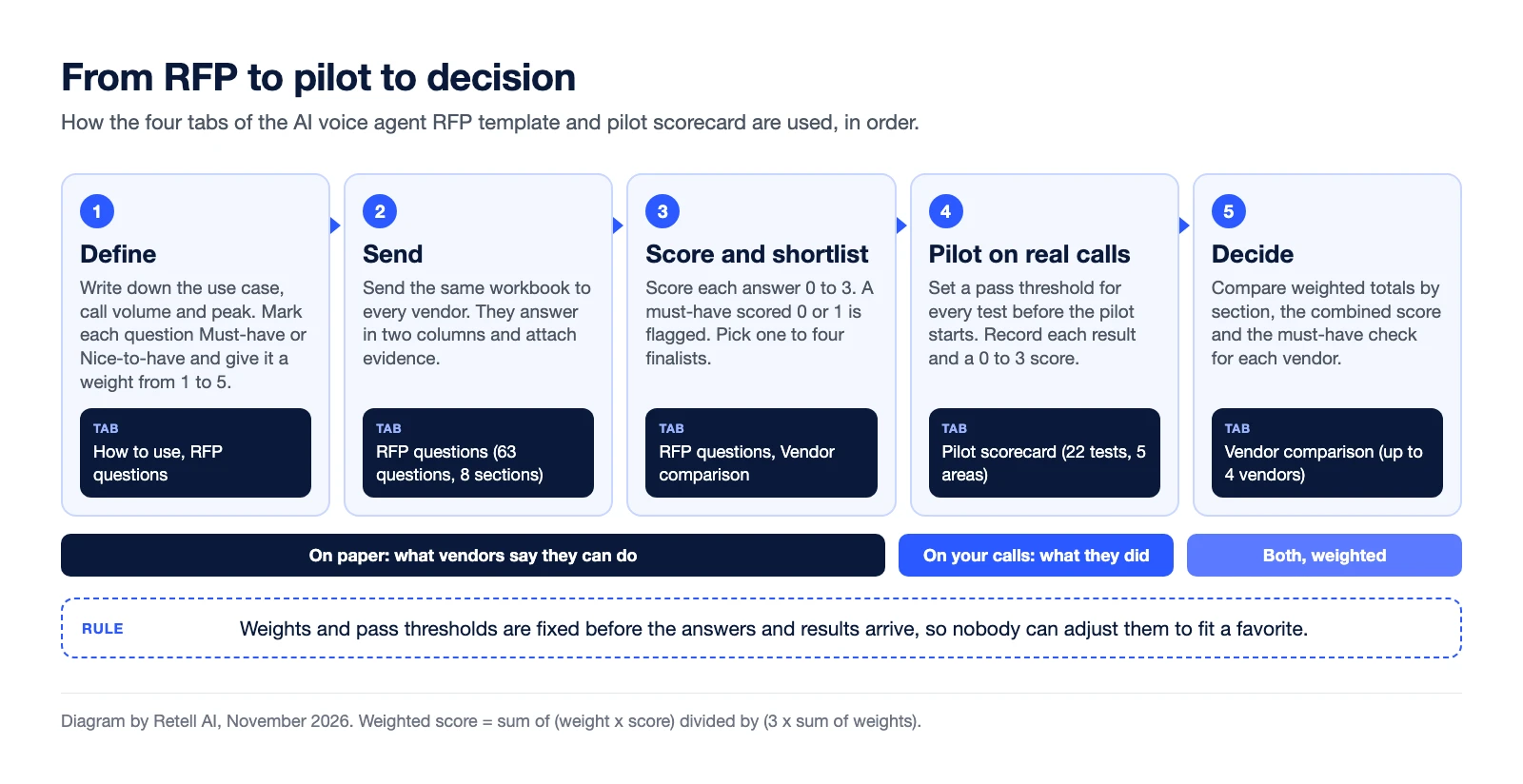
The workbook has four tabs. Vendors type in two columns of one tab. Everything else is yours.
| Tab | What it holds | Who fills it in |
|---|---|---|
| How to use | Instructions for buyer and vendor, the 0 to 3 scoring scale, and a buyer details block (use case, monthly volume, peak concurrent calls, systems, regulations) | Buyer, before sending |
| RFP questions | 63 questions in 8 sections, each with why it matters, a priority and a weight | Vendor answers and adds evidence. Buyer scores each answer |
| Pilot scorecard | 22 tests in 5 areas, each with how to measure it and a blank cell for your pass threshold | Buyer, with up to four finalists |
| Vendor comparison | Weighted totals by section for up to four vendors, a must-have check and a combined score | Calculated by formula |
Every answer and every test is scored from 0 to 3 and carries a weight from 1 to 5. A vendor's weighted score is the sum of weight times score, divided by three times the sum of the weights, shown as a percentage. The suggested priorities and weights are a starting point. Change them to match your own risks before you send anything.
What should an AI voice agent RFP ask?
An AI voice agent RFP should cover eight areas: the company and its security, telephony and integrations, agent quality, latency and reliability, analytics and QA, compliance, pricing and commercial terms, and support. The template has questions for each.
| Section | Questions | Example of what the template asks |
|---|---|---|
| Company and security | 9 | Is our call data used to train or improve any model, yours or a third party's? State the default, the contract language and how to opt out. |
| Telephony and integrations | 9 | Can we keep our existing phone numbers and carrier? Describe SIP trunking options, number porting and any numbers you provide. |
| Agent quality | 9 | Who on our team could make a change to the agent without your help, and what skills do they need? |
| Latency and reliability | 7 | Provide measured response latency on phone calls, median and 90th or 95th percentile, and say how it was measured. |
| Analytics and QA | 7 | Can calls be scored against criteria we define, and on what share of calls? |
| Compliance | 7 | How are AI disclosure and call recording notices configured, and can they differ by state or country? |
| Pricing and commercial terms | 8 | Estimate our total monthly cost at the volume and call length in this RFP. Show your assumptions. |
| Support and services | 7 | What deployment help is included, and what is billed separately? |
Each question asks the vendor to describe or show something, so a one-word "yes" is not an acceptable answer. Three areas deserve more weight than most buyers give them:
- Who can change the agent after launch. Once every shortlisted vendor sounds good on a call, how fast and how safely your team can change the agent becomes the deciding factor.
- The full monthly cost. A per-minute headline rate can leave out speech, model, telephony and testing charges. Ask for one number at your volume, and check it against what you are actually paying for on a voice AI platform.
- Security and compliance documents. Ask for the reports and agreements themselves. The enterprise voice AI compliance guide explains what each document covers. Confirm your own legal requirements with counsel.
How do you send and score the RFP?
Decide what matters before any vendor answers, then score every response against the same scale.
- Fill in the buyer details on the first tab, so every vendor quotes against the same use case, call volume and peak.
- Mark each question Must-have or Nice-to-have and set its weight. Delete questions that do not apply.
- Send the same workbook to every vendor with the scoring columns blank.
- Score each answer: 0 for no answer or does not meet, 1 for partly meets or roadmap only, 2 for meets with evidence you could verify, 3 for meets and you have seen it working for your use case.
- Read the Vendor comparison tab and pick your finalists.
The must-have check works apart from the total. A vendor that scores 0 or 1 on any must-have is flagged, even if its weighted score is the highest. Resolve the gap or drop the vendor.
How do you run a pilot, and what should you test?
Run the pilot on one use case with real calls, and write the pass threshold for every test before the first call. The scorecard groups 22 tests into five areas:
- Task completion. Does each scenario pass on every repeated run, and is the booking or update correct in your own system? Review transcripts for invented facts and out-of-scope answers.
- Conversation quality. Response latency on real phone calls, interruptions, and capture of names, numbers and dates. The voice AI latency benchmarks guide shows how to measure latency from the caller's side.
- Telephony and integration. Your numbers and carrier, reads and writes to your systems, peak concurrency, and transfers to your human team on real phone lines.
- Operations and ownership. Have your own team fix one failed call, test the fix, publish it and roll it back, and time the whole loop.
- Reliability, compliance and cost. Incidents during the pilot, disclosures on sampled calls, and the pilot invoice compared with the quote.
The pilot scorecard is not a call quality form. To grade individual calls during the pilot, use the voice agent QA scorecard and feed its results into the tests above.
How do you score the pilot and compare vendors?
Score each pilot test against the threshold you wrote down: 0 if it failed or could not be run, 1 if it fell below your threshold, 2 if it met it, 3 if it beat it with room to spare on repeated runs.
The scorecard has a column of example thresholds, such as "36 of 40 scenarios pass on all three runs." These are examples of how to word a threshold. They are not industry standards. Set your own from how the same calls perform today and from what a failed call costs you.
The Vendor comparison tab then shows, for each vendor, the RFP score by section, the pilot score by area and a combined score. The combined score uses a split of 40 percent RFP and 60 percent pilot as an example. Change the split to suit your decision. A vendor with no pilot shows "No pilot" in place of a combined score, so a strong written response cannot outrank a tested one by accident.
This scorecard helps you choose a vendor. Once you have chosen, the pilot-to-production scorecard covers when to send the agent more traffic.
What mistakes weaken a voice AI RFP?
Most weak RFPs fail in the same few ways:
- Yes or no questions. Every vendor answers yes. Ask how, and ask for evidence.
- Weights set after the responses arrive. It becomes easy to tune the weights until a favorite wins.
- Scoring the demo. A demo runs the easy path once. Score the pilot.
- Thresholds written after the results. A threshold chosen afterward will always be met.
- No question about ownership. If only the vendor can change the agent, every fix waits in their queue. See who owns the voice agent after launch.
- Comparing headline rates. Compare the estimated monthly cost of running an AI voice agent at your own volume.
- Security review left until after the pilot. Run it in parallel, so a late finding does not waste the pilot.
Frequently asked questions
What is an AI voice agent RFP?
An AI voice agent RFP (request for proposal) is a document a buyer sends to voice AI vendors that lists its requirements and asks each vendor to respond in the same format. It usually covers security, telephony, integrations, agent quality, reliability, analytics, compliance, pricing and support, so the responses can be scored and compared.
Do you need an RFP to buy an AI voice agent?
Not always. If you have one use case and two or three vendors in mind, the pilot scorecard alone may be enough, with the must-have questions sent by email first. A full RFP earns its time when procurement, security and legal all need written answers, or when several teams have to agree on the choice.
How many vendors should receive the RFP?
Send it to as many vendors as you can score carefully. The comparison tab has columns for four. Keep the pilot smaller than the RFP, because each pilot takes real calls and staff time from your team.
What is the difference between a pilot scorecard and a QA scorecard?
A pilot scorecard grades a vendor: it lists the tests a platform must pass before you sign. A QA scorecard grades a call: it lists the criteria one conversation is judged against. During a pilot you use both, and the QA results become evidence for several pilot tests.
Can you change the questions, weights and thresholds?
Yes. Delete what does not apply, reword questions for your industry and set your own weights. To add a question or a test, insert a row inside the table so the totals include it. Fix the weights and thresholds before vendors respond, then leave them alone.
Send it to your shortlist
Download the AI voice agent RFP template and pilot scorecard (Excel, .xlsx) and send it to every vendor you are considering.
If Retell AI is on that list, send us the same workbook and ask for a pilot on real calls, scored against your own thresholds. Talk to the Retell team about a pilot.