Best Bland AI Alternatives in 2026 (Ranked)
8
MIN READ
October 12, 2026
The question behind “what are the alternatives to Bland” is usually not which platform sounds best. It is which one you can still change in six months.
Voice platforms differ most in what they lock down: the voice, the language model, the workflow logic, the contract. A platform that runs its own stack end to end gives you one set of choices and no way to revise them. A platform that stays provider-agnostic gives you the opposite. That distinction decides more migrations than call quality does.
This comparison sorts the alternatives by what each one hands you and what each one keeps. With Retell, a change does not become a ticket, a queue, or another SOW.
Enterprise leaders are no longer experimenting with voice AI, they’re operationalizing it with expectations of fast deployment, hyper-scalability, and immediate time to value. Bland AI helped define the programmable voice category.
Bland sells enterprise-first, which works well if you can commit to an enterprise agreement on day one. Teams that want to prove a use case on a few thousand calls and keep month-to-month terms need a platform that starts small and scales after the proof, not before it.
That is the structural difference. You should be able to run the thing on your own calls before you sign anything.
Six questions that come up repeatedly once teams are past the demo and into production. They apply to any vendor on this page, including us.
These issues have caused many enterprise teams to pivot toward more reliable, integration-ready platforms that offer built-in testing, better multilingual coverage, real-time fallback, and more capabilities that platforms like Retell AI have made standard.
When evaluating alternatives to Bland AI, organizations should focus on platforms purpose-built for enterprise environments. Consider these five pillars:
SOC 2 and HIPAA are the ones every vendor page lists. They are rarely what holds up a contract. These are:
Ask for each in writing during evaluation rather than during redlining. The gap between “compliant” on a marketing page and what a vendor will actually sign is where voice deals stall.
This comparison table highlights key voice and conversational AI platforms that are commonly considered alternatives to Bland AI, focusing on what they’re best suited for, ease of use, conversation capabilities, pricing clarity, and general market adoption.
| Platform | Best For | Ease of Use | Conversation Quality | Pricing Transparency | Market Adoption |
|---|---|---|---|---|---|
| Retell AI | Enterprise-ready voice automation and phone call workflows | Moderate (API and dashboard support) | High (natural, low-latency voice) | Clear usage-based pricing available | Widely used across support and sales teams |
| Replicant | Contact-center automation for support call flows | Moderate (prebuilt templates) | Good for structured customer calls | Standard vendor pricing | Adoption in contact center use cases |
| Five9 IVA | AI virtual agents integrated with contact center suite | Moderate to complex (contact center toolchain) | Good within the Five9 ecosystem | Enterprise pricing models | Strong among legacy contact center customers |
| Dialpad AI Voice | Unified communications with built-in voice AI | Easy to moderate (UCaaS integration) | Good (real-time transcription and AI features) | Transparent for UCaaS users | Used by teams with existing Dialpad deployments |
| Twilio + Flex | Custom voice automation for developer teams | Complex (full customization) | Varies by implementation | Pay-as-you-go, transparent API pricing | Popular among developer-centric teams |
| Voximplant VoiceAI | Global speech infrastructure with AI automation | Moderate (SDK and console) | Good (speech recognition focus) | Transparent usage pricing | Used by international teams needing flexible deployment |
| Synthflow AI | No-code and low-code AI voice workflows | Easy (visual builder) | Good (automation-friendly voice) | Clear pricing information | Growing adoption among SMBs and automation teams |
| Droxy AI | AI-driven voice and multichannel interactions | Easy (ready-to-deploy) | Good customer interaction automation | Standard published pricing | Emerging alternative among SMBs |
| Air AI | High-volume AI calling focused on scale | Moderate (developer and product use) | Good (optimized for volume) | Not clearly published | Early adoption among scale-focused teams |
The rate matters less than the shape of the commitment. Bland’s model favours volume committed up front: a platform fee, a lower per-minute rate underneath it, and a preference for longer terms. That is efficient once your volume is known and predictable.
Retell’s model is built for the period before that. A free workspace, no subscription, no platform fee and no feature gating, so every plan opens the entire platform and you pay per minute for what you actually run. Add-ons carry published per-minute rates, so you can cost a deployment before you build it.
The practical question is whether you know your volume yet. Committing to a term you cannot size is the most expensive mistake on this page, and it is the one that is hardest to reverse. Pay per minute while the use case is unproven, then commit once the numbers hold.
Retell AI was purpose-built for modern enterprise phone operations and can function as an AI answering service for high-volume support workflows. The platform combines secure infrastructure, superior voice quality, and the operational tooling needed to scale automation across global teams.
Key Strengths:
Best for: Enterprise teams with complex voice workflows, multilingual needs, and strict security/compliance requirements.
Learn how Retell compares directly with Bland AI in our full comparison guide.

Bland runs its own voice and language models and positions that vertical integration as its advantage. It is a real advantage for consistency. It is also a ceiling: the quality of your agent is bounded by one vendor’s model roadmap, and you cannot swap a component that is not working.
Retell pairs its own contact-centre models with the best frontier model per call, and routes each step of a conversation to the model that handles it best. You pick the stack, and you can change it later without rebuilding the agent.
Replicant focuses on high-volume customer service workflows with an emphasis on prebuilt dialog structures and fast onboarding.
Key Strengths:
Best for: Customer support teams looking for rapid automation of repetitive Tier 1 use cases without the need for heavy customization.
Five9’s Intelligent Virtual Agent solution offers AI enhancements for companies already using Five9 for contact center operations.
Key Strengths:
Best for: Companies already standardized on Five9 infrastructure looking to add voice automation within a unified system.
Pros
Like Five9 VoIP but compromising on the platform? Here’s how Retell integrates seamlessly with enterprise VoIP platforms like Five9, Talkdesk, and NICE to enhance reliability, streamline handoffs, and unify your voice infrastructure with AI automation.

Dialpad offers a unified communications and contact center solution with built-in AI that powers both internal and external voice use cases.
Key Strengths:
Best for: Businesses already using Dialpad that want lightweight voice AI features without deploying a standalone system.

Twilio Flex allows engineering teams to build completely customized contact center and AI workflows from scratch.
Key Strengths:
Best for: Organizations with strong technical teams looking for total control over their voice automation stack.
Ongoing maintenance and custom development required for complex use cases.

Voximplant provides global speech infrastructure with voice automation capabilities tailored for international support environments.
Key Strengths:
Best for: Enterprises serving multilingual markets who want flexible deployment and control over infrastructure cost.

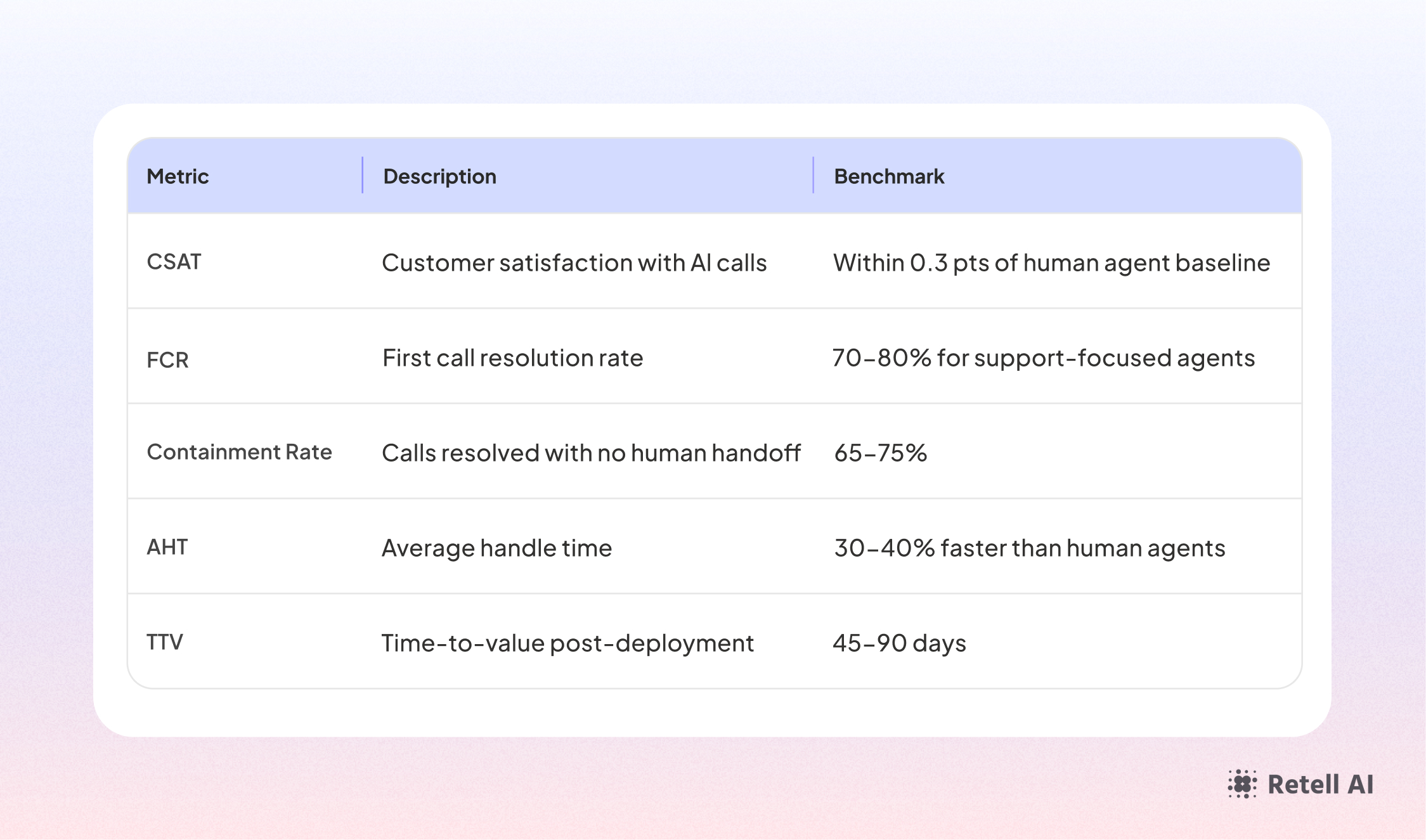
The most common AI agent use case is in customer service (CX), so we will use that as the example benchmark. In a fully scaled CX automation environment, your AI voice agents should:
To sustain that level of performance, teams must track:
You will rebuild rather than lift and shift. Pathways do not port across platforms, so the realistic plan is to re-implement your flows rather than convert them. Teams that budget for a rebuild go faster than teams that discover it in week two.
Phase it by use case. Move one workflow, run it alongside the existing one, compare the call outcomes, then move the next. This is also how you find out which of your current flows were working around a platform limitation rather than solving a real problem.
Carry the recordings and the transcripts, not the configuration. Your call history is the most valuable thing you own from the old platform, because it becomes the test set for the new one.
Retell runs a hands-on support programme for migrations with real volume. Bring your worst calls to it.
Retell AI doesn’t just replace IVRs, it powers natural, multi-turn conversations that sound human, adapt in real time, and drive resolution without sounding robotic.
Voice AI is no longer a nice-to-have. It’s foundational infrastructure for support, sales, and revenue operations. Retell AI is the best Bland AI alternative because it delivers where others fall short: security, scale, naturalness, fallback, and trust all in one conversational AI platform.
Retell AI is already trusted by leading enterprise and B2B organizations across industries like real estate, insurance, SaaS, and e-commerce. Our customer case studies show how teams have scaled call coverage, reduced response times, and improved customer experience using our voice agents in real world operations.
Prove it on your own calls before you sign anything. Start a pilot on the workflow you care most about, run it against your real call volume, and compare the outcomes to what you have now. No enterprise agreement required to find out.
Use our ROI calculator below to project your potential savings and efficiency gains with Retell AI.
See how much your business could save by switching to AI-powered voice agents.
Total Human Agent Cost
AI Agent Cost
Estimated Savings
Ready to see why Retell is the top enterprise alternative to Bland AI? Book your personalized demo and see how we fit your call workflows, tech stack, and compliance goals.
A Demo Phone Number From Retell Clinic Office