Erlang C Calculator for Call Center Staffing
Free Erlang C calculator: enter call volume, handle time and a service level target to get agents required, occupancy and average speed of answer.
An Erlang C calculator works out how many agents a call center needs in one interval to answer a target share of calls within a target time. Enter calls, average handle time and your service level target, and it returns the agents required, the service level they reach, average speed of answer, occupancy and the probability a caller waits.
Enter one interval of demand. Results update as you type. Nothing you enter leaves this page.
- Agents required on the phones
- Agents to schedule, with shrinkage
- Traffic intensity
- Service level achieved
- Average speed of answer
- Occupancy
- Probability of waiting
| Agents | Service level | ASA | Occupancy | Chance of waiting |
|---|
This re-runs the same Erlang C math on the calls that remain. It is arithmetic on your inputs, not a forecast of the share an agent will handle. It keeps the same average handle time; if the calls that remain are the longer ones, raise the handle time above.
Erlang C assumes random arrivals at a steady rate, no caller hanging up and no blocked calls. With real abandonment it tends to ask for more agents than you need. Use it for one interval at a time.
Enter one interval of your forecast in the calculator above. It is free, has no sign-up, and runs in your browser, so nothing you type is sent anywhere.
What is Erlang C?
Erlang C is a formula that gives the probability that an arriving call has to wait, from the workload and the number of agents. It is one of two formulas the Danish engineer Agner Krarup Erlang derived while studying telephone traffic, as the Wikipedia entry on the erlang records. The workload is measured in Erlangs: one Erlang is one agent busy for the whole interval.
What is the Erlang C formula?
Traffic intensity (A, in Erlangs) = calls x average handle time / interval length

Probability of waiting (Pw) =
  (A^N / N!) x N / (N - A)
  divided by
  [ sum for i = 0 to N - 1 of (A^i / i!) ] + (A^N / N!) x N / (N - A)

Service level = 1 - Pw x e^(-(N - A) x target answer time / average handle time)
Average speed of answer = Pw x average handle time / (N - A)
Occupancy = A / N
Agents to schedule = N / (1 - shrinkage)
N is the number of agents and must be larger than A, or the queue never clears. The service level and speed of answer lines are the ones set out in Call Centre Helper's worked example. The factorials overflow quickly, so this calculator uses the recursive form of Erlang B and converts it to Erlang C, which gives the same answer at any size.
A worked example that matches the calculator
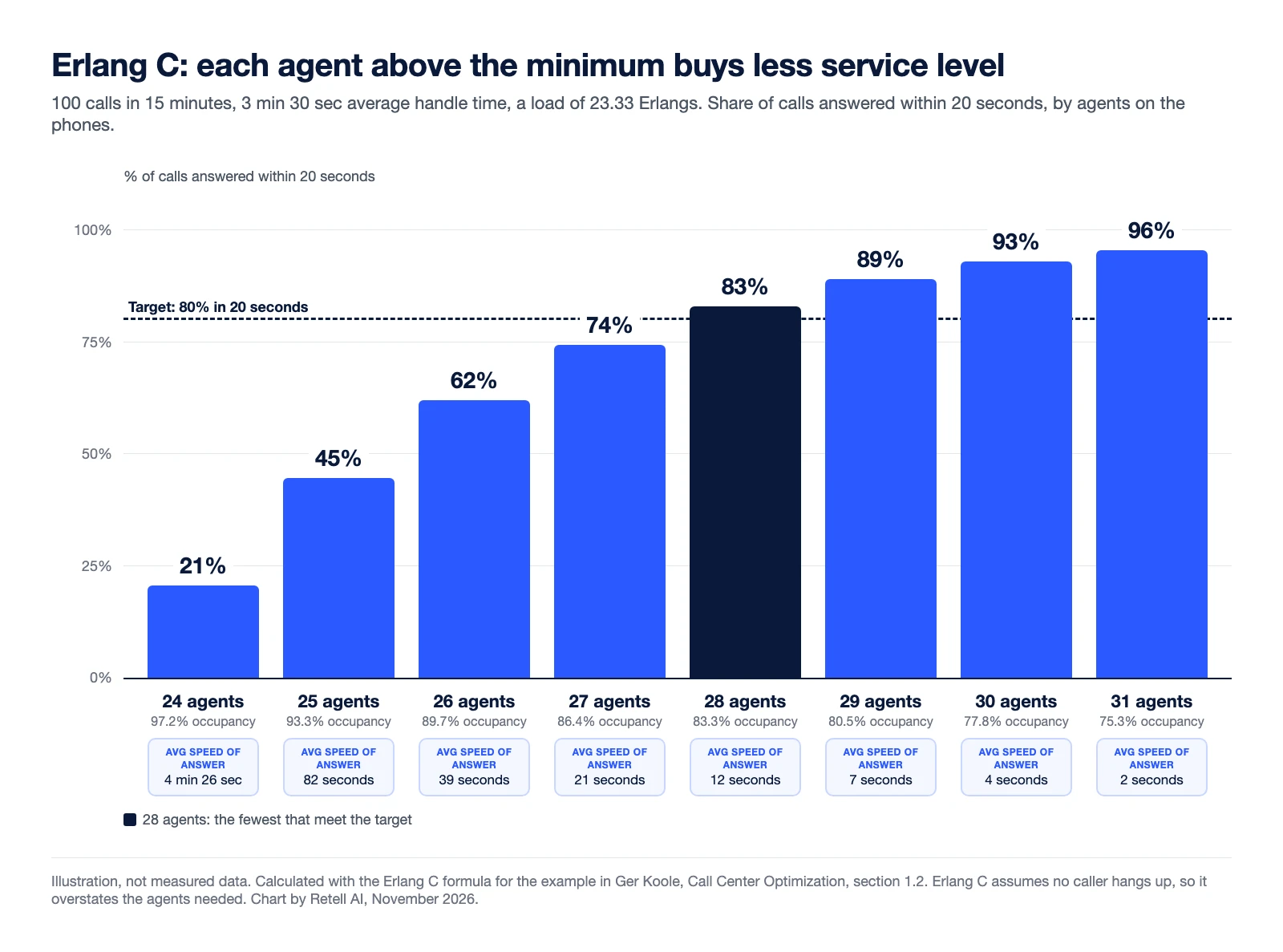
The calculator opens on a textbook case. Ger Koole's Call Center Optimization (section 1.2) takes 100 calls forecast for a 15 minute interval with a handle time of 3 minutes 30 seconds. The load is 100 x 210 / 900 = 23.33 Erlangs, so 24 agents is the bare minimum. The book states that 24 agents answer only about 21% of calls within 20 seconds and that 28 are needed to reach 80%. The calculator returns the same result:
| Agents | Probability of waiting | Answered in 20 seconds | Average speed of answer | Occupancy |
|---|---|---|---|---|
| 24 | 84.6% | 20.6% | 266 seconds | 97.2% |
| 26 | 49.0% | 62.0% | 39 seconds | 89.7% |
| 27 | 36.3% | 74.4% | 21 seconds | 86.4% |
| 28 | 26.5% | 83.0% | 12 seconds | 83.3% |
| 30 | 13.2% | 93.0% | 4 seconds | 77.8% |
With the example 30% shrinkage, 28 agents on the phones means 28 / 0.7 = 40 on the schedule. As a second check, enter Call Centre Helper's case (100 calls in 30 minutes, 180 seconds, 80% in 20 seconds, 30% shrinkage) and you get its published answer: 14 agents, 20 scheduled.
What does Erlang C assume, and where does it go wrong?
Erlang C is the queue that mathematicians write as M/M/n: calls arrive at random at a steady rate, handle times follow an exponential distribution, and, in Wikipedia's words, "callers never hang up while in queue". Real call centers break all three.
- No abandonment. Mandelbaum and Zeltyn's paper on the Erlang A queue says that workforce tools that ignore abandonment "would result in over-staffing as actually fewer agents are needed". Callers who hang up shorten the wait for everyone behind them.
- A steady arrival rate. The formula describes a center running on the same inputs for a long time. Koole notes that a 15 or 30 minute interval will vary around the predicted figure even when the forecast is right.
- One queue, one skill. It has no answer for skills-based routing, callbacks or retries.
Erlang C vs Erlang A vs simulation
| Model | Adds | Use it when |
|---|---|---|
| Erlang C | Nothing: callers wait forever | Abandonment is low and you need a quick, cautious figure for one queue |
| Erlang A | Caller patience, so some calls abandon | Abandonment is material and you can estimate how long callers wait before hanging up |
| Simulation | Any rule you can describe: skills, callbacks, redials, uneven handle times | Routing is multi-skill or the stakes justify the run time |
Erlang A is named for abandonment and, per the same paper, sits between Erlang C and Erlang B. Koole calls simulation essential once skills-based routing is involved, at the cost of long run times.
How should you use the result?
Treat the output as the starting figure for one interval, not a roster.
- Run every interval of the day. Peaks set headcount; quiet intervals show where breaks and training fit.
- Check both limits. If service level is met but occupancy is above your cap, the calculator adds agents and says so.
- Read the table. In the example, one agent fewer costs 8.7 points of service level and one more buys 6, while average speed of answer goes from 12 seconds to 21.
- Build the schedule in a workforce management tool, and plan for the days the forecast is wrong with a high call volume plan.
The second panel answers one more question: what if some calls never reach the human queue? Type your own share and it repeats the math on the calls that remain. In the example, removing 20 of the 100 calls leaves 18.67 Erlangs and 23 agents. That is arithmetic on your inputs. It is not a prediction of what an AI voice agent will handle, and the calls that remain may be longer than the average. Capacity on the agent side is counted differently too: Retell AI's documentation defines concurrency as "the number of simultaneous active voice calls" a workspace can handle, a limit you set, not a headcount.
To test what that share is on your own calls, talk to the Retell AI team about a pilot.