What Is Call Center Shrinkage?
Call center shrinkage is paid agent time not spent available for calls. The formula, a worked example, typical rates, and how to apply it to staffing.
Call center shrinkage is the share of paid agent hours in which agents are not available to handle customer contacts, because of planned time away such as breaks, training and meetings, or unplanned time away such as sickness and lateness. Workforce planners use it to turn the number of agents a staffing model says must be available into the number of agents to schedule.
A staffing model built from automatic call distribution (ACD) volume data tells you how many agents need to be on the phones in each interval. Shrinkage tells you how many more to roster so that those agents are actually there.
How do you calculate call center shrinkage?
Divide shrinkage hours by the hours agents are paid to work. Call Centre Helper gives the formula as:
- Shrinkage (%) = (out-of-center shrinkage hours + in-center shrinkage hours) ÷ total hours available × 100
Its worked example counts every paid working day as available, so the denominator is total paid hours, as in the example below.
Out-of-center (external) shrinkage covers annual leave, public holidays, sickness, absenteeism, lateness and, in Call Centre Helper's list, paid breaks. In-center (internal) shrinkage is time agents are at work but off the phones: unplanned breaks, training, coaching, one-to-ones, team meetings and system downtime. Some planners also split it into planned and unplanned shrinkage.
Call center shrinkage example
One full-time agent paid for 40 hours a week is paid for 2,080 hours a year. The numbers below are illustrative.
| Shrinkage item | Type | Planned or unplanned | Hours a year | Share of paid hours |
|---|---|---|---|---|
| Annual leave (20 days) | Out-of-center | Planned | 160 | 7.7% |
| Public holidays (10 days) | Out-of-center | Planned | 80 | 3.8% |
| Sickness and absence (8 days) | Out-of-center | Unplanned | 64 | 3.1% |
| Paid breaks (30 minutes a day worked) | Out-of-center | Planned | 111 | 5.3% |
| Training | In-center | Planned | 72 | 3.5% |
| Coaching and one-to-ones | In-center | Planned | 52 | 2.5% |
| Team meetings | In-center | Planned | 39 | 1.9% |
| System downtime | In-center | Unplanned | 46 | 2.2% |
| Total | 624 | 30.0% |
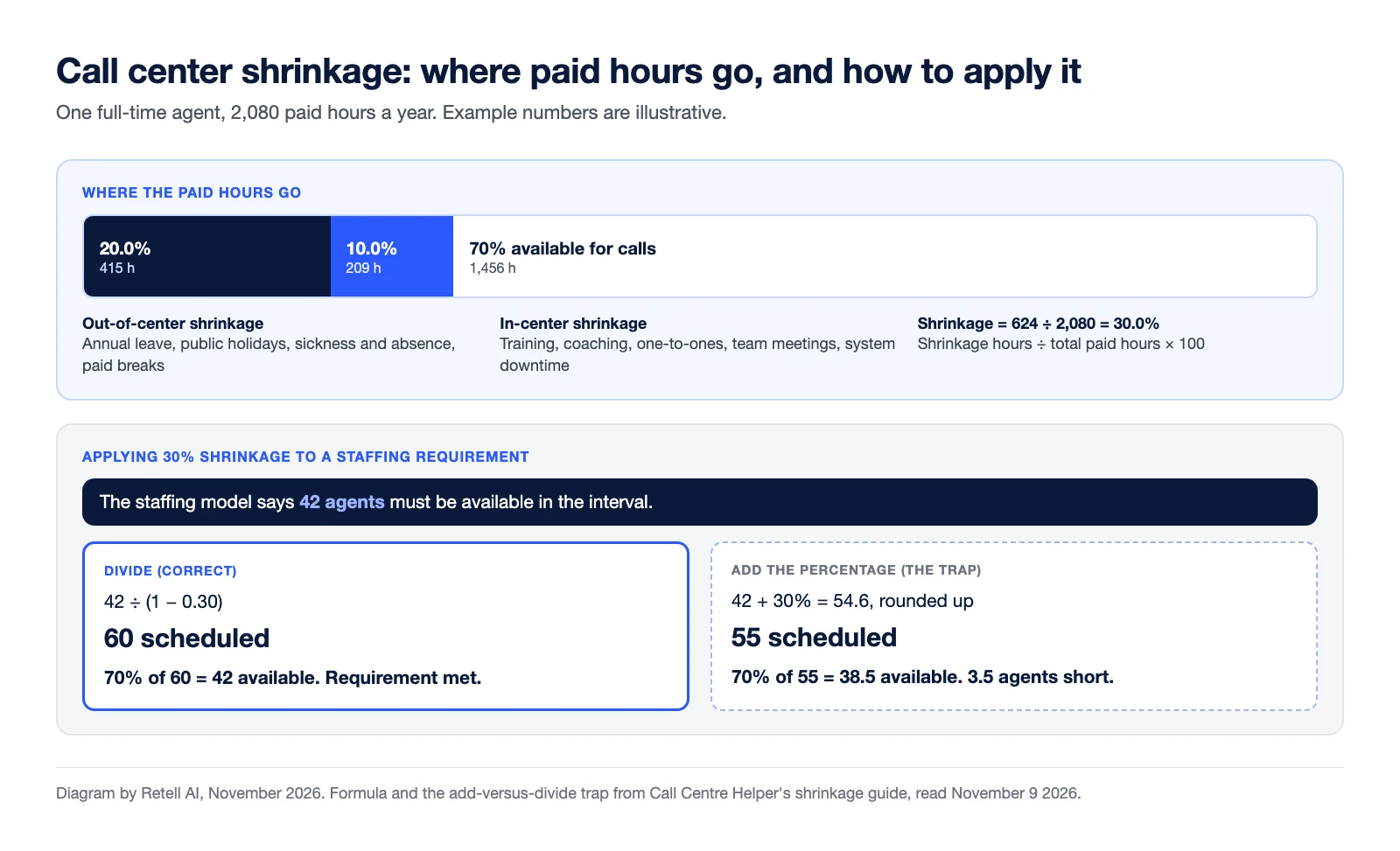
Shrinkage is 624 ÷ 2,080 × 100 = 30.0%, so the agent is available for calls 70% of paid time.
How to apply shrinkage to staffing
Divide the required agents by one minus the shrinkage rate. Do not add the percentage on top. If an Erlang C staffing model says 42 agents must be available in an interval and shrinkage is 30%:
- Correct: 42 ÷ (1 − 0.30) = 60 agents scheduled. 70% of 60 is 42 available.
- The trap: 42 + 30% = 54.6, so 55 scheduled. 70% of 55 is 38.5 available, 3.5 agents short every interval.
Call Centre Helper calls adding the percentage a trap that leaves you short. The gap shows up as longer waits and a higher call abandonment rate.
What is a typical call center shrinkage rate?
Call Centre Helper says most contact center professionals seem to agree shrinkage falls between 30% and 35%. That is practitioner consensus, not a survey, so measure your own. Shrinkage also moves within the year and the day: the same guide notes it runs highest in the summer holidays and around Christmas, and that it can peak mid-morning and early afternoon, when meetings tend to be booked.
Lower is not always better. Cutting training and coaching lowers shrinkage today and costs quality later. Track it next to service level, adherence and utilization, covered in call center metrics and KPIs.
Where AI voice agents fit
Shrinkage measures human hours. Retell documents AI voice agent capacity as a concurrency limit instead: per the concurrency docs, one agent can handle any number of simultaneous calls as long as the workspace stays within its quota. Unless concurrency burst is enabled, when inbound calls reach the limit a new call waits about 40 seconds for a slot, then goes to a fallback number if one is set; otherwise it ends. The people who take transferred calls still have leave, breaks and training, so apply shrinkage to that roster.
Frequently asked questions about call center shrinkage
What is a good shrinkage percentage for a call center?
There is no fixed standard. Call Centre Helper says most practitioners seem to agree it falls between 30% and 35%. Compare against your own history, interval by interval.
Should breaks count as shrinkage?
Yes, if they are paid. Paid breaks are paid time when agents cannot take contacts, and Call Centre Helper lists them as shrinkage. Unpaid breaks are not paid hours, so they sit outside the calculation.
Is shrinkage the same as absenteeism?
No. Absenteeism is one part of unplanned shrinkage. Shrinkage also includes planned items such as annual leave, training and meetings.
What is the difference between shrinkage and schedule adherence?
Shrinkage measures how much paid time is unavailable for contacts. Schedule adherence measures whether agents were available during the hours the schedule said they would be. An unscheduled break hurts adherence and adds unplanned shrinkage.
Does shrinkage apply to AI voice agents?
Not in the same way. Plan AI-handled calls against your Retell concurrency limit, and apply shrinkage to the human team that takes transfers.
Cover more calls with the team you have
Retell AI is an AI voice agent platform for contact centers. Its agents answer calls up to your concurrency limit and transfer callers to a person when needed. Talk to the Retell team.