What Is Service Level in a Call Center?
What service level means in a call center, the 80/20 formula with a worked example, typical targets, and how AI agents change the math.
Service level is the percentage of calls answered within a target time, written as X/Y: X percent of calls answered in Y seconds. An 80/20 service level means 80% of calls answered within 20 seconds.
The clock usually starts when the call enters the queue, after any IVR menu, and stops when an agent answers. An automatic call distribution (ACD) system reports the counts the formula needs, and most contact centers calculate it for each 30-minute interval.
How do you calculate service level?
Call Centre Helper gives the basic formula:
- Service level = calls answered within the threshold ÷ calls offered × 100
The disagreement is over abandoned calls. In Genesys Cloud, abandons and short abandons are settings: when included, an abandoned call counts as a miss. Asked whether all abandoned calls should be excluded, Call Centre Helper answers "no", and it warns that counting calls abandoned within the threshold as answered "is used to manipulate service levels". On short abandons, hang-ups in the first few seconds, the experts split: Call Centre Helper says ignoring those under 5 seconds is "generally seen as being OK", while COPC, a contact center standards firm, answers "no". Pick one rule, write it down and keep it fixed.
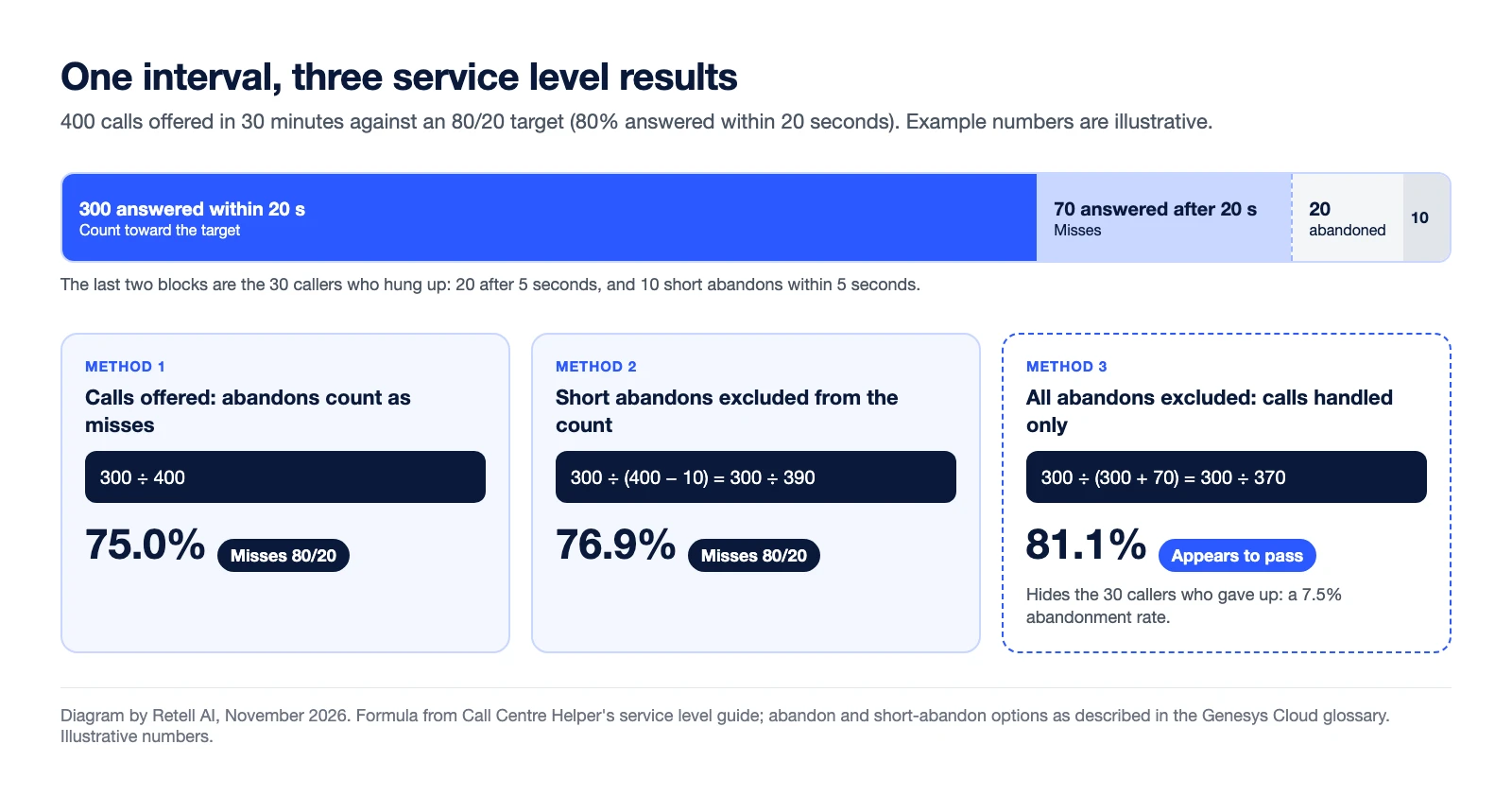
Worked example (illustrative numbers). In one 30-minute interval, 400 calls are offered. 300 are answered within 20 seconds, 70 are answered later, and 30 callers hang up, 10 of them within 5 seconds.
| Method | Calculation | Service level | Meets 80/20? |
|---|---|---|---|
| Calls offered (abandons count as misses) | 300 ÷ 400 | 75.0% | No |
| Short abandons excluded | 300 ÷ 390 | 76.9% | No |
| All abandons excluded (calls handled) | 300 ÷ 370 | 81.1% | Yes |
The same interval passes or fails depending on the formula. COPC's answer to calculating service level on calls handled is "definitely not". The 30 hang-ups also give this interval a 7.5% call abandonment rate, which the third method hides.
What is a good service level target?
80/20 is the most common target, but it is a convention, not a rule. A 2016 Call Centre Helper guest article called it "the most common service level in place today" and added that "there is no single perfect set of service levels". It cited 90/10 and 70% in 60 seconds as alternatives, and 80% of chats within 90 seconds or 80% of emails within four hours for other channels. Asked whether 80/20 is right because it is the industry standard, COPC answers "not likely".
COPC suggests working backwards from the abandonment rate you can accept, "three to five percent for most customer service environments", and using your queue's history to find the service level that delivers it. It also recommends a range, such as 78% to 85%, measured by day or interval, because a month-end average lets good days hide bad ones.
To work out how many agents a target needs, see how to handle high call volume, which walks through Erlang C. Then add shrinkage for time agents are paid but off the phones. Call center metrics and KPIs shows where service level sits next to the other queue metrics.
How AI voice agents change the service level math
Fewer calls reach the human queue. In an Erlang C illustration, 200 calls an hour at 3 minutes each need 14 agents to reach 80/20. If an AI voice agent resolves 15% of calls end to end, the remaining 170 need 12 agents. If those remaining calls average 3 minutes 20 seconds because the quick ones are gone, they need 13. These are Erlang C calculations, not measured results.
AI-answered calls queue on capacity, not staff. Per Retell's concurrency docs, one agent can take any number of simultaneous calls within the workspace's concurrency limit. At the limit, unless burst is on, a new inbound call waits up to about 40 seconds for a slot, then transfers to a fallback number if one is set; otherwise it ends. Retell's analytics dashboard charts peak concurrency used, which shows how close traffic runs to the limit. Calls the agent transfers to a person join the human queue, so report a separate service level for that queue rather than blending the two.
Frequently asked questions about service level
What does an 80/20 service level mean?
It means answering 80% of calls within 20 seconds. The other 20% can wait much longer, so pair it with average wait and abandonment.
Should abandoned calls count in service level?
Yes. Treating abandoned calls as misses is the method Call Centre Helper labels correct. Some teams exclude only short abandons under about 5 seconds; COPC advises against even that.
Is service level the same as an SLA?
No. Service level is the measured percentage. A service level agreement is a contract, for example with an outsourcer, that can set a service level target along with other terms.
How often should you measure service level?
By interval. Call Centre Helper suggests calculating it every half hour, and COPC recommends daily or interval targets over a single monthly number.
Answer more calls inside your target
Retell AI is an AI voice agent platform for contact centers. Its agents answer inbound calls up to your concurrency limit and hand off to your team when a person is needed. Talk to the Retell team.