What Is Average Speed of Answer (ASA)?
Average speed of answer (ASA) is how long answered calls wait in queue. The formula, a worked example, and where each industry standard comes from.
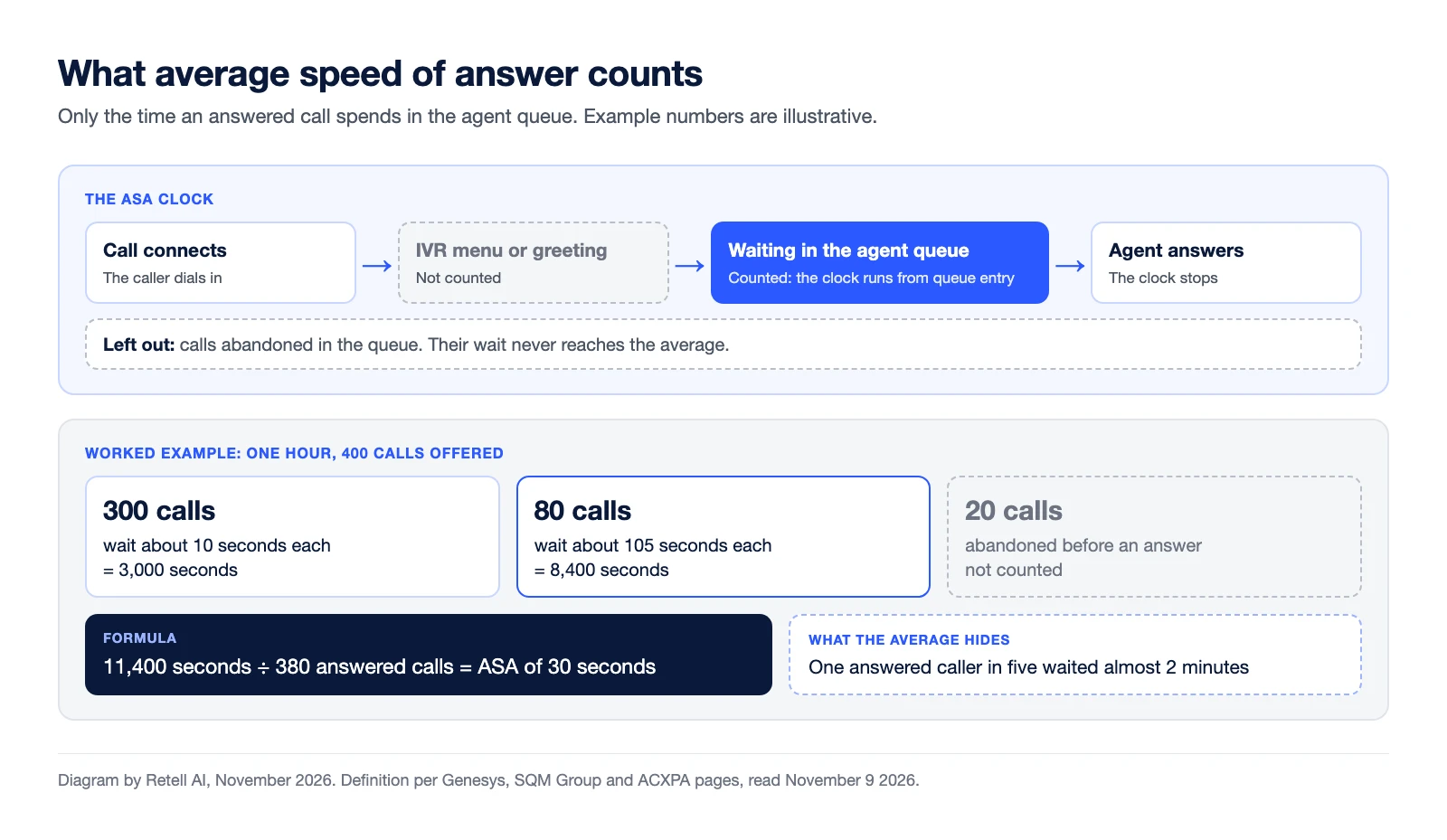
Average speed of answer (ASA) is the average time an answered call waits in the queue before an agent picks up. The clock starts when the call enters the queue and stops when an agent answers, so time in the IVR menu is not counted, and neither are callers who hang up first.
An automatic call distribution (ACD) system queues the calls and reports the wait times that ASA averages. Genesys and SQM Group define it this way, and SQM's formula counts answered calls only.
How do you calculate average speed of answer?
ASA = total wait time for answered calls ÷ number of answered calls
- Count answered calls only. Abandoned calls drop out of both counts.
- Start the clock at queue entry, after the IVR or greeting.
- Report by interval too; a daily average hides the busy hour.
Worked example (illustrative numbers). In one hour a queue is offered 400 calls, and 20 callers hang up before anyone answers. Of the 380 answered calls, 300 wait about 10 seconds each (3,000 seconds) and 80 wait about 105 seconds each (8,400 seconds). ASA is 11,400 ÷ 380 = 30 seconds. That looks healthy, yet about one answered caller in five waited almost two minutes, and the 20 who gave up are not counted.
What is the industry standard for average speed of answer?
There is no single ASA standard. These are the figures quoted most often, and their sources.
| Figure | What it is | Source |
|---|---|---|
| 28 seconds | Talkdesk's cross-industry average; no year or sample given | Talkdesk |
| 80% of calls answered in 20 seconds (80/20) | A service level target, not an ASA. SQM calls it the industry standard; only 16% of centers meet it consistently | SQM Group, 2023 |
| 95% answered in 2 minutes (95/120) | SQM's alternative: answers within 2 minutes of leaving the IVR showed no drop in customer satisfaction | SQM Group, 2023 |
| 97 to 130 seconds | Self-reported Australian ASA: 97 for inbound sales, 115 for customer service, 130 for tech support | Smaart Recruitment 2024 report, via ACXPA |
| 2 minutes average hold time; 80% answered in 30 seconds | US rule for Medicare Advantage and Part D plan call centers since 2022. CMS calls it hold time, timed after the IVR or greeting | 42 CFR 422.111(h)(1)(ii), 42 CFR 423.128(d)(1)(ii) |
The 80/20 rule is a convention, not a law, and the Medicare rule covers only those plans (this summary is not legal advice). SQM suggests setting your own target from abandonment and customer satisfaction data; the Erlang C math in how to handle high call volume shows the staffing a target needs.
Why does ASA need service level and abandonment beside it?
ASA is an average, so it hides the spread of waits. And because abandoned calls are excluded, the callers who waited longest fall out of it, as ACXPA points out. A low ASA with a rising call abandonment rate is a warning, not a win. See call center metrics and KPIs for the full set.
ASA falls with more agents in the busy interval, a shorter average handle time, or fewer calls reaching the queue through well-designed self-service. Callbacks mainly cut abandonment, not ASA, per ACXPA.
Where AI voice agents fit
With an AI voice agent, capacity is set by concurrency rather than headcount. Per Retell's concurrency docs, one agent can take any number of simultaneous calls while the workspace stays within its concurrency limit, and reserved inbound concurrency holds slots for inbound calls. At the limit, a new inbound call waits about 40 seconds for a slot, then goes to the number's fallback number if one is set. With no fallback, or if that transfer fails, the call ends.
Report calls the AI agent answers apart from your human queue's ASA. When the agent transfers a caller to a person, any wait after the transfer belongs to that team's ASA.
Frequently asked questions about average speed of answer
Is average speed of answer the same as average wait time?
Usually. SQM Group treats them as one metric, while Talkdesk defines average wait time more broadly, including time in automated systems. Check which definition your ACD report uses before comparing numbers.
Does average speed of answer include abandoned calls?
No. ASA counts answered calls only, so callers who hang up in the queue are left out. Report call abandonment rate beside it.
Does ASA include IVR time?
No. The clock starts when the call enters the agent queue, so long IVR menus can add minutes that ASA never shows.
What is the 80/20 rule in call centers?
It is a service level target: 80% of calls answered within 20 seconds. SQM Group calls it the industry standard but finds only 16% of call centers meet it consistently. It is a convention, not a law.
What is a good average speed of answer?
One that keeps abandonment and customer satisfaction on target. SQM Group found that answers within 2 minutes of leaving the IVR did not lower customer satisfaction.
Put an AI voice agent on your inbound line
Retell AI is an AI voice agent platform for contact centers. Its agents answer inbound calls up to your concurrency limit and transfer callers to a human when needed. Talk to the Retell team.