AI Customer Experience: Strategy, Use Cases, and Real Business Impact in 2026
20
MIN READ
September 14, 2026

Can AI improve customer service? The data says yes — 58% of customers already believe it can.
AI is already embedded in service interactions. 1 in 6 consumers say their last customer service interaction was entirely with a chatbot or AI assistant. It delivers the greatest value when it reduces the need for problem resolution in the first place.
By 2028, 68% of all customer service and support interactions with technology vendors are predicted to be handled by agentic AI. Across the customer journey, artificial intelligence is helping teams work more efficiently while giving customers exactly what they want and when they need it.
From instant resolution to taking feedback to improve future interactions, AI is reshaping customer experience.
In this article, we will break down.
AI customer experience (AI CX) is the use of artificial intelligence to improve how customers interact with a business across every touchpoint, from phone calls and chat conversations to support tickets, scheduling, onboarding, and follow-up communication.
Rather than simply automating tasks, AI customer experience focuses on making interactions faster, more personalized, more consistent, and available whenever customers need help.
For example, an AI system can:
AI agents are capable of acting, helping and supporting businesses in a way that traditional chatbots could never.
By 2029, AI will autonomously resolve 80% of common customer service issues without human intervention.
Today's customers expect seamless, end-to-end customer journeys. They hate repeating themselves, and want fast, personalized responses that are consistent across every touchpoint. AI gives organizations the ability to understand customer needs in real time, analyze large amounts of data, and make decisions quickly.
The improvement happens across the entire customer journey, from the moment a customer reaches out to the point where the business learns from the interaction.
When customers have a problem, the first thing they do is reach out to your customer support team. It could be through a phone call, chat, email, social media message, or website form.
An automated call center seamlessly integrates across channels, letting your customers connect with your business using their favorite channel.
For instance, Retell AI voice agents handle real-time conversations and integrate outcomes into CRM, help desk, or marketing platforms. Plus, seamlessly switch conversations to SMS, email, or chat when appropriate (e.g., sending documentation or confirmation links).
Once a caller has been identified and authenticated, the AI agent will interact with the caller in natural language to determine their intent (the reason for their call).
Understanding call intent helps identify the underlying reason a person is calling. It's the "why" behind the conversation: whether that's booking an appointment, asking a billing question, resetting a password, or canceling a service. On the other hand, sentiment analysis detects when the human is positive, neutral, or negative.
Here's how AI agents detect call intent and sentiment:
Both intent and sentiment analysis happen in real time, so AI voice agents do more than just route calls; they also listen with emotional awareness, able to then display empathy towards customer sentiment.
AI agents can match calls with human agents with far greater precision than traditional IVR systems. It compares intent and sentiment analysis with predefined routing rules and agent expertise to match the caller with the right agent.
AI routes directly to the best-matched agent, with a screen pop that shows the full context.
The difference is transformative. The caller does not navigate those rigid menus. They explain their issue once. They reach someone who can actually help. The agent has full context before saying hello.
Many tickets that your customer support team handles throughout the day are repetitive, straightforward questions that can be automated using customer service automation software. Answering these repetitive questions is a key part of customer support, but these tickets are not high-impact tickets for revenue generation.
Fortunately, a customer service platform like Retell AI can help you completely automate these tickets so that your team can focus on more impactful tickets (such as escalated complaints and pre-sale discussions).
Here's what an AI agent from Retell can do:
For instance, a mid-sized consumer lending company used Retell AI voice agents to process over 700,000 applications monthly, resolving 80% of customer calls and reducing abandonment rates by 6 times.
Most AI agents are designed with feedback collection in mind. Their call flows can be built to handle calls naturally and, once the core task is complete, transition directly into a feedback prompt without switching modes or disrupting the customer experience.
For instance, Retell's embedded approach enables:
Because customers don't need to complete a separate survey or follow-up, Retell AI clients report significantly higher feedback completion rates, often multiple times above industry averages.
In 2026, AI does more than just reduce customer efforts.
It's now capable of powering experience orchestration. That means building a platform where AI is deeply infused within channels, systems and workflows, enabling experiences that adapt, recommend and optimize in real time.
How can you start to harness AI to better service customers? This section describes the top ways tech-savvy businesses are using AI to improve service speed, accuracy, efficiency, and personalization.
Today's shopper no longer browses dozens of product pages. Instead, they open a conversation, ask highly personal questions, and expect responses that meet them at that same level of personalization.
So, instead of putting the onus on customers to search FAQs, navigate chatbot automation loops, or scour product collections, winning brands are leveraging voice AI agents. That's why the majority of businesses that use AI agents for voice use them for call summarization or answering customer questions.
For instance, modern voice AI agents help businesses:
By 2030, 89% of buyers would expect AI voice purchasing, with multilingual support and personalized upsells and cross-sells. Always-on availability is a basic expectation for customers, regardless of how and when they reach out.
Retell's low-latency, AI voice model integrates with your tech stack and fully automates these routine workflows end-to-end. It can handle thousands of calls simultaneously and provide seamless human handoff that frees up agents' capacity for complex, high-empathy interactions.
Plus, Retell supports over 50+ languages, so for businesses with global clients, it can save them a lot of money and resources.
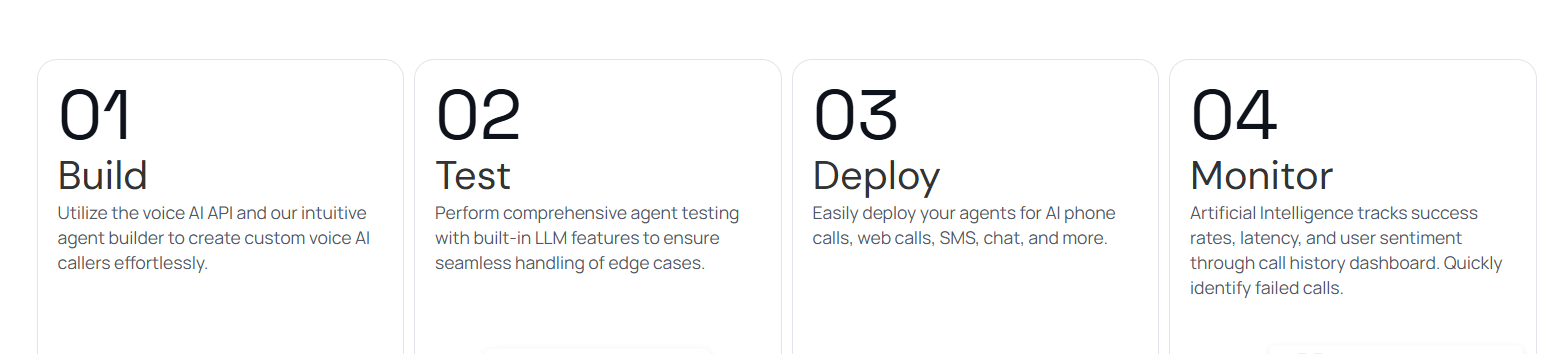
Imagine calling your favorite coffee store, the AI agent greets you by name, already sees your last order from the app, asks if you want the same drink, and proactively apologizes for the delayed delivery you reported via chat yesterday.
That's AI personalized at its finest.
High-tech leaders are starting to create unified personalization strategies that span all touchpoints, from awareness campaigns to loyalty programs, using AI-powered orchestration tools.
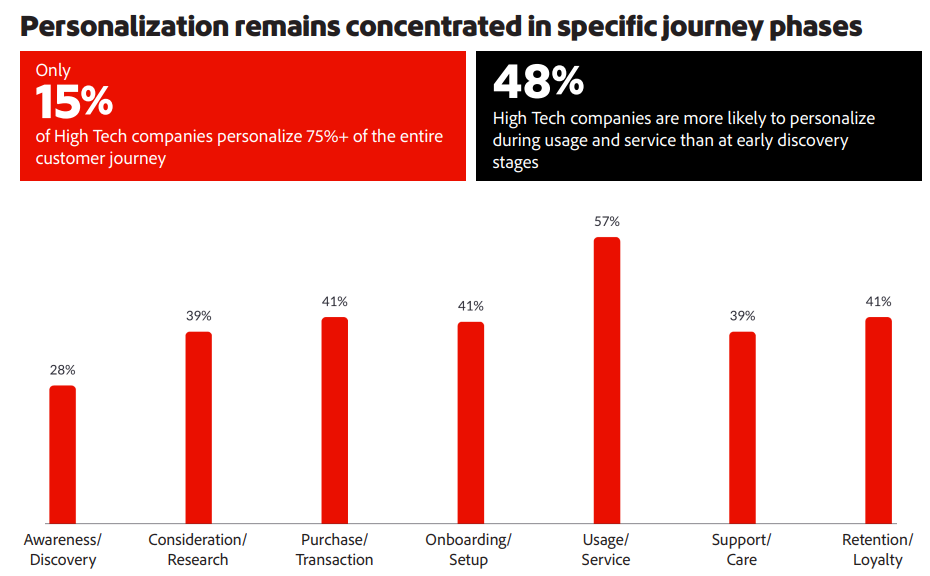
Here's how AI helps:
Expanding personalization earlier in the funnel not only boosts acquisition rates but also drives lifetime value and long-term customer loyalty.
Most contact centers are swimming in data, but they're often used to look at the past. The real power comes from shifting your focus from what did happen to what will happen.
Predictive analytics is a branch of advanced analytics that makes predictions about future outcomes using historical data, artificial intelligence (AI), and machine learning (ML) to forecast future outcomes.
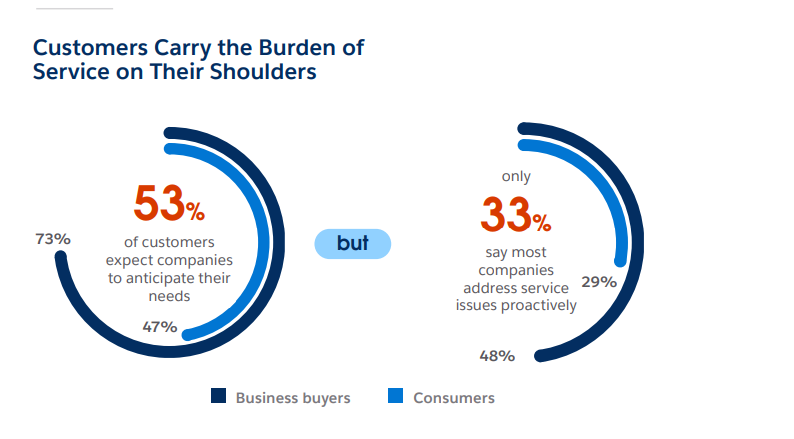
Increasingly, customers expect companies to deliver proactive customer service rather than relying on them to file the initial case. According to Salesforce, 53% of customers expect companies to anticipate their needs, but only 33% say most companies address service issues proactively.
Predictive models can save call centers millions, cut handling times by 40%, through:
This isn't a minor trend; it's a major industry transformation. The contact center analytics market has expanded from $2.23 billion to $2.57 billion and is on track to more than double to $5.08 billion, driven by a strong 18.5% CAGR.
Customers value consistency across channels, devices, and departments. However, consistency is not the norm, and 56% customers find themselves repeating themselves to different representatives — a sign of siloed information.
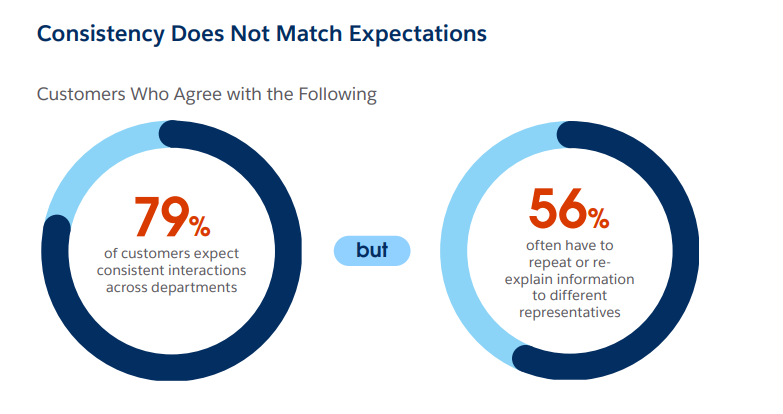
Ultimately, when technology and processes aren't well connected, 55% of customers say their experience feels fragmented, as if they're dealing with separate departments instead of one unified organization.
Here are some key components of effective omnichannel support through AI:
This allows agents to deliver personalized support without requiring customers to repeat their information, regardless of which channel they choose.
According to Forrestor, integrated omnichannel solutions experienced a 31% reduction in first-resolution times and a 39% decrease in customer wait times.
Agentic AI systems are designed to handle complex goals and workflows with limited direct human supervision. It demonstrates genuine problem-solving capabilities and adapts its approach based on context, customer history and real-time data analysis.
A recent Intercom report reveals that the top areas where agentic AI agents are saving support teams are:
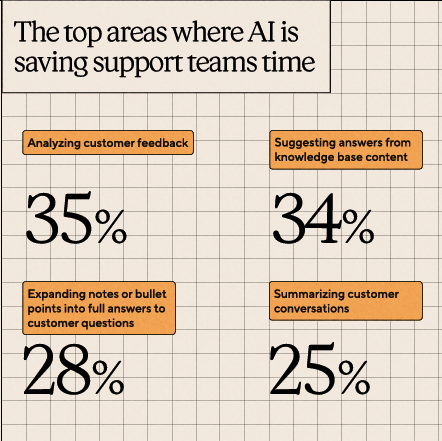
A major reason for this rise in AI adoption for customer experience is largely because of increased support volume, staffing challenges and the need to be more cost-efficient. So it's no surprise that CX leaders are eager to declutter this mess through technology.
Here's how Automation is beneficial both inside and outside of the contact center:
Waiting in a queue, whether via chat or phone, is a reality for consumers. But the length of the wait can either be a source of frustration or satisfaction.
Only 13% of consumers globally say they've waited less than five minutes; most people wait five to 30 minutes (59%). Frustratingly, 29% of consumers are waiting 30 minutes or more, including 8%
who were on hold for more than an hour.
AI in call centers smoothens the process of getting a resolution. The moment a customer reaches the call center, the AI voice agent begins gathering data like:
Instead of making the person wait on calls, conversational AI voice bots gather relevant information and help customers with routine, repetitive, and monotonous queries. If things are complex, these voice bots simply escalate resolution to human agents with other relevant information.
When consumers are satisfied with wait times, they are 2.6x more likely to trust, repurchase from,
And 3x more likely to recommend the company to others.
In 8x8's survey of more than 300 contact center and IT leaders says increasing support volume is their top challenge their organization is facing. It's no surprise that 82 percent of service reps say customers are asking for more help than they used to.
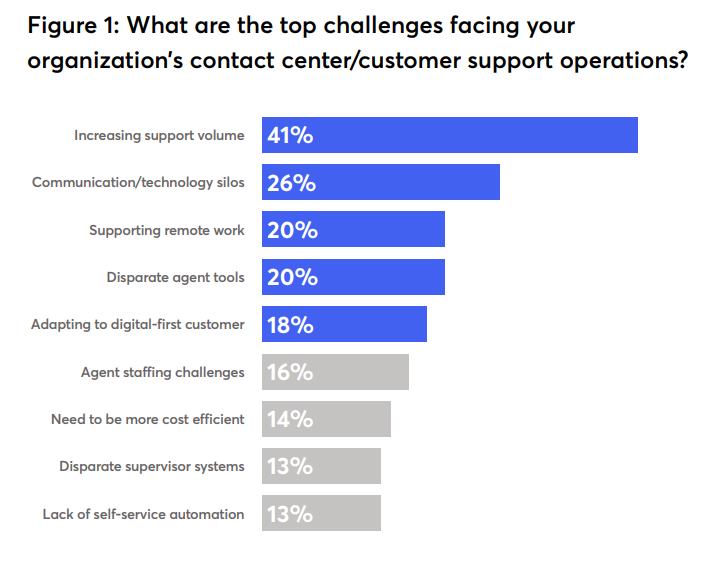
Processing thousands of these support calls isn't just about answering phones–it's about consistently delivering value during every interaction while managing operational costs.
Traditional call centers face multiple breaking points:
These challenges explain why many contact center leaders are investing in AI capabilities.
AI agents represent a fundamental shift from managing calls to processing them without needing any human guidance.
Without AI-first customer service, you won't get the benefits of breaking the traditional linear growth model. The quality of your customer service will be limited by the size of your support team, needing to add (and recruit, onboard, and train) new staff to handle any business growth.
That's why the true value of AI-first customer service goes beyond cost reduction; it delivers improved support quality, scalability, and overall business impact.
At Retell, our most successful clients think about the return on investment through two lenses: increased bandwidth and cost efficiency.
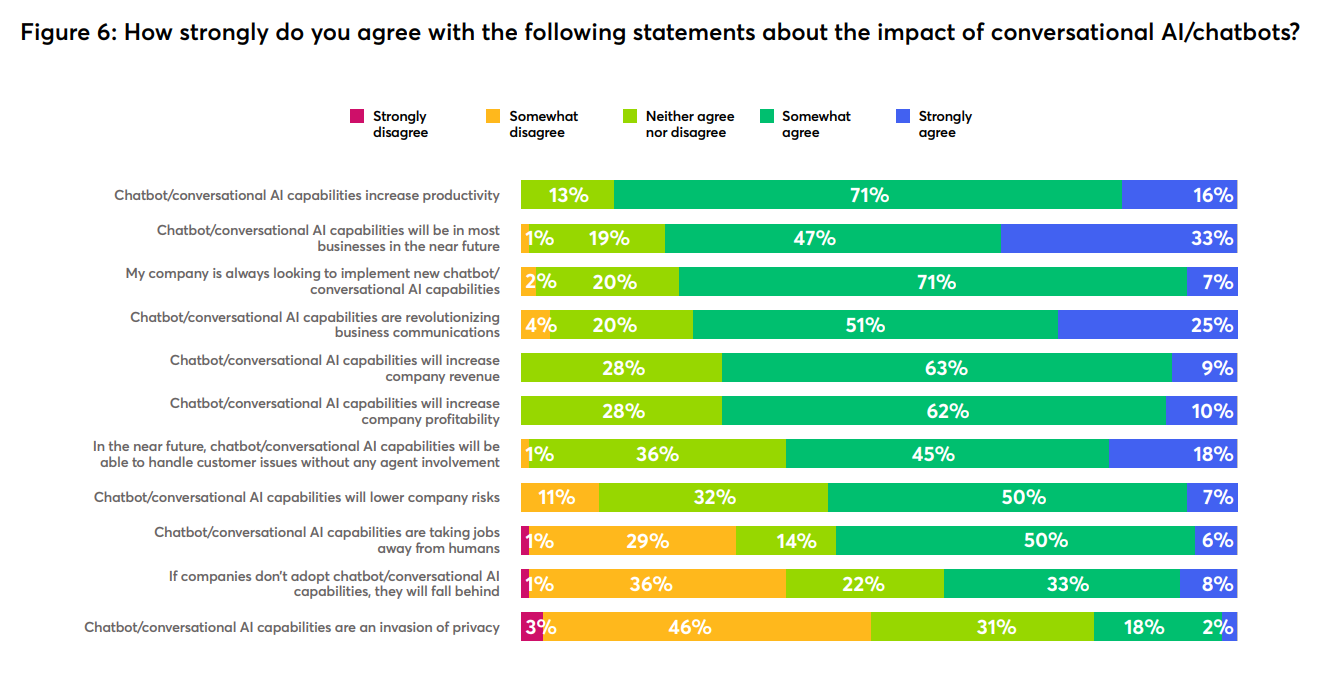
It's not about replacing human agents; it's enabling the team to focus on more impactful and rewarding tasks. That's exactly why 72% of leaders believe these capabilities will increase company profitability and revenue and lower company risks (57%).
Building enterprise-ready AI agents for customer experience is more than just setting up simple automations or scripts. When you develop or integrate AI agents, your role shifts from writing code to architecting an autonomous system that can think, adapt, and act across third-party systems.
Retell AI is a proven, enterprise-ready platform designed to deliver AI agents that can meet your business's toughest needs from the start.
Here's how you can get started to build your own AI agent for customer experience :
Start by identifying the conversations that consume the most time and resources. These are often repetitive, predictable requests that follow a clear process.
Common examples include:
Review call logs, support tickets, chat transcripts, and email inquiries to understand where customers are contacting you most often. Prioritizing these high-volume interactions allows you to deliver quick wins, reduce support workload, and improve response times without disrupting more complex customer journeys.
Before introducing AI, document how customer requests are currently handled from start to finish.
For each interaction, identify:
This process helps uncover bottlenecks, manual tasks, and unnecessary handoffs. It also ensures that AI supports existing operations rather than creating disconnected experiences. A clear workflow map provides the foundation for designing Automation that reflects how your business actually works.
Successful AI adoption rarely happens all at once. Instead of attempting to automate every customer interaction immediately, begin with a small set of clearly defined use cases.
For example, AI can:
As performance improves and confidence grows, automation can expand into more sophisticated workflows. A phased approach reduces risk, makes implementation easier, and allows teams to learn what works before scaling AI across the customer experience.
When creating an AI assistant, configure the base system parameters. This includes selecting the language model that will generate responses, choosing the voice for audio output, and setting initial defaults that influence how the assistant processes input and responds.
These settings define the environment in which all conversation logic will operate. Secondly, configure how an agent behaves when it interacts:
This response logic enforces boundaries so that the assistant does not drift into unrelated responses or over-explain.
After defining response behavior, structure how the conversation progresses.
Creating conversation flows helps agents handle different scenarios in conversations. The assistant moves through a sequence of steps, ensuring that required inputs are collected and actions are triggered in the correct order.
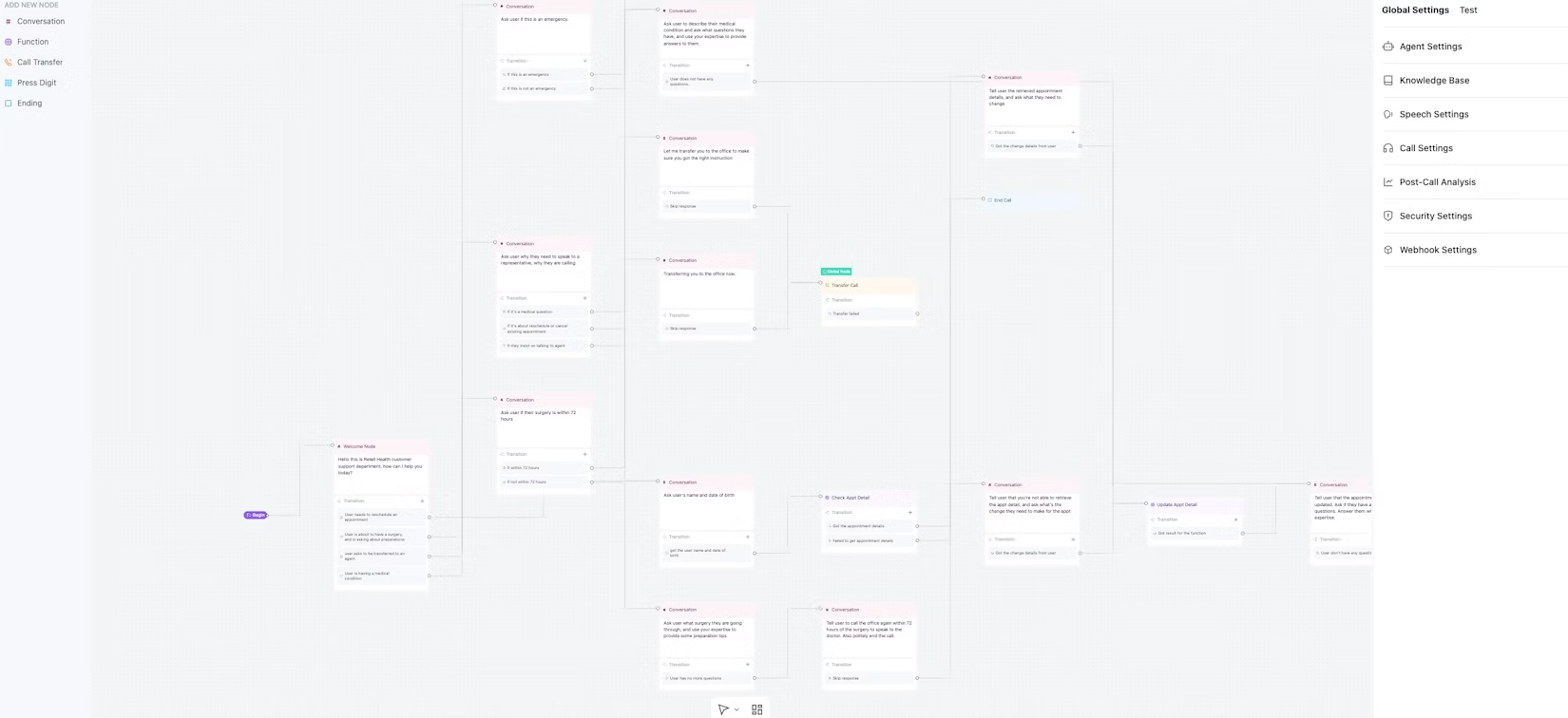
For more flexible use cases, prompt-driven logic can be used to allow the assistant to adapt while still operating within defined constraints.
To enable task completion, your AI assistants need to be connected to allow the assistant to take any action.
These tools represent operations such as checking availability, retrieving information, updating records, or transferring customer calls to human agents. Each action should be mapped to a function that can be triggered when the corresponding intent is detected.
Retell AI shines when connected to your business systems. The 2026 platform supports:
Function calling serves as the execution layer of the assistant. When the system detects that an action is needed, it invokes the appropriate function, processes the returned data, and continues the conversation seamlessly.
The assistant's response logic and action layer need to work in sync. It must understand both when to trigger a function and how to use the resulting output to guide the interaction forward effectively.
Testing should simulate real call behavior rather than ideal inputs. The assistant must be evaluated under conditions such as:
The focus is on conversational behavior. The assistant should pause when interrupted, adjust to new input in real time, and resume the interaction from the appropriate point naturally.
Retell AI's simulation tools let you:
Aim for 90%+ success rate in simulations before going live. Track call duration - agents should be 30-40% faster than humans on routine tasks.
In an era where 72% of consumers trust companies less than they did a year ago, delivering exceptional customer experiences is critical.
Retail's Voice AI addresses this challenge by enhancing clarity, efficiency, comprehension, and engagement in every interaction, leading to improved CSAT, FCR, and reduced operational costs.
From intelligent call handling to real-time accent conversion and voice translation in 50+ languages, Krisp ensures every call is clearer, faster, and more effective.
Ready to see how real-time voice agents can transform your customer experience? Try Retell AI for free.
AI customer experience (AI CX) is the use of artificial intelligence to improve how customers interact with a business across every touchpoint, including phone calls, chat, email, support, scheduling, and follow-ups. Beyond simple automation, AI CX delivers faster, more personalized, and consistent experiences by understanding customer intent, resolving routine issues, routing requests, and supporting agents with real-time insights.
AI helps businesses improve customer satisfaction while reducing operational costs. It provides 24/7 support, shortens wait times, automates repetitive conversations, personalizes interactions, and scales customer service without requiring proportional staff growth. AI can also analyze customer sentiment, route inquiries intelligently, and assist agents with recommendations, allowing teams to focus on complex, high-value interactions that require human expertise.
No. AI in customer experience is designed to complement human agents rather than replace them. It handles routine and repetitive tasks such as answering FAQs, booking appointments, and collecting information, while human agents focus on complex issues that require judgment, empathy, and relationship-building. The most effective customer service strategies combine AI efficiency with human expertise to deliver better outcomes for customers and support teams.
Yes, when implemented properly, AI can be highly reliable for customer service. Modern AI systems like Retell AI follow predefined workflows, integrate with business systems, and can escalate conversations to human agents when needed. It provides consistent responses, maintains service quality at scale, and operates continuously.
The success of AI in customer experience is measured through both customer and operational metrics. Common indicators include customer satisfaction (CSAT), Net Promoter Score (NPS), first-contact resolution rates, response times, call abandonment rates, and feedback completion rates. Businesses also track efficiency metrics such as automation rates, cost per resolution, agent productivity, and reductions in customer wait times.
Yes. Modern AI voice agents like Retell AI can manage customer service phone calls end-to-end, including answering questions, scheduling appointments, processing requests, qualifying leads, and routing callers to the right department. They can understand intent, detect sentiment, support multiple languages, and handle thousands of conversations simultaneously. For more complex situations, Retell AI can seamlessly transfer customers to human agents with full conversation context.
See how much your business could save by switching to AI-powered voice agents.
Total Human Agent Cost
AI Agent Cost
Estimated Savings
A Demo Phone Number From Retell Clinic Office