Conversational AI for Customer Service in 2026: How It Works & Why You Need It
Today's consumers expect an unprecedented level of customer service more than any previous generation.
And, when they don't receive the service they deserve, they're vocal about it. Fast response, accuracy, and not having to repeat themselves are the most frequently cited 'top service quality in both B2B and B2C experiences.
However, even the most state-of-the-art chatbots can fail to answer a customer's query. Human language is complex, and standard bots fall short in understanding its nuances.
So, what's the secret sauce to meeting sky-high customer expectations without stretching your human support team? Adopting conversational AI solutions.
If you're an ambitious business leader eager to bring your customer experience to the next level and automate at least 50% of conversations, stick around.
This blog is your roadmap to understanding how conversational AI is transforming customer support and why you should act now.
Conversational AI platform in customer service refers to using AI-powered voice bots or voice assistants that customer support teams use to offer real-time support to customers around the clock. It uses Natural Language Processing (NLP) and machine learning (ML) to analyse and create human-like responses.
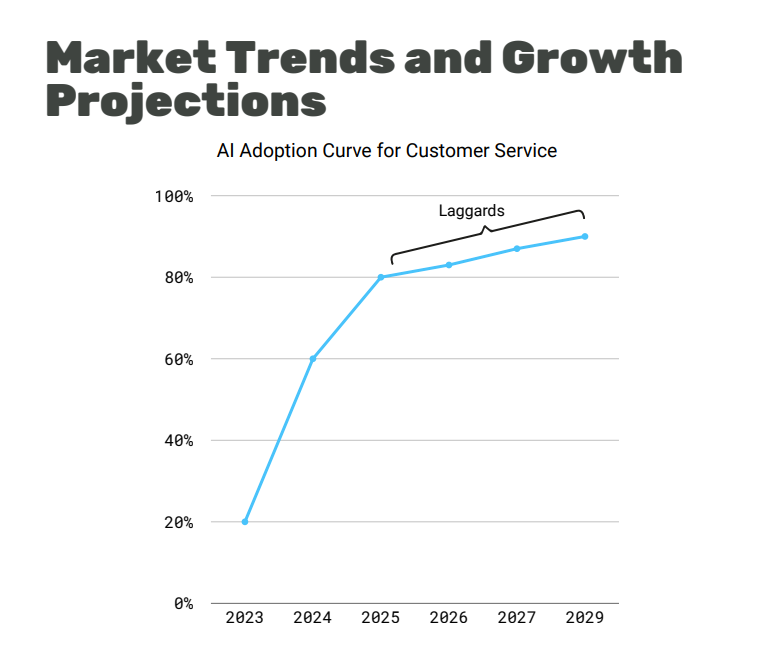
The adoption of AI in customer service is accelerating at an unprecedented pace. In 2023, the adoption of AI-powered support agents was just 20%; however, by 2025, it had surged to 80%. The projection suggests that by 2029, nearly 90% of companies will rely on AI to manage a majority of service interactions.
One of the reasons behind the surge of conversational AI is the preference for getting fast replies over waiting for a human agent. An outstanding 82% of consumers would choose a chatbot if it could help them out, similar to a human.
Despite their growing sophistication, AI agents are not designed to replace humans entirely. Instead, they complement human teams by handling routine and repetitive requests, allowing employees to focus on empathy-driven or high-stakes interactions.
Various studies confirm that hybrid models work best: AI boosts human agent productivity by as much as 15%, particularly for less experienced staff, while improving customer outcomes.
Conversational AI for customer support is built from several tightly integrated components that work together to handle customer issues end-to-end, from the moment a customer reaches out to the final resolution or handoff.
Here's how it all comes together in a conversational AI tech stack:
| Speech-to-text | It captures what the customer says on a call into text transcriptions. |
| Intent detection and entity extraction | AI identifies why the customer is contacting support (billing issues, order status, password reset, cancellation requests) and extracts critical details such as order numbers, dates, or account IDs. |
| Lead scoring and routing logic | Determines the best action, whether to resolve the issue automatically or escalate to a human agent. |
| Natural language generation and voice synthesis (Text-to-speech) | Produces clear, empathetic spoken responses aligned with the brand’s tone. |
| Post-conversation automation | Updates CRM records, logs outcomes, and flags required follow-ups. |
Subpar chatbots used to be a source of frustration for consumers who often found themselves yelling into their phones, "Just let me talk to a human!"
Fortunately, AI-powered, robust conversational AI can transform this dire situation. You can make the most of your support teams by influencing them with a conversational AI chatbot that provides instant response, personalizes as a human and saves your human agents from constant burnouts.
Here are some conversational AI standout benefits that provides most value in customer support operations:
Fast responses are not exclusive to B2C customer service. Quick responses are just as high in demand for B2B customer interactions. When asked to choose the top three service qualities they value most, both B2B and B2C customers replied:
And that's exactly what conversational AI helps with. Recently, at Retell, we helped one of our clients (TripleTen) handle over 17000+ concurrent calls handled by our AI agents. Fast and accurate response helped TripleTen increase pickup and conversion rates by 20%.

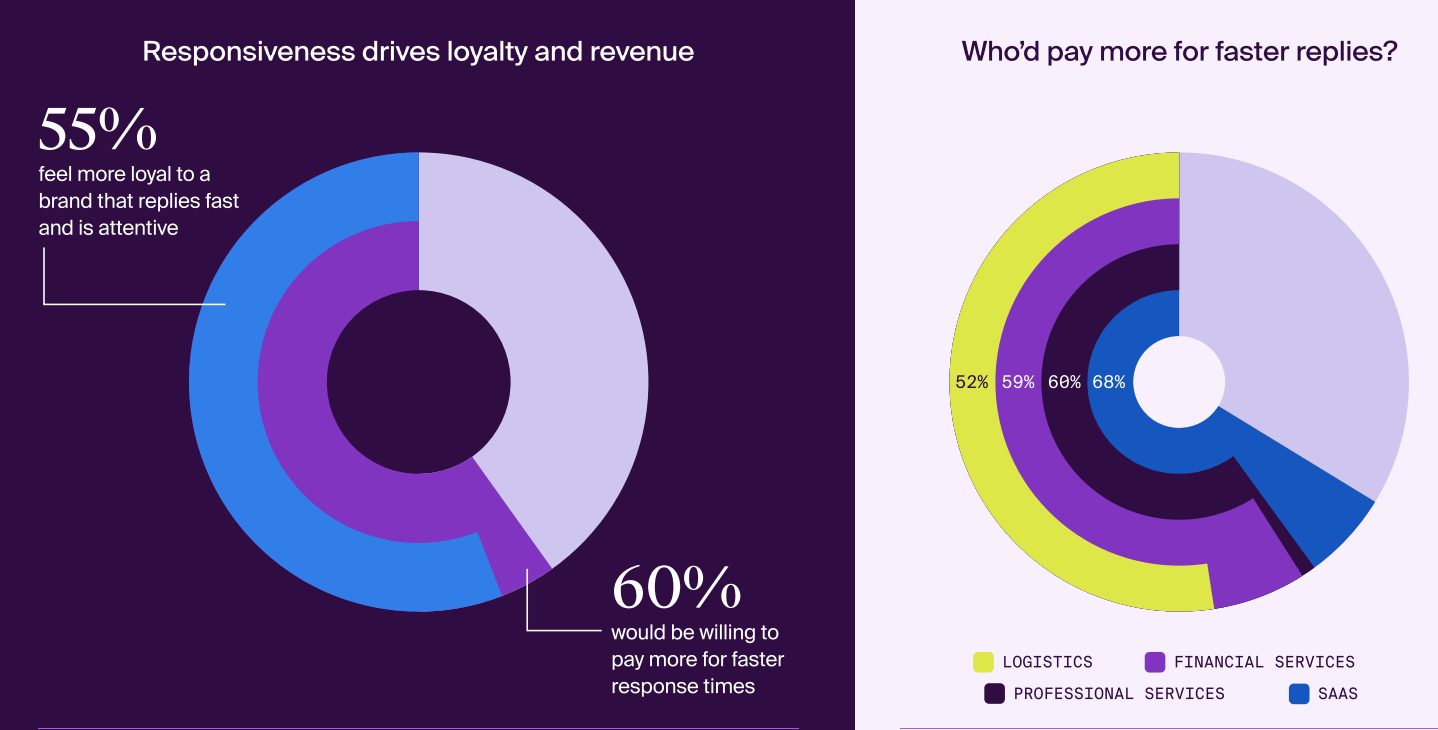
Responsiveness is one of the top factors that drives loyalty and revenue; the majority of customers across the industry would pay extra for faster replies.
Imagine calling your favorite coffee store, they greet you by name, already see your last order from the app, ask if you want the same drink, and proactively apologize for the delayed delivery you reported via chat yesterday.
That's personalized and omnichannel service at its finest.
Sixty-six percent of consumers use at least three communication channels to contact a company, making gathering and correlating information increasingly difficult. On the other hand, 79% of customers expect consistent interactions across channels so they don't have to repeat themselves.
Conversational AI bridges this gap by mining calls, emails, chat logs, agent notes, surveys, and behavioral signals, unifying them into a single, continuously updated customer profile. According to Zendesk, 85% of CX leaders say memory-rich AI builds deeper relationships.
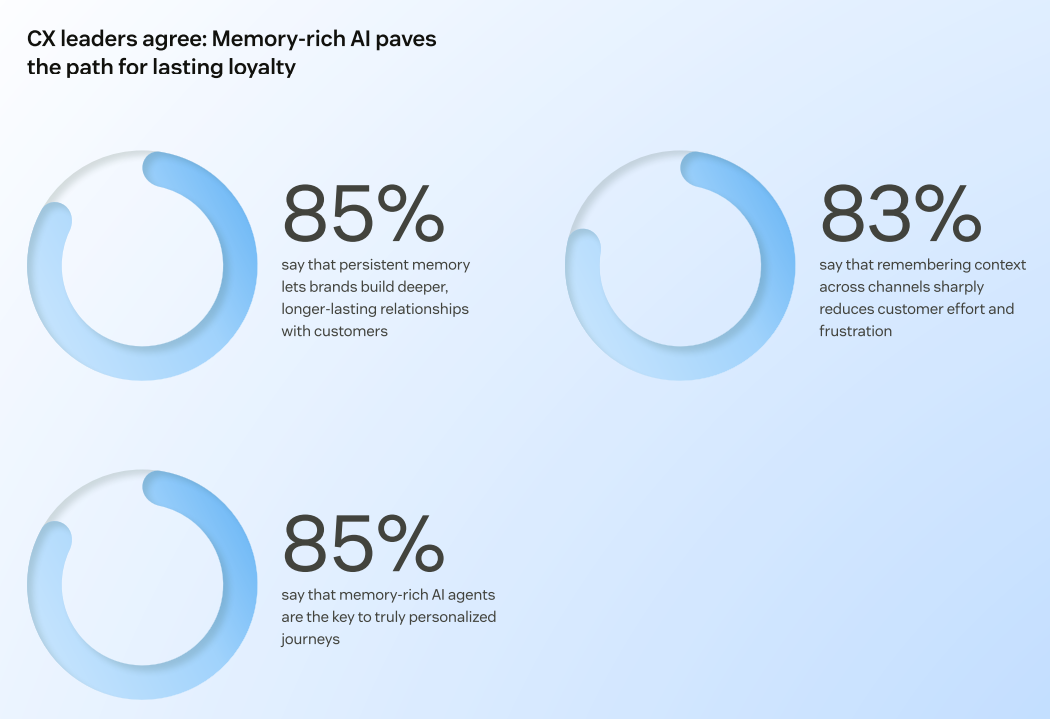
Meanwhile, experiences that memory-rich AI doesn't power will feel increasingly impersonal
—and irrelevant. And, that's a mistake CX leaders cannot afford to make.
Burnout is a reality many call center automation agents face as they navigate high workload, tight schedules and demanding customer interactions.
A recent interview from Custify reveals that 86% of customer success managers want to quit in 2025. On average, call centers face turnover rates of 30-45%, more than double the average for other industries.
Conversational AI offers hope for burned-out service agents. It helps them with:
Ultimately, advanced technology may be the key to boosting customer satisfaction while finally giving overworked agents the support they need.
Customer service teams can use conversational skills to automate tasks at scale, while still offering personalised interactions. If you're curious about how conversational AI helps you improve customer service processes, consider the use cases below.
A frustrated customer calls an AI agent, and the IVR traps them in menus ("Press 1 for Billing…") before they can ever reach an agent. Conversational AI, on the other hand, acts as an intelligent concierge, not a gatekeeper.
It starts with a meaningful conversation to understand the underlying reason a person is calling: whether that's booking an appointment, asking a billing question, resetting a password, or canceling a service.
It then routes the call to the right destination, whether it's an AI agent, a human rep, or a specific department.
Cutting-edge platforms like Retell AI take AI call routing to the next level with warm transfers, allowing AI phone agents to understand caller needs, and warm transfer them to live agents when the situation demands it.
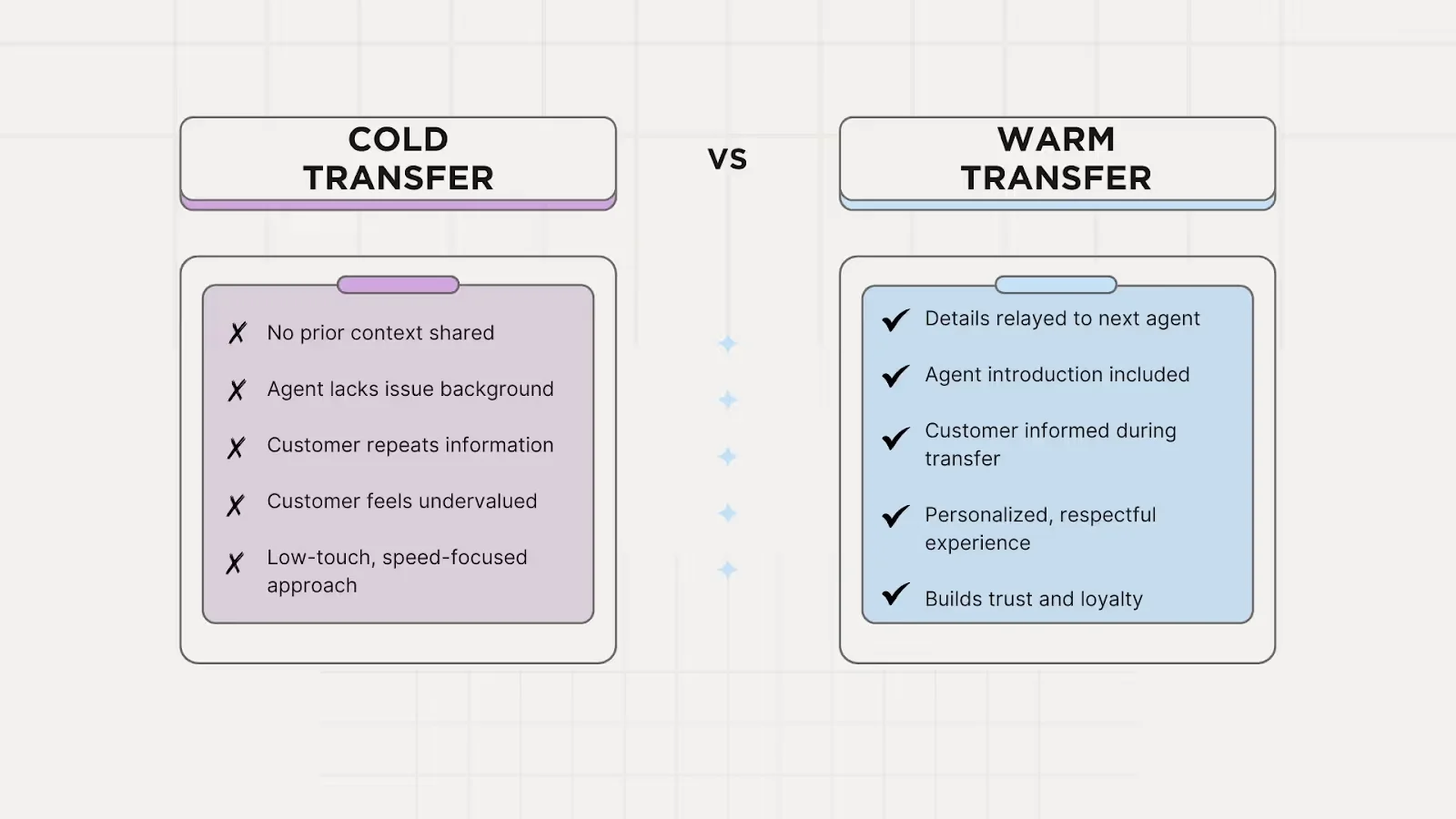
AI-powered customer service promises a more conversational and efficient way to get support. It can handle simple inquiries and leave the more complex ones to humans.
Today, customers appreciate the use of AI; in fact, 71% wish they could solve their problem without needing a human. Well-designed and implemented AI cuts through the complexity to offer a service that is predictive, proactive, and personalized.
Here's what an AI agent from Retell can do:
At Retell, we see that at least 50% of your low-complexity inquiries currently handled by your team could be handled by AI.
Plus, everything is personalised, right from your AI agent architecture to tone, scripts and workflows. This makes scaling during peak season effortless, simultaneously delivering consistent and high-quality responses.
In traditional contact centers, pre-call authentication typically takes 45 seconds to 2 minutes per call, depending on industry and security requirements.
That time is spent asking and verifying details like:
At scale, this adds up fast: 1 minute wasted per call × 10,000 calls/day = ~167 agent hours lost daily. That means your agents spend 10–20% of their call time on identity checks instead of problem-solving.
Conversational AI saves time by authenticating callers before the agent ever joins. Retell AI agent verifies identity naturally during the conversation using:
As the customer talks, the authentication happens in the background. So, your team starts the conversation knowing exactly who is on the line.
Once a call ends, conversational AI automatically processes everything that happened during the interaction, without adding work for human agents.
Retell AI agent offers the following post-call assistance after the customer hangs up:
These summaries are instantly logged in the CRM or ticketing system, eliminating manual wrap-up time.
It's the biggest question on everyone's mind at the moment: Are robots going to steal my job?
Intercom research shows that just over half (53%) of support teams are worried about the potential negative impact of AI on the customer service industry.
A straightforward answer would be 'No'. Despite their growing sophistication, AI agents are not designed to replace humans entirely.
Instead, they complement human teams by handling routine and repetitive requests, allowing employees to focus on empathy-driven or high-stakes interactions. Studies have revealed that a hybrid model works best; AI boosts human agent productivity by as much as 15%.
Here's how AI and humans work together to provide a seamless customer experience and lower employee burnout:
| Task | Best fit | Why |
|---|---|---|
| Routing conversations | AI | Automation instantly routes conversations to the right team or individual, eliminating the need for teammates to manually read, tag, or triage messages. |
| Summarizing conversations | AI | An AI-powered bot condenses entire conversations into clear, concise summaries, capturing key details so teams don’t have to sift through long message histories. |
| Quickly resolving simple or repetitive queries | AI | AI-powered bots efficiently handle routine and moderately complex queries, significantly reducing the volume of conversations your support team must manage. |
| Resolving complex queries | AI + Human | Advanced AI recognizes when to hand off to a human agent, after collecting relevant context to ensure faster and smoother resolution. |
| Handling emotionally complex or sensitive queries | Human | Humans excel at empathy and judgment, building meaningful, long-term customer relationships in sensitive situations. |
The lesson is clear: the future of customer service is not AI or humans—it is AI and humans working together, with AI as the first line of defense and humans stepping in where judgment and empathy are required.
The use cases and examples of conversational AI are wide-ranging. Emergen research shows the dominance of three prominent industries, which are:
According to Gartner, close to 60% of banking CIOs plan to implement AI tools within the next year.
Another Nvidia research shows that 30% of financial institutions are using AI to drive more than a 10% increase in annual revenue, while over a quarter report cost reductions exceeding 10% annually through AI adoption.
In the banking industry, voice assistants and chatbots can be used for:
To meet demands for timely service, brands are using both customer-facing AI-powered assistants (to help customers self-serve) and agent-facing AI tools (to get their people the information, context, and even suggested language to help customers faster).
Business leaders feel confident about using AI to engage with customers, with 55% of retail businesses prioritizing voice agents over messaging.
In retail, conversational AI is commonly used for:
The global conversational AI market in healthcare was valued at approximately USD 13.68 billion in 2024 and is expected to grow to USD 106.67 billion by 2033, registering a CAGR of 25.71% between 2025 and 2033.
Consumers are excited for innovation that eliminates barriers to care. As a result, a majority (52%) now prefer interacting with AI voice agents over in-person visits or home appointments—signaling a broader shift toward convenience and accessibility in the healthcare system.
In the healthcare industry, conversational AI can be used for:
Retell AI is an industry-leading conversational AI platform that makes building and deploying voice agents accessible to users without extensive programming knowledge.
Here's a step-by-step guide to building conversational AI for customer service in Retell:
Start by identifying the specific use cases your AI agent will support. For instance:
Example: A telehealth provider can build an AI agent to triage symptoms, route patients to the right specialist, set up virtual appointments, and send follow-up reminders.
Use Retell's no-code visual builder to create multiple nodes to handle different scenarios in conversations, enabling you to handle more complex scenarios with predictable outcomes.
This involves mapping out the different ways a conversation can flow, including greetings, questions, handoffs, and closing statements.
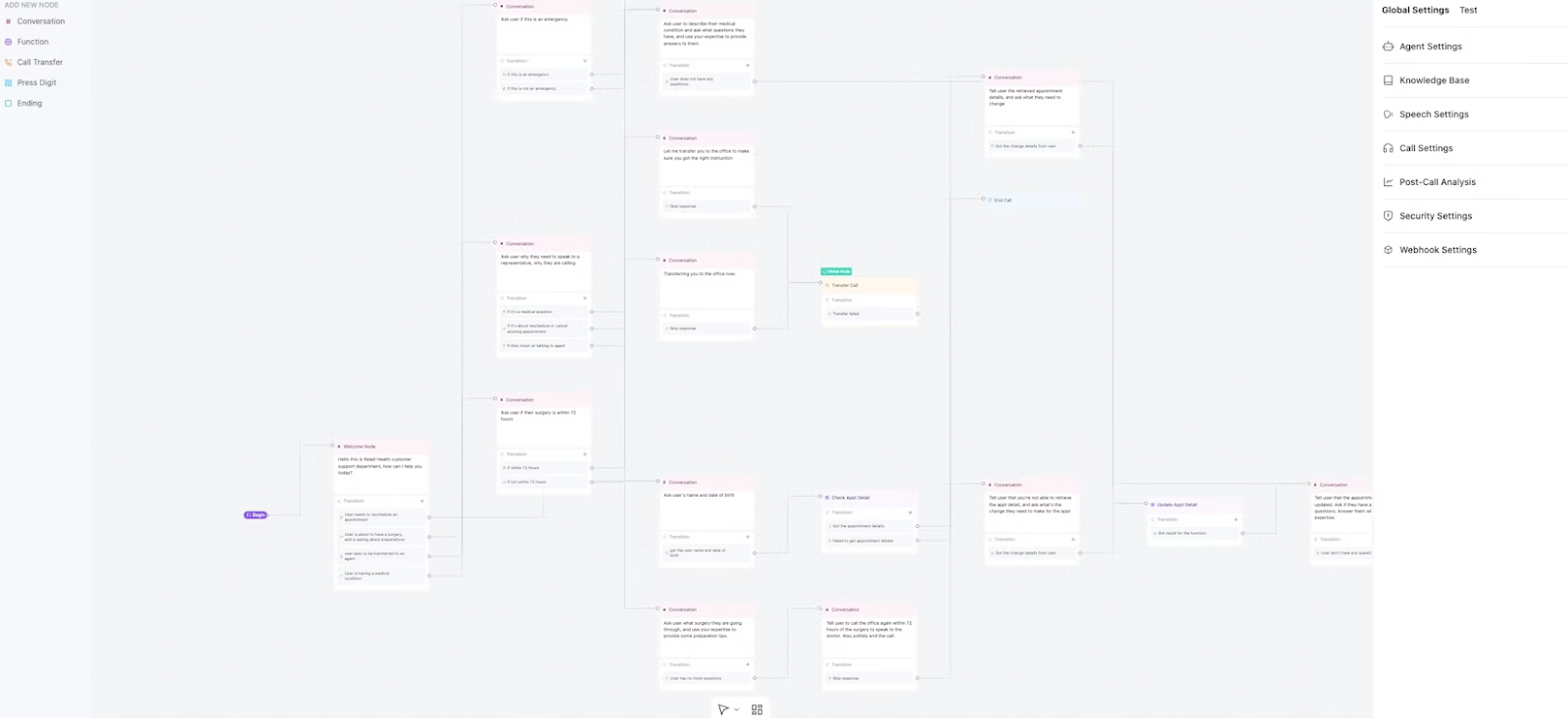
Connect your AI agent to various systems such as phone systems, CRMs, and calendars, so your agents can access and update information in real-time. For scenarios where security is paramount, integrate DTMF capabilities to enable users to input information using their keypad.
This is particularly useful for tasks such as entering passwords, account numbers and other sensitive data.
You can use Retell's AI testing tools to stimulate conversations with your AI agent. Based on the results of the testing, you can refine your prompts and dialogue logic to improve the agent's accuracy and effectiveness.
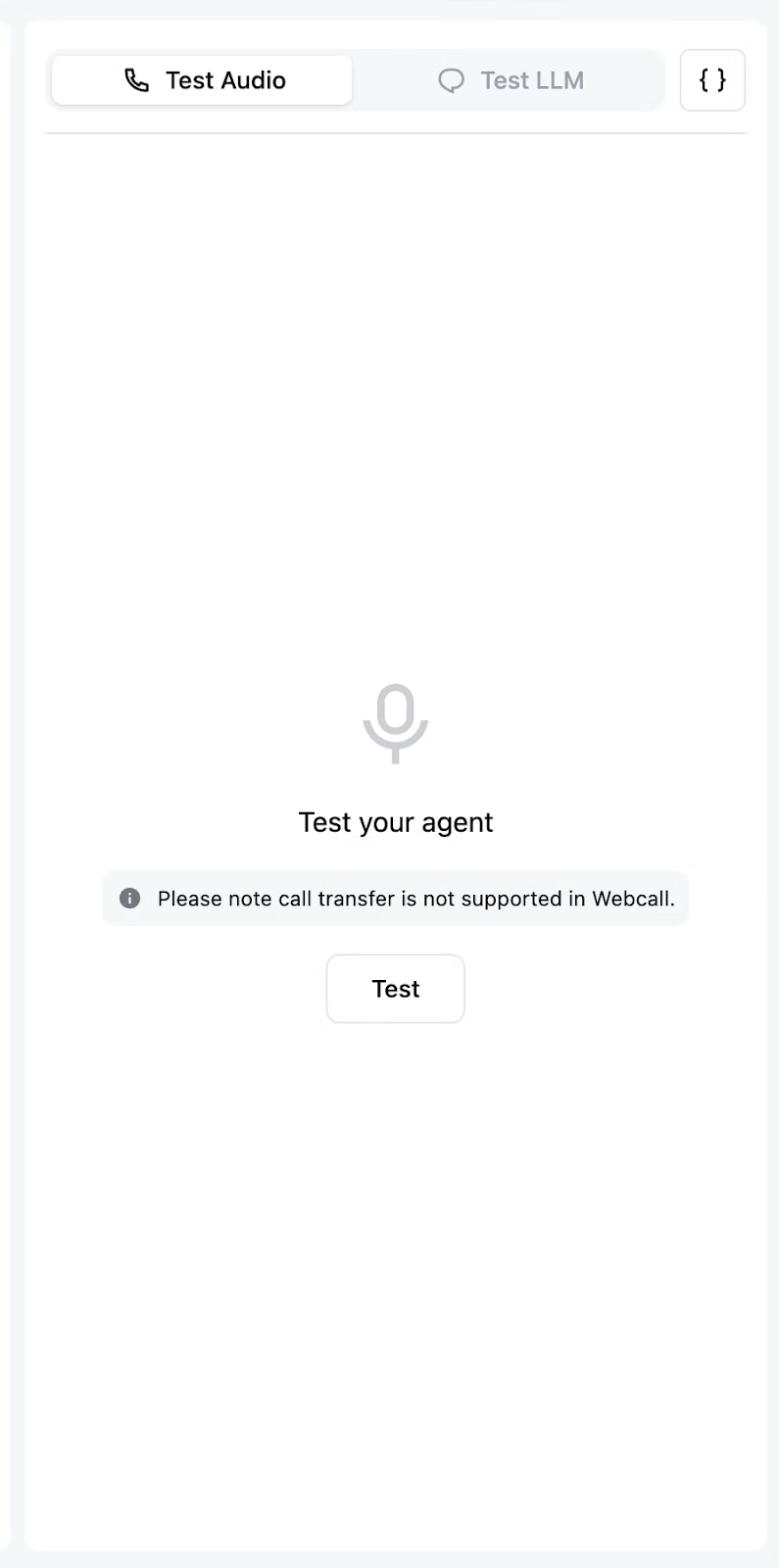
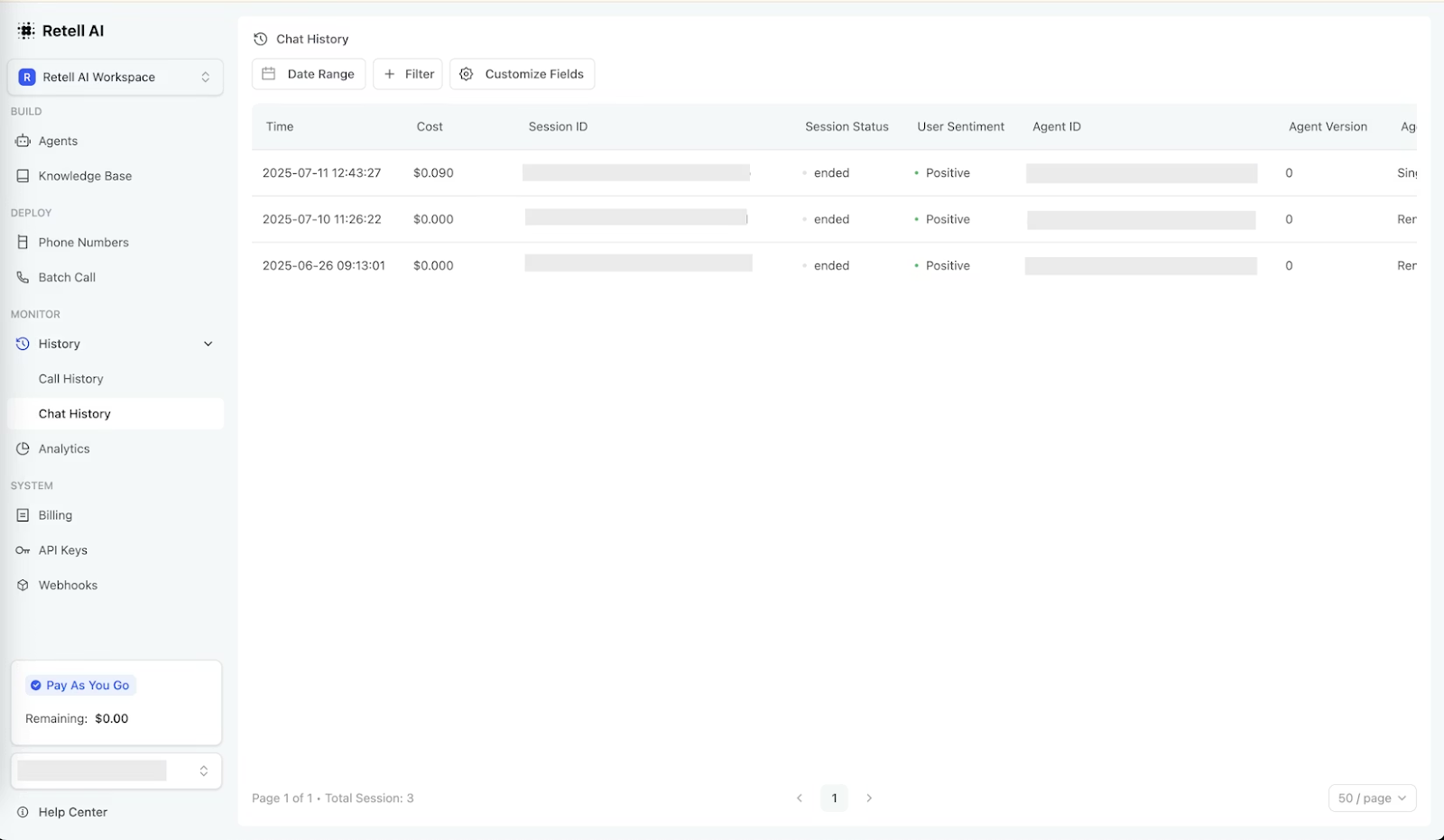
Simply deploy conversational AI agents on the channels where you want it to interact with customers, such as phone, chat, or email. Continuously monitor the agent's performance using Retell AI's dashboard.
You can track metrics such as escalation rate, resolution rate and customer satisfaction to ensure that the agent is meeting your business objectives.
Conversational AI delivers real value only when it moves beyond demos and prototypes into live customer service environments, where it must handle real conversations, objective complexity, and real expectations.
This is where platforms like RetellAI play a role, enabling teams to deploy conversational AI directly into production customer service workflows rather than controlled experiments.
With Retell AI, your voice agent will be up and running in less than five minutes. Our clients have achieved over 80% resolution rate and automated at least 40-50% of customer calls with voice agents.
Want to see Retell AI in action? Try Retell AI for free!
Conversational AI in customer service refers to AI-powered voice bots or chat assistants that can understand natural language, hold human-like conversations, and resolve customer issues in real time. Unlike traditional chatbots, conversational AI uses NLP, machine learning, and context retention to handle complex queries, personalize responses, and seamlessly hand off to human agents when needed.
No. Conversational AI is designed to augment, not replace, human agents. AI handles routine tasks and gathers context, while humans focus on empathy-driven, complex, or high-stakes conversations. Organizations using a hybrid AI + human model see higher productivity, better CSAT, and lower agent burnout.
With no-code or low-code platforms like Retell AI, teams can deploy a production-ready voice agent in minutes. Most businesses start seeing value within weeks, not months, by automating targeted use cases first and expanding gradually.
Customer expectations for instant, accurate, and personalized service are higher than ever. By 2026, AI-powered service is becoming the default, not a differentiator. Businesses that delay adoption risk higher costs, slower response times, and declining customer loyalty compared to AI-enabled competitors.
The future of AI in customer service is hybrid and proactive. AI will act as the first point of contact, resolving most routine queries, predicting customer needs, and assisting agents in real time—while humans focus on complex, emotional, and high-value interactions that require judgment and empathy.
In 2026, customer service goals center on speed, accuracy, and personalization at scale. Organizations aim to automate 40–60% of interactions, deliver seamless omnichannel experiences, reduce agent burnout, and use AI-driven insights to improve resolution rates, loyalty, and operational efficiency.
See how much your business could save by switching to AI-powered voice agents.
Total Human Agent Cost
AI Agent Cost
Estimated Savings
A Demo Phone Number From Retell Clinic Office