Conversational AI For Enterprise
18
MIN READ
October 19, 2026
Over the past several months, AI agents have moved from experimental technology to infrastructure that enterprises use in production.
Unlike traditional chatbots that simply respond to prompts, conversational AI agents can understand context, reason through interactions, make decisions, and take action autonomously.
They can handle everything from answering customer inquiries and qualifying leads to scheduling appointments, updating CRMs, and managing complex, multi-step customer conversations without constant human intervention.
Eight in 10 organizationsbelieve AI agents have already delivered measurable ROI, with another 1 in 10 saying they expect them to deliver more economic impact in the future. The question facing leaders in 2026 isn't whether to adopt AI agents but how to scale them strategically, and that's exactly what we're gonna discuss here.
This blog is your roadmap to understanding how conversational AI is transforming enterprises and why you should act now.
Conversational AI in enterprise is not just chatbots answering simple questions, it combines technologies like natural language processing (NLP), large language models (LLMs), speech recognition, and workflow automation to create human-like interactions that can handle complex business processes from start to finish.
A majority of organizations (52%) believe "customer service or task automation" to be the most transformative use case for voice technology. However, its impact extends well beyond support:
61% cite complete transactions or checkout
59% point toanswering FAQs
48% to appointment scheduling
The technology is now being adopted across virtually every department, from customer support and sales to HR, IT help desks, healthcare, banking, and internal operations.
Themajority of organizations (80%) report that their AI agent investments are already delivering measurable economic impact today, and confidence is even higher looking forward—88% expect continued or increased returns. This isn't speculative ROI; most enterprises are seeing concrete business value from their deployments.
Now that we've explored what conversational AI is, understanding the fundamentals will help you make informed decisions.
Let's break down how these intelligent systems actually work!
Every interaction begins when a customer communicates through a channel such as live chat, SMS, WhatsApp, email, or a voice call.
YourAI call center first captures this raw input and converts it into a format that can be analyzed:
Text channels: Messages are processed directly.
Voice channels: Automatic Speech Recognition (ASR) converts spoken language into text before further processing.
Modern ASR systems can handle different accents, speaking speeds, pauses, and even background noise, ensuring that customer requests are accurately captured from the very beginning.
Once the message is captured, conversational AI must determine what the customer actually wants. This is where Natural Language Understanding (NLU) and Natural Language Processing (NLP) come into play.
When someone writes, "I need to change my flight from London to Paris next Tuesday," the conversational AI system doesn't simply read the sentence as text. Using Natural Language Understanding (NLU), it breaks the message into structured information that the system can act on.
This process, known as intent recognition and entity extraction, enables the system to understand not just what the customer said, but what they actually want to accomplish.
Intent: Flight change
Origin: London
Destination: Paris
Date: Next Tuesday
Importantly, NLU can recognize the same request even when people phrase it differently. Customers might say:
"Can I switch my flight?"
"I want to rebook my ticket."
"I need to move my flight to another day."
"Change my reservation for next week."
Although the wording varies, the system understands that all of these requests relate to the same underlying intent: modifying an existing flight booking.
This capability is powered by Natural Language Processing (NLP), the broader field of AI that enables machines to understand, interpret, and generate human language. NLP helps conversational AI deal with the inherent complexity and unpredictability of real-world communication.
After understanding the customer's request, the system generates an appropriate response through Natural Language Generation (NLG).
Modern conversational AI does far more than select a pre-written answer. It can:
Retrieve information from backend systems such as CRMs, databases, andknowledge bases
Personalize responses using customer history and preferences
Complete transactions and execute workflows
Ask follow-up questions when additional information is needed
Generate human-like responses tailored to the context of the conversation
For example, after identifying a flight change request, the AI can instantly access an airline's booking, check available flights, confirm the customer's selection and update the reservation automatically.
One of conversational AI's biggest advantages is its ability to improve over time. Machine learning algorithms analyse which responses lead to successful outcomes (resolved issues, completed purchases, positive feedback) and adjust future behavior accordingly.
Over weeks and months of interaction, this continuous learning loop improves accuracy, reduces escalations, and helps the system handle increasingly complex requests.
This four-step cycle runs in milliseconds. To customers, it feels like a natural conversation with an intelligent assistant. Behind the scenes, layers of conversational AI technology work together to make it happen.
For enterprises, conversational AI eliminates routine work, reduces friction across teams and aids decisions to help humans move faster. Let's take a look at each of them:
This is conversational AI's biggest differentiator because most traditional chatbots can only personalise based on what the customer is saying during the session.
For instance, with Retell AI, your voice agent already knows the customer's history, preferences, purchase behavior, and lifecycle before the first message arrives.
The customer never has to repeat their name, order number or issue. The voice agent recommends products based on what they've actually bought before. And high-value customers get routed to priority support automatically. A returning customer asking about an order gets their specific order status, not a generic "please provide your order number" prompt.
This isn't integration-project personalization that takes six months to configure. It's the native integration between the conversational AI solution and your CRM that feeds all the latest information.
"Multilingual support" sounds like a checkbox until you're serving customers across Southeast Asia, the Middle East and Latin America simultaneously. Retell's conversational AI agents detect preferred language automatically and respond naturally, with product vocabulary, industry terminology, and cultural context preserved.
For enterprises operating across diverse regions, this eliminates a massive operational burden and opens the door to audiences you couldn't serve before. Customers who interact in their native language convert at a higher rate, and one build gets you there in every market.
Without AI-first customer service, you won't get the benefits of breaking the traditional linear growth model. The size of your support team will limit the quality of your customer service, as you need to add (and recruit, onboard, and train) new staff to handle any business growth.
That's why the true value of AI-first customer service goes beyond cost reduction; it delivers improvedsupport quality,scalability, and overall business impact.
At Retell, our most successful clients think about the return on investment through two lenses: increased bandwidth and cost efficiency.
| Simplified example: Let's say your support operation has 1,000 conversations to resolve per month. It also has a $4 cost per human resolution. Total cost per month, pre-AI: $4 × 1,000 = $4,000 Then you adopt the Retell AI Agent, and it resolves 50% of your total conversations for $0.50 per resolution. Assuming it takes a few minutes to answer queries. Now, rather than paying $4 for every resolution, you're paying $4 for just 50% of resolutions, and $0.50 for the other 50%. In other words, you're saving $3.50 per resolution on that 50% of your total conversations, which the AI Agent resolves. AI resolutions: ($0.50) × (500) = $250 Human resolutions: ($4) × (500) = $2,000 Total cost per month, post-AI = $2,500 This means it saves your business $1500 per 1000 conversations. |
|---|
It's not about replacing human agents; it's enabling the team to focus on more impactful and rewarding tasks. That's exactly why 72% of leaders believe these capabilities will increase company profitability and revenue and lower company risks (57%).
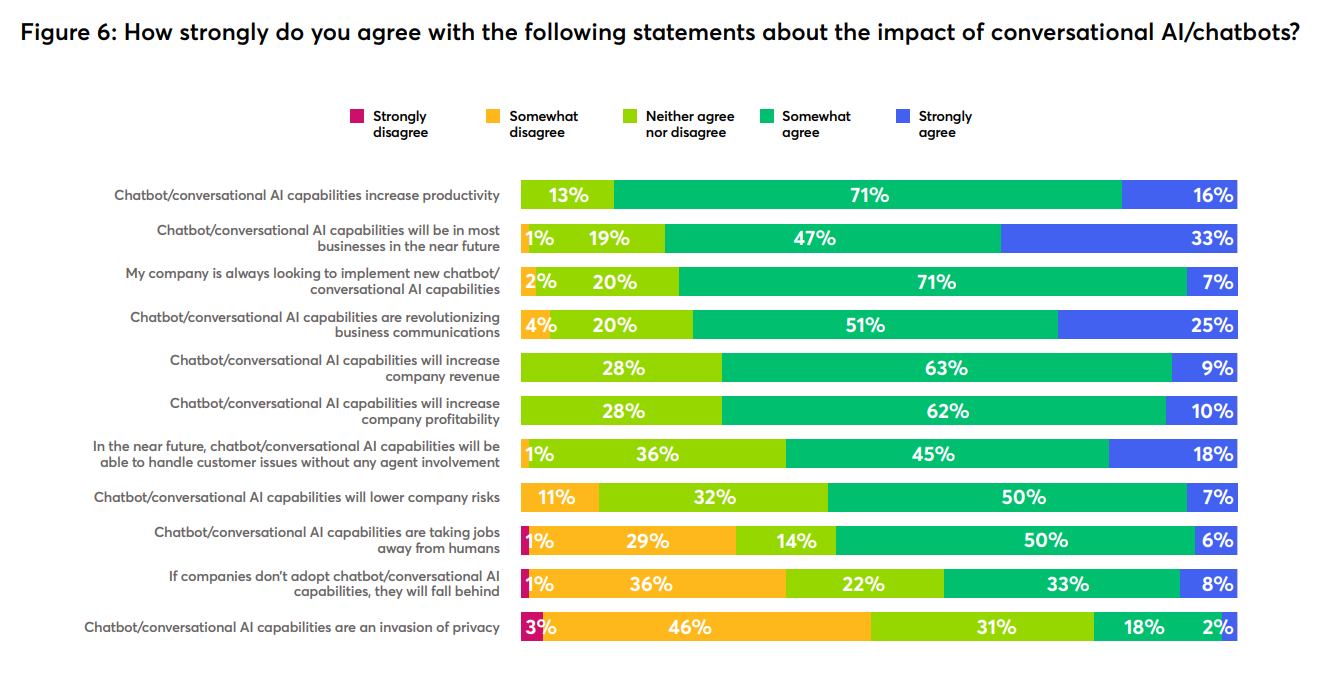
Scaling customer interaction is often a challenge, but conversational AI makes it effortless. While humans struggle to keep up with demand, conversational AI can handle thousands of interactions simultaneously, delivering consistent and high-quality responses.
Data from leading conversational AI vendors shows that agent interactions can surge by up to 250% during peak periods across industries, without any decline in service quality.
Also, a BCG report highlights that 62% of AI-driven value is created within core business functions, with sales and marketing emerging as the second-largest contributor.

The use cases and examples of conversational AI in enterprises are wide-ranging. Emergen research shows the dominance of three prominent industries, which are:
Banking and financial services (BFSI) (market share of 24–30%)
Retail & E-Commerce (market share of 18–22%)
Healthcare (market share of 15–19%, fastest growth projections)
According to Gartner, close to 60% of banking CIOs plan to implement AI tools within the next year.
Another Nvidia research shows that 30% of financial institutions are using AI to drive more than a 10% increase in annual revenue, while over a quarter report cost reductions exceeding 10% annually through AI adoption.
In thebanking industry, voice assistants and chatbots can be used for:
Fraud detection and prevention
AI receptionist for handling repetitive account inquiries, including balance checks, account updates, account opening, and password resets
Personalized service based on customer history, behavior, and preferences
Reporting lost or stolen debit and credit cards
Intelligent sales recommendations, cross-selling, and upselling based on customer needs and data
PIN creation and reset assistance
Money transfers and payment processing
Handling FAQs, such as branch operating hours and product-related questions
Customer authentication through natural, conversational interactions
Proactive reminders and alerts for payments, transactions, and account activities
Intent capture and intelligent call routing to the appropriate department or agent
To meet demands for timely service, brands are using both customer-facing AI-powered assistants (to help customers self-serve) and agent-facing AI tools (to get their people the information, context, and even suggested language to help customers faster).
Business leaders feel confident about using AI to engage with customers, with 55% of retail businesses prioritizing voice agents over messaging.
Inretail, conversational AI is commonly used for:
Cart abandonment reminders and promotional alerts
Inventory and store availability checks, both online and at nearby locations
Personalized shopping experiences powered by customer history and loyalty data
Handling returns, exchanges, and refund requests
Intent capture and intelligent routing to sales, support, or store assistance teams
Loyalty program queries, points balance checks, and reward redemptions
Intelligent upselling and cross-selling based on customer intent and purchase patterns
AI telemarketing for answering questions related to order placement, tracking, and delivery updates
FAQs covering store hours, product availability, and pricing information
Product discovery and recommendations based on browsing behavior and customer preferences
The global conversational AI market in healthcare was valued at approximately USD 13.68 billion in 2024 and is expected to grow to USD 106.67 billion by 2033, registering a CAGR of 25.71% between 2025 and 2033.
Consumers are excited for innovation that eliminates barriers to care. As a result, a majority (52%) now prefer interacting with AI voice agentsover in-person visits or home appointments—signaling a broader shift toward convenience and accessibility in the healthcare system.
In thehealthcare industry, conversational AI can be used for:
Prescription refill requests and status updates
Patient registration and intake, including form completion and information updates
Answering FAQs such as clinic hours, insurance coverage, and service availability
Medication reminders and adherence support
AI receptionist for pre- and post-visit follow-ups, care instructions, and reminders
Appointment scheduling, rescheduling, and cancellations
Personalized patient support based on medical history and individual preferences
Billing and insurance queries, including claims status and co-pay information
Symptom checking and care navigation to guide patients to the appropriate level of care
Patient intent capture and intelligent call routing to the right department or provider
While people often use these terms interchangeably, there are distinct differences between conversational AI, chatbots and agentic AI based on how they understand and respond to customer needs.
Let's have a closer look at some of the key differences.
Chatbots generally follow predefined scripts and decision trees, recognizing specific key phrases or keywords with templated answers.
While it's used for simple interactions, chatbots aren't advanced enough to understand context, learn from past interactions or take autonomous action beyond their infrastructure.
For example, a traditional chatbot might provide you with a link to reset your password when it detects the phrase "forgot password." However, it can't verify the user's identity and help them change the password in the same thread.
Conversational AI, on the other hand, uses more advanced AI and NLP that help understand the context and intent behind a user's question, regardless of its phrasing. They can also connect with different backend systems to share even more information.
In the last scenario, a conversational AI solution would recognize and understand the request, then verify the user's identity through integrated security protocols.
Then, it would reset the password in accordance with your IT password policies and communicate the new credentials and next steps securely — all without a human team member ever lifting a finger.
Conversational AI excels at interpreting human language and engaging in natural, dialogue-based interactions. Its primary strength lies in guiding users through simple processes, handling repetitive questions and ensuring fast, consistent communication across multiple channels.
Agentic AI is built around action and execution. Its systems are designed to handle complex goals and workflows with limited direct human supervision. It demonstrates genuine problem-solving capabilities and adapts its approach based on context, customer history and real-time data analysis.
Take Retell's AI receptionist, for example. It can handle inbound calls autonomously, ensuring no enquiry is missed, even after-hours. Meanwhile, our agents also provide live sentiment analysis and contextual recommendations, enabling them to navigate even the most complex conversations with greater confidence and speed.
By anchoring agentic AI in voice, Retell AI delivers a more human, more trustworthy form of automation that builds connections, not just efficiency.
An enterprise receives hundreds or even thousands of calls and messages every day, so it's important to choose a pricing model that fits its needs and budget. The cost of enterprise conversational AI varies significantly depending on the deployment model, features, channels, and level of customization required.
There are various types of pricing models for businesses, ranging from usage-based pricing, subscription pricing or a mix of both.
For usage-based pricing, you only pay for what you use, without a monthly commitment or for idle capacity. This model works well if your volume is unpredictable or seasonal. For instance, a marketing agency running outbound campaigns likeAI cold calling might process 5000 minutes in one month and 500 in the next. Per-minute billing absorbs that variance without locking you into an expensive monthly plan.
Subscription-based pricing gives you a fixed monthly or annual fee for access to conversational AI capabilities. The risk is exceeding your minute cap, which triggers overcharges that are almost always priced higher than the plan rate, which is usually a big problem with enterprises.
That's why the best conversational AI tools offer the best of both worlds with dedicated enterprise plans.
Enterprise voice AI pricingtypically runs high, around $40,000 to $70,000 per year for platform access alone. When you add integration, compliance, and dedicated support, the pricing can reach six figures.
For instance, Retell AI offers adedicated enterprise planfor enterprises that demand higher reliability, tighter compliance, and dedicated support, with volume pricing that scales as you grow.
What you get for that money:
Volume discounts: Per-minute rates can drop significantly for high-volume organizations handling millions of call minutes.
Dedicated support: Includes priority SLAs, named account managers, role-based access and a path to custom feature development.
Compliance: Enterprise plans often support standards like HIPAA, GDPR, SOC 2, and PCI DSS, and dedicated stable servers.
Custom integrations: Support tailored CRM integrations, custom voice models, and multilingual AI deployments.
A clear cost difference drives the ROI for enterpriseAI deployments: AI voice agents typically handle calls for around $0.05–$0.10 per minute, while human agents often cost $0.50–$1.00+ per minute when salaries, benefits, training, and overhead are included.
Organizations that automate 30–50% of inbound call volume can substantially reduce support costs, with many achieving ROI within 3–6 months.
Retell AI is an industry-leading conversational AI platform that makes building and deploying voice agents accessible to users without extensive programming knowledge.
Here's a step-by-step guide to building conversational AI for customer service in Retell:
Start by identifying the specific use cases your AI agent will support. For instance:
Example: A telehealth provider can build an AI agent to triage symptoms, route patients to the right specialist, set up virtual appointments, and send follow-up reminders.
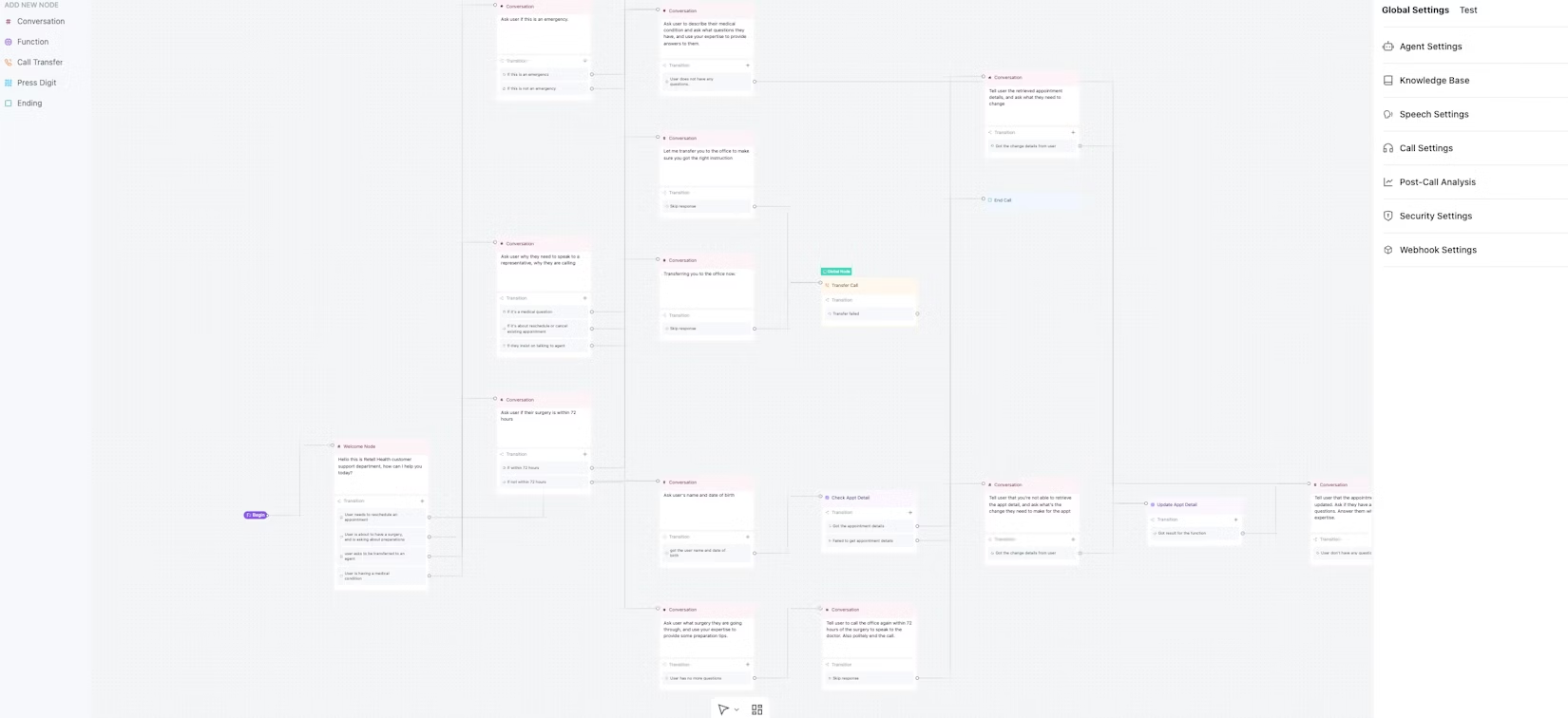
Use Retell's no-code visual builder to create multiple nodes to handle different scenarios in conversations, enabling you to handle more complex scenarios with predictable outcomes.
This involves mapping out the different ways a conversation can flow, including greetings, questions, handoffs, and closing statements.
Connect your AI agent to various systems such as phone systems, CRMs, and calendars, so your agents can access and update information in real-time. For scenarios where security is paramount, integrate DTMF capabilities to enable users to input information using their keypad.
This is particularly useful for tasks such as entering passwords, account numbers and other sensitive data.
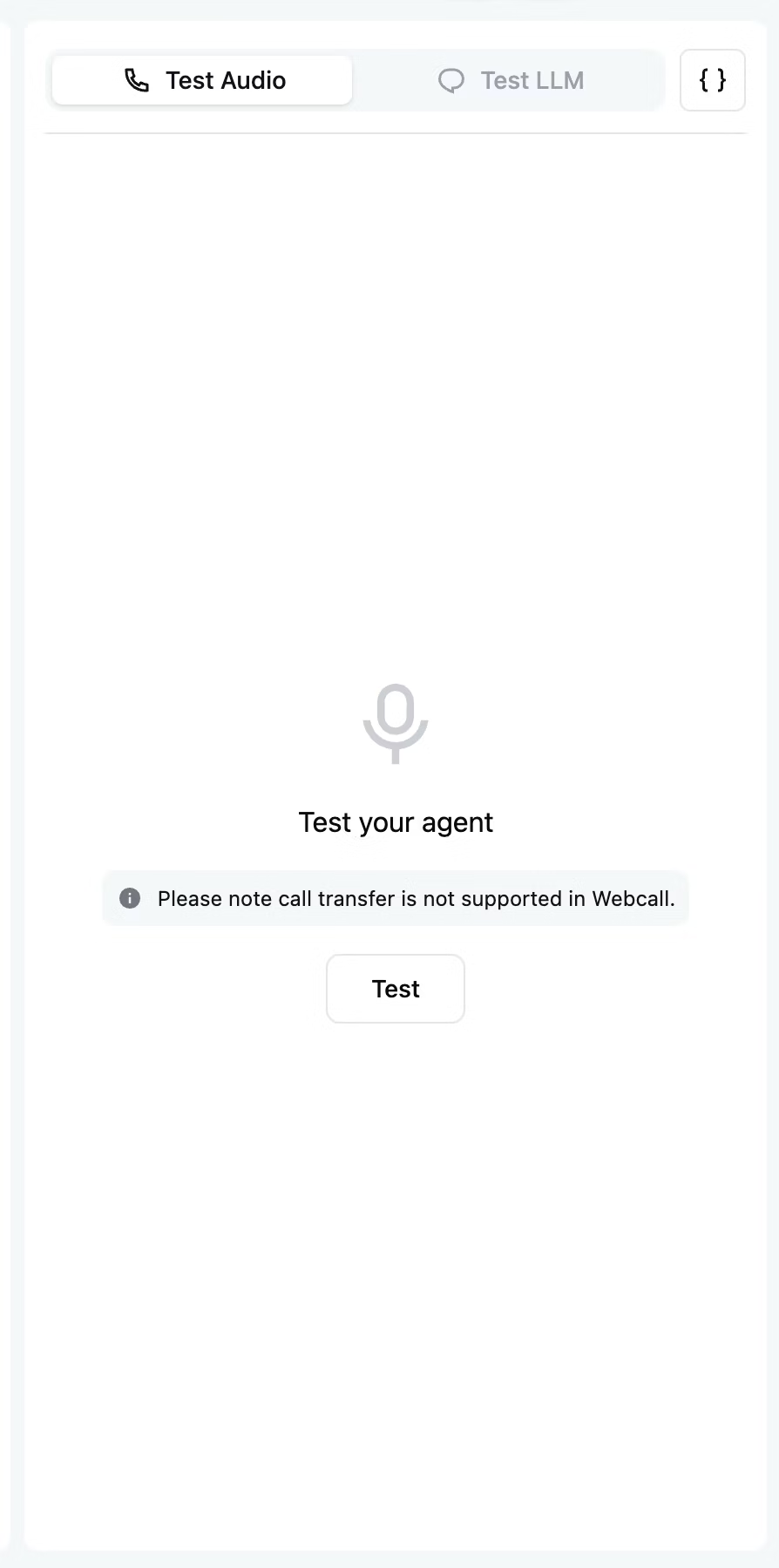
You can use Retell's AI testing tools to stimulate conversations with your AI agent. Based on the results of the testing, you can refine your prompts and dialogue logic to improve the agent's accuracy and effectiveness.
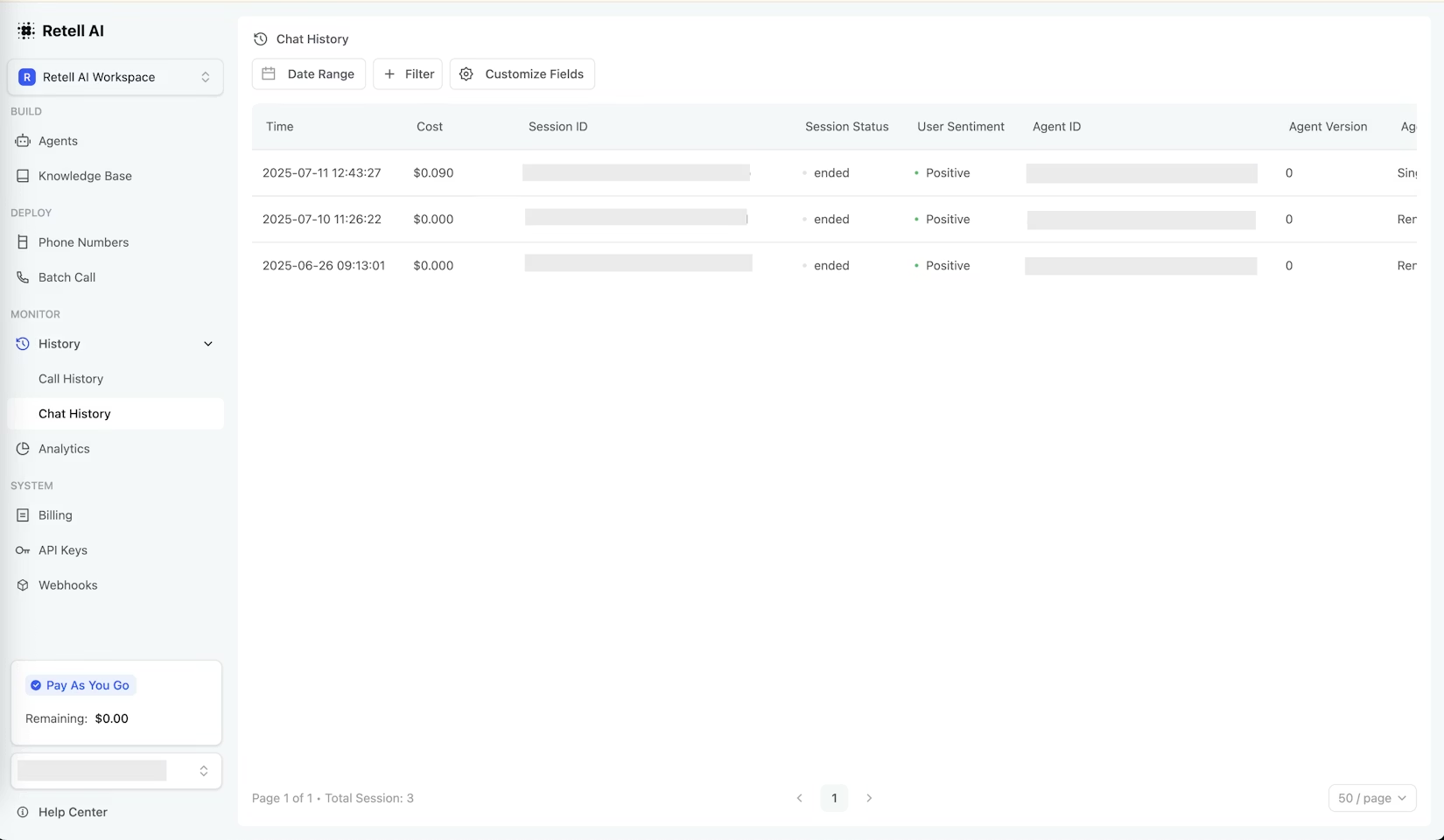
Simply deploy your AI agent on the channels where you want it to interact with customers, such as phone, chat, or email. Continuously monitor the agent's performance using Retell AI's dashboard.
You can track metrics such as escalation rate, resolution rate and customer satisfaction to ensure that the agent is meeting your business objectives.
Most conversational AI platforms focus on prebuilt customer support agents, which lack the flexibility important for enterprises. Retell AI takes a different approach: it gives enterprises and developers the infrastructure to build highly customized AI phone agents from scratch.
Instead of offering a one-size-fits-all bot, Retell AI provides the building blocks for creating production-ready voice agents that sound natural, integrate with your systems, and handle complex conversations in real time.
Here's how it works: you pay based on usage, typically by the minute, while getting access to low-latency voice infrastructure, custom workflows, and deep API flexibility. Businesses can connect their own LLMs, CRMs, scheduling tools, and backend systems to create agents tailored to their exact use case.
That means you're not limited to basic FAQ automation. You can build AI agents for sales calls, appointment booking,lead qualification, healthcare intake, customer support, collections, or outbound campaigns.
What makes Retell AI different:
Built for customization: Retell AI is designed for teams that want full control over how their AI phone agents behave. You can define prompts, workflows, escalation logic, memory handling, andintegrations instead of relying on rigid templates.
Ultra-low-latency conversations: One of Retell AI's biggest strengths is conversational speed. The platform is optimized for real-time interactions with fast response times, making conversations feel more human and less robotic.
Bring your own AI stack: You can connect models like OpenAI GPT models, custom APIs, retrieval systems, CRMs, and scheduling tools. This flexibility makes Retell popular with startups and engineering teams building advanced voice experiences.
Production-ready telephony: Retell supports inbound and outbound calling,call transfers, voicemail handling, interruption detection, and live agent escalation. It's designed to support real business workflows rather than just demos.
Scales with your usage: Because pricing is usage-based, businesses can start small and scale call volume over time, rather than committing to large upfront contracts.
For enterprises that need flexibility and developer control, Retell AI often provides more freedom than turnkey AI voice agents. Instead of paying for a fixed support bot, you're building a voice infrastructure layer tailored to your own operations.
Want to test how an AI phone agent sounds with your workflows? You can build and deploy a prototype quickly using Retell AI's platform.
Conversational AI in enterprise delivers real value only when it moves beyond demos and prototypes into live customer service environments, where it must handle real conversations, objective complexity, and real expectations.
This is where platforms like RetellAI play a role, enabling teams to deploy conversational AI directly into production customer service workflows rather than controlled experiments.
With Retell AI, your voice agent will be up and running in less than five minutes. Our clients have achieved an over 80% resolution rate and automated at least 40-50% of customer calls with voice agents.
Want to see Retell AI in action? Try Retell AI for free!
Conversational AI for enterprise is AI-powered software that enables businesses to automate human-like interactions across voice and digital channels while integrating with business systems to complete tasks end-to-end. Unlike basic chatbots, it understands context, accesses enterprise data, and executes workflows such as customer support, appointment scheduling, and lead qualification at scale with the security and reliability enterprises require.
Conversational AI converts voice into text using speech recognition (ASR), then uses LLMs and NLP to understand intent and extract information. It retrieves relevant data from knowledge bases, CRMs, or databases and can call APIs to complete tasks such as booking appointments or updating records. Platforms like Retell AI combine these capabilities with real-time voice infrastructure to deliver natural, low-latency conversations.
An enterprise-grade conversational AI platform combines scalability, security, and integration capabilities. It should support thousands of simultaneous interactions, provide features like SSO, RBAC, and data residency controls, and integrate seamlessly with CRMs, telephony systems, and business applications. Platforms such as Retell AI also offer dedicated infrastructure, compliance support, and monitoring tools for production deployments.
Traditional chatbots follow predefined scripts and decision trees, making them suitable for simple FAQs and structured tasks. Conversational AI understands context, manages multi-turn conversations, and adapts to different ways people phrase requests. It can integrate with backend systems, personalize responses, and execute workflows, enabling far more sophisticated and human-like customer interactions.
No. Conversational AI focuses on understanding and responding naturally to human language, while generative AI creates content such as text and images. Agentic AI goes further by autonomously planning and executing tasks. Modern platforms increasingly combine these capabilities. For example, Retell AI's voice agents are both conversational and agentic, enabling them to hold natural conversations and complete actions autonomously.
Enterprise conversational AI pricing depends on factors such as conversation volume, LLM selection, voice engines, telephony usage, integrations, and compliance requirements. Most vendors offer a combination of usage-based pricing and custom enterprise plans. Retell AI, for example, provides pay-as-you-go pricing alongside dedicated enterprise packages with volume discounts, compliance features, and premium support, so there is no one-size-fits-all price.
Conversational AI is designed to automate repetitive and high-volume interactions, not completely replace human employees. It can efficiently handle tasks such as FAQs, scheduling, and account inquiries while escalating complex, sensitive, or high-value conversations to people. This approach reduces operational costs and frees employees to focus on work that requires empathy, judgment, and relationship building.
Yes, enterprise conversational AI platforms are built with security and compliance requirements in mind. Leading providers offer capabilities such as HIPAA, SOC 2 Type II, and GDPR compliance, along with SSO, role-based access controls, and PII protection. Retell AI also supports features like RBAC, PII redaction, and dedicated infrastructure options for organizations operating in highly regulated industries.
Deployment timelines vary based on complexity and integration requirements. Simple FAQ agents can often be launched within days, while enterprise deployments involving multiple systems and custom workflows typically take several weeks. With no-code builders and prebuilt integrations, platforms like Retell AI allow businesses to prototype quickly and accelerate the path from pilot to production.
See how much your business could save by switching to AI-powered voice agents.
Total Human Agent Cost
AI Agent Cost
Estimated Savings
A Demo Phone Number From Retell Clinic Office