Beste stemagenten voor callcenters in 2026
17
MIN READ
August 11, 2026
Als je zoekt naar stemagenten die gebouwd zijn voor callcenters, merk je al snel hoe druk deze markt is geworden. Vrijwel elke leverancier claimt natuurlijk klinkende gesprekken, directe automatisering en lagere operationele kosten te leveren. In werkelijkheid kampen veel callcenters nog steeds met weggevallen gesprekken, merkbare vertragingen, inflexibele IVR-systemen en onbetrouwbare doorverbindingen. Latency-problemen, gebrekkige escalatielogica en rigide belstromen blijven wrijving veroorzaken voor zowel klanten als frontlijnteams.
Ik stuitte op deze kloof toen ik stemagenten beoordeelde die bedoeld zijn voor echte callcenteractiviteiten, niet voor gescripte demo's of gecontroleerde testomgevingen. De hier beoordeelde platforms werden geëvalueerd op live telefoonlijnen, terwijl ze echt inkomend en uitgaand verkeer verwerkten. De focus lag op hoe deze systemen zich gedragen zodra het volume toeneemt en er in de praktijk randgevallen opduiken.
Deze gids beschrijft de stemagent-platforms die echt relevant zijn voor moderne callcenters. Oplossingen zoals Retell AI zijn opgenomen als onderdeel van deze praktische evaluatie, niet als theoretische voorbeelden.
Een voice-AI-platform is software waarmee callcenters AI-gestuurde stemagenten kunnen ontwerpen, uitrollen en beheren die live telefoongesprekken op schaal afhandelen. Deze platforms zitten direct bovenop telefoniesystemen en zijn verantwoordelijk voor het beantwoorden van gesprekken, het begrijpen van gesproken taal, het in realtime reageren en het uitvoeren van acties in CRM's en interne tools.
Voice-AI-platforms worden vaak besproken naast chatbots en bredere conversationele AI-platforms, maar ze werken onder heel andere beperkingen. Chatbots bestaan in tekstomgevingen waar pauzes, nieuwe pogingen en gestructureerde beurtwisseling acceptabel zijn. Telefoongesprekken zijn veel minder vergevingsgezind. Bellers onderbreken, praten door de agent heen, wisselen midden in een zin van onderwerp en verwachten directe reacties. Conversationele AI-platforms die primair voor tekst zijn gebouwd, hebben vaak moeite wanneer ze worden uitgebreid naar live stem.
Voice-AI-platforms verschillen ook van traditionele IVR-systemen. Traditionele IVR's vertrouwen op invoer via het toetsenblok en rigide menustructuren. Hoewel ze gesprekken kunnen routeren, falen ze wanneer bellers problemen in hun eigen woorden uitleggen of afwijken van gescripte paden. Voice-AI-platforms vervangen statische menu's door conversationele logica. In callcenteromgevingen wordt deze verschuiving vaak beschreven als de overgang van traditionele IVR naar AI-IVR, waar bellers natuurlijk spreken in plaats van door vaste opties te navigeren.
Moderne voice-AI-platforms combineren meerdere technische lagen in één operationele stack die is gebouwd op een voice-first AI-architectuur. Dit omvat doorgaans large language models voor intentieafhandeling, speech-to-text voor transcriptie, text-to-speech voor stemuitvoer, telefonie-infrastructuur voor gesprekscontrole en orkestratielagen die routering en integraties beheren.
Kernmogelijkheden omvatten meestal:
Ik heb dit als een review behandeld, niet als een willekeurige lijst met tools. Elk voice-AI-platform is beoordeeld aan de hand van een kleine set criteria die er in de dagelijkse callcenteractiviteiten toe doen.
Ik heb praktijktesten, leveranciersdocumentatie en feedback van externe gebruikers uit bronnen zoals G2 en Gartner Peer Insights gecombineerd.
Het doel is om te laten zien hoe deze platforms presteren in gebruik in de praktijk, niet alleen hoe ze eruitzien in een productdemo.
Hieronder vind je een overzicht van de top 9 voice-AI- en stemagent-platforms die echt gebouwd zijn voor callcentergebruik — niet voor demo's. Elke vermelding bevat een objectieve beoordeling, het type callcentergebruik waarvoor het het beste geschikt is, waarom het een plek op deze lijst verdient en een startprijs op basis van openbaar beschikbare prijzen.
| Platform | Beoordeling | Beste voor | Waarom het op de lijst staat | Prijzen |
|---|---|---|---|---|
| Retell AI | G2: 4,8 / 5 | Beste allrounder voor live stemagenten in callcenters | Gebouwd voor productiestem, sterke telefoniestack, transparante prijzen per minuut en focus op compliance | Betalen naar gebruik vanaf $0,07/min stem + $0,002/bericht chat |
| Vapi AI | G2: ~4,2 / 5 | Ontwikkelaarsgerichte aangepaste stemagenten | Diepgaande API-controle en modulaire stemstack voor zeer op maat gemaakte implementaties | Op gebruik gebaseerd vanaf ~$0,05/min platformkosten; effectief $0,13–$0,33+/min totaal |
| Synthflow | G2: ~4,5 / 5* | Visueel, no-code ontwerp van stemworkflows | No-code builder en goede basisafhandeling van gesprekken voor kleine teams | Betalen naar gebruik, ongeveer $0,15 tot $0,24/min all-in; Enterprise voor 10K+ min/maand |
| Cognigy AI (NICE) | G2: ~4,6 / 5 | Contactcenterautomatisering voor enterprise (NICE CXone-ecosysteem) | In 2025 overgenomen door NICE; volwassen platform met diepe CXone-integratie en CCaaS-focus | Enterprisecontracten via sales (aangepaste prijzen) |
| Kore.ai | G2: ~4,7 / 5 | Gestructureerde enterprise-automatisering | Sterke governance en intentieafhandeling over kanalen heen | Op enterprisecontracten gebaseerde plannen (aangepast) |
| Google Dialogflow CX (Conversational Agents) | G2: ~4,4 / 5 | Engineeringteams op Google Cloud | Nu onderdeel van het geïntegreerde Conversational Agents-platform; robuuste NLU en flowcontrole | Stem ongeveer $0,06/min (Flows) tot $0,12/min (Playbooks) |
| Amazon Lex | G2: ~4,2 / 5 | Dev-teams op AWS die spraaktoepassingen bouwen | Geïntegreerd met AWS-tools, gedetailleerde controle | Betalen naar gebruik per aanvraag (~$0,004 per spraakaanvraag) |
| Talkdesk | G2: ~4,4 / 5 | Callcenters die AI-routering en bots toevoegen | Sterke contactcenterintegratie en rapportage | Vanaf $85/gebruiker/maand (alleen digitaal); stem vanaf $105; omnichannel vanaf $165. AI-functies zijn betaalde add-ons. |
| Twilio Voice + AI Stack | G2: ~4,4 / 5 | Programmeerbare stem en telefonie | Zeer betrouwbare telefonie-infrastructuur voor aangepaste agents | Betalen naar gebruik ongeveer $0,0085 tot $0,014/min gesprekken + $0,07/min ConversationRelay voor AI-laag |
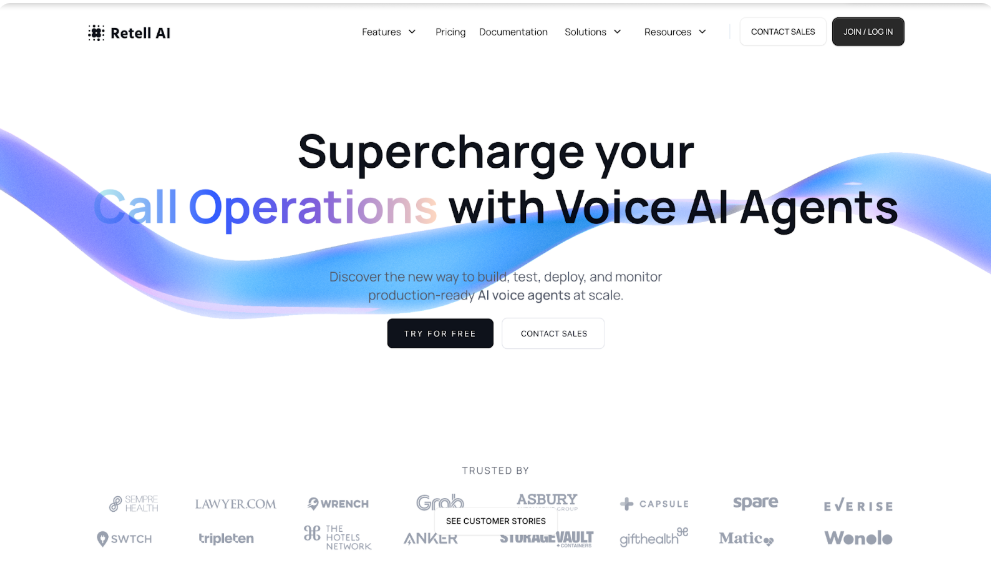
Retell AI staat bovenaan mijn lijst voor voice-gedreven AI-platforms die specifiek zijn gebouwd voor callcenter- en telefoongebaseerde activiteiten. Het is ontworpen rond AI-stemagenten die echte inkomende en uitgaande gesprekken op schaal afhandelen, zonder de conversationele flow te verliezen of robotachtig te klinken. Het platform wordt voornamelijk gebruikt door contactcenters, supportteams en salesoperaties die vertrouwen op conversationele AI voor sales en het grootste deel van hun dag aan live telefoongesprekken besteden.
Je ontwerpt agents met een visuele builder, verbindt gestructureerde of ongestructureerde kennisbronnen, test randgevallen via simulatietools en rolt uit over telefoongesprekken, webgesprekken, SMS en chat. Een gecombineerde gespreksgeschiedenis en analysedashboard dekt alle interacties, wat de operationele overhead vermindert bij het beheren van stemagenten in productie.
De telefonielaag is waar Retell AI duidelijk voorop loopt. Het ondersteunt AI-gestuurde IVR-navigatie, SIP-trunking om bestaande telefoonnummers of VOIP-providers te behouden, batchgesprekken voor uitgaande campagnes, warme doorverbindingen, gebrande beller-ID en geverifieerde telefoonnummers om spamlabeling te verminderen. Deze functies doen ertoe in echte callcenteromgevingen waar routering, overdracht en leverbaarheid direct de resultaten beïnvloeden.
Beveiliging en betrouwbaarheid worden behandeld als kernvereisten. Retell AI is SOC 2-, HIPAA- en GDPR-compliant, ondersteunt meer dan 18 talen en is gebouwd om hoge gelijktijdigheid met consistent lage latency aan te kunnen. Dit maakt het geschikt voor gereguleerde sectoren zoals de gezondheidszorg en financiële dienstverlening, evenals grote enterprise-contactcenters met aanhoudend belvolume.
Wat het goed doet
Waar het tekortschiet
Testnotities
Tijdens het testen scoorde Retell AI consistent het hoogst op gesprekskwaliteit, latency en telefoniebetrouwbaarheid. Het gedraagt zich meer als een AI-gestuurde callcenter-ruggengraat dan als een chatbot die is uitgebreid naar stem, wat het een sterke optie maakt wanneer telefoonwachtrijen het primaire operationele knelpunt zijn.
Wie het zou moeten gebruiken
Middelgrote tot grote contactcenters, supportteams en salesoperaties die betrouwbare, compliant stemautomatisering op schaal nodig hebben.
Wie het zou moeten vermijden
Teams die alleen een lichtgewicht websitechatbot of marketingassistent nodig hebben zonder echte behoefte aan telefoonautomatisering.
G2-beoordeling en gebruikersfeedback
G2-beoordeling: 4,8 / 5
Gebruikers benadrukken consistent de gesprekskwaliteit, prestatiestabiliteit en productiegereedheid.
Overwegingen bij prijzen & schaal
Retell AI hanteert op gebruik gebaseerde prijzen vanaf $0,07/min voor de stemengine, zonder platformkosten. LLM-kosten variëren van $0,003 tot $0,08/min afhankelijk van de modelkeuze en Twilio-telefonie voegt ongeveer $0,015/min toe. Realistische all-in kosten voor standaardconfiguraties variëren van $0,08 tot $0,15/min. AI-chat begint bij $0,002 per bericht. Elk account krijgt $10 aan gratis credits en 20 gelijktijdige gesprekken inbegrepen bij aanmelding. Bij hogere volumes schalen de prijzen per minuut voorspelbaar mee, maar grote contactcenters moeten nog steeds de verwachte gelijktijdigheid en gespreksduur modelleren om kosten te beheersen. Bekijk de volledige prijsuitsplitsing.
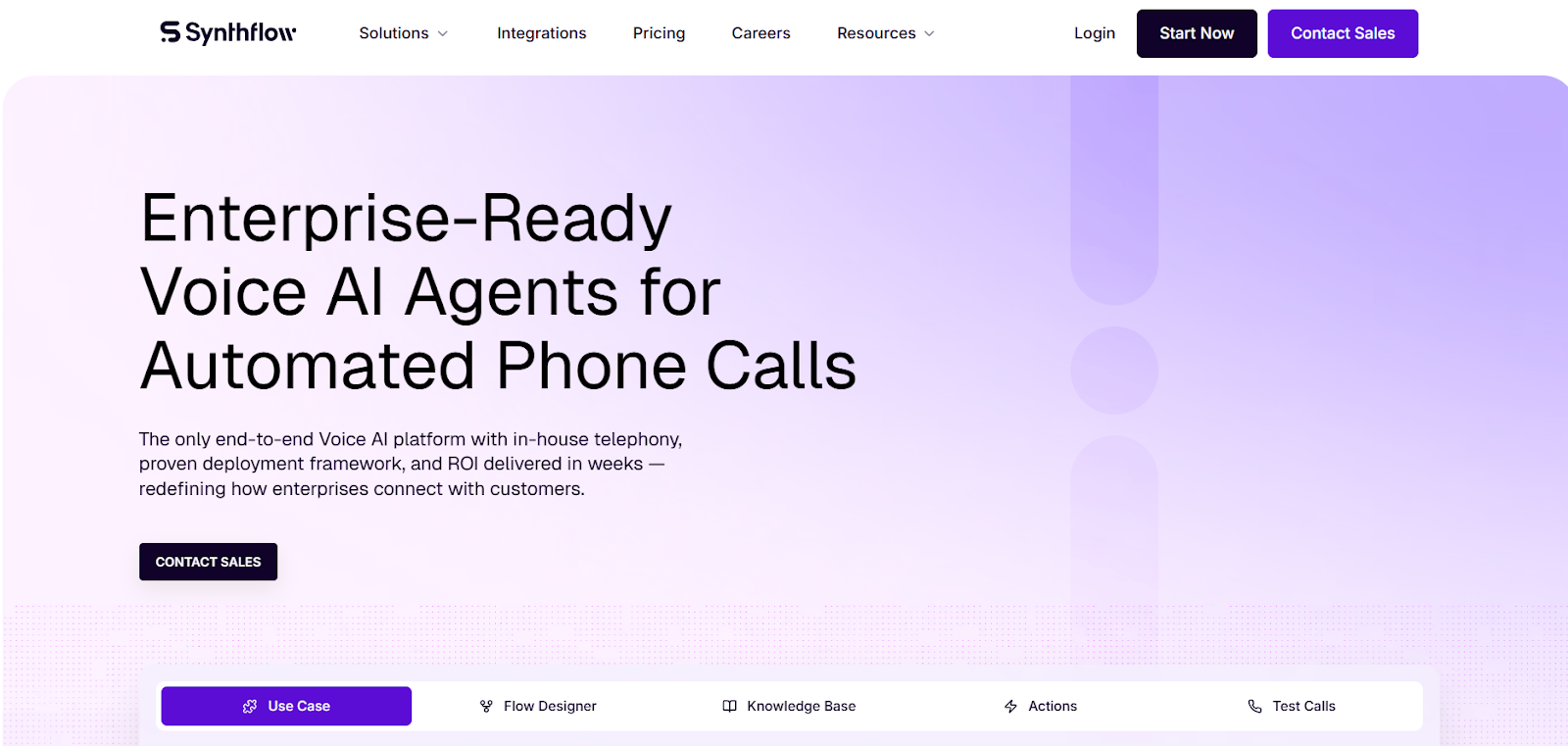
Synthflow is een no-code voice-AI-platform ontworpen voor teams die snel AI-telefoonagenten willen lanceren zonder zware engineeringbetrokkenheid. Het wordt voornamelijk gebruikt door mkb's, bureaus en niet-technische teams die snelheid van uitrol belangrijker vinden dan diepgaande telefoniemaatwerk.
Je ontwerpt belstromen in een visuele editor, verbindt CRM's en agenda's en rolt agents uit om inkomende support, uitgaande outreach en het inplannen van afspraken af te handelen. Synthflow ondersteunt ook white-label- en subaccountconfiguraties, wat het aantrekkelijk maakt voor bureaus die AI-stemagenten onder hun eigen merk doorverkopen.
Wat het goed doet
Waar het tekortschiet
Testnotities
Tijdens het testen en de reviewanalyse presteerde Synthflow het beste wanneer snelheid belangrijker was dan maatwerk. Teams konden snel eenvoudige AI-receptionisten of uitgaande agents lanceren, maar het afhandelen van gesprekken buiten het script vereiste extra promptwerk en hogere abonnementen.
Wie het zou moeten gebruiken
Mkb's en bureaus die snel conversationele AI-agents willen uitrollen zonder aangepaste infrastructuur te bouwen.
Wie het zou moeten vermijden
Enterprises die strikte SLA's, geavanceerde routering of diepgaande telefoniecontrole vereisen.
G2-beoordeling en gebruikersfeedback
G2-beoordeling: ~4,5 / 5
Gebruikers prijzen vaak het gebruiksgemak en de snelle installatie, terwijl ze wijzen op kostenzorgen op schaal.
Overwegingen bij prijzen & schaal
Synthflow is overgestapt op een model van betalen naar gebruik zonder vaste maandelijkse kosten. De stemengine kost $0,09/min, waarbij LLM-gebruik $0,02 tot $0,05/min toevoegt en door Synthflow beheerde telefonie $0,02/min. De meeste configuraties komen uit tussen $0,15 en $0,24 per minuut afhankelijk van LLM- en telefoniekeuzes. Het PAYG-plan bevat 5 gelijktijdige gesprekken (uitbreidbaar tegen $20 per slot per maand), onbeperkte AI-agents en volledige API-toegang. Er is een Enterprise-plan beschikbaar voor organisaties die meer dan 10.000 minuten per maand overschrijden, met aangepaste prijzen en een SLA van 99,99%.
3. Vapi AI
Vapi AI is een ontwikkelaarsgericht voice-AI-platform gebouwd voor teams die fijnmazige controle over hun stemstack willen. Het wordt voornamelijk gebruikt door engineering-gedreven teams die aangepaste stemagenten bouwen met specifieke technische vereisten in plaats van kant-en-klare oplossingen.
Je stelt stemagenten samen door elke laag onafhankelijk te configureren, inclusief speech-to-text, text-to-speech, taalmodellen en telefonieproviders. Deze modulaire aanpak maakt optimalisatie voor latency, stemkwaliteit of compliance-routering mogelijk, maar verhoogt de complexiteit van de installatie.
Wat het goed doet
Waar het tekortschiet
Testnotities
Tijdens het testen toonde Vapi sterke flexibiliteit maar meer wrijving bij de installatie. Gesprekskwaliteit en latency waren sterk afhankelijk van externe providers, en het beheren van facturering over meerdere services voegde operationele overhead toe.
Wie het zou moeten gebruiken
Engineering-zware teams die zeer op maat gemaakte stemagenten bouwen met specifieke infrastructuurbehoeften.
Wie het zou moeten vermijden
Teams die op zoek zijn naar een no-code of gecombineerd voice-AI-platform met minimale installatie.
G2-beoordeling en gebruikersfeedback
G2-beoordeling: ~4,2 / 5
Gebruikers benadrukken flexibiliteit en controle, terwijl ze vaak wijzen op kostencomplexiteit en installatie-overhead.
Overwegingen bij prijzen & schaal
Vapi AI brengt platformkosten in rekening vanaf ongeveer $0,05 per minuut, met extra kosten van STT-, TTS-, LLM- en telefonieproviders. Naarmate het belvolume opschaalt, introduceren facturering bij meerdere leveranciers en variabele kosten per minuut prognose- en operationele risico's.
Cognigy AI, dat nu opereert als NICE Cognigy na de overname door NICE van ongeveer 955 miljoen dollar in september 2025, is een conversationeel AI-platform voor enterprise dat speciaal is gebouwd voor grote contactcenters met complexe behoeften op het gebied van stem- en digitale automatisering. Het platform integreert diep met bestaande CCaaS-infrastructuur, met name NICE CXone, evenals Genesys, Avaya en Five9, en is ontworpen voor organisaties met gestructureerde governance, compliance-vereisten en meertalige ondersteuning. Cognigy wordt het meest gebruikt in gereguleerde sectoren waar governance, analyses en operationele controle belangrijker zijn dan snelle experimenten.
Stemagenten worden gebouwd met de visuele flow-builder van Cognigy, waar teams intenties, acties en dialoogpaden definiëren en deze vervolgens integreren met telefoniesystemen, CRM's en CCaaS-platforms. Het platform ondersteunt geavanceerd dialoogbeheer, agent-assist-scenario's en gecontroleerde overdrachten aan menselijke agents. Cognigy past het beste wanneer gesprekken gedefinieerde processen en escalatieregels volgen in plaats van open dialoog.
Wat het goed doet
Waar het tekortschiet
Testnotities
Tijdens het testen en in externe reviews voelde Cognigy stabiel en voorspelbaar aan zodra het geconfigureerd was. Gestructureerde belstromen presteerden betrouwbaar op schaal, maar het maken van wijzigingen vereiste zorgvuldige planning en tests. Het platform geeft de voorkeur aan consistentie en controle boven conversationele flexibiliteit.
Wie het zou moeten gebruiken
Grote enterprise-contactcenters met bestaande CCaaS-infrastructuur, met name die op NICE CXone zitten of het overwegen, met toegewijde ontwikkelteams en meertalige vereisten.
Wie het zou moeten vermijden
Start-ups, mkb's of teams die op zoek zijn naar snelle uitrol en lichtgewicht stemautomatisering zonder enterprise-overhead.
G2-beoordeling en gebruikersfeedback
G2-beoordeling: ~4,6 / 5
Gebruikers noemen vaak enterprisegereedheid, stabiliteit en contactcenterintegraties als belangrijke sterke punten.
Overwegingen bij prijzen & schaal
Cognigy AI hanteert op enterprisecontracten gebaseerde prijzen in plaats van betalen naar gebruik. Openbare benchmarks en klantrapporten suggereren dat de instapprijs doorgaans rond de $2.000–$3.000 per maand begint, waarbij volledige implementaties opschalen naar jaarcontracten van zes cijfers, afhankelijk van belvolume, ingeschakelde modules en supportniveaus. De prijzen zijn het meest geschikt voor organisaties met toegewijde CX-budgetten.

Kore.ai is een conversationeel AI-platform voor enterprise ontworpen voor organisaties die gestructureerde automatisering nodig hebben over stem- en digitale kanalen op schaal. Het wordt vaak gebruikt door grote contactcenters en IT-gedreven teams die conversationele ervaringen willen standaardiseren over klantenservice, interne helpdesks en transactionele workflows. Het platform legt de nadruk op governance, analyses en operationele controle boven snelheid of experimenten.
Stemagenten worden gebouwd met de dialoog-builder van Kore.ai, waar teams intenties, workflows en integraties met telefoniesystemen, CRM's en backendservices definiëren. Kore.ai ondersteunt zowel stembots als agent-assist-gebruik, waardoor AI routine-interacties kan afhandelen en tegelijkertijd menselijke agents ondersteunt tijdens complexere gesprekken. Het past het beste wanneer conversationele AI onderdeel is van een bredere enterprise CX- of IT-strategie.
Wat het goed doet
Waar het tekortschiet
Testnotities
Tijdens het testen en in reviews presteerde Kore.ai betrouwbaar voor vooraf gedefinieerde en semi-gestructureerde belstromen. Steminteracties waren consistent, en escalatie naar menselijke agents werkte zoals verwacht. Het aanpassen van live flows vereiste echter coördinatie en tests, waardoor het beter geschikt is voor stabiele omgevingen.
Wie het zou moeten gebruiken
Grote enterprises die prioriteit geven aan consistentie, governance en schaalbaarheid over stem- en digitale automatisering.
Wie het zou moeten vermijden
Teams die op zoek zijn naar snelle uitrol, lichtgewicht stemautomatisering of minimale operationele overhead.
G2-beoordeling en gebruikersfeedback
G2-beoordeling: ~4,7 / 5
Gebruikers benadrukken vaak betrouwbaarheid, enterprise-integraties en schaalbaarheid, terwijl ze complexiteit als een compromis noemen.
Overwegingen bij prijzen & schaal
Kore.ai gebruikt aangepaste enterprisecontracten voor grote implementaties, met typische jaardeals die rond de $300.000 beginnen. Selfservice "Essential"- en "Advanced"-plannen variëren van $50 tot $180 per maand maar hebben beperkte functies, kanalen en volume in vergelijking met het volledige enterpriseaanbod. De facturering is sessiegebaseerd in blokken van 15 minuten, wat de kosten onvoorspelbaar kan maken. De totale eigendomskosten bereiken in het eerste jaar vaak 150 tot 200% van de opgegeven softwareprijs zodra implementatie, training, stemmogelijkheden en maatwerk worden meegerekend.
Google Dialogflow CX, nu onderdeel van Googles geïntegreerde "Conversational Agents"-platform binnen het bredere Gemini Enterprise Agent Platform, is ontworpen voor het bouwen van gestructureerde, stateful stem- en chatagents binnen het Google Cloud-ecosysteem. De standalone Dialogflow CX-console werd in oktober 2025 uitgefaseerd, en agents worden nu beheerd binnen de geïntegreerde Conversational Agents-console.
Agents worden ontworpen met een op status gebaseerde visuele flow-builder waar teams intenties, routes en fulfillment-logica definiëren. Dialogflow CX legt de nadruk op versiebeheer, omgevingsbeheer en integratie met Google Cloud-services, wat het geschikt maakt voor grote teams die meerdere agents in productie beheren. Het werkt het beste wanneer gesprekken duidelijk gedefinieerde paden volgen en backendsystemen het grootste deel van de logica afhandelen.
Wat het goed doet
Waar het tekortschiet
Testnotities
Tijdens het testen en in reviews presteerde Dialogflow CX betrouwbaar voor gestructureerde belroutering en intentieafhandeling. Conversationele flexibiliteit was echter beperkt, en wijzigingen aan live agents vereisten zorgvuldige tests om te voorkomen dat productiestromen zouden breken.
Wie het zou moeten gebruiken
Engineering-gedreven teams die gestructureerde stem- en chatbots bouwen binnen Google Cloud.
Wie het zou moeten vermijden
Teams die zich primair richten op telefoonautomatisering of op zoek zijn naar voice-first conversationele flexibiliteit.
G2-beoordeling en gebruikersfeedback
G2-beoordeling: ~4,4 / 5
Gebruikers prijzen schaalbaarheid en controle, terwijl ze vaak wijzen op complexiteit en installatie-inspanning.
Overwegingen bij prijzen & schaal
Dialogflow CX hanteert op gebruik gebaseerde prijzen. Steminteracties worden doorgaans gefactureerd tussen $0,07 en $0,20 per minuut, afhankelijk van configuratie en regio. Zodra spraakservices en telefonie zijn inbegrepen, komen de jaarlijkse kosten voor productie-implementaties vaak uit in de range van $10.000–$100.000+.
Amazon Lex is een conversationele AI-service ontworpen voor organisaties die stem- en chatinterfaces bouwen binnen het AWS-ecosysteem. Het wordt voornamelijk gebruikt door engineering-gedreven teams die nauwe integratie met AWS-services, controle op infrastructuurniveau en sterke beveiligingsprimitieven willen. Lex wordt niet gepositioneerd als een kant-en-klaar voice-AI-platform, maar eerder als een basisdienst voor het bouwen van gestructureerde conversationele workflows.
Stemagenten in Amazon Lex zijn gebouwd rond intenties, slots en fulfillment-logica, en vervolgens verbonden met telefoniesystemen, AWS Lambda-functies en backendservices. Dit ontwerp maakt Lex goed geschikt voor voorspelbare, taakgerichte gesprekken zoals accountopzoekingen, statuscontroles en begeleide workflows. Het past het beste wanneer conversationele AI wordt behandeld als een backendmogelijkheid in plaats van een productgedreven platform.
Wat het goed doet
Waar het tekortschiet
Testnotities
Tijdens het testen en in externe reviews handelde Amazon Lex gestructureerde intentieherkenning betrouwbaar af zodra het correct was geconfigureerd. Het beheren van onderbrekingen, conversationele nuance en fallback-logica vereiste echter aanzienlijke aangepaste ontwikkeling. Steminteracties voelden functioneel aan in plaats van natuurlijk zonder uitgebreide afstemming.
Wie het zou moeten gebruiken
Engineeringteams die al in AWS investeren en gestructureerde stemworkflows willen inbedden in applicaties of contactcenter-stacks.
Wie het zou moeten vermijden
Niet-technische teams of organisaties die op zoek zijn naar kant-en-klare AI-stemagenten met minimale installatie.
G2-beoordeling en gebruikersfeedback
G2-beoordeling: ~4,2 / 5
Gebruikers prijzen vaak schaalbaarheid en AWS-integratie, terwijl ze wijzen op complexiteit en installatie-inspanning.
Overwegingen bij prijzen & schaal
Amazon Lex hanteert op gebruik gebaseerde prijzen vanaf ongeveer $0,004 per spraakaanvraag. De totale kosten stijgen met spraakservices, telefonie en AWS-infrastructuur. In productieomgevingen varieert de jaarlijkse uitgave vaak van $20.000 tot $150.000+, afhankelijk van belvolume en architectuur.
Talkdesk is een cloud-contactcenterplatform dat AI-gestuurde stemautomatisering bevat als onderdeel van een bredere CX-suite. Het is ontworpen voor supportorganisaties die bestaande callcenter-workflows willen aanvullen met AI in plaats van volledig autonome stemagenten uit te rollen. Talkdesk werkt het beste in omgevingen waar menselijke agents centraal blijven staan en AI helpt met routering, deflectie en routine-interacties.
Stembots worden geconfigureerd binnen het Talkdesk-ecosysteem en geïntegreerd met IVR-systemen, CRM's en agent-workflows. Het platform legt de nadruk op betrouwbaarheid, rapportage en soepele agent-overdracht boven conversationele flexibiliteit. Het past goed bij gevestigde contactcenters die prioriteit geven aan operationele zichtbaarheid en uptime.
Wat het goed doet
Waar het tekortschiet
Testnotities
Tijdens het testen en in reviews presteerde Talkdesk-stemautomatisering betrouwbaar voor belroutering en basissupportscenario's. Escalatie naar menselijke agents verliep soepel, en rapportage was sterk. Complexere dialoogafhandeling vereiste echter workarounds of handmatige interventie.
Wie het zou moeten gebruiken
Middelgrote tot grote supportorganisaties die al Talkdesk-contactcenters gebruiken.
Wie het zou moeten vermijden
Teams die op zoek zijn naar standalone, AI-first stemagenten of snelle conversationele experimenten.
G2-beoordeling en gebruikersfeedback
G2-beoordeling: ~4,4 / 5
Gebruikers benadrukken stabiliteit, CX-tooling en enterprise-support.
Overwegingen bij prijzen & schaal
Talkdesk hanteert prijzen per agent per maand, doorgaans met driejarige contracten. CX Cloud Digital Essentials begint bij ongeveer $85 per agent per maand (alleen digitale kanalen, geen stem). CX Cloud Voice Essentials begint bij ongeveer $105 per agent per maand. Het omnichannel CX Cloud Elite-plan begint bij ongeveer $165 per agent per maand. De AI-functies van Talkdesk, waaronder Autopilot (virtuele agent) en Copilot (agent-assist), zijn betaalde add-ons en niet inbegrepen in de basisprijs. Met AI-modules en telecomgebruik kunnen de totale kosten per agent oplopen tot $200 tot $300 per maand.
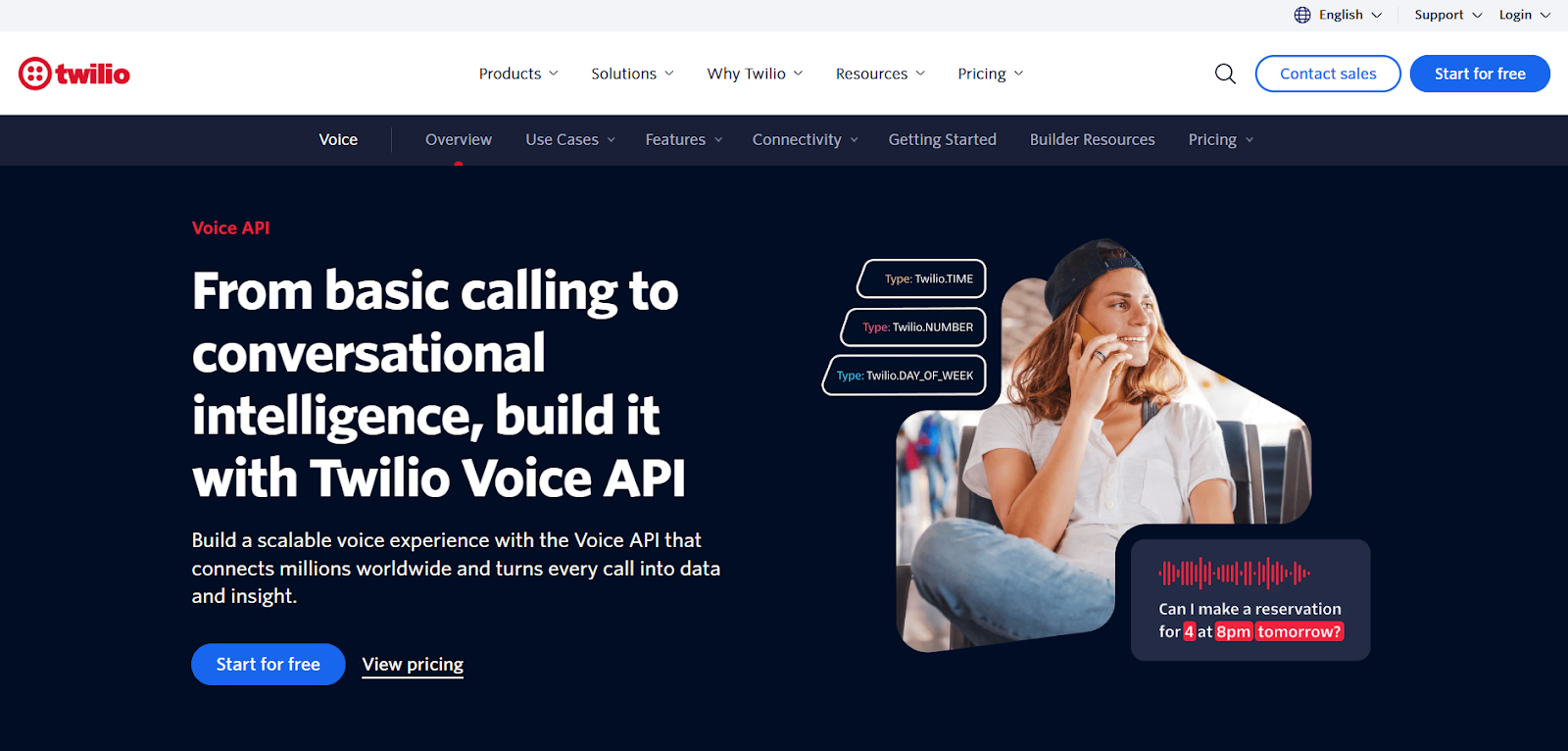
De Voice- en AI-stack van Twilio is een ontwikkelaarsgerichte toolkit voor het bouwen van aangepaste voice-AI-systemen met programmeerbare telefonie, spraakservices en taalmodellen van derden. Het is geen ingepakt voice-AI-platform, maar een set bouwstenen voor teams die volledige controle willen over belstromen, infrastructuur en integraties.
Stemervaringen worden samengesteld met Twilio Voice, gecombineerd met speech-to-text, text-to-speech en externe LLM's. Deze aanpak biedt maximale flexibiliteit, maar legt de verantwoordelijkheid voor orkestratie, betrouwbaarheid en kostenbeheer volledig bij het team. Twilio past het beste wanneer voice-AI wordt behandeld als een aangepast product in plaats van een kant-en-klare oplossing.
Twilio heeft zijn AI-stemmogelijkheden in 2025 en 2026 aanzienlijk uitgebreid. ConversationRelay, nu algemeen beschikbaar, stelt ontwikkelaars in staat om AI-stemagenten te bouwen met expressief tempo, afhandeling van onderbrekingen en LLM-integratie tegen $0,07 per minuut (los van standaard tarieven voor telefoongesprekken). Op SIGNAL 2026 introduceerde Twilio Conversation Memory, Conversation Orchestrator, Conversation Intelligence en Agent Connect, een open-source framework voor het verbinden van elke AI-agent met de stem- en berichtenkanalen van Twilio. De stemomzet bereikte in Q1 2026 de hoogste groei in bijna vijf jaar, aangedreven door AI-gebruikssituaties.
Wat het goed doet
Waar het tekortschiet
Testnotities
Tijdens het testen en in reviews bleek Twilio uiterst betrouwbaar op de telefonielaag, met sterke belconnectiviteit en globaal bereik. Het bouwen van conversationele intelligentie vereiste echter aanzienlijke engineering, en het handhaven van consistente stemkwaliteit hing af van zorgvuldige providerselectie en afstemming.
Wie het zou moeten gebruiken
Engineering-zware teams die aangepaste voice-AI-producten of diep geïntegreerde systemen bouwen.
Wie het zou moeten vermijden
Teams die op zoek zijn naar een kant-en-klaar voice-AI-platform of minimale installatie-overhead.
G2-beoordeling en gebruikersfeedback
G2-beoordeling: ~4,4 / 5
Gebruikers prijzen consistent de betrouwbaarheid en ontwikkelaarstooling.
Overwegingen bij prijzen & schaal
+-
Wanneer ik een voice-AI-platform kies, begin ik met echte telefoongesprekken, niet met demo's. Vrijwel elke leverancier kan een gepolijste doorloop tonen, maar callcenters brengen problemen snel aan het licht zodra live verkeer binnenkomt. De platforms die het beste standhielden, waren die welke gebouwd waren voor de dagelijkse activiteiten, niet alleen voor indrukwekkende AI-claims.
Hier is het framework dat ik gebruik om opties te beperken zonder het te ingewikkeld te maken.
Behandel elke shortlist als een uitgangspunt. Voer een kleine pilot uit, verbind het platform met echte workflows en luister goed naar hoe het presteert op live gesprekken. Daar komen de echte verschillen naar voren.
Als er één duidelijke conclusie uit deze analyse te trekken is, dan is het dat voice-first platforms beter presteren dan stem-add-ons in echte callcenteromgevingen — en daar valt Retell AI op.
Het toonde consistent sterkere gesprekskwaliteit, lagere latency en diepere telefoniecontrole dan platforms waar stem secundair is. Belangrijker nog, het hield stand onder echt verkeer, met compliance, routering en prijzen ontworpen voor productiegebruik — niet voor demo's.
Als telefoongesprekken de kern zijn van je activiteiten, is Retell AI het meest praktische platform om als eerste te piloten. Het is gebouwd om te werken wanneer wachtrijen vol zijn en er veel op het spel staat, wat uiteindelijk meer telt dan opvallende functies.
Waarvoor worden AI-stemagenten gebruikt in callcenters?
AI-stemagenten handelen inkomende en uitgaande telefoongesprekken af, inclusief klantenservice, het inplannen van afspraken, bestelstatus, betaalherinneringen en belroutering. Ze worden gebruikt om wachttijden te verkorten, repetitieve gesprekken af te leiden en agents te ondersteunen tijdens piekvolumes.
Hoe verschillen AI-stemagenten van traditionele IVR-systemen?
Traditionele IVR's vertrouwen op vaste menu's en invoer via het toetsenblok. AI-stemagenten gebruiken conversationele spraak, begrijpen natuurlijke taal en passen zich aan hoe bellers spreken, wat ze effectiever maakt wanneer problemen geen gescripte paden volgen.
Kunnen AI-stemagenten callcentermedewerkers vervangen?
Niet volledig. AI-stemagenten handelen de repetitieve, hoogvolume gesprekken af die menselijke teams uitputten: controle van bestelstatus, afspraakbevestigingen, accountverificaties, betaalherinneringen en basisprobleemoplossing. Deze vertegenwoordigen doorgaans 40 tot 60% van het inkomende belvolume. Complexe kwesties, emotioneel geladen gesprekken en geschillen met hoge inzet worden nog steeds naar menselijke agents gerouteerd met volledige context behouden. Het praktische resultaat is dat voice-AI de druk op personeelsbezetting en overuren vermindert zonder menselijke rollen te elimineren. Teams die voice-AI goed uitrollen, verschuiven menselijke agents doorgaans naar werk met een hogere waarde in plaats van posities volledig te schrappen.
Hoe kies ik een voice-AI-platform voor een hoogvolume contactcenter?
Begin met vier praktische tests in plaats van functievergelijkingstabellen. Meet eerst de responslatency op een echte telefoonlijn, niet in een webdemo. Alles boven 800 ms creëert merkbare pauzes die bellers frustreren. Retell AI testte consistent op 580 tot 640 ms; de meeste concurrenten komen uit tussen 800 ms en 2 seconden. Test ten tweede de afhandeling van onderbrekingen. Laat iemand midden in een zin door de AI heen praten. Platforms die barge-in niet soepel kunnen afhandelen, zullen falen in productie waar bellers regelmatig onderbreken. Test ten derde op volume. Voer 20 of meer gelijktijdige gesprekken uit en controleer of de kwaliteit verslechtert. Sommige platforms vertragen merkbaar onder belasting. Breng ten vierde je integratievereisten in kaart voordat je platforms evalueert. Als je realtime CRM-opzoekingen, agendaplanning of betalingsverwerking tijdens gesprekken nodig hebt, moet het platform live API-aanroepen ondersteunen, niet alleen webhooks na het gesprek.
Welke voice-AI-platforms werken het beste voor specifieke sectoren zoals reizen, verzekeringen of gezondheidszorg?
Verschillende sectoren hebben verschillende onmisbare vereisten, en niet elk voice-AI-platform handelt ze even goed af.
Voor callcenters in reizen en horeca doen meertalige ondersteuning en realtime integratie met boekingssystemen er het meest toe. De stemagent moet datumwijzigingen, annuleringsbeleid en omboekingen over tijdzones heen in één gesprek afhandelen. Retell AI ondersteunt 55 of meer talen met sub-seconde latency, wat ertoe doet wanneer een beller een vlucht omboekt in een ander land.
Voor callcenters in verzekeringen is gestructureerde dataverzameling cruciaal. De stemagent moet polisnummers, schadedata en claimdetails nauwkeurig vastleggen tijdens een live gesprek en deze doorsturen naar het claimsysteem. Zoek naar SOC 2 Type II-certificering en PII-redactie als basisfuncties.
Voor callcenters in de gezondheidszorg is HIPAA-compliance met een ondertekende BAA onmisbaar. De stemagent moet ook het inplannen van afspraken, aanvragen voor herhaalrecepten en patiëntroutering afhandelen zonder beschermde gezondheidsinformatie bloot te leggen. Retell AI bevat HIPAA met een selfservice-BAA zonder extra kosten. Sommige concurrenten rekenen apart: Vapi AI voegt $1.000 per maand toe voor HIPAA.
Voor financiële dienstverlening en kredietunies zoek je naar platforms met sterke bellerauthenticatiestromen, auditlogging en de mogelijkheid om midden in een gesprek te integreren met kernbank- of CRM-systemen.
Hoe lang duurt het om voice-AI in een callcenter uit te rollen?
Eenvoudige use cases kunnen binnen enkele dagen live gaan. Complexere implementaties met CRM-integraties, routeringslogica en compliance-vereisten hebben doorgaans enkele weken nodig om te stabiliseren in productie.
Welk voice-AI-platform heeft de laagste latency voor live telefoongesprekken?
Tijdens het testen leverde Retell AI consistent de laagste responslatency van 580 tot 640 milliseconden end-to-end op live telefoongesprekken. Dat omvat spraakherkenning, LLM-verwerking en text-to-speech-generatie. Ter context: een natuurlijke menselijke conversationele pauze is ongeveer 200 tot 300 ms, dus alles onder 700 ms voelt responsief aan.
Bland AI kwam doorgaans uit tussen 1 en 2 seconden. Vapi AI varieerde sterk afhankelijk van de combinatie van stemengine en LLM, variërend van 700 ms tot meer dan 2 seconden. Synthflow testte op ongeveer 1 tot 2 seconden. ElevenLabs bereikt rond de 500 ms in ingebedde webcontexten, maar die meting geldt voor browsergebaseerde agents, niet voor live telefoniegesprekken.
Latency is bijzonder cruciaal voor callcenters omdat bellers stilte interpreteren als verwarring of systeemfalen. Bij 2 seconden vertraging nemen afbreekpercentages meetbaar toe. Test latency op een echte telefoonlijn, niet in een browserdemo, omdat telefonie netwerkoverhead toevoegt die webgebaseerde demo's niet weerspiegelen.
Hoe handelt voice-AI overdrachten naar menselijke agents in een callcenter af?
De kwaliteit van de overdracht van AI naar mens varieert aanzienlijk tussen platforms en is vaak de zwakste schakel in een voice-AI-implementatie.
Retell AI ondersteunt realtime warme doorverbindingen met volledige gesprekscontext. Wanneer de AI bepaalt dat een gesprek menselijke interventie nodig heeft (op basis van sentiment, complexiteitstriggers of verzoek van de beller), verbindt het het gesprek door naar een menselijke agent samen met een gestructureerde samenvatting van wat er besproken is, wat de beller nodig heeft en welke data er tijdens het gesprek is verzameld. De menselijke agent neemt over zonder de beller te vragen informatie te herhalen.
Cognigy (NICE) en Talkdesk handelen overdrachten af binnen hun eigen contactcenter-ecosystemen, wat goed werkt als je hun platforms al gebruikt. Vapi AI ondersteunt overdrachten via aangepaste API-integraties, maar je moet de routerings- en contextdoorgeeflogica zelf bouwen.
De meest voorkomende faalmodus is niet de overdracht zelf maar het contextverlies. Veel platforms kunnen een gesprek naar een menselijke agent routeren maar geven beperkte of geen context door, waardoor de beller gedwongen wordt zijn probleem te herhalen. Test bij het evalueren van platforms de overdracht end-to-end: activeer een doorverbinding, neem op als de menselijke agent en controleer welke informatie je ontvangt voordat je spreekt.
Kan voice-AI hoge belvolumes tijdens piekuren aan zonder gesprekken weg te laten vallen?
Het hangt volledig af van de infrastructuur van het platform. Sommige voice-AI-systemen verslechteren merkbaar onder belasting, met verhoogde latency, weggevallen verbindingen en wachtrijvertragingen.
Tijdens het testen handelde Retell AI gelijktijdige belladingen af zonder verslechtering in gesprekskwaliteit of responstijd. Elk account begint met 20 gelijktijdige gesprekken inbegrepen, en extra capaciteit is op aanvraag beschikbaar. Enterprise-plannen ondersteunen aangepaste gelijktijdigheid voor contactcenters die honderden gelijktijdige gesprekken draaien.
Bland AI kan tot 20.000 gesprekken per uur aan op zijn enterprise-niveau, wat het geschikt maakt voor hoogvolume uitgaande campagnes. Cognigy (NICE) en Talkdesk zijn ontworpen voor contactcenteractiviteiten op enterpriseschaal en handelen aanhoudend volume goed af, hoewel de implementatiecomplexiteit hoger is.
De meest voorkomende faalmodus tijdens piekuren is niet de voice-AI zelf maar de integratielaag. Als het CRM- of ticketingsysteem onder belasting vertraagt, verslechtert het vermogen van de AI-agent om records op te halen en bij te werken midden in het gesprek. Voer altijd een load-test uit op de volledige stack, niet alleen op het stemplatform.
Welke voice-AI-platforms integreren met CRM- en contactcentersystemen?
De diepte van integraties varieert aanzienlijk tussen platforms. Er is een verschil tussen een platform dat data naar een CRM kan pushen na het gesprek en een platform dat klantrecords kan ophalen, velden kan bijwerken en workflows kan activeren tijdens een live gesprek.
Retell AI integreert met CRM's (HubSpot, Salesforce en anderen), planningstools, helpdesks en interne API's. Het platform ondersteunt realtime data-uitwisseling tijdens gesprekken, zodat agents klantrecords kunnen opzoeken, tickets kunnen bijwerken en vervolgworkflows kunnen activeren zonder handmatige invoer na het gesprek. Met SIP-trunking kun je bestaande telefoonnummers en VoIP-providers verbinden zonder je telefonie-infrastructuur te vervangen.
Cognigy (NICE) biedt de diepste contactcenterintegraties, met name binnen het NICE CXone-ecosysteem, met native verbindingen naar Genesys, Avaya en Five9. Talkdesk integreert nauw met zijn eigen CCaaS-stack. Vapi AI biedt integratieflexibiliteit op API-niveau maar vereist ontwikkelaarsresources om verbindingen te bouwen en te onderhouden.
Voor teams met traditionele telefonie die niet vervangen kan worden, zoek je naar SIP-trunk-ondersteuning en de mogelijkheid om de AI-agent over bestaande belstromen te leggen in plaats van een volledige infrastructuurwissel te vereisen.
See how much your business could save by switching to AI-powered voice agents.
Total Human Agent Cost
AI Agent Cost
Estimated Savings
Een demodemonummer van Retell Clinic Office





.avif)