AI Agent Platform: What It Is and How to Choose One (2026)



An AI agent platform is software that lets a team build, run and manage AI agents: programs that use a large language model to work toward a goal by planning steps, calling tools and acting in other systems. The platform supplies what a model alone lacks, including connections to your data and apps, memory, guardrails, testing and monitoring.
This guide explains what an AI agent platform includes, the five main types on the market in 2026, and how 10 AI agent platforms compare on what they are built for and how they charge. It ends with a use-case matrix and a short way to choose.
Retell AI publishes this guide and is one of the platforms compared. Retell is a voice platform for phone calls and contact centers, not a general agent builder, so it appears here in one category only. This page does not rank the platforms or give them scores.
What is an AI agent platform?
An AI agent platform is the layer between a language model and the work you want done. A model can write and reason. An agent can also act: look up an order, update a record, send a message, book a slot, or hand a task to a person. The platform is where you define that agent, connect it to your systems, control what it may do and watch how it performs.
Three nearby terms get mixed up with it:
- Chatbot. A chatbot answers questions or follows scripted paths. An agent chooses its own steps and uses tools to finish a task.
- AI agent framework. A framework is a code library that developers use to build agents. It gives you building blocks. Hosting, security and monitoring stay with you unless you add a platform on top.
- Workflow automation tool. These tools run fixed steps that you define ahead of time. Many now let you place an agent inside a workflow for the steps that need judgment.
In practice the lines blur. Framework makers sell hosted platforms, automation tools add agents, and enterprise software suites ship agent builders inside products that teams already use. That is why it helps to sort AI agent platforms by type before you compare vendors.
What are the key components of an AI agent platform?
Most AI agent platforms cover the same set of parts, even when the names differ. Use this table as a checklist when you read a vendor's product page.
| Component | What it does | What to ask the vendor |
|---|---|---|
| Model access | Supplies the language model that reasons and writes | Which models can I use, and can I switch per agent or per task? |
| Orchestration | Decides the next step and coordinates more than one agent | Can I fix the order of steps where the process must not vary? |
| Tools and integrations | Let the agent read and write in other systems | Which connectors exist today, and does it support custom APIs or the Model Context Protocol (MCP)? |
| Knowledge and memory | Ground answers in your content and keep context | How is content indexed, and what is remembered between sessions? |
| Channels | Where the agent meets people: chat, email, Slack, phone | Is my channel built in, or added through a partner? |
| Guardrails and permissions | Limit what the agent may do and when a person must approve | Can I require approval for any action with an outside effect? |
| Testing and evaluation | Check behavior before and after a change | Can I replay past sessions against a new version? |
| Monitoring | Logs, traces, cost and outcome metrics | Can I see every tool call and what each run cost? |
| Deployment and security | Hosting, access control, audit logs, compliance | Cloud only, or my own VPC? Which plan includes SSO, role-based access and audit logs? |
What are the main types of AI agent platforms?
AI agent platforms fall into five types. The type tells you who is expected to build the agent, what the platform runs for you, and what stays your job.
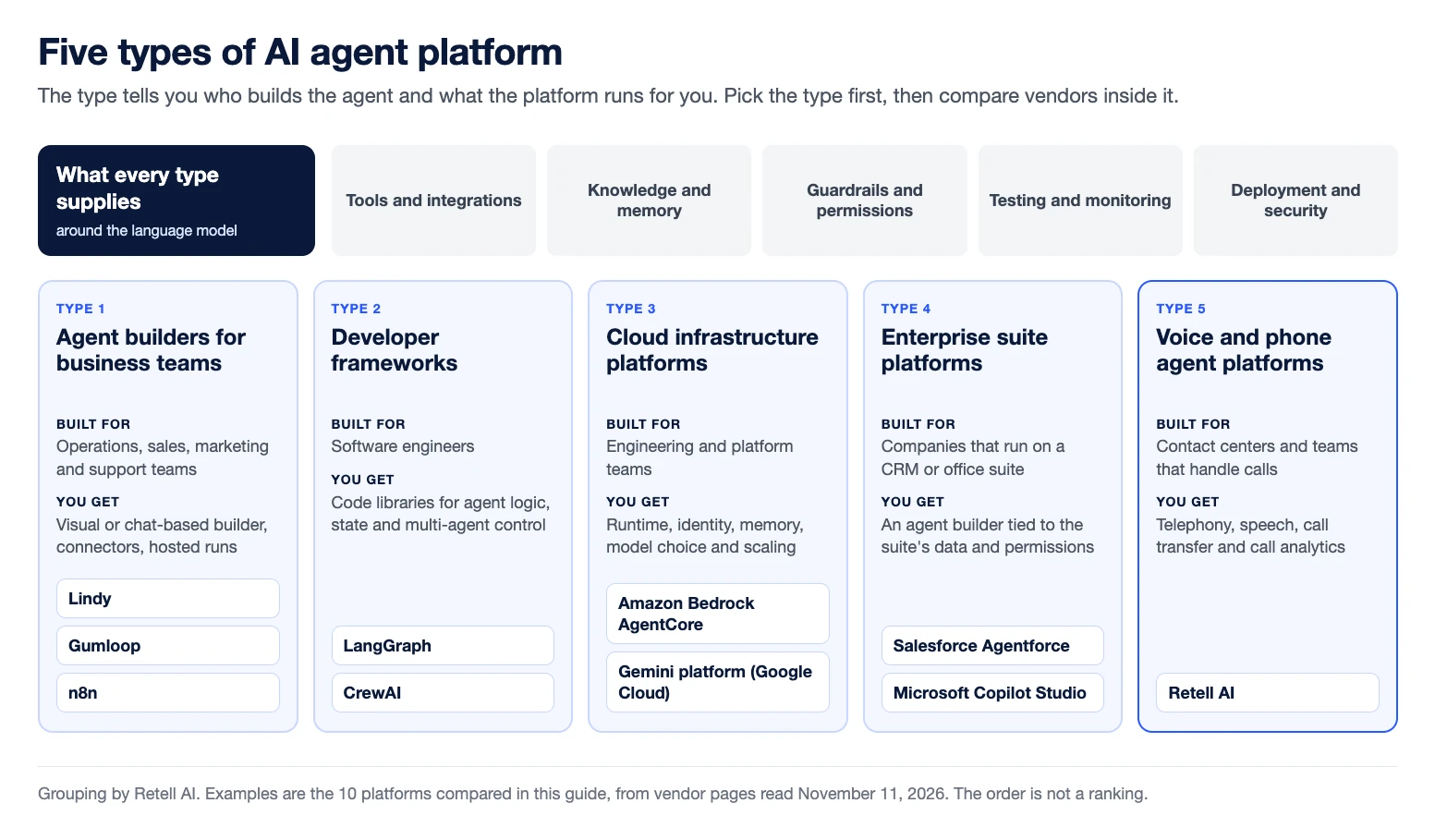
| Type | Built for | You get | You still own |
|---|---|---|---|
| Agent builders for business teams | Operations, sales, marketing and support teams | A visual or chat-based builder, ready-made connectors, hosted runs | Process design, review of agent actions |
| Developer frameworks | Software engineers | Code libraries for agent logic, state and multi-agent control | Hosting, security and monitoring, unless you buy the maker's hosted product |
| Cloud infrastructure platforms | Engineering and platform teams | Runtime, identity, memory, model choice and scaling on a major cloud | The agent code and its design |
| Enterprise suite platforms | Companies that already run on a CRM or office suite | An agent builder tied to the suite's data, users and permissions | Fit with systems outside the suite |
| Voice and phone agent platforms | Contact centers and teams that handle calls | Telephony, speech, call transfer and call analytics around the agent | Call scripts, escalation rules, compliance review |
How were these AI agent platforms picked?
The method is short, and it has limits you should know before reading the comparison.
- Selection. We sorted the market into the five types above and picked one to three platforms per type whose makers publish both a product description and a pricing model on their own website. The list is a sample of each type, not a full census of the market.
- Sources. Every fact about a platform comes from that vendor's own pages, read on November 11, 2026, and is linked next to the claim. Text in quotation marks is the vendor's wording.
- No trials and no scores. We have not run hands-on trials of the other platforms. This page makes no claims about their quality, speed or accuracy and gives no ratings. The order of the table follows the five types. It is not a ranking.
- Left out. Platforms with no public pricing model, or whose pages could not be read that day, were left out instead of estimated.
- Our own product. Retell AI is listed in one type only, voice and phone, and a later section says when it is not the right fit.
Prices and plans change often. Check the linked page before you budget.
AI agent platforms compared: 10 options in 2026
| Platform | Type | The vendor's own description | Published pricing, November 11, 2026 |
|---|---|---|---|
| Lindy | Agent builder for business teams | "the AI employee that connects to all your tools, knows everything about your company, and does real work for the whole team" | Free credits for 7 days, then from $29.99 per user per month for 3,000 credits. Enterprise is custom. Lindy pricing |
| Gumloop | Agent builder for business teams | "Build AI agents for work" | Pro starts at $37 per month with 20,000 credits and a 14-day trial. Enterprise is custom. Gumloop pricing |
| n8n | Agent builder for business teams | "a workflow automation platform that uniquely combines AI capabilities with business process automation" | Billed by workflow executions. Starter is €20 per month, billed annually, for 2,500 executions. A self-hosted Community Edition is on GitHub. n8n pricing |
| LangGraph (LangChain) | Developer framework | "an agent runtime and low-level orchestration framework" | The library is MIT-licensed and free. The LangSmith platform has a $0 Developer plan, Plus at $39 per seat per month, and custom Enterprise, each with usage charges. LangSmith pricing |
| CrewAI | Developer framework | "The open source, multi-agent platform" | Open-source framework. The hosted Basic plan is free with 50 workflow executions per month. Enterprise is custom. CrewAI pricing |
| Amazon Bedrock AgentCore | Cloud infrastructure platform | "The platform for production AI agents. Any framework. Any model." | Billed on usage: "consumption-based pricing with no upfront commitments or minimum fees". AgentCore pricing |
| Gemini platform (Google Cloud) | Cloud infrastructure platform | "a comprehensive platform for developers to build, scale, govern and optimize agents" | Usage-based, set by the models and infrastructure used. Eligible new users get a $300 Google Cloud trial credit valid for 90 days. Gemini platform |
| Salesforce Agentforce | Enterprise suite platform | "Agentforce: The AI Agent Platform" | Salesforce Foundations at $0, Flex Credits at $500 per 100,000 credits, or Conversations at $2 per conversation. Agentforce pricing |
| Microsoft Copilot Studio | Enterprise suite platform | A platform to "create agents using natural language or a graphical interface" | $200 per month per pack of 25,000 Copilot Credits, or pay-as-you-go with no upfront commitment. Copilot Studio pricing |
| Retell AI | Voice and phone agent platform | "a platform to build, test, deploy, and monitor AI voice and chat agents with telephony, prompts, tools, and analytics built in" | Pay as you go, from $0.07 per minute. Retell AI pricing |
Agent builders for business teams: Lindy, Gumloop and n8n
These platforms are aimed at people who know the process but do not write code every day. Lindy lists 3,000+ integrations and says that "anything with outside impact waits for approval", such as sending an email or updating a ticket. Its Enterprise plan adds SSO, audit logs and HIPAA compliance with a signed BAA.
Gumloop lists unlimited agents, seats and teams on its Pro plan and access to 35+ models. Role-based access control, SCIM and SAML support, and audit logs are listed on the pricing page as plan features, so check which plan you need.
n8n describes itself as "giving technical teams the flexibility of code with the speed of no-code". It lets you mix fixed workflows with agents, offers "600+ native integrations" as agent tools, and can be self-hosted "to keep data in-house". All plans include "unlimited users and workflows and every integration".
If this is your type, Retell's guide to AI agent builders with pricing tradeoffs covers more builders.
Developer frameworks: LangGraph and CrewAI
Frameworks give engineers control over how an agent reasons, stores state and works with other agents. LangGraph is, in LangChain's words, "an MIT-licensed open-source library and is free to use". Its page lists human-in-the-loop checks, built-in memory and token-by-token streaming. LangChain sells LangSmith alongside it for observability, evaluation and deployment.
CrewAI calls its open-source product "an open-source agent framework with high-level abstractions and low-level APIs for building complex, agent-driven workflows". Its paid Enterprise plan can be deployed "on CrewAI cloud, your own VPC, or your own infrastructure" and adds SSO, role-based access and PII redaction.
Cloud infrastructure platforms: Amazon Bedrock AgentCore and Gemini platform
Cloud platforms run agents you have already written. Amazon Bedrock AgentCore says you can "start with LangChain, OpenAI Agents SDK, Claude Agent SDK, Strands SDK, or your own framework, and deploy with any model". Each AgentCore feature is priced separately on usage.
Google Cloud's Gemini platform page says technical teams can build agents with frameworks such as its Agent Development Kit (ADK) and choose from "200+ Google and third-party AI models and tools". Google says infrastructure charges are metered on agent compute, memory and storage, and it tells buyers to contact sales for detailed estimates.
Enterprise suite platforms: Salesforce Agentforce and Microsoft Copilot Studio
Suite platforms put the agent next to the customer and employee data a company already keeps there. Salesforce offers "consumption-based pricing, with Flex Credits or Conversations, or per-user licensing". It defines an action as "a specific function that an AI agent executes on the platform", and each action draws from a pool of Flex Credits. Salesforce notes that its pricing page is "for information purposes only and is subject to change".
Microsoft Copilot Studio connects to "1500+ pre-built data connectors, and MCP servers" and can build "chat or voice agents". Microsoft's pricing page says "an Azure subscription is required to use agents" and that a standalone Copilot Studio plan is needed to publish agents to outside channels.
If the agent is for a support desk, Retell also has a roundup of AI customer service software and a guide to conversational AI for customer service.
Voice and phone agent platforms: Retell AI
Voice AI on a phone call adds work that a text agent never meets: phone numbers, carriers, speech recognition, spoken replies fast enough for conversation, and transfer to a person. Voice and phone platforms package those parts around the agent. Retell AI is the option from this type in the table, and the section below covers it. For a comparison of vendors inside this type, see voice AI agent platforms compared.
Which AI agent platform fits which use case?
This matrix is our reading of what each type is built for, based on the vendor descriptions above. It is a starting point for a shortlist, not a trial result.
| Use case | Type that usually fits | Why | Examples from this guide |
|---|---|---|---|
| Automating inbox, reporting and research work across SaaS apps | Agent builders for business teams | The people who own the process can build and adjust the agent | Lindy, Gumloop, n8n |
| Adding an agent to your own software product | Developer frameworks | Code-level control of logic, state and model choice | LangGraph, CrewAI |
| Running many custom agents in production under central security | Cloud infrastructure platforms | Runtime, identity and scaling come from the cloud you already use | Amazon Bedrock AgentCore, Gemini platform |
| Agents that act on CRM records or office documents | Enterprise suite platforms | The agent inherits the suite's data and permissions | Salesforce Agentforce, Microsoft Copilot Studio |
| Chat support on a website or app | Enterprise suite platforms | Both vendors list customer-facing agents or outside channels such as websites | Salesforce Agentforce, Microsoft Copilot Studio |
| Answering and placing phone calls, contact center automation | Voice and phone agent platforms | Telephony, speech and transfer are part of the platform | Retell AI |
| Mixed fixed workflows with a few judgment steps | Agent builders for business teams | Workflows and agents sit in one tool | n8n |
How do you choose an AI agent platform?
Work through these questions in order. Most teams can narrow the field to one type after the first three.
- Who will build and maintain the agent? If the owner is an operations lead, start with builders or a suite platform. If engineers own it, frameworks and cloud platforms give more control.
- Where does the work happen? Pick the platform closest to the data and the channel. CRM work points to a suite, internal app work to a builder, phone work to a voice platform.
- How fixed is the process? Regulated or scripted work needs steps you can lock. Open-ended work needs more agent freedom and stronger review.
- What may the agent do without a person? List the actions that need approval, then confirm the platform can enforce them.
- How is it priced at your volume? The 10 platforms above charge by credits, executions, seats, conversations, compute or minutes. Model a normal month and a peak month in the vendor's own unit.
- Can you test a change before it goes live? Ask to see versioning, replay of past sessions and rollback in a demo account, not on a slide.
- What happens when you outgrow it? Check export options, self-hosting, model choice and contract terms.
Then run a pilot on one real process with a clear success measure. A pilot on your own data tells you more than any comparison page, this one included.
Where does Retell AI fit, and when is it not the right fit?
Retell AI is the pick in this guide for one job: phone calls and contact center work. Its documentation describes it as "a platform to build, test, deploy, and monitor AI voice and chat agents with telephony, prompts, tools, and analytics built in" and says that "Retell runs the telephony, speech, and language model layers", so a team configures the agent instead of connecting providers.
What the docs describe for call work:
- Call transfer to a person, with cold, warm, and agentic warm transfer modes.
- Your own carrier and numbers through SIP trunking or SIP URI dialing, with setup guides for Twilio, Telnyx, Vonage, Genesys Cloud, Five9, Avaya and Amazon Connect.
- Tools during the call, including HubSpot, Salesforce, Zendesk and Cal.com integration tools and remote MCP servers.
- Testing before launch with the LLM Playground, simulation, batch, web call and phone call methods.
Pricing is pay as you go, from $0.07 per minute, on the pricing page. The homepage describes the product as an AI voice agent platform, and the Learn hub has a checklist for evaluating a voice platform before going live.
Retell is not the right fit when:
- The work is not a conversation. Research, reporting, inbox triage, data entry and back-office tasks belong on a general agent builder or framework.
- You want one tool for every kind of agent. Retell builds voice and chat agents. It is not a workspace for internal assistants across all your apps.
- Your agents should live inside a CRM or office suite. A suite platform keeps the agent with that data and those permissions.
- You need to own the whole stack. A team that wants to host its own models and orchestration should look at frameworks and cloud platforms, and weigh building against buying.
Many companies end up with two platforms: a general one for internal work and a voice one for the phone line, connected through APIs or MCP.
Frequently asked questions
What is an AI agent platform?
An AI agent platform is software for building, running and managing AI agents. It connects a language model to tools, data and channels, and adds memory, guardrails, testing and monitoring so the agent can finish tasks instead of only answering questions.
Is there a platform for AI agents?
Yes, and there are several types. Agent builders such as Lindy, Gumloop and n8n serve business teams. Frameworks such as LangGraph and CrewAI serve developers. Amazon Bedrock AgentCore and Google Cloud's Gemini platform provide cloud infrastructure. Salesforce Agentforce and Microsoft Copilot Studio sit inside enterprise suites. Retell AI covers phone calls.
What is the difference between an AI agent platform and an AI agent framework?
A framework is a code library for writing agent logic. A platform also runs the agent and supplies hosting, access control, monitoring and connectors. LangGraph, for example, is a free open-source library, and LangChain sells the LangSmith platform next to it for deployment and observability.
How much does an AI agent platform cost?
It depends on the pricing unit. On November 11, 2026, published entry prices included $29.99 per user per month at Lindy, $37 per month at Gumloop, $2 per conversation or $500 per 100,000 Flex Credits at Salesforce Agentforce, and $200 per month per 25,000 Copilot Credits at Microsoft Copilot Studio. Cloud platforms bill on usage. Open-source frameworks are free, and you pay for hosting and model calls.
Which AI agent platform is best?
No single platform is best for every job. Match the type to the work first: a builder for internal tasks, a framework or cloud platform for custom software, a suite platform for CRM or office data, and a voice platform for phone calls. Then compare two or three vendors of that type in a pilot.
Can an AI agent platform handle phone calls?
Some can. Salesforce lists Agentforce Voice on its pricing page, and Microsoft says Copilot Studio can build chat or voice agents. Voice and phone platforms such as Retell AI are built around the call itself, with telephony, call transfer and SIP connections to contact center systems.
See how much your business could save by switching to AI-powered voice agents.
ROI Result
Total Human Agent Cost
AI Agent Cost
Estimated Savings
Estimate your monthly voice AI cost


Revolutionize your call operation with Retell