Contact Center Automation: How It Works, Benefits, and Tools
22
MIN READ
October 12, 2026
Call centers have evolved into contact centers, with inquiries now coming from various digital channels like voice calls, text, messaging, or social media.
A customer who can't reach you through a channel picks another brand. A customer stuck in a broken chat loop doesn't buy more. A customer who waited 90 minutes on hold will tell their friends.
These are billions of dollars in revenue potential sitting inside these service channels. You just have to make it easy for them to get help when they need it.
And, the only realistic way to meet these expectations comes through automation.
Contact center automation has the potential to reduce waiting time, provide real-time assistance, and make agents' work-life easier. In fact, all (100%) contact center leaders said their companies are experiencing benefits from using Automation.
In this blog, we'll dive into what contact center automation is, its benefits, and the changing roles of human agents. We'll also help you choose the best call center automation and what features to look for.
Firstly, the terms contact center and call center are often used interchangeably. A contact center enables customers to contact the business on their preferred channels across voice calls, text, messaging, or social media. In contrast, a call center is exactly what it sounds like: taking or making voice calls.
Contact center automation is the use of AI, workflow engines, and system integrations across chat, email, voice, and social channels to resolve customer inquiries without manual agent intervention.
Such automation goes beyond simple auto-replies, IVR menus, or canned responses; it verifies identities, updates account details, processes refunds, checks order statuses, and routes complex cases to the right human agent when needed.
The simplest example of a contact center automaton is connecting a knowledge base to an AI customer service model and answering FAQs. The most advanced use case is orchestrating multiple AI agents, backend systems, and workflow automation to resolve multi-step requests.
For instance, a customer asking to return an item bought with a gift card past the return window, as a VIP member. That's not a knowledge lookup. That's a process.
Contact center automation relies on a series of interconnected technologies that work behind the scenes for seamless operations and reflect evolving contact center automation trends. At the heart of these systems lie tools such as AI, NLP, ML and RPA– each playing a unique role in making automation successful.

Beyond customer-facing Automation, AI and ML play a critical role in agent augmentation by comprehending intent, responding conversationally, and reducing cognitive load on agents.
The system interprets intent, understands context, and dynamically determines the best action, whether that's resolving the request automatically, retrieving information, or routing the call to the most appropriate agent.
This integration allows the automation layer, like chatbots, RPA, and IVR systems, to access customer data to ensure both agents and self-service channels provide accurate, personalized support.
Want a quick breakdown of contact centers and call centers? Check out the table:
| Feature | Contact Center Automation | Call Center Automation |
|---|---|---|
| Definition | Automates customer interactions across multiple communication channels. | Automates customer interactions that take place over voice calls only. |
| Channels Supported | Voice, email, live chat, SMS, WhatsApp, social media, web forms, and messaging apps. | Inbound and outbound phone calls. |
| Primary Goal | Deliver a seamless omnichannel customer experience while improving operational efficiency. | Handle calls faster, reduce agent workload, and improve call handling efficiency. |
| Customer Journey | Maintains context across channels, allowing customers to switch between them without repeating information. | Focuses only on the phone conversation, with limited cross-channel continuity. |
| Common Automation Features | AI chatbots, voice bots, intelligent routing, workflow automation, omnichannel ticketing, CRM updates, conversation summaries, and analytics. | Interactive Voice Response (IVR), automatic call distribution (ACD), AI voice agents, call routing, call recording, and voicemail automation. |
| AI Capabilities | Uses AI for both voice and digital conversations, intent detection, multilingual support, agent assist, and workflow automation. | Primarily uses AI for voice interactions, speech recognition, call transcription, sentiment analysis, and call routing. |
| Human Agent Support | Provides unified customer history, real-time agent assistance, knowledge recommendations, and cross-channel conversation context. | Assists agents during calls with scripts, call summaries, and real-time coaching. |
| Best For | Businesses that support customers across multiple digital and voice channels. | Organizations whose customer service is primarily phone-based, such as healthcare, banking, insurance, and appointment scheduling. |
| Scalability | Easily scales across new channels and customer touchpoints as the business grows. | Scales call volumes efficiently but remain limited to voice communications. |
Contact center automation uses AI, workflow automation, and integrations to manage customer interactions from the moment they begin until they are resolved. Instead of relying on manual routing and repetitive agent tasks, the system understands customer requests, automates common workflows, and involves human agents only when needed.
The process begins when a customer reaches out through their preferred channel, whether that's a phone call, live chat, email, SMS, WhatsApp, social media, or a customer portal.
Omnichannel contact centers consolidate conversations from every channel into a single platform, allowing customers to switch channels without having to repeat their issue.
The system immediately captures information such as:
Having this context available from the start helps personalize the interaction and eliminates repetitive questions.
Once the interaction begins, AI agents will interact with the caller in natural language to determine their intent (the reason for their call).
Understandingcall intent helps identify the underlying reason a person is calling. It's the "why" behind the conversation: whether that's booking an appointment, asking a billing question, resetting a password, or canceling a service. On the other hand, sentiment analysis detects when the human is positive, neutral, or negative.
Here's how IVR agents detect call intent and sentiment:
Both intent and sentiment analysis happen in real time, so AI voice agents do more than just route calls; they also listen with emotional awareness, able to then display empathy towards customer sentiment.
Based on the detected intent and predefined business rules, the automation engine determines the most efficient resolution path.
The system may:
Rather than following rigid IVR menus, AI routing dynamically adapts to each customer's request and sends them to the most appropriate resource.
Many customer requests don't require a live agent. Instead, AI agents or automated workflows handle repetitive interactions from start to finish.
For instance, Retell AI agents can:
Because these tasks are automated, customers receive immediate responses 24/7 without waiting in a queue, while human agents are freed to focus on higher-value conversations.
Not every issue can, or should, be automated. If the customer asks a complex question, requests an exception, becomes frustrated, or the AI reaches its confidence threshold, the conversation is escalated to a human representative.
Instead of forcing customers to repeat themselves, the platform transfers:
This gives agents complete context before they join the conversation, reducing average handle time and improving first-contact resolution.
Cutting-edge platforms like Retell AI take AI call routing to the next level with features like warm transfer, allowing the AI IVR system to understand caller needs and warm transfer them to live agents when the situation demands it.
AI-powered answering services can answer FAQs, book appointments, or process simple requests. Advanced answering systems can also automate outbound calls for appointment reminders, payment notifications, and follow-up campaigns.
An automated answering service can seamlessly interact with your tech stack to process these requests:
In an industry where every second counts, AI is not just transforming contact centers. It's redefining the way businesses interact with customers.
Here's how contact center automation is beneficial both inside and outside of the contact center:
One of the most immediate and impactful applications of AI in the contact center is agent assistance. Agents often lose valuable time searching for information, navigating multiple systems, or completing repetitive administrative tasks.
For instance, agents can use AI for:
AI agents act as an intelligent co-pilot, supporting human agents in real time so they can focus on what matters most: building rapport and resolving customer issues.
Waiting in a queue, whether via chat or phone, is a reality for consumers. But the length of the wait can either be a source of frustration or satisfaction.
Only 13% of consumers globally say they've waited less than five minutes; most people wait five to 30 minutes (59%). Frustratingly, 29% of consumers are waiting 30 minutes or more, including 8%
who were on hold for more than an hour.
Contact center automation smooths the process of getting a resolution. The moment a customer reaches the call center,the AI IVR system begins gathering data like:
Instead of making the person wait on calls, conversational AI voice bots gather relevant information and help customers with routine, repetitive, and monotonous queries. If things are complex, these voice bots simply escalate resolution to human agents with other relevant information.
When consumers aresatisfied with wait times, they are 2.6x more likely to trust, repurchase from, and 3x more likely to recommend the company to others.
The solutions contact centers use vary in maturity, from manual spreadsheets to AI-powered platforms. One thing is constant: juggling multiple technologies is the unfortunate norm. Research says62% of agents use more than two tools for analysis, requiring operators to jump from solution to solution, opening the door for inefficiencies and inaccuracies.

Contact center automation eliminates much of this friction by connecting these systems into a unified workflow. Instead of requiring agents to manually search for customer records, copy information between platforms, or update multiple applications after every interaction, Automation synchronizes data across systems in real time.
For instance, it can retrieve customer information from the CRM, verify account details, generate recommended responses from the knowledge base, create or update support tickets, schedule follow-up tasks, send confirmation emails or SMS messages, and log interaction summaries across integrated systems automatically.
Reducing cost is a driver for all automation efforts.
Overall, research says that businessesspend at least 25-30% of their total contact center budget on automation.
Contact centers with more than 100 seats rated technology improvements a higher priority than their peers, while those spending more than $1 million per year (about 60% of our respondents' organizations) and those with more than 500 agent positions (about 40%) were slightly more likely to prioritize cost savings as a top reason to invest in AI.
At Retell, our most successful clients think about the return on investment through two lenses: increased bandwidth and cost efficiency.
| Simplified example: Let’s say your support operation handles 1,000 conversations per month, with a $4 cost per human resolution. Total cost per month, pre-AI: $4 × 1,000 = $4,000 Now you adopt the Retell AI Agent, which resolves 50% of conversations at $0.50 per resolution. Instead of paying $4 for every resolution, you now pay $4 for 50% of conversations and $0.50 for the other 50%. That’s a savings of $3.50 per AI-resolved conversation. AI resolutions: ($0.50) × 500 = $250 Human resolutions: ($4) × 500 = $2,000 Total cost per month, post-AI: $2,500 Result: This saves your business $1,500 per 1,000 conversations. |
|---|
It's not about replacing human agents; it's about enabling the team to focus on more impactful and rewarding tasks.
Research shows that ninety-three percent (93%) of contact center and IT leaders consider contact center Automation a very important focus.
A major reason for this is the variety of use cases it offers that help reduce support volume, staffing challenges, and be more cost-efficient.
Here are the top contact center automation use cases to consider for your business:
AI call routing uses artificial intelligence to automatically direct incoming calls to the right destination, whether another AI agent, a human rep, or a specific department.
Businesses using AI call routing reporta 60% drop in wait times and a 25% increase in customer satisfaction.
Instead of randomly assigning calls, the system considers factors such as agent availability, idle time, talk duration, skills, and shift schedules to create a more balanced workload across the team. For instance:
Retell AI agents act as an AI front desk, helping contact centers manage a high volume of requests across channels and direct them to the right human agent or resolve them independently. It supports cold transfers for speed and warm transfers to maintain context.
These strategies reduce agent tension by evenly distributing calls between sales team reps. Agents are also less exhausted, providing higher-quality customer service and support.
This is a task that conversational AI agents easily automate. Every minute spent double-checking calendars or chasing confirmations is a minute lost to revenue growth.
A Juniper Research Study estimates businesses lose over $8 billion annually due to inefficient customer service processes, with scheduling bottlenecks as a major contributor.
Automation is redefining what scheduling can do. Unlike traditional bots, Retell AI uses dual RAG + Knowledge Graph technology to understand conversation context and execute multi-step workflows autonomously.
The following diagram shows a simplified version of the potential customer journeys through the reservation flow.

Powered by advanced NLP and real-time integrations, AI booking agents helps:
For instance, a real estate firm streamlined its booking process by implementing an AI agent that automatically schedules property viewings, manages time-zone availability, and collects deposits through Stripe, without any human involvement.
In the early days of call center technology, summarization tools were designed to relieve agents of manual note-taking. However, these tools were limited:
The rise of AI-driven text summarization, or automatic summarization, was a major turning point. For businesses implementing AI voice agents, transcription serves as the connecting bridge between spoken conversations and meaningful business actions.
Retell's high-quality live transcription works in the following way:
A B2B insurance provider uses Retell AI to transcribe every incoming claims call. Each transcript is automatically categorized by claim type, such as auto, home, or health, and synced to the CRM, reducing downstream case processing time by 40%.
A support person spends the vast majority of their time updating CRMs. However, with conversational AI, CRM records get updated automatically. This not only saves time but also keeps CRM data more accurate. All information, like pain points, deal stages, etc., gets updated in real time.
This removes the burden of accuracy from sales agents. Instead, they're focused on what moves the needle, whether that involves discussing next steps or spreading out questions on a sales call.
Quality assurance is the process of making sure that your services meet (or maybe exceed) the predefined standards. Since contact centers work across channels like phone, email, chat, and social, it's extremely important to build a structured quality assurance system to maintain the quality of conversation at your contact center.
Teams using manual QA can only review 2-5% of their conversations. The larger the ticket volume, the harder it is even to achieve that proportion. This is not ideal if you want a reliable measure of support quality.
Automated QA analyzes 100% of calls, chats, and emails in real time, scoring interactions on key metrics like empathy, compliance, accuracy, tone, resolution, and process adherence.
For instance, if a customer calls to update billing details, the auto QA checks the call for the exact steps your team requires, like identity verification and required disclosures. Then rate the interaction based on your contact center quality standard.
AI-powered customer service promises a more conversational and efficient way to get support. It can handle simple inquiries and leave the more complex ones to humans.
Today, customers appreciate the use of AI; in fact, 71% wish they could solve their problem without
needing a human. Well-designed and implemented AI cuts through the complexity to offer a service that
is predictive, proactive, and personalized.
Here's what an AI agent from Retell can do:
At Retell, we see that at least 50% of your low-complexity inquiries currently handled by your team could be handled by AI.
Plus, everything is personalized, right from your AI agent architecture to tone, scripts, and workflows. This makes scaling during peak season effortless, simultaneously delivering consistent and high-quality responses.
For a contact center to scale globally, it needs to be able to support customers who speak different languages and use multiple devices.
Harvard research shows consumers are "72 % more likely to purchase when information is provided in their native language". In addition, customers prefer brands that offer them an omnichannel experience so that they can connect with support anytime, anywhere.
AnAI voice agent helps you achieve such seamless interaction without all of the resources and investment demanded by human teams.
Retell AI operates on multiple voice and digital channels with 50+ multilingual capabilities, meaning customers can choose how they interact and even swap channels mid-purchase.
Whether they connect over social media, a website, or ecommerce channels, your AI voice agent would be well aware of all past interactions.
In traditional contact centers, pre-call authentication typically takes 45 seconds to 2 minutes per call, depending on industry and security requirements.
That time is spent asking and verifying details like:
At scale, this adds up fast: 1 minute wasted per call × 10,000 calls/day = ~167 agent hours lost daily. That means your agents spend 10–20% of their call time on identity checks instead of problem-solving.
AI call routing saves time by authenticating callers before the human agent ever joins. Retell AI agent verifies identity naturally during the conversation using:
As the customer speaks, authentication occurs in the background. So, your team starts the conversation knowing exactly who is on the line.
When choosing your contact center automation platform, focus on architecture rather than a feature checklist. The technology that handles FAQ automation won't get you through process execution, and what handles processes won't scale to multi-agent orchestration.
A reliable automation platform should separate conversational AI from business logic. While an LLM can understand customer intent, critical workflows, such as refunds, order cancellations, identity verification, or account updates, should be executed through predefined business rules rather than AI-generated decisions.
This deterministic approach eliminates hallucinations during process execution, enforces company policies consistently, and ensures every workflow follows the same approved path. It also makes Automation predictable, easier to test, and safer for customer-facing operations.
Today's customers interact with businesses across chat, email, phone, SMS, social media, and messaging apps, and they expect conversations to continue seamlessly regardless of the channel.
Look for a platform that maintains customer context across every touchpoint instead of treating each interaction as a separate ticket. Capacity, for example, unifies AI agents, knowledge and workflows across channels to do exactly this. It should intelligently route conversations to the most appropriate AI agent or human representative based on customer intent, issue complexity, previous interactions, and customer value, not simply the communication channel.
True contact center automation orchestrates the entire customer journey across channels, rather than automating isolated conversations.
As organizations expand their automation strategy, relying on a single AI assistant quickly becomes limiting. Different business functions require specialized expertise, whether it's billing, technical support, product recommendations, returns, scheduling, or sales.
A modern platform should support multiple specialized AI agents that collaborate behind the scenes. More importantly, it should orchestrate these agents without forcing customers to repeat information or restart conversations whenever responsibility shifts between departments or systems.
This modular architecture also allows organizations to combine in-house AI agents with third-party solutions while maintaining a consistent customer experience.
Automation should never operate as a black box. Every AI interaction should be measurable, traceable, and continuously evaluated for accuracy, compliance, and customer experience.
Comprehensive monitoring capabilities should include conversation scoring, reasoning logs, decision traces, escalation tracking, and performance analytics. When an AI agent makes a mistake, teams should be able to understand not only what happened but also why the decision was made.
Customer support teams routinely handle sensitive personal, financial, and healthcare information, making security and regulatory compliance a non-negotiable requirement.
Choose a platform that offers enterprise-grade protections such as SOC 2 Type II certification, GDPR and CCPA compliance, role-based access controls, encryption, audit logs, and secure data handling by default. Organizations operating in regulated industries should also look for support for standards like HIPAA, PCI DSS, or DORA, depending on their compliance requirements.
Equally important, the platform should provide explainable and auditable AI decision-making so organizations can demonstrate compliance during internal reviews or regulatory audits.
Just as contact center budgets grow, so does the number of channels they're engaging with current and future customers, including live chat, email, social media, and SMS texting.
And, as the world increasingly becomes digital-first, consumers expect to engage with brands on their terms, yet phone and voice are the primary means of communication, with 82% of contact centers engaging with customers via phone.
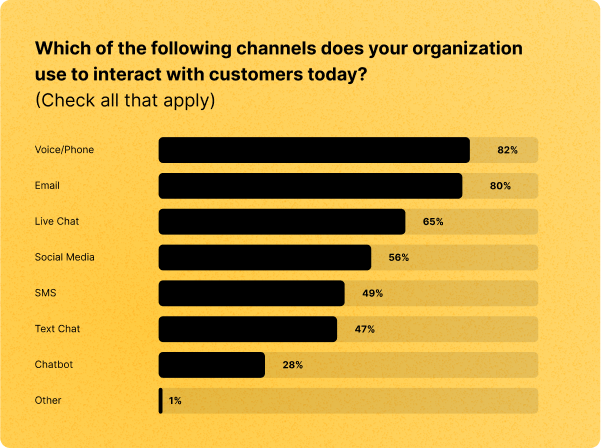
Whilst voice remains a key channel, it is one of the more expensive to support because of agent costs. To assist with these challenges, many contact centers have adopted voice technology to stay ahead.
According to Deepgram, the major use cases of AI voice agents in the contact center include:

The biggest return of using voice technology in contact centers came from increasing productivity, with a majority of respondents (71%) saying that they experienced a 26-50% increase in productivity from speech technology. The second biggest impact was increasing revenue, with 53% of respondents
saying they experienced a 26-50% increase and 41% seeing a 1-25% increase.
Retell AI is a Y Combinator-backed voice AI platform that lets enterprises build, test, and deploy production-ready voice agents for their call centers.
Its features include:
Performance metrics:
Ready to see how real-time voice agents can transform your customer interactions? Try Retell AI for free.
Contact center automation uses AI, workflow automation, and system integrations to handle customer interactions across voice, chat, email, SMS, and social channels with minimal human intervention. It can answer FAQs, route conversations, verify identities, process requests, and escalate complex issues to agents. Platforms like Retell AI extend this further with real-time AI voice agents that automate end-to-end customer conversations while maintaining natural, human-like interactions.
Call center automation focuses exclusively on voice interactions, automating tasks like IVR, call routing, transcription, and AI voice agents. Contact center Automation supports voice alongside digital channels such as chat, email, SMS, WhatsApp, and social media, while maintaining customer context across every touchpoint. It's designed to deliver a unified omnichannel experience rather than optimizing phone calls alone.
Modern contact center automation can handle FAQs, appointment scheduling, password resets, order tracking, payment processing, identity verification, CRM updates, call routing, live transcription, conversation summaries, quality assurance, and multilingual customer support. Advanced platforms like Retell AI can also automate outbound reminders, warm transfers to human agents, and multi-step workflows by integrating with CRMs, calendars, and business systems.
No. Contact center automation is designed to augment, not replace, human agents. AI handles repetitive, high-volume tasks such as answering common questions, updating records, and routing calls, allowing agents to focus on complex cases that require empathy, judgment, and problem-solving. This improves productivity, reduces wait times, and creates a better experience for both customers and support teams.
No. Traditional IVR systems rely on fixed "press 1, press 2" menus with limited flexibility. Modern contact center automation uses conversational AI to understand natural language, detect customer intent, complete tasks, and make intelligent routing decisions. Solutions like Retell AI enable voice agents to hold natural conversations, execute workflows, and seamlessly transfer customers to human agents with full conversation context.
Yes. Contact center automation isn't limited to large enterprises. Small and mid-sized businesses can automate repetitive customer interactions, reduce staffing costs, and provide 24/7 support without hiring large teams. Cloud-based platforms like Retell AI make it easy to deploy AI voice agents that handle appointment booking, lead qualification, FAQs, and customer support, allowing businesses to scale service without significantly increasing operational costs.
See how much your business could save by switching to AI-powered voice agents.
Total Human Agent Cost
AI Agent Cost
Estimated Savings
A Demo Phone Number From Retell Clinic Office