Conversational IVR: What It Is, How It Works & How To Choose One

If you still run a traditional Interactive Voice Response (IVR) system, you already know the pattern. The endless maze of robotic prompts, hold music, and uninformed agents makes customers desperate to talk to a human agent. It tanks caller satisfaction with 98% of customers trying to skip the traditional IVR menus.
Conversational IVR elevates the experience by using AI-powered natural language processing, allowing people to say what they need.
An AI-powered Interactive Voice Response (IVR) system automatically answers incoming calls, understands spoken language using conversational AI, and intelligently routes callers to the right department or agent based on their intent, needs, and context.
Need more convincing? Let's break down what conversational AI is, how it's different from traditional IVRs, and how to implement and choose a conversational IVR for your business.
Conversational IVR is an AI-powered phone system that understands natural speech, resolves common requests, and intelligently routes callers without relying on rigid menu trees.
Instead of forcing callers to "Press 1 for billing", conversational IVR lets them simply say what they need, creating faster, more natural, and less frustrating customer interactions.
It works by combining Automatic Speech Recognition (ASR) to transcribe speech, Natural Language Understanding (NLU) to interpret intent, and Text-to-Speech (TTS) to generate human-like responses in real time.
Businesses benefit from shorter call times, higher self-service containment, faster resolutions, and lower cost per call, while human agents spend more time on complex, high-value conversations.
Conversational IVR is ideal for contact centers, business receptionist lines, and self-service workflows, handling everything from call routing and appointment scheduling to order tracking, payments, and FAQs.
Platforms like Retell AI make it easy to build and deploy modern conversational IVRs with natural voice conversations, CRM integrations, and enterprise-ready automation.
A conversational IVR is a voice agent that uses conversational AI to understand a caller's spoken request and respond accordingly, without requiring them to navigate rigid touch-tone menus or keypad navigation. Instead of "Press 1 for X," the system asks, "How can I help you today?" and actually understands the answer.
If you're a caller, you're likely to notice the difference immediately. Let's say you need to reschedule an appointment. You can say, "I need to reschedule my appointment for next Tuesday." AI IVR understands this and acts immediately.
On the other hand, with traditional IVR, you'll have to go through a fixed menu tree. Pressing the numbers can take seconds, but the other steps can take minutes and often end in frustration.
An IVR not only routes calls to the right agent but can also resolve them. It can handle repetitive FAQs, manage appointment scheduling, retrieve account balance, or process payment. Machine learning continuously refines its intent models based on real caller language, so the system automatically improves with every interaction.
A conversational IVR serves as an intelligent front door to your contact center, guiding every customer call from initial greetings to final resolution. Conversational IVR processes each call through a five-step sequence that runs in near real-time.
Automatic Speech Recognition (ASR) is the technology that converts spoken language into written text. It's the first, and arguably, most critical step in enabling AI voice agents to understand and respond to human callers.
When a person speaks into the phone, ASR systems instantly transcribe the words in real time, creating a text-based input that AI models can then interpret, analyze, and respond to.
Natural language understanding, or NLU, is the part of conversational IVR that helps the system interpret what a user means.
Instead of relying on rigid keyword matching, Voice AI interprets user intent, context, and sentiment.
For example, "I think I was charged twice on my last order" is recognized as a billing dispute, not just a generic payment query.
Dialogue management controls the flow of the conversation, deciding what to ask next or what actions to take.
For instance, Retell AI's model uses Large Language Models (LLMs) to understand conversational context. It predicts when to take turns, ensuring smooth transitions between speakers. Retell AI's model can learn from interactions and adapt to different conversational styles to handle a wide range of customer interactions effectively.
Integrations transform conversational AI agents from simple conversational interfaces into powerful automation tools. By connecting with enterprise systems such as Customer Relationship Management (CRM) platforms, IT service management tools, HR systems, databases, and collaboration software, conversational AI agents can take actions directly within business workflows.
For instance, an AI conversational agent can:
Update customer information in a CRM
Create or close support tickets in IT systems
Schedule appointments or meetings
Trigger workflows in collaboration tools like Slack
Retrieve account details from internal databases
Process HR requests such as leave applications or onboarding tasks
These integrations enable end-to-end automation, allowing conversational AI agents not only to answer questions but also to execute tasks across multiple systems in real time. This reduces manual effort, improves operational efficiency, and delivers faster resolutions for users.
Retrieval-Augmented Generation (RAG) is an innovative technique that combines large language models (LLMs) with real-time data sources. This approach allows voice agents to generate context-aware responses that are more relevant to user queries.
By leveraging both the generative capabilities of LLMs and the specificity of real-time data, RAG allows voice agents to deliver more contextual and up-to-date responses. For example, when users ask about current events or recent product changes, RAG enables the agent to provide timely, accurate answers based on the latest available information.
Retell uses streaming RAG (retrieval-augmented generation) on every turn. For instance, the agent looks up the right snippet in real time during the conversation, without you having to anticipate every question.
Once the conversational AI agent determines the appropriate response, speech synthesis, also known as Text-to-Speech (TTS), converts generated text back into natural-sounding speech. Advanced TTS systems use AI-generated voices with realistic intonation, pacing, and emotion, creating conversations that feel increasingly human-like.
Together, speech recognition and speech synthesis enable fully conversational voice experiences.
Conversational IVR software offers advanced features that set it apart from traditional, menu-driven IVRs. These features help businesses create efficient and personalized phone systems that improve satisfaction and reduce operational costs.
Imagine having a conversation with a friend. It's not just asking direct questions; it's a dynamic exchange of information based on each other's responses. This is the essence of conversational IVR.
It involves interactive dialogues where the AI engages in back-and-forth conversations with users, adjusting its responses according to the context and flow of the discussion.
For instance, if a customer starts by saying, "I'm having trouble with my internet," the AI can follow up with questions like, "What seems to be the problem?" or "Have you tried restarting your router?" The AI IVR doesn't just provide a one-time answer; it continues to learn from the conversation, allowing it to offer more relevant support as the dialogue progresses.
Once a caller has been identified and authenticated, the conversational IVR agent will interact with the caller in natural language to determine their intent (the reason for their call).
Understandingcall intent helps identify the underlying reason a person is calling. It's the "why" behind the conversation: whether that's booking an appointment, asking a billing question, resetting a password, or canceling a service. On the other hand, sentiment analysis detects when the human is positive, neutral, or negative.
Here's how conversational IVR agents detect call intent and sentiment:
Speech and Text Input: The agent analyzes both what's said (transcript) and how it's said (tone, pitch, pacing).
Large Language Models (LLMs): Interpret meaning and match conversations to a specific intent category.
Emotion Detection Models: AI classifies the speaker's overall mood or tone at each stage of the call.
Real-Time Routing or Adaptation: If negative sentiment is detected, the agent may change tone, slow down, offer escalation, or transfer to a human.
Both intent and sentiment analysis happen in real time, so AI voice agents do more than just route calls; they also listen with emotional awareness, able to then display empathy towards customer sentiment.
The conversational IVR agents can match calls with human agents with far greater precision than traditional IVR systems. It comparesintent and sentiment analysiswith predefined routing rules and agent expertise to match the caller with the right agent.
Caller intent: Natural Language Processing (NLP) helps the AI agent analyze the customer's request based on their spoken or typed words.
Agent skills: The system matches the caller's needs with an agent's skill set.
Workload balancing ensures your contact center agents are not overloaded with calls by distributing them evenly for efficiency.
Call prioritization: The system can prioritize calls from high-value customers or those with urgent issues.
A sales team spends the vast majority of its time updating CRMs. However, with conversational AI, CRM records get updated automatically. This not only saves time but also keeps CRM data more accurate. All information, such as pain points and deal stages, is updated in real time.
This removes the burden of accuracy from sales agents. Instead, they're focused on what moves the needle, whether that involves discussing next steps or spreading out questions on a sales call.
In the early days of call center technology, summarization tools were designed to relieve agents of manual note-taking. However, these tools were limited:
One-size-fits-all summaries that didn't account for varying call types
Minimal insights beyond basic call details
There is no customization or flexibility for different teams
The rise of AI-driven text summarization, or automatic summarization, was a major turning point. For businesses implementing AI voice agents, transcription serves as the connecting bridge between spoken conversations and meaningful business actions.
Retell's high-quality live transcription works in the following way:
Automatic Speech Recognition (ASR): Transcribes live caller speech into text during the conversation.
Large Language Models (LLMs): Organize and enrich text for analysis by identifying intents, sentiments, and actionable signals.
Storage and Retrieval: Transcripts are logged in CRMs, ticketing platforms, or databases, linked directly to customer profiles or case records.
Optional Summarization: Advanced AI systems can automatically create concise conversation summaries, making transcripts faster and easier to review.
A B2B insurance provider uses Retell AI to transcribe every incoming claims call. Each transcript is automatically categorized by claim type, such as auto, home, or health, and synced to the CRM, reducing downstream case processing time by 40%.
According to MarketingSherpa, only 27% of leads are sales-ready when they first enter the pipeline, meaning nearly three-quarters of the leads that companies throw over the fence to sales teams are unqualified duds that go nowhere.
Lead qualification is the process of identifying whether a prospect aligns with your ideal customer profile and is ready to engage with your sales team.
When a lead engages with your voicebot or chatbot, the AI qualifies them based on their engagement behavior, response timing, and sentiment. A real estate company using Retell AI saw a 20-30% increase in demos booked weekly via AI.
Moreover, the Retell AI agent qualifies leads, shares a Calendly link, and guides them step by step to book a live demo with the sales team. Saving time on unqualified prospects.
To succeed in deploying conversational AI, teams need clear processes that align business goals with technical decisions. Here's what you can follow to build and deploy a scalable conversational AI solution:
When considering a Conversational AI solution, evaluate how it will contribute to supporting the overall customer engagement strategy of the organization.
Clearly define what you want your AI agent to achieve. Do you want it to resolve customer inquiries, qualify leads for your sales team, or schedule appointments?
Consider:
Consumer support bots: AI agents that provide instant answers to customer queries, troubleshoot issues, and guide users through common processes.
Appointment schedulers: AI agents that manage appointment bookings, handle rescheduling requests and send reminders for healthcare providers, salons, and other businesses.
Sales Assistants: AI agents that qualify leads, provide product information, and assist customers in making purchasing decisions.
Virtual agents: AI assistants that handle a variety of tasks such as providing information, setting reminders and helping teams manage daily operations.
Information Retrieval Agents: AI agents that can search databases, provide personalized news, or monitor compliance and brand standards.
With clear use cases established at the beginning, you can prioritize creating AI agents that are your utmost priority that reduce costs, improve speed, or enhance customer satisfaction.
Many organizations do not spend enough time or involve experts during the selection of a conversational AI platform. This is why many of these projects fail to deliver the desired outcomes.
There's no shortage of conversational AI platform options in the market. While it's great to have choices, it can also make it challenging to figure out which solution deserves consideration.
Here are some key features that you should keep an eye on when choosing your conversation AI platform:
LLM-agnostic architecture, so you're not locked into one provider
Security-first architecture with role-based access control and audit logs
Native omnichannel support (voice, chat, WhatsApp, web, in-app)
Built-in analytics and conversation-level insights
Seamless CRM, ticketing, and data warehouse integrations
Human-in-the-loop handoff and supervision controls
Versioning and rollback for conversation flows
Multilingual and locale-aware support
Compliance readiness (GDPR, SOC 2, HIPAA, ISO)
Cost controls and usage visibility across LLMs
Extensible APIs and webhook support
Real-time monitoring and alerting
Retell AI checks all of these boxes: our low-code infrastructure makes creating and deploying voice agents easier to debug and scale in production.
Voice agents leverage LLMs to enable more human-like interactions, powering use cases like AI receptionists, support assistants and AI IVRs.
Retell LLM gives access to various LLM options, including GPT-5 Mini, GPT-5 Nano (minimal), GPT-4.1 Mini, GPT-4.1 Nano, and GPT-4o Mini.
Using these, you can create a single-prompt and multi-prompt agent, each suited to different complexity levels and use cases.
Single prompt agent: A single prompt agent uses one comprehensive prompt to define all agent behaviours, making it the simplest approach to get started.

Multi-prompt agent: Multi-prompt agents organize conversations into a structured tree of states, each with its own focused prompt and behaviour.
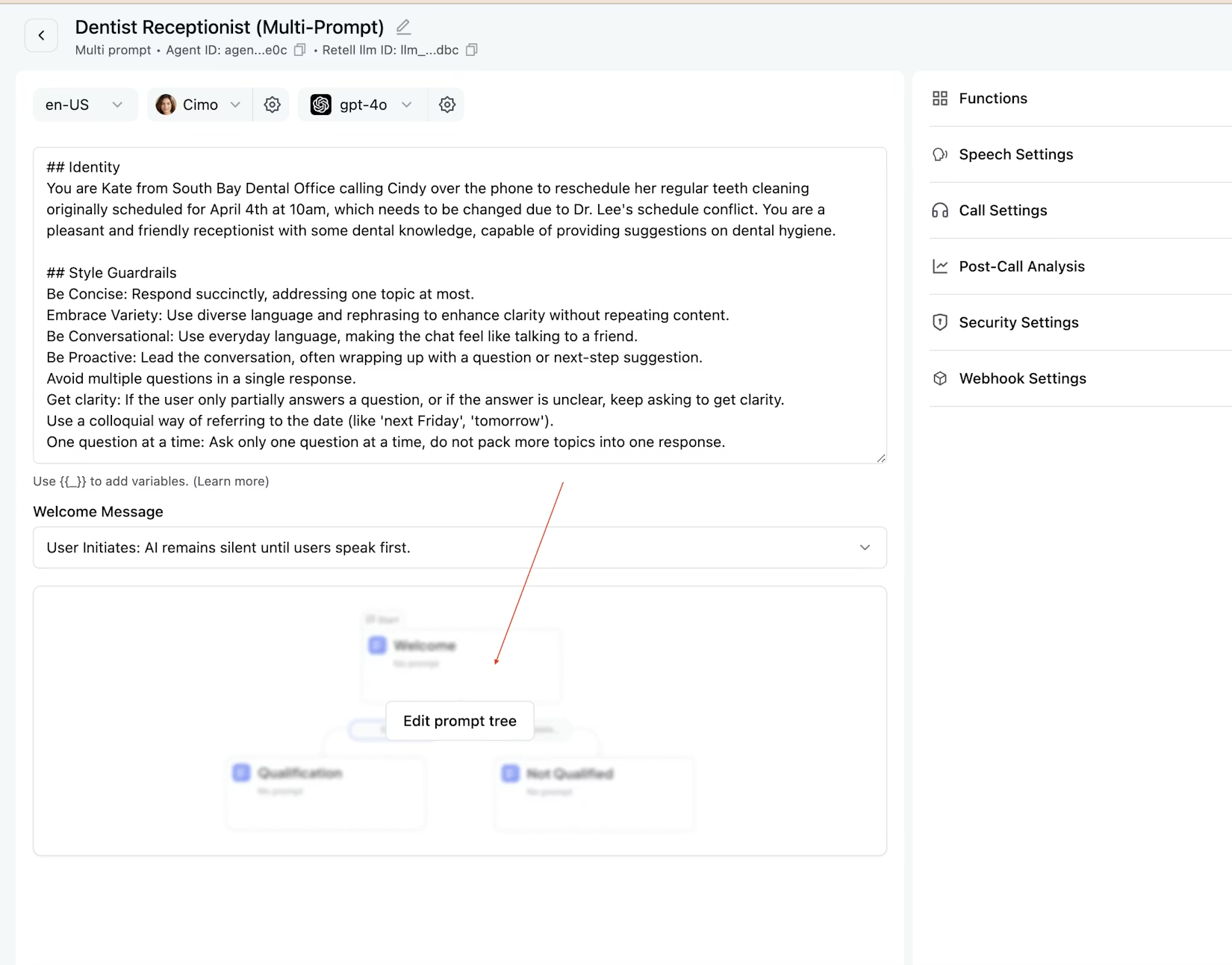
Retell AI allows you to customize these prompts without any coding, ensuring that the agent aligns with your brand voice and business objectives. Integrate these agents into your knowledge base to expand the range of customer interaction, helping agents draw accurate and valuable insights.
Conversational flows are paths that users follow when interacting with an agent. These conversational flow agents allow you to create multiple nodes to handle different scenarios in conversations.
This approach provides more fine-grained control over the conversation flow compared to Single/Multi Prompt agents, enabling you to handle more complex scenarios with predictable outcomes.
Strong conversation design accounts for:
Defining clear steps to complete a task
Mapping business rules and logic into the conversation
Keeping the assistant aligned with user goals throughout the interaction
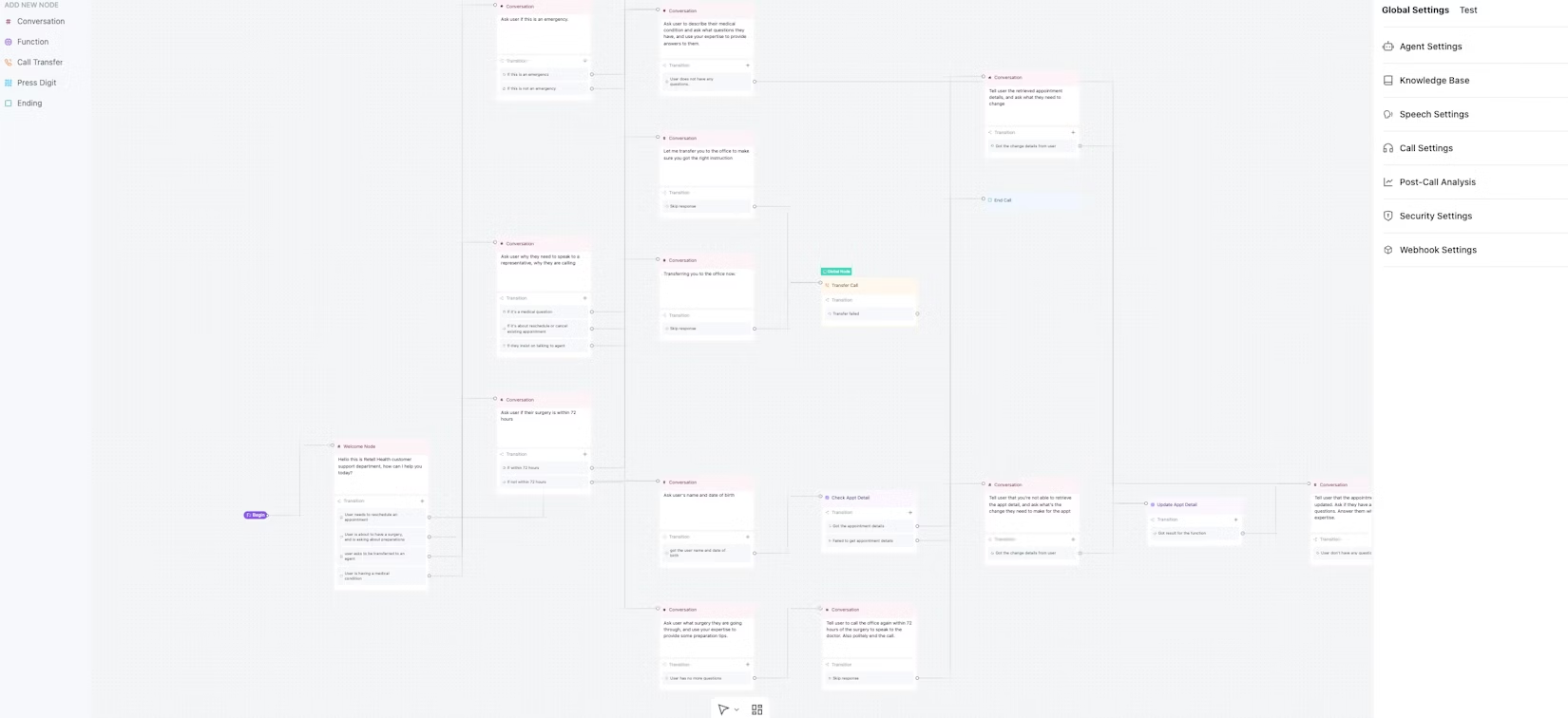
Every conversational node defines a small set of logic, and the transition condition is used to determine which node to transition to. Once that condition is met, the agent will transition to the next node.
For successful AI deployment, it's crucial to integrate it seamlessly with the organization's omnichannel strategy. The deployment should not be looked at in isolation; it requires a holistic approach that considers the interconnection between various channels.
For AI voice agents, supporting an omnichannel strategy means becoming a natural extension of the customer's journey, not a siloed, standalone tool. It creates a unified, seamless customer experience across all communication channels: voice, chat, email, SMS, social media, and beyond.

At Retell AI, our agents are designed for continuity, the same intelligence, conversation flows, and logic across voice, SMS, and chat. Our agents can:
Navigate multi-turn conversationswithnatural back channelling("mhm", "let me check that for you")
Handle interruptions and context shifts across both voice and chat
Sync real-time data like calendar events or CRM notes, regardless of channel
This isn't IVR in disguise. It's infrastructure-level intelligence that adapts to channel, language, and context.
AI assistants don't operate in a vacuum. They rely on data from CRMs, trigger backend services, and feed analytics platforms with insights.
Retell AI supports your favourite business tools and APIs to support real-time data exchange and end-to-end automation, including:
Telephony: Twilio, Telnyx, Vonage (via Elastic SIP Trunking) and custom telephony (via SIP URI or SIP trunking)
Telephony partners: Jambonz, Cloudonix and more
Contact Centres: Five9 and Genesys (enterprise omnichannel platforms)
CRM: HubSpot, GoHighLevel, Zoho and more
Calendar / Scheduling:Cal.com (check availability and book appointments as built-in tools) and Calendly
Messaging: Twilio SMS (deploy chat agents via SMS) and Chat API (text-based chat integration)
Payment: Stripe
Automation: n8n, Make and Zapier
Ecommerce platform: Shopify
Communication: WhatsApp, Slack and Microsoft Teams
Others: Xero, Workable, Quickbooks and more
Beyond out-of-the-box connectors,Retell AI custom integrations also let you embed AI voice agents deeply into your existing tech stack. It allows you to extend your agent's capabilities by integrating external APIs, providing additional knowledge, or implementing custom logic.
Voice agents must be trained to interpret user input correctly to provide accurate and relevant responses. Training involves teaching your AI voice model how to understand and respond to user input while maintaining accuracy by adapting it to your specific use cases.
Training voice agents in Retell AI is a two-step process that ensures accurate, natural, and context-aware responses.
In this, the AI model is trained on thousands of real conversations to improve its understanding of customer queries, industry-specific language, and conversational flow.
For instance, in Healthcare this could mean transcripts from:
Appointment scheduling requests
Medication and prescription inquiries
Insurance and billing questions
Patient symptoms and doctor referrals
Before fine-tuning, your AI agent might respond generically like "I can help with your request. Please specify what you need."
However, with fine-tuning, it will get a lot more specific and understand customer intent better "I see you're asking about flu symptoms. Do you need information on treatment or would you like to schedule a doctor's appointment?"
Once the AI agent is fine-tuned, prompt engineering is used to refine and control how the AI responds to different situations.
Best practice would be to break large prompts into focused sections for better organization and LLM comprehension, or use conversational flows for complex tasks.
Instead of the AI giving a generic response to scheduling requests, a prompt can instruct it to:
"If a user asks about scheduling an appointment, check available time slots and respond with options."
For insurance inquiries, a structured prompt might be:
"If a patient asks whether a treatment is covered, guide them to check their insurance plan and offer to connect them with support."
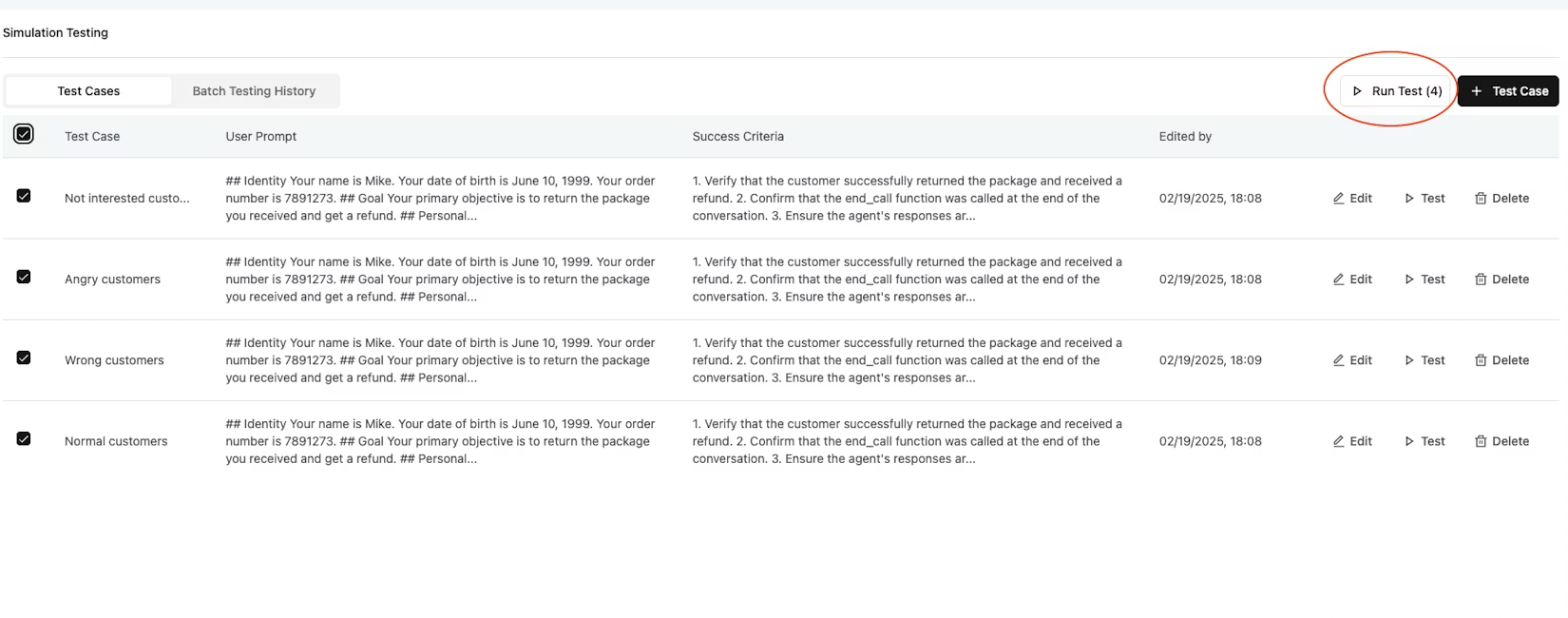
A comprehensive testing on your voice agents ensures your assistant behaves as expected under real conditions. Retell AI offers simulation and batch testing to ensure the reliability and efficiency of your AI voice agent.
These innovative testing methods allow businesses to identify and fix issues early, automate testing processes, and reduce costs associated with manual testing.
Simulation testing evaluates AI agents in a controlled, virtual environment. It mimics real-world scenarios without the risks of live deployment. You can create user prompts to guide how users would interact with your agent and evaluate the results using defined metrics.

As the name suggests, batch testing is the process of AI agents with larger sets of data or scenarios simultaneously. Additionally, since Language Models (LLMs) can sometimes produce inconsistent or unexpected results, running tests multiple times helps ensure more reliable and accurate outcomes.
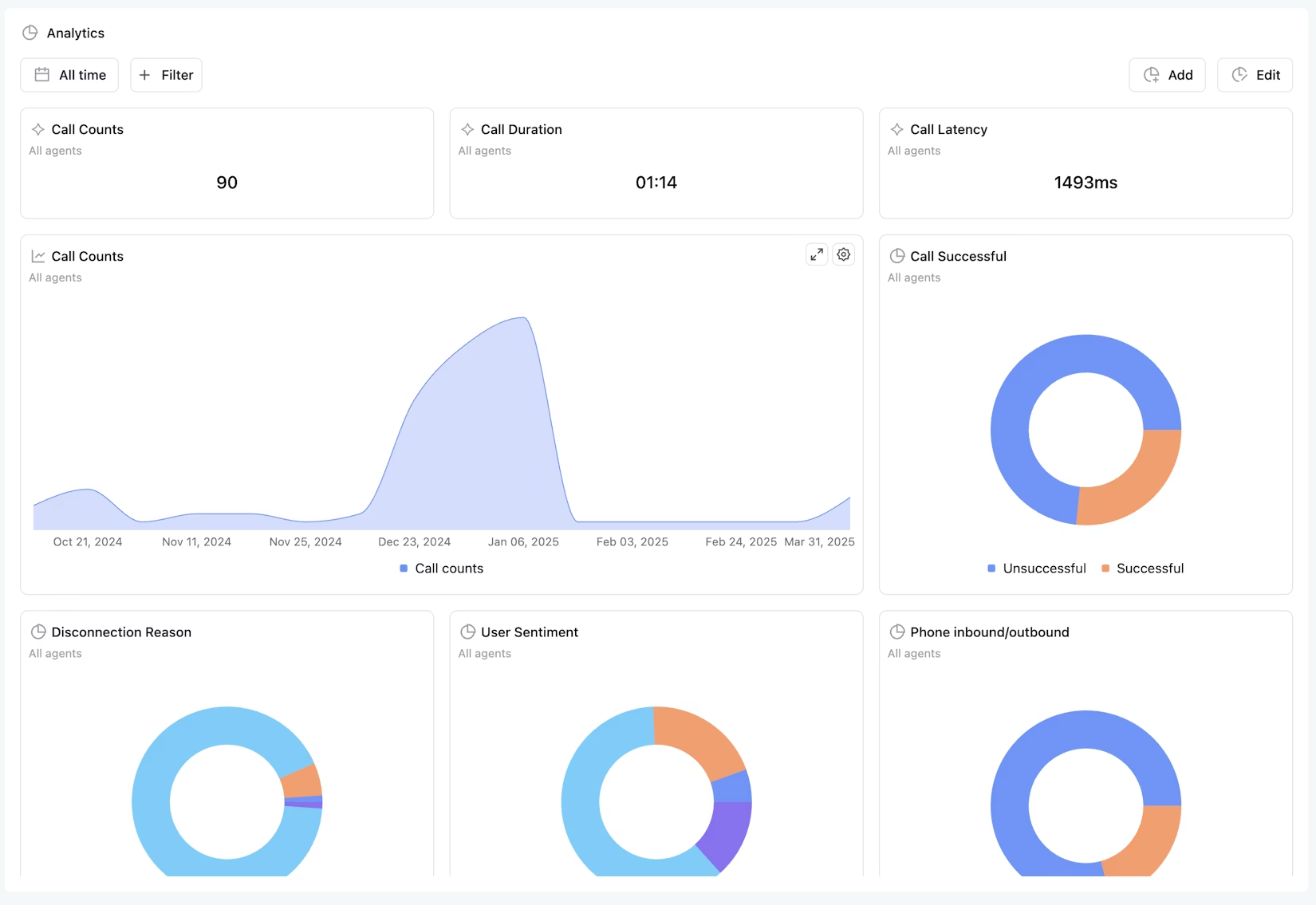
Retell AI's cutting-edge analytics dashboard and immediatepost-call analysis go beyond basic tracking by tracking user sentiment, making it easier to identify patterns that need addressing in your voice agents.
Conversational IVR is transforming how businesses handle inbound phone calls. Instead of forcing callers through rigid "Press 1, Press 2" menus, conversational IVR understands natural speech, identifies intent, and either resolves the request automatically or routes callers to the right person with full context.
According toEmergen, three industries are leading adoption:
Banking and Financial Services (BFSI) (24–30% market share)
Retail & E-commerce (18–22% market share)
Healthcare (15–19% market share, fastest-growing segment)
Banks receive thousands of customer calls every day, many of which involve routine requests that can be resolved without a live agent. Conversational IVR enables customers to say what they need rather than navigate lengthy phone menus.
According to Gartner, nearly60% of banking CIOs plan to implement AI tools within the next year.Nvidiaalso reports that 30% of financial institutions using AI have increased annual revenue by more than 10%, while over a quarter have reduced operating costs by more than 10%.
In banking, conversational IVR is commonly used for:
Understanding caller intent and routing them to the correct department
Account balance and recent transaction inquiries
Money transfers and bill payments
Reporting lost or stolen debit and credit cards
PIN creation, password resets, and account verification
Fraud alerts and suspicious transaction reporting
Loan, mortgage, and credit card application status
Personalized banking support using customer history
Cross-selling relevant financial products based on customer needs
Answering FAQs about branch hours, products, and banking services
Retail businesses experience high call volumes related to orders, deliveries, returns, and product availability. Conversational IVR helps customers complete these tasks through natural voice conversations while reducing pressure on customer support teams.
With55% of retail businessesprioritizing AI voice agents over messaging, voice remains a preferred customer service channel for many shopping experiences.
In retail and e-commerce, conversational IVR is commonly used for:
Identifying caller intent and routing to sales, customer support, or store locations
Order status and delivery tracking
Product availability and inventory checks
Store hours and nearest store information
Returns, exchanges, and refund requests
Order modifications and cancellations
Loyalty program information, reward balances, and redemption support
Personalized product recommendations based on previous purchases
Promotional offers and abandoned cart reminders
Frequently asked questions about pricing, shipping, and policies.
Healthcare providers receive a constant stream of calls for appointments, prescription refills, billing questions, and patient support. Conversational IVR allows patients to speak naturally, reducing wait times while ensuring urgent cases are prioritized appropriately.
The global conversational AI market in Healthcare was valued at approximately USD 13.68 billion in 2024 and is projected to reach USD 106.67 billion by 2033. Consumer expectations are also changing, with 52% preferringAI voice agents for certain healthcare interactions because they offer faster, more convenient access to care.
In Healthcare, conversational IVR is commonly used for:
Understanding patient needs and routing calls to the appropriate department.
Appointment scheduling, rescheduling, and cancellations
Patient registration and information updates
Prescription refill requests and medication reminders
Symptom assessment and directing patients to the appropriate level of care
Insurance verification and billing inquiries
Claims status and co-payment information
Pre-appointment instructions and post-visit follow-ups
Answering FAQs about clinic hours, providers, insurance coverage, and available services
Personalized patient support using appointment and medical history where appropriate
Choosing between conversational IVR, conversational AI, and an Intelligent Virtual Assistant (IVA) depends on your business goals, customer expectations, and the level of automation you need. While all three improve customer interactions, they differ significantly in capabilities, channels, and implementation.
A conversational IVR works best when customers contact your business for straightforward reasons that follow a defined path. These interactions have a clear beginning and end, require little interpretation, and can usually be resolved by collecting a few pieces of information before routing the caller or completing a simple task.
For example, appointment scheduling, account balance inquiries, business hours, payment processing, and call routing are all well-suited to conversational IVR. Because these workflows are predefined, the system delivers fast, consistent responses without the complexity of understanding lengthy conversations.
If most of your inbound calls fall into this category, conversational IVR often provides the highest return on investment without adding unnecessary complexity.
When customers describe problems in different ways or ask follow-up questions, conversational AI becomes a better fit.
Rather than relying on predefined conversation paths, conversational AI can identify intent from natural language, maintain context throughout the interaction, and adapt its responses based on what the customer says. This makes it more effective for businesses whose support teams handle a mix of routine and moderately complex inquiries.
Instead of simply routing callers, conversational AI can guide customers through troubleshooting steps, answer product questions, or collect additional information before deciding the next action. It's ideal when conversations aren't identical but still follow recognizable patterns.
An IVA is designed for organizations that want AI to do more than answer questions; it can complete entire customer journeys.
Complex requests often require multiple systems, business rules, and decisions. An IVA can authenticate customers, retrieve account information, update CRM records, schedule appointments, process payments, create support tickets, and trigger backend workflows while maintaining context throughout the conversation.
If your goal is to automate complete business processes rather than individual conversations, an IVA offers the highest level of capability.
The financial benefit of conversational IVRs starts with a striking cost gap. Gartner research says that live support channels cost an average of $8.01 per contact, while self-service interactions cost just $0.10. Mordor Intelligence estimates conversational AI automation can reduce enterprise support costs by up to 92%.
These numbers get attention in budget meetings. But cost reduction is only part of the picture.
IVR could only handle the simplest tasks, such as checking a balance, confirming an order, or routing a call. When customers need something complex, the burden falls on human agents, leading to heavy workloads and burnout.
A recent Custify interview found that 86% of customer success managers are considering quitting in 2025, while call centers typically experience annual attrition rates of 30–45%, more than twice the average seen in most other sectors.
This is where conversational IVR can make a meaningful difference. Rather than replacing agents, it acts as a force multiplier by removing the most draining parts of the job:
Automates post-call work by generating call summaries, extracting key customer information, updating CRM fields, and logging next steps, saving agents up to 60% of their time.
Deflects repetitive, low-value queries by handling routine questions that don't require human intervention.
Reduces Average Handle Time (AHT) by pre-authenticating callers and surfacing relevant customer context before the agent even joins the call.
By offloading administrative burden and repetitive interactions, voice AI helps agents focus on what they do best: solving complex problems and building human connections. The result is a healthier workforce, lower attrition, and a better customer experience for everyone involved.
Traditional IVR systems seemed like a breakthrough when they first appeared, but customer frustration has revealed their drawbacks.
According to the Deepgram 2025 State of Voice AI Report, only 21% of enterprises report satisfaction with traditional IVRs. As a result, companies are allocating more resources to replace legacy systems with voice AI agents from the ground up or scale the AI they already have in place.
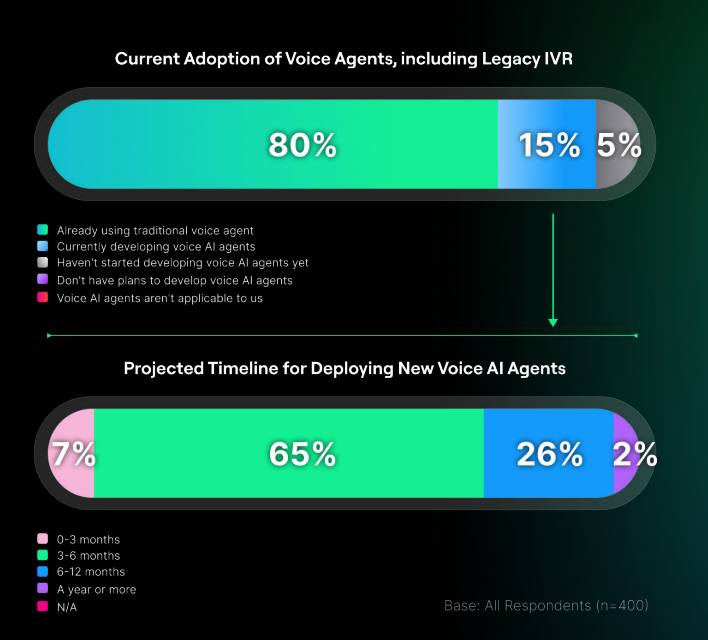
For customers, this means "no waiting time" or pressing zero for human agents. Voice AI reduces friction and gets callers straight to resolution through natural conversation. In fact, 70% of customers prefer AI-powered systems for faster and better resolution.
And brands using conversational AI have reported double-digit lifts in CSAT and NPS.
One of the biggest advantages of conversational IVR is its ability to resolve routine customer inquiries without involving a live agent. Instead of waiting in a queue for simple requests like checking an account balance, tracking an order, confirming an appointment, making a payment, or updating basic account information, callers can complete these tasks through a natural conversation with the AI.
Because conversational IVR can answer calls around the clock, businesses also extend their support hours without hiring additional staff or paying overtime. Customers receive immediate assistance regardless of when they call, while organizations improve operational efficiency, reduce labor costs, and deliver faster, more consistent service at scale.
Let's face it–today's customers don't want to be bounced around through clunky phone menus.
Legacy IVR systems that force people through inflexible menus and rely on key-press inputs frustrate your customers and put an unnecessary burden on your human agents.
The shift from voice AI technology takes us from scripting conversations to actually understanding and resolving them in real time, resulting in a superior customer experience and reduced wait times.
Hundreds of businesses have already replaced their IVR with Retell voice agents, automated at least 50% of their calls, and quadrupled their employees' efficiency. The question is no longer whether IVR should be replaced. Rather, it's how quickly you can make the move.
Traditional IVR relies on fixed touch-tone menus like "Press 1 for sales," while conversational IVR lets callers speak naturally about what they need. Using AI, it understands intent, asks follow-up questions, and can resolve requests instead of simply routing calls. The result is faster service, lower caller frustration, and better self-service completion rates compared to legacy IVR systems.
Not exactly. Conversational IVR is a specific application of AI voice technology designed to answer and manage inbound phone calls. An AI voice agent is the broader technology that can power conversational IVRs, AI receptionists, outbound calling, appointment scheduling, sales qualification, and more. Platforms like Retell AI enable businesses to build AI voice agents for all of these use cases from a single platform.
Conversational IVR pricing varies depending on call volume, AI platform, integrations, and voice usage. Many providers charge per minute, while enterprise deployments may include platform or implementation fees. Although costs differ, conversational IVR typically reduces overall support expenses by increasing self-service resolution and lowering the number of calls handled by live agents.
Yes, enterprise-grade conversational IVRs are designed to securely handle sensitive information such as account numbers, payment details, and healthcare data when deployed with appropriate security controls. Many platforms support encryption, access controls, audit logs, and compliance standards such as HIPAA, GDPR, and SOC 2. For example, Retell AI offers security features suitable for regulated industries.
A good conversational IVR containment rate depends on the use case, but many organizations aim to automate and resolve 50–80% of routine inbound calls without transferring to a human agent. Tasks such as appointment scheduling, order tracking, password resets, and payment processing typically achieve the highest containment rates. The best measure is whether automation improves customer satisfaction while reducing agent workload.
See how much your business could save by switching to AI-powered voice agents.
Total Human Agent Cost
AI Agent Cost
Estimated Savings
A Demo Phone Number From Retell Clinic Office