What Are Conversational Agents?
What conversational agents are, how they understand and respond in real time, and how voice agents differ from chatbots on a live phone call.
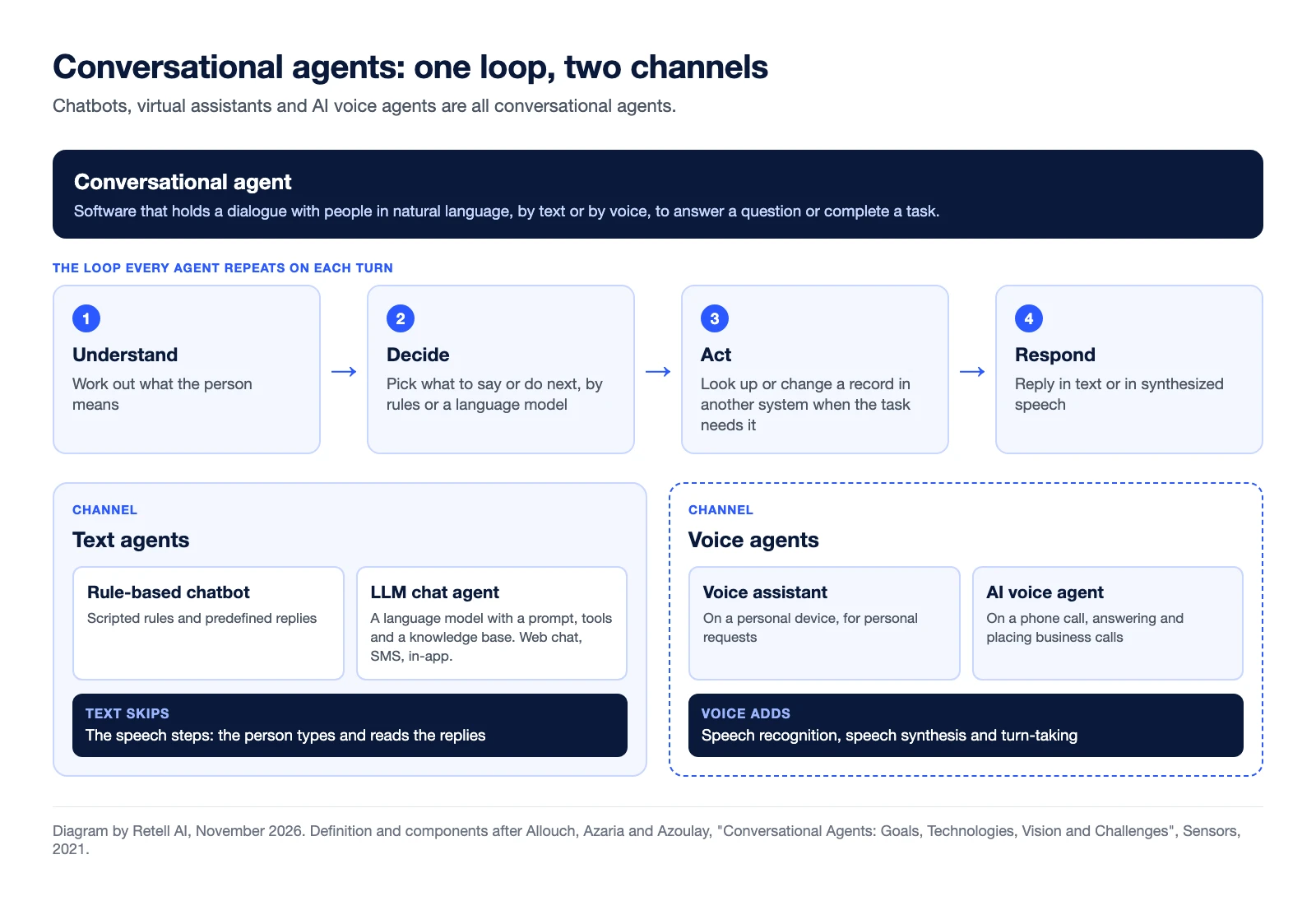
Conversational agents are software programs that hold a dialogue with people in natural language, by text or by voice, to answer a question or complete a task. Chatbots, virtual assistants and AI voice agents are all conversational agents.
The term comes from research. A 2021 review in the journal Sensors defines conversational agents as "agents that interact with users via written or spoken natural language" and adds that some "are capable of taking specific actions". The agent is the thing a person talks to. Conversational AI is the technology underneath it, and voice AI is the part of that technology that handles speech.
How do conversational agents work?
A conversational agent repeats the same loop on every turn of the conversation:
- Understand. It works out what the person means. A voice agent first turns the audio into text with speech recognition.
- Decide. It picks what to say or do next, using what was said earlier in the conversation. This is dialogue management, done by scripted rules or by a large language model.
- Act. When the task needs it, the agent looks something up or changes a record in another system.
- Respond. It replies in text, or in synthesized speech on a call.
The Sensors review describes the text part of this loop as three components: natural language understanding, a dialogue manager that "decides on how to respond", and natural language generation. Voice agents, it says, add steps at each end: "translating the sound waves into text" and turning the text reply back into sound.
What types of conversational agents are there?
Conversational agents differ in two ways: the channel they use, and how they decide what to say.
| Type | Channel | How it decides what to say | Typical job |
|---|---|---|---|
| Rule-based chatbot | Text | Scripted rules and predefined replies | Set answers to common questions |
| LLM chat agent | Text: web chat, SMS, in-app | A large language model following a prompt, with tools and a knowledge base | Support questions, order status |
| Voice assistant | Voice on a personal device | Speech recognition plus natural language processing | Personal requests, such as Apple's Siri |
| AI voice agent | Voice on a phone call | Speech recognition, a language model and speech synthesis, with turn-taking | Answering and placing business calls |
Researchers also sort conversational agents by purpose. The Sensors review cites a grouping into question-answering agents, task-oriented dialogue agents and chatbots, and it calls agents built to complete a goal, such as planning and booking a vacation, "goal-oriented conversational agents".
Are conversational agents the same as chatbots?
Not quite. A chatbot is one kind of conversational agent. The Sensors review notes that the two terms "are sometimes used interchangeably" and lists attempts to separate them. In one, conversational agents are "all types of software programs that interpret and respond to statements made by users in natural language", and chatbots are the type built to simulate conversation. In another, chatbots are conversational agents with a text-based interface.
Vendors often draw the line by capability instead. Slack's guide calls conversational agents "highly evolved chatbots, a level up from simple chatbots that follow predefined rules". For more on the split, see the chatbot entry and chatbot vs conversational AI.
Why does a search for conversational agents show Google Cloud?
Google Cloud uses the term as a product name. Its Conversational Agents console is the tool for building agents on Dialogflow, and Google's documentation says it "includes the features from both deprecated Dialogflow CX console and Vertex AI Agent Builder console". Results for the term mix that product with the general meaning this entry covers.
How are voice conversational agents different on a phone call?
A voice agent runs the same loop under tighter conditions. It has to tell when the caller has finished speaking, cope with interruptions and background noise, and reply without a long pause. The turn-taking entry covers the timing, and how AI voice agents work on a call follows one call from start to finish.
Retell AI builds both kinds. Its docs describe voice agents for calls and chat agents for text, and chat agents "use the same prompt types, functions, and knowledge bases as voice agents". On calls, Retell's orchestration layer handles turn-taking and interruptions. Function calling connects an agent to outside systems, for example to book appointments or check availability, and the transfer call tool hands a live phone call to a person. See the AI voice agent entry for the full definition.
Frequently asked questions about conversational agents
What is the difference between a conversational agent and conversational AI?
Conversational AI is the technology: speech recognition, language models and dialogue management. A conversational agent is one piece of software built with that technology to do a job, such as answering billing calls.
What are examples of conversational agents?
A support chatbot on a website, a voice assistant such as Siri, and an AI voice agent that answers a company's phone line are all conversational agents.
Do conversational agents need a large language model?
No. Rule-based agents reply from scripts and predefined answers. Language models let an agent handle questions nobody scripted and plan tasks with several steps.
Is an AI voice agent a conversational agent?
Yes. It is a conversational agent that works by voice, usually on phone calls. It adds speech recognition, speech synthesis and turn-taking to the loop that text agents use.
Hear a conversational agent on your own calls
Retell AI is an AI voice agent platform for contact centers. Talk to the Retell team about a pilot on real calls.