What Is SLA Compliance?
What SLA compliance means in customer support, the compliance rate formula with a worked example, typical targets, and what to do after a breach.
SLA compliance is how fully a service provider meets the commitments written into a service level agreement (SLA). It is usually reported as the SLA compliance rate: the percentage of contacts or cases handled within the agreed response and resolution times.
An SLA can sit between a company and its customers, an outsourcer and its client, or two internal teams. CIO describes it as the expected level of service, the metrics that measure it, and "the remedies or penalties, if any, should service levels not be achieved".
It is not the same as service level, the share of calls answered within a set number of seconds. Service level is one metric. An SLA usually holds several commitments, and a service level target is often one of them.
What does an SLA commit a support team to?
In customer support, most commitments are time limits. Umbrex's analysis guide names four: first response, update cadence, restore time and full resolution. Each is set by channel, priority and customer tier. On phone lines the first response commitment is an answer-time target, tracked alongside average speed of answer.
Two clock rules matter as much as the targets: whether time counts in business hours or calendar hours, and which statuses pause the timer, such as waiting on the customer. Umbrex lists both as inputs to settle before measuring.
How do you calculate SLA compliance rate?
- SLA compliance rate = contacts that met their SLA target ÷ contacts with an SLA target × 100
Freshworks gives a matching ratio for resolution: tickets resolved within SLA ÷ total tickets resolved × 100. Calculate it for each commitment first, then overall.
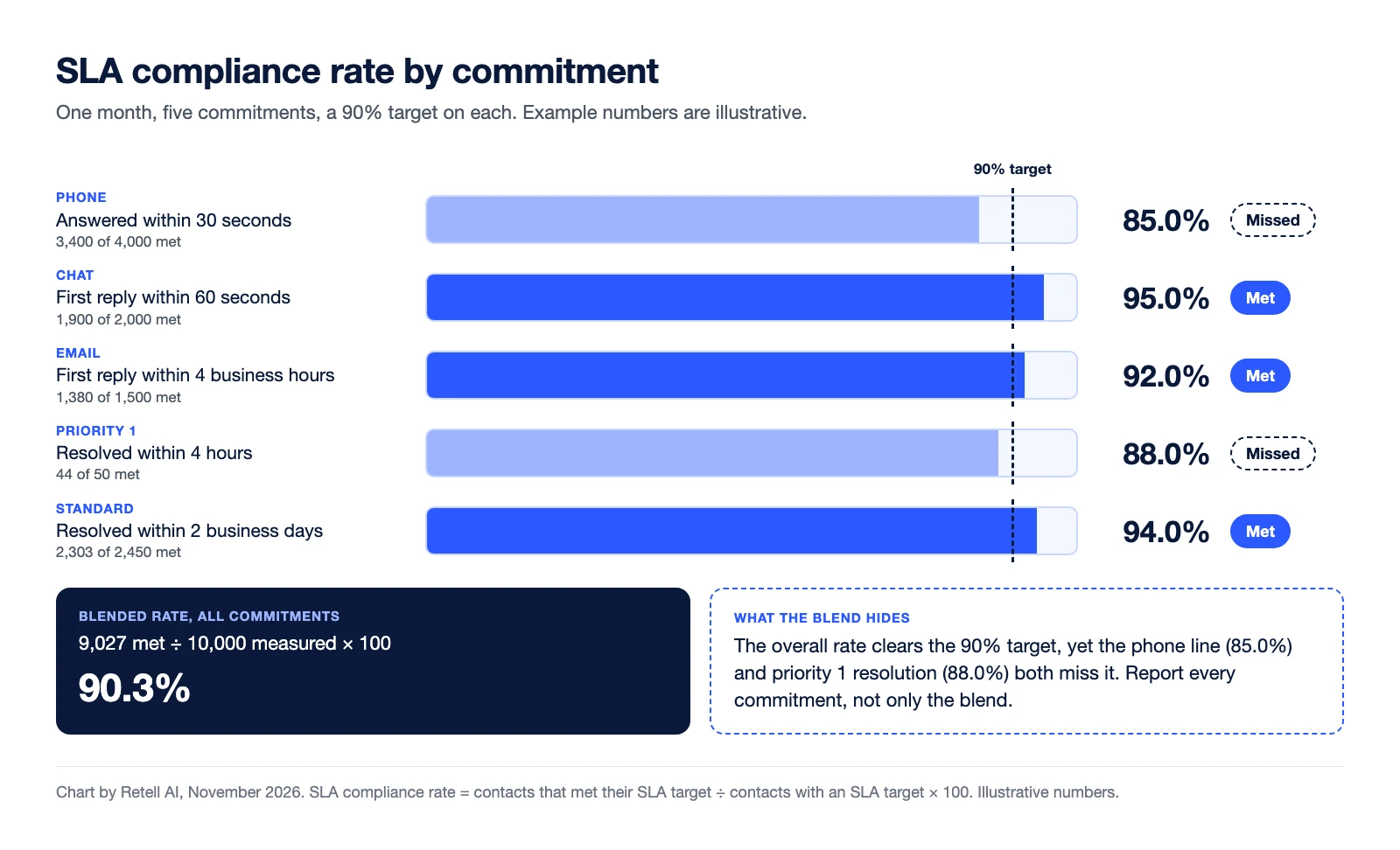
Worked example (illustrative numbers). One month for a support team whose agreement sets a 90% target on every commitment:
| Commitment | Measured | Met | Compliance | 90% target |
|---|---|---|---|---|
| Phone: answered within 30 seconds | 4,000 | 3,400 | 85.0% | Missed |
| Chat: first reply within 60 seconds | 2,000 | 1,900 | 95.0% | Met |
| Email: first reply within 4 business hours | 1,500 | 1,380 | 92.0% | Met |
| Priority 1: resolved within 4 hours | 50 | 44 | 88.0% | Missed |
| Standard: resolved within 2 business days | 2,450 | 2,303 | 94.0% | Met |
| All commitments | 10,000 | 9,027 | 90.3% | Met |
The blended 90.3% clears the target while the phone line and the priority 1 cases miss it. Report every line. Umbrex also defines a stricter overall rate: cases meeting all applicable SLAs ÷ total eligible cases.
What is a good SLA compliance rate?
There is no single standard target. The target is whatever the agreement says, and it only means something next to its threshold: 95% on a 24-hour reply is easier than 90% on a 30-minute one. Set an internal target tighter than the contracted one.
On phone lines, slow answers tend to raise the call abandonment rate. Call center metrics and KPIs covers the queue metrics under these targets.
What happens when an SLA is breached?
A breach happens at two levels. A single contact breaches when it passes its deadline. The agreement is breached on the terms the contract sets, often the period's compliance rate falling below target.
Before the deadline. Umbrex's guide tracks an at-risk rate: open cases predicted to breach within the next interval. That leaves time to reassign the case or follow the escalation matrix.
After a breach. CIO lists the possible remedies: "service credits, fee reductions, other agreed remedies" and, in serious or repeated cases, the right to terminate. It also gives an example of a fair exclusion: if a target is missed because the client did not provide information in time, "the supplier should not be penalized". Both are contract terms, so read the agreement itself and ask counsel about anything unclear.
Then find the cause. Umbrex suggests ranking breaches by driver, such as late assignment, long queue wait or excessive transfers, and scheduling weekly reviews with queue owners.
Where AI voice agents fit
Per Retell's concurrency docs, one agent can take any number of simultaneous calls within the workspace's concurrency limit, so a call does not wait for a free person. At the limit, new inbound calls wait briefly for a free slot. Calls the agent transfers to a person go to the number you set. If that destination queues calls, measure that queue against its own target.
Retell's alert rules send an email or webhook when call success rate, concurrency used or transfer failures cross a threshold you set. That is an early warning, not an SLA report.
Frequently asked questions about SLA compliance
What is the formula for SLA compliance rate?
Divide the contacts that met their SLA target by the contacts that had one, then multiply by 100.
Is SLA compliance the same as service level?
No. Service level is one metric: the percentage of calls answered within a set time. SLA compliance covers every commitment in the agreement, across channels.
What counts as an SLA breach?
A contact that passes its response or resolution deadline. At the agreement level, the contract defines it, often as a period's compliance rate falling below target.
Should the SLA clock pause while waiting on the customer?
Only if the agreement says so.
Keep phone response times inside your SLA
Retell AI is an AI voice agent platform for contact centers. Its agents answer inbound calls up to your concurrency limit and hand off to your team when a person is needed. Talk to the Retell team.