Interleaved reasoning is a way of running a reasoning model in which the model alternates between private reasoning and visible actions, such as tool calls or parts of its answer, instead of finishing all of its reasoning before it responds.
It is also called interleaved thinking. Vendor documentation mostly uses the term for reasoning between tool calls. Research papers use it for a model that alternates thinking with parts of its answer. Both describe the same change: reasoning stops being a single block at the start of the turn.
What is a reasoning model?
A reasoning model is a large language model that generates intermediate reasoning before its answer. OpenAI's reasoning guide puts it in one line: "Reasoning models use internal reasoning tokens before producing a response." Google's Gemini docs say a thinking model "reasons internally before responding", and DeepSeek's docs say its thinking mode produces chain-of-thought reasoning "to improve the accuracy of the final response".
What are reasoning tokens?
Reasoning tokens, also called thinking tokens, are the tokens a model generates while it works through a problem. They are not part of the answer. Three properties matter:
- They are billed. OpenAI says reasoning tokens "are billed as output tokens". Anthropic's thinking docs say the same about Claude, "even when the thinking text isn't returned to you". Google prices a response as "the sum of output tokens and thinking tokens".
- They are often hidden. OpenAI's reasoning tokens "are not visible via the API". Anthropic says what you see "is never the raw chain of thought". Both can return a summary if you ask for one.
- They take time and space. OpenAI says a model may generate "anywhere from a few hundred to tens of thousands of reasoning tokens" on one request, and they occupy the context window.
Developers control the amount with a setting: reasoning effort at OpenAI, effort at Anthropic, thinking level at Google.
How is interleaved reasoning different from think-first reasoning?
In think-first reasoning, all the reasoning happens before the first visible token. Anthropic calls this up-front thinking: thinking blocks "arrive before the text blocks". Interleaved reasoning splits the reasoning into smaller blocks and places them where they are needed.
| Pattern | Order of work in one turn | First thing the user sees | Publicly described by |
|---|---|---|---|
| No reasoning | Answer | The start of the answer | Any model with reasoning turned off |
| Think-first | All reasoning, then the answer | Nothing until the reasoning ends | Anthropic (up-front thinking), DeepSeek |
| Interleaved between tool calls | Reason, call a tool, read the result, reason again, then answer | Nothing until the last reasoning block ends, unless the model writes text between steps | Anthropic, OpenAI, vLLM, DeepSeek (without the term) |
| Interleaved with the answer | A preamble or part of the answer, reasoning, more of the answer | A preamble or an early part of the answer | OpenAI, research papers |
| Interleaved with speech | First sentence of the reply, silent reasoning while it plays, then the rest of the reply | The first sentence of the reply | Tell-1, Retell's own LLM |
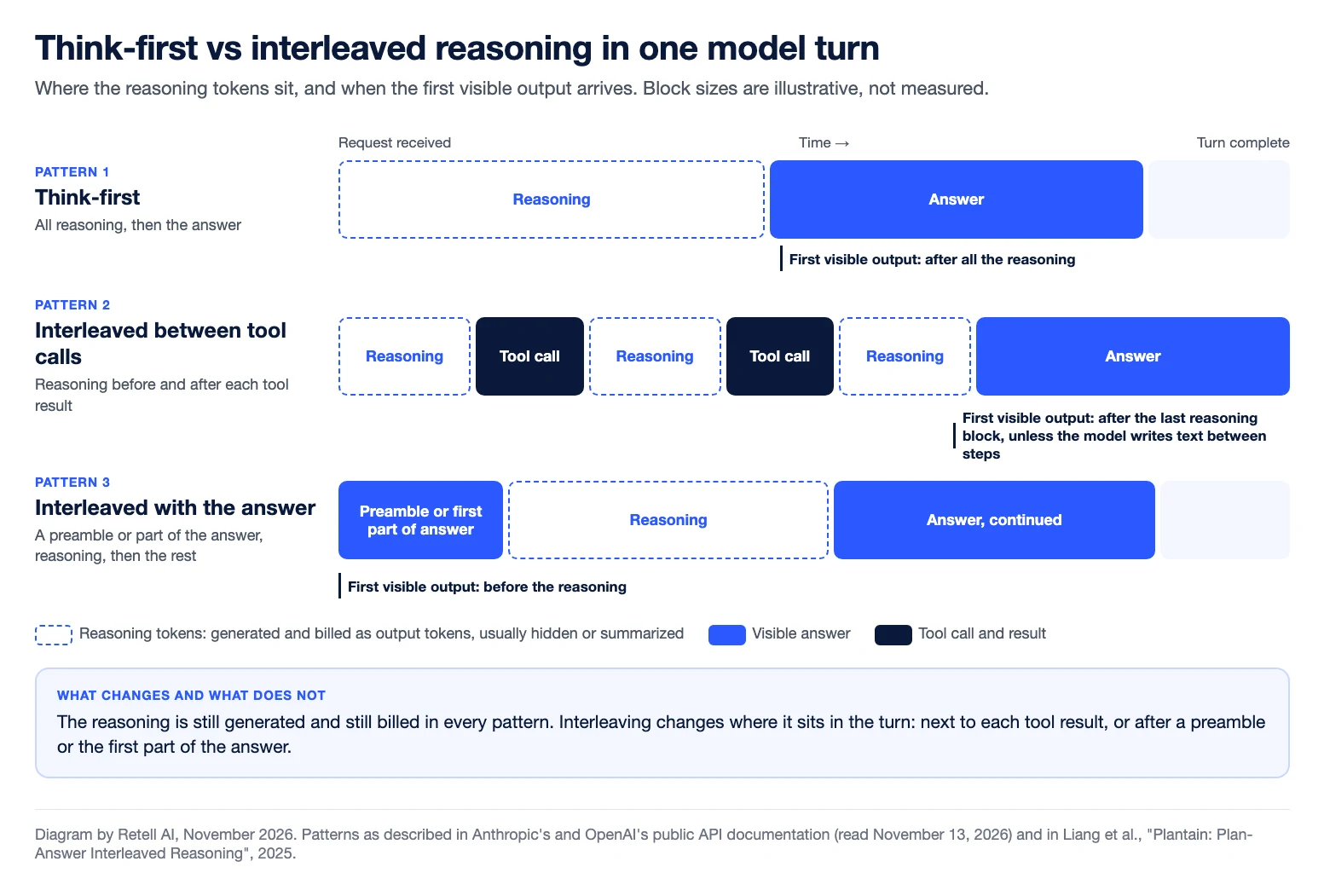
What do vendors document today?
Read on November 13, 2026:
- Anthropic. "Interleaved thinking lets Claude think between tool calls, reasoning about each tool result before acting on it." It is automatic on models that support adaptive thinking. Models on manual extended thinking need a beta header.
- OpenAI. Models such as gpt-5.5 "support interleaved thinking, where the model is able to generate visible output tokens before and in between thinking, and is able to think in between tool calls".
- Google. The Gemini thinking page does not use the term. It says thought steps "appear chronologically alongside function calls, user inputs or model outputs", and that thought signatures are "required to maintain reasoning continuity across multi-turn interactions".
- vLLM. The open-source inference server supports interleaved thinking for two model series and warns that it "increases token usage and response latency".
In research, Xie et al. (2025) trained models "to interleave thinking and answering" and report time to first token down by over 80% on average. Liang et al. (2025) define interleaved reasoning as a model that "alternates between thinking and surfacing intermediate responses" and report that their plan-first variant, Plantain, cut time to first response by over 60%. Both studied text tasks.
Why does think-first reasoning cost silence on a phone call?
On a phone call, speech synthesis cannot start until the model produces the first words of its reply. Every reasoning token generated before those words is time the caller hears nothing. In a chat window the same wait is a progress indicator. On a call it is dead air and added latency.
Retell's latency troubleshooting docs say that larger, reasoning-oriented models "are slower to first token" and "trade latency for capability". OpenAI lists voice as a common use case for running with reasoning effort set to none, and suggests that latency-sensitive applications "ask the model to generate a short preamble before continuing with deeper reasoning". The guide to the best LLM for voice AI agents covers the model choice.
What is interleaved reasoning in a voice agent?
In a voice agent, interleaved reasoning means the model writes the first sentence of its reply right away, reasons silently while that sentence is being spoken, and then continues the reply grounded in that reasoning. The caller hears one unbroken answer, and the reasoning is never spoken.
Tell-1 works this way. Retell's technical post, Retell LLM: Interleaved Reasoning for Real-Time Voice Agents, describes the format as "a spoken lead, then reasoning, then the rest of the reply". The post reports 200 reasoning tokens mid-reply on average, and that 99.98% of turns pause for less than 400 ms after the first sentence.
Compared with think-first reasoning, the caller does not wait in silence for the reasoning to finish. The post also states the trade-off: "speaking sooner means committing to the lead before any reasoning has happened". Tell-1 ranks #1 overall on the Retell vCX Benchmark (as of November 2026).
Frequently asked questions about interleaved reasoning
Is interleaved reasoning the same as interleaved thinking?
Yes, in most uses. Anthropic and OpenAI say interleaved thinking; research papers tend to say interleaved reasoning.
Are reasoning tokens billed?
Yes. OpenAI, Anthropic and Google all count them toward billed output. OpenAI and Anthropic bill them even when the reasoning text is not returned.
Can you read a model's reasoning tokens?
Usually not. OpenAI and Anthropic can return a summary if you ask for one. Neither returns the raw reasoning.
Does interleaved reasoning make a model respond faster?
Not by itself. Between tool calls it adds tokens, and vLLM's docs warn that it increases response latency. The first visible output arrives sooner only when visible output comes before the reasoning, or between shorter blocks of it.
What is interleaved reasoning in voice AI?
It is a model that starts speaking right away, reasons silently while its first sentence plays, then finishes the reply using that reasoning. Tell-1, Retell's own LLM, is built this way.
Run reasoning models on live calls
Retell AI is an AI voice agent platform for contact centers. You choose the model behind each agent. Tell-1 is one of them. Talk to the Retell team.
Security & compliance for regulated deployments
How Retell handles audits, data retention and access control.
Further Reading
Related terms
Table of contents