Tool calling, also called function calling, is how a large language model (LLM) gets work done outside its own text: the model returns the name of a tool and structured arguments, and the application runs it.
The model never runs anything itself. It asks, and software acts. That is what lets an AI agent check an order, book an appointment or transfer a call instead of only talking about it.
Is tool calling the same as function calling?
In everyday use, yes. The model vendors treat the two as names for one mechanism. OpenAI's guide opens with "Function calling (also known as tool calling)". Anthropic's docs open with "Tool use (also called function calling)". IBM writes "Tool calling, sometimes referred to as function calling".
Where a line is drawn, "tool" is the wider word. OpenAI's guide says: "A function is a specific kind of tool, defined by a JSON schema."
| Term | Where you see it | What it covers |
|---|---|---|
| Function calling | OpenAI's guide title, Retell's docs | The model fills in arguments for a function you described with a JSON schema, and your code runs it |
| Tool calling | OpenAI, IBM, the Retell vCX Benchmark | The same mechanism for any tool: your functions, a platform's built-in tools, tools on an MCP server |
| Tool use | Anthropic's docs | Anthropic's name for the same mechanism |
| MCP (Model Context Protocol) | modelcontextprotocol.io | "An open-source standard for connecting AI applications to external systems". It supplies tools. The model still decides when to call one |
How does tool calling work?
OpenAI's guide describes tool calling as "a multi-step conversation between your application and a model" with five steps:
- Offer the tools. The application sends the model the conversation and a list of tools it could call.
- Receive a tool call. If a tool is needed, the model replies with the tool's name and arguments.
- Run it. The application executes the code or API request.
- Return the result. The application sends the tool's output back to the model.
- Get the answer. The model writes its reply from the result, or asks for another tool.
The call itself is a few lines of JSON. This example is from Retell's function calling docs:
{"function": "book_appointment", "arguments": {"date": "2024-03-15", "time": "14:00", "customer_name": "John Smith"}}
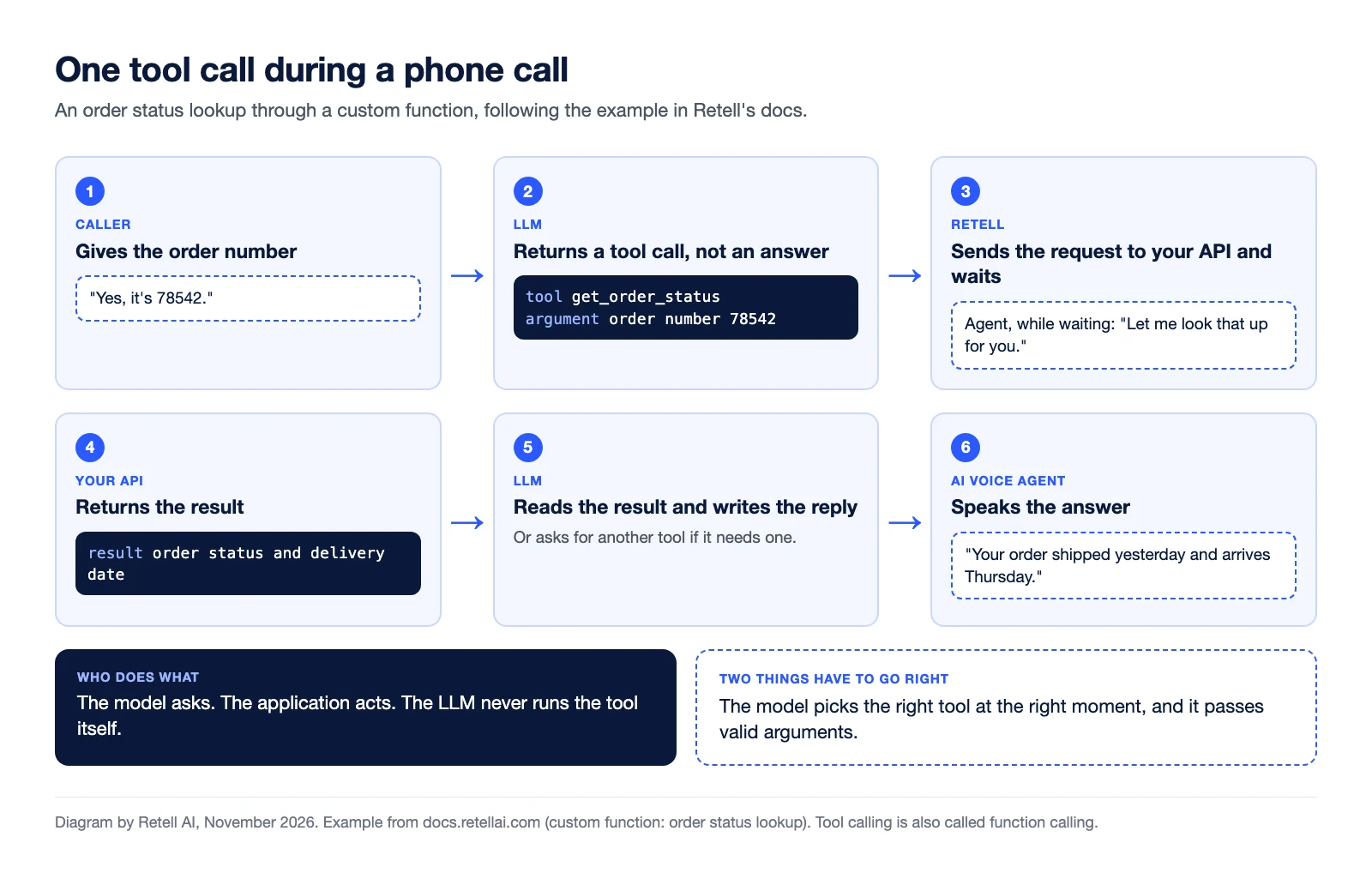
What makes a tool call succeed or fail?
Two things have to go right. The model has to pick the right tool at the right moment, and it has to pass valid arguments.
- Descriptions drive the choice. Anthropic's docs say Claude decides when to call a tool "based on the user's request and the tool's description". Retell's custom function docs call vague descriptions "the most common reason a function never fires".
- Schemas constrain the arguments. OpenAI's strict mode makes function calls "reliably adhere to the function schema, instead of being best effort".
- Benchmarks score it on its own. Tool calling is one of four suites on the Retell vCX Benchmark, next to instruction following, grounding and colloquial speech. It tests "whether the model selects the right action and passes valid arguments". Tell-1, Retell's own LLM, passes 95.4% of the tool calling cases (rank 5 on that suite) and ranks #1 on the overall average, as of November 2026 (board read November 13, 2026). The Retell LLM technical post explains how the model is trained and scored.
How does tool calling work on a phone call?
On a call, the caller waits while the tool runs, so timing is part of the design. Retell's docs list the tools an AI voice agent can call during a call:
- Pre-built functions: End Call, Transfer Call, Press Digits and Send SMS.
- Integration tools: actions on a connected provider such as HubSpot, Salesforce, Zendesk or Cal.com, with no endpoint to host.
- Custom functions: the agent calls your own API and uses the response.
- Code tool: JavaScript that runs in Retell's sandbox.
- MCP tools: tools on a remote MCP server you connect.
With a custom function, Retell "sends a request to your URL with the function's arguments and waits for your response before continuing". The timeout defaults to 120 seconds and there is no retry by default. If the request fails, the agent receives the error and continues based on your prompt, so the prompt should say what to tell the caller. The agent can talk while it waits, or the function can run in the background.
In a conversation flow, a function node runs its tool every time the flow enters it. A subagent node lets the LLM decide whether and when to call each tool.
Related terms: API integration and webhook. For the wider picture, see voice AI integrations with your CRM and telephony stack.
Frequently asked questions about tool calling
Is function calling the same as tool calling?
Yes, in everyday use. OpenAI, Anthropic and IBM each give one term as another name for the other. Strictly, a function is one kind of tool.
Does the LLM run the tool itself?
No. The model returns the tool's name and arguments. The application or platform runs the tool and sends the result back.
What is the difference between tool calling and MCP?
Tool calling is how a model asks for an action. MCP is an open-source standard for connecting AI applications to the systems that provide tools.
What happens when a tool call fails during a live call?
On Retell, the agent receives the error and continues the conversation based on your prompt. A custom function is not retried unless you set a retry count.
Why does an agent skip a tool it should have called?
Usually the description. The model decides from the tool's name, its description and the prompt, so state what the tool does and when to use it.
Connect an AI voice agent to your systems
Retell AI is an AI voice agent platform for contact centers. Its agents call pre-built, integration and custom tools during a live call. See the Retell AI integrations. To run those tools on Retell's own LLM, see Tell-1.
Security & compliance for regulated deployments
How Retell handles audits, data retention and access control.
Further Reading
Related terms
Table of contents