Workforce optimization (WFO) is the contact center practice, and the software suite behind it, that combines workforce management with quality management, call recording, performance management and analytics. It joins two questions a contact center usually answers in separate tools: are enough agents on the phones, and how well is each call handled.
Outside customer service, WFO is also a common abbreviation for "work from office", the opposite of WFH (work from home). This entry covers the contact center meaning.
What does a WFO suite include?
NiCE's WFO guide lists the typical capabilities as "workforce management, quality management, recording, interaction analytics, performance management, coaching, and reporting", and adds that the exact mix varies by platform. The five core parts:
- Workforce management (WFM). Forecasting contact volume, scheduling agents against it, and managing the day as it happens. For choosing a tool, see our guide to call center workforce management software.
- Quality management (QM). Reviewing calls against a scorecard for accuracy, compliance and resolution. See call quality monitoring.
- Recording. Capturing calls, and often agent screens, so there is something to review.
- Performance management. Tracking each agent and team against targets, then turning the gaps into coaching.
- Analytics. Searching transcripts and recordings across many calls to find patterns that one-by-one review misses.
WFO vs WFM vs WEM: what is the difference?
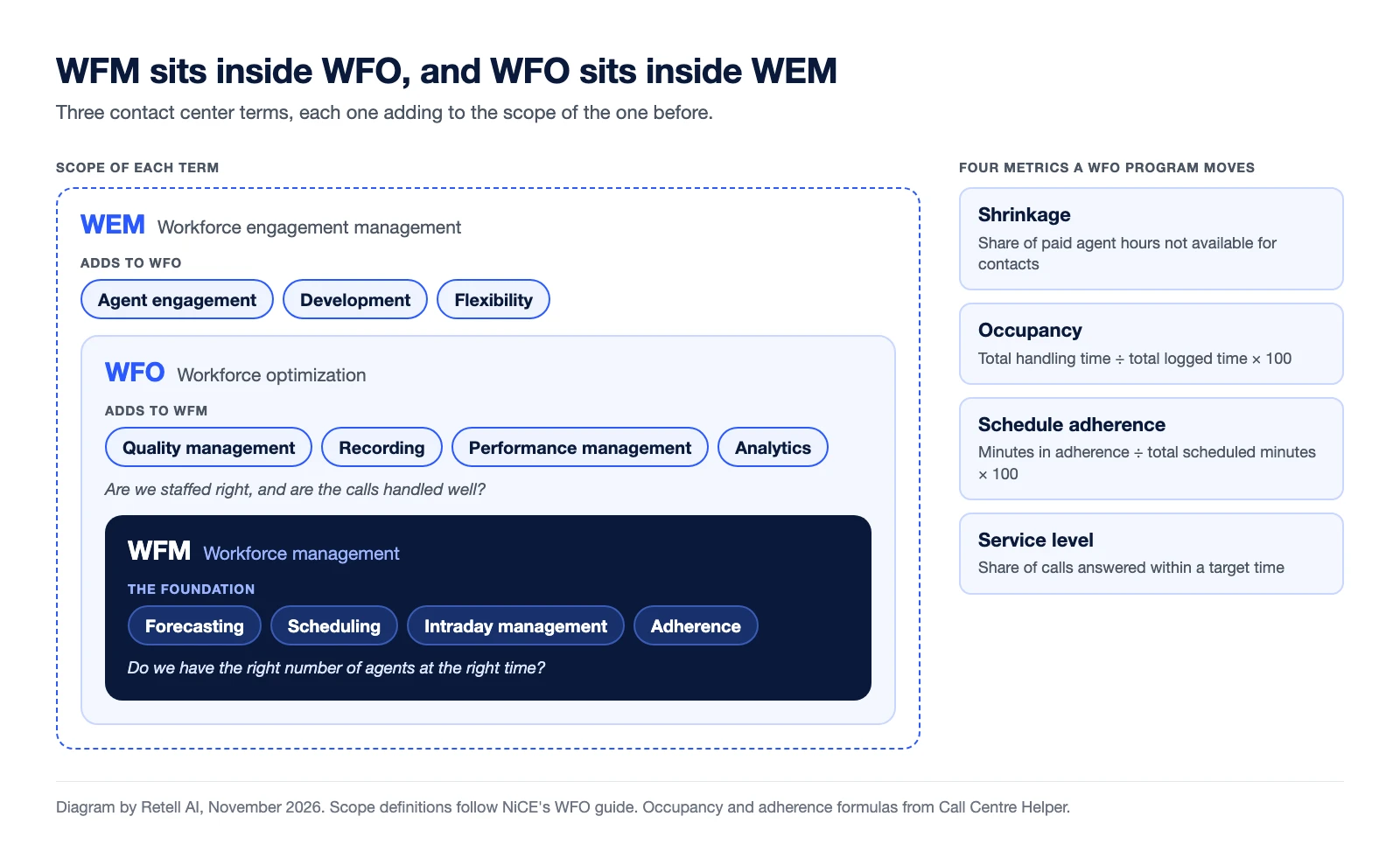
The three terms describe scopes that sit inside one another. NiCE puts it this way: "WFM is the staffing and scheduling foundation. WFO adds quality, performance, and analytics to improve the operation. WEM builds on that foundation with stronger employee engagement, coaching, flexibility, and development."
| WFM | WFO | WEM | |
|---|---|---|---|
| Full name | Workforce management | Workforce optimization | Workforce engagement management |
| Scope | Forecasting, scheduling, intraday management, adherence | WFM plus quality management, recording, performance management and analytics | WFO plus agent engagement, development and flexibility |
| Main question | Do we have the right number of agents at the right time? | Are we staffed right, and are the calls handled well? | Are agents engaged enough to keep performing well? |
| Typical output | Forecast, schedule, adherence report | Schedules, QA scores, coaching plans, trend reports | The WFO outputs plus flexible scheduling, development plans and recognition |
Some vendors now use WEM as the name for the whole suite. NiCE says WFO "has evolved into the broader discipline of workforce engagement management", and Aspect writes that "WEM has all but replaced WFO as a common term". The software parts are largely the same. The newer label adds the agent's experience to the goal.
Which metrics does WFO move?
A WFO program is judged on a small set of numbers. Four of them connect the staffing side to the quality side:
- Shrinkage. The share of paid agent hours when agents are not available for contacts. Training and coaching count toward it, so a WFO program has to budget for its own activities. See call center shrinkage.
- Occupancy. Call Centre Helper gives the formula as total handling time ÷ total logged time × 100. Too low wastes paid time; too high leaves agents no gap between calls.
- Schedule adherence. Minutes in adherence ÷ total scheduled minutes × 100, per Call Centre Helper. It shows whether the schedule the forecast produced was followed.
- Service level. The share of calls answered within a target time. It is the result the other three exist to protect. See service level.
Quality scores sit beside these. A center can hit service level with poor calls, or score well on calls that waited too long. WFO exists so the same team sees both. More metrics are covered in call center metrics and KPIs.
How do AI voice agents change staffing and QA?
WFO was built for human agents. When an AI voice agent answers some call types, both halves of the practice shift.
Staffing. Calls an AI agent handles are planned against a concurrency limit, not a roster. Retell's concurrency docs say each agent "can handle an unlimited number of calls, as long as total concurrency stays within your quota". A spike in an AI-handled call type becomes a capacity setting to check, not a peak to staff with extra shifts. The people who take transferred calls still need forecasts, schedules and shrinkage planning, so WFM applies to that smaller queue.
QA. Manual quality programs review a sample because listening takes time. With an AI agent, every call can be opened for review:
- By default, Retell stores a transcript and recording for each call, shown in Call History.
- Post Call Extraction adds built-in fields to every call, including a summary, the caller's sentiment and whether the call met your success criteria.
- AI QA scores a sample of calls, at a percentage you set, on resolution, hallucination, latency and other metrics.
A failed score also leads somewhere different. A human agent gets coaching; an AI agent gets a prompt or knowledge base fix, tested before release. Our voice agent QA scorecard lists the criteria to score.
Frequently asked questions about workforce optimization
What does WFO stand for in a contact center?
Workforce optimization. It covers workforce management, quality management, recording, performance management and analytics.
What is the difference between WFO and WFM?
WFM covers forecasting, scheduling, intraday management and adherence. WFO includes WFM and adds quality management, recording, performance management and analytics.
Is WFO the same as WEM?
Nearly. Workforce engagement management (WEM) covers the same functions as WFO and adds a stronger focus on agent engagement, development and flexibility. Some vendors now use WEM for the whole suite.
What does workforce optimization software do?
It puts scheduling, call recording, quality scoring, performance tracking and analytics in one suite, so staffing data and quality data can be read together. The exact mix varies by vendor.
Does workforce optimization apply to AI voice agents?
Partly. AI-handled calls are planned against a concurrency limit and need no schedule. Quality management still applies, and the human team that takes transfers still needs workforce management.
Review every call, staff for the ones that need a person
Retell AI is an AI voice agent platform for contact centers. Its agents answer calls up to your concurrency limit, keep a transcript and analysis for each call, and transfer callers to your team when needed. Talk to the Retell team.
Security & compliance for regulated deployments
How Retell handles audits, data retention and access control.
Further Reading
Related terms
Table of contents