Call queue management is the practice of controlling how inbound calls wait when no agent is free: the order they are answered in, which agent or team gets each one, and where a call goes when the wait runs too long. The goal is to keep wait times and abandoned calls inside a target without scheduling more agents than the call volume needs.
In a contact center, "queue management" usually means this. The queue itself is held by an automatic call distribution (ACD) system. NiCE's glossary describes a call queue as "a waiting line within a contact center that holds inbound customer interactions until the appropriate agent or resource is available."
How does a call queue work?
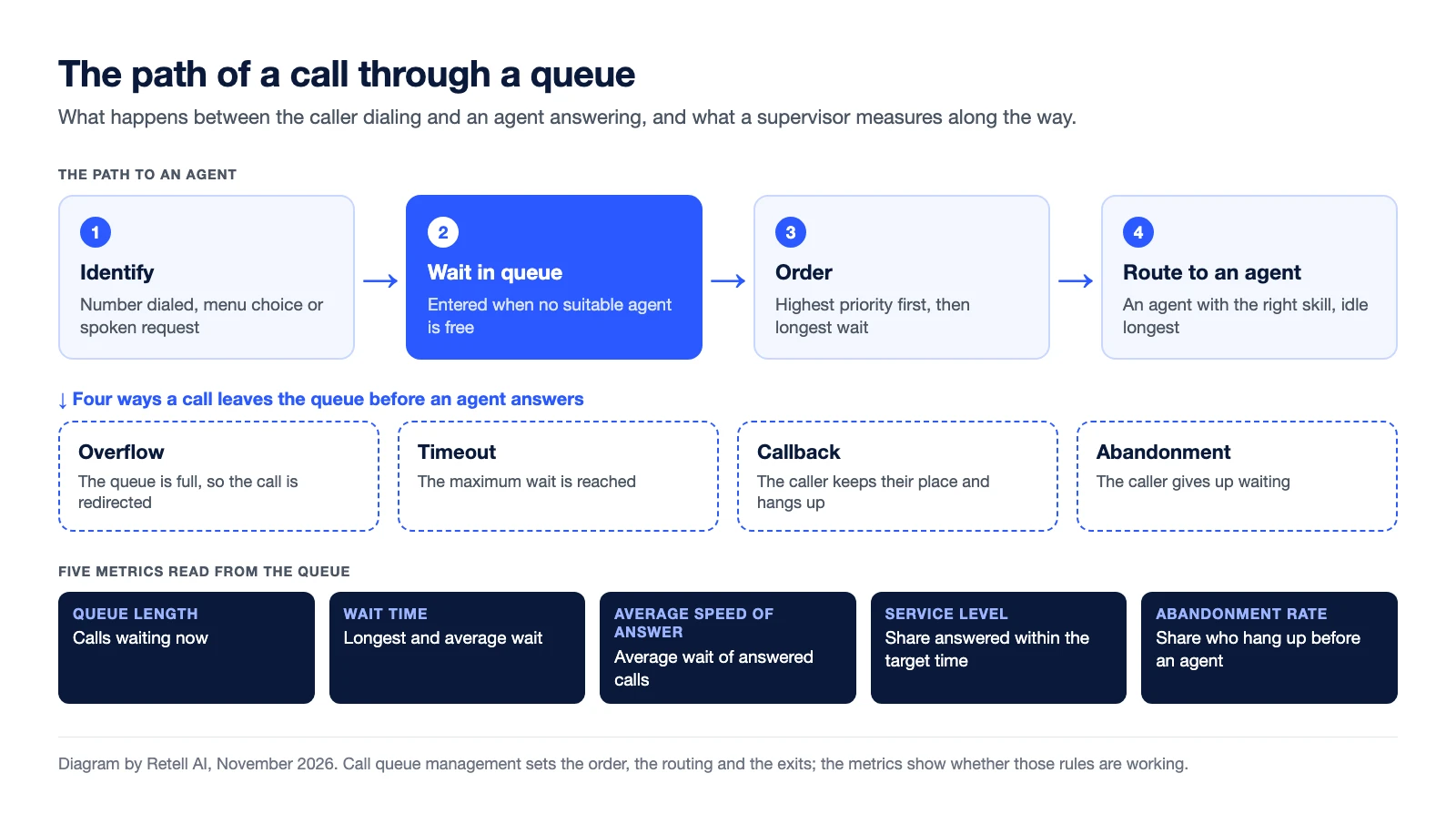
A caller is identified by the number dialed, a menu choice or a spoken request, then queued if no suitable agent is free. Five rules decide what happens next:
- Order. The default is first in, first out. AWS's contact center documentation says callers on hold are served "by their time in queue, on a first-come, first-served basis", and the call goes to the agent who has been idle longest.
- Skills-based routing. Calls are grouped into queues by need, such as language or product, and only agents with that skill take them.
- Priority. Some calls move ahead of others. In Microsoft Teams, an agent who becomes free receives "the highest-priority call that has been waiting the longest".
- Overflow and timeout. A queue has a maximum size and a maximum wait. Microsoft's call queue setup guide lets an admin redirect calls past either limit to another queue, an outside number or voicemail, or disconnect them.
- Callback. The caller hangs up and keeps their turn. AWS describes queued callback as letting customers "maintain their position in queue without requiring them to stay on the call".
Which metrics show how a queue is performing?
Read these five by 15 or 30 minute interval, because a daily average hides the busy hour.
- Queue length. The number of calls waiting right now.
- Wait time. The longest current wait, and the average wait across all callers.
- Average speed of answer. The average time answered calls waited before an agent picked up.
- Service level. The percentage of calls answered within a target time.
- Call abandonment rate. The percentage of callers who hang up before reaching an agent.
Staffing sits behind all five: call center shrinkage decides how many scheduled agents are available to take calls.
Call queue strategies and when each fits
| Strategy | What it does | Fits when | Watch for |
|---|---|---|---|
| First in, first out | Answers calls in arrival order | One team handles every call type | Urgent calls wait behind routine ones |
| Skills-based routing | Sends each call to a queue for agents with the right skill | Calls differ by language, product or tier | Small skill groups mean longer waits |
| Priority queuing | Moves chosen callers or call types to the front | Some calls are time-critical or high value | Low-priority callers can wait a long time |
| Overflow routing | Redirects calls when the queue is full or the wait limit is reached | A backup team, site or outsourcer can take calls | The backup team may not know the caller's context |
| Queued callback | Holds the caller's place and calls back when an agent is free | Waits are long but agents catch up later | Missed callbacks create repeat calls |
| Answer first with self-service | An IVR or AI voice agent handles routine requests before the queue | A few simple reasons drive much of the volume | Callers need a clear path to a person |
Tips for managing a call queue
- Set the limits on purpose. Choose the maximum queue size and maximum wait, and decide where calls go at each limit.
- Offer the callback early. A callback offered after most callers have given up does not lower abandonment.
- Review by interval. Compare the same half hour week to week.
- Plan for peaks. See how to handle high call volume for staffing to the busiest interval.
What changes when an AI voice agent answers first?
When an AI voice agent answers, the caller does not wait for a free person. The limit becomes concurrency, the number of calls in progress at once, instead of seats. From Retell AI's concurrency documentation:
- One agent, many calls. "Each agent can handle an unlimited number of calls, as long as total concurrency stays within your quota."
- A short wait at the limit. When inbound traffic reaches the concurrency limit, Retell "briefly keeps new inbound calls waiting for an available slot". After about 40 seconds with no slot, the call goes to a fallback number if one is set.
- Room for peaks. Concurrency burst lets a workspace "temporarily exceed your standard concurrency limit during peak demand", for a surcharge. Reserved inbound concurrency keeps outbound call campaigns from using the slots inbound callers need.
The human queue still exists for calls that need a person. Retell's call transfer tool supports cold, warm and agentic warm transfer. In a warm transfer the agent can wait in the destination's queue until "a real person starts speaking", then brief that person privately. Calls the AI agent resolves never join the human queue, and a transferred call can arrive with a briefing.
Frequently asked questions about call queue management
What is a call queue?
A call queue is a waiting line that holds inbound calls until an agent is free to answer them.
What is the difference between a call queue and ACD?
The queue is the line of waiting calls. The ACD is the system that holds the queue and decides which agent gets each call.
What is a good wait time in a call queue?
There is no universal standard. Most teams set a service level target, a percentage of calls answered within a set number of seconds, and check it against their abandonment rate.
How do you reduce call queue wait times?
Staff to the busiest interval, route to the right skill the first time, offer callbacks, and move routine requests to self-service or an AI voice agent.
What is a virtual queue?
A virtual queue, also called queued callback, holds the caller's place in line after they hang up and calls them back when an agent is free.
Answer first, queue less
Retell AI is an AI voice agent platform for contact centers. Its agents answer inbound calls, handle routine requests and transfer the rest to your team with a briefing. Talk to the Retell team.
Security & compliance for regulated deployments
How Retell handles audits, data retention and access control.
Further Reading
Related terms
Contact Center Workflows: Examples to Automate
How to Handle High Call Volume
Table of contents