A CSAT score (customer satisfaction score) is the percentage of surveyed customers who say they were satisfied with a specific interaction, product or service. It comes from one survey question asked right after the experience, and it is reported as a number from 0% to 100%.
This entry covers how the score is defined and measured. For ways to raise it, see 7 ways to improve CSAT score in your contact center.
How do you calculate a CSAT score?
- CSAT score = satisfied responses ÷ total responses × 100
Qualtrics gives the same formula and counts ratings of 4 and 5 on a 1 to 5 scale as satisfied.
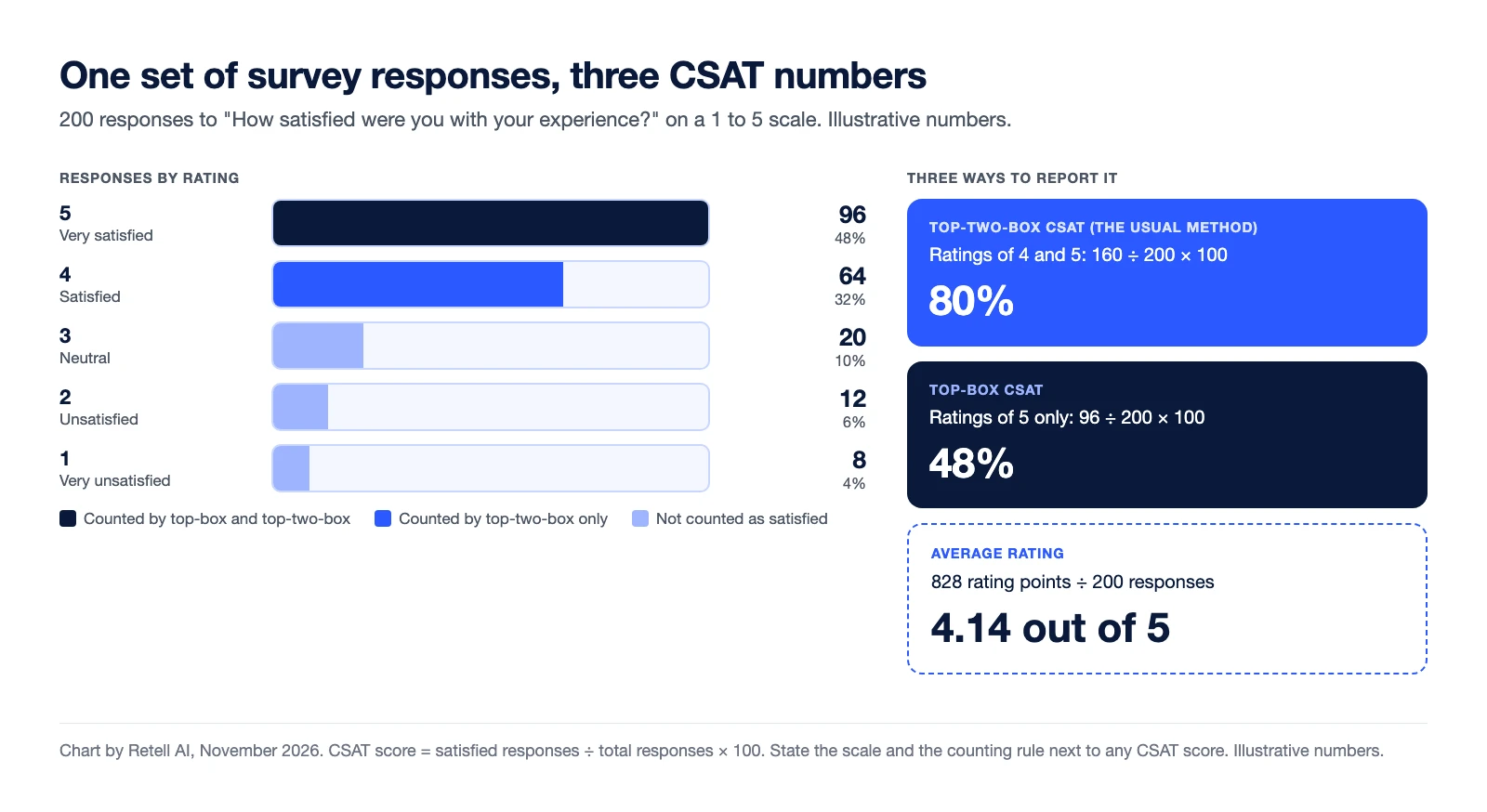
Worked example (illustrative numbers). A support line gets 200 responses on a 1 to 5 scale: 96 fives, 64 fours, 20 threes, 12 twos and 8 ones.
- Satisfied responses: 96 + 64 = 160
- CSAT score: 160 ÷ 200 × 100 = 80%
Customers who did not answer the survey are not in the formula.
What question and scale does a CSAT survey use?
The standard question is a version of "How satisfied were you with your experience?" The answer scale varies. SurveyMonkey lists 1 to 5, 1 to 7 and 1 to 10 scales, and counts 5, 6 and 7 as satisfied on the 7-point scale.
The counting rule matters as much as the scale:
- Top-two-box. Count the two highest ratings as satisfied, the usual method on a 1 to 5 scale.
- Top-box. Count only the highest rating.
- Average rating. Report the mean, with no percentage.
In the worked example, the three rules give 80%, 48% and 4.14 out of 5. State the scale and the rule next to the score, and keep both fixed.
What is a good CSAT score?
There is no universal good CSAT score. The number depends on the industry, the channel, the kind of contact being rated, the scale and the counting rule. The benchmark you can trust most is your own trend: the same question, on the same scale, for the same contact type, over time.
For an outside reference, the American Customer Satisfaction Index (ACSI) publishes satisfaction scores by industry. These 2026 scores were read on theacsi.com on November 16, 2026:
- Banks: 80. Call center satisfaction for banks: 82.
- Wireless phone service: 77. Call center satisfaction for mobile network operators: 75.
- Health insurance: 75. Call center satisfaction: 76.
- Non-fiber internet service providers: 71.
- National ACSI score, second quarter of 2026: 76.1.
ACSI scores are not CSAT percentages. ACSI says its scores "are reported on a 0 to 100 scale" (October 2026 study). Its methodology page says the score is "a weighted average of three survey questions" run through an econometric model. An ACSI of 80 does not mean 80% of customers chose 4 or 5 on a survey, so use the index to compare industries, not as a survey target.
CSAT vs NPS vs CES: what is the difference?
| CSAT | NPS | CES | |
|---|---|---|---|
| Full name | Customer satisfaction score | Net Promoter Score | Customer effort score |
| What it measures | Satisfaction with one interaction, product or service | Loyalty to the company | How easy it was to get something done |
| Typical question | "How satisfied were you with your experience?" | "How likely are you to recommend us to a friend or colleague?" | "The company made it easy for me to handle my issue." |
| Scale | 1 to 5, 1 to 7 or 1 to 10 | 0 to 10 | Often 1 to 7, from disagree to agree |
| How it is scored | Satisfied responses ÷ total responses × 100 | Percentage of promoters (9 to 10) minus percentage of detractors (0 to 6) | Average score, or share who found it easy |
The NPS question and scoring come from Bain's Net Promoter System. See also what Net Promoter Score is and customer effort score.
What are the limits of CSAT?
- Response bias. Qualtrics notes that people who answer are likely to have had "a very positive or very negative experience", while neutral customers are less motivated to respond.
- Low response rates. Geckoboard notes that not all customers respond, "so you'll never get a full picture". Track the response rate next to the score.
- One moment, not the relationship. Qualtrics calls CSAT a "here and now" reaction, limited for measuring a customer's ongoing relationship with a company.
Read CSAT next to first contact resolution, average speed of answer, service level and call abandonment rate. Callers who hang up in the queue never see a survey.
How is CSAT collected after a phone call?
Twilio's glossary lists SMS, email and IVR as channels for post-contact surveys. On phone lines there are three common setups:
- Post-call IVR survey. The caller stays on the line and an automated prompt asks for a rating by keypad or voice. It only reaches callers who stay on.
- SMS survey. A text goes out after the call with the question. It only works when the caller is on a number that can receive texts.
- The agent asks before the call ends. A human or AI agent asks the question as the last turn of the call. More callers hear it, but they are answering to the party being rated.
Pick one method per line and do not mix scores from different methods in one trend.
Where AI voice agents fit
Retell AI's documentation does not describe a prebuilt CSAT survey. It documents the parts for running one:
- Asking the question. You prompt the agent to ask for a rating. Keypad presses are "captured by default and factored into the agent's responses", per the DTMF docs, so the caller can press or say a number.
- Recording the answer. Post Call Extraction reads the transcript after the call and writes structured fields. Its Number field type is described as suited to values "like a transaction amount or satisfaction score".
- Sentiment on calls with no survey answer. Every call gets a built-in
user_sentimentfield, which the docs say is inferred from the transcript with an LLM. That is sentiment analysis, not a survey answer, so report it separately from CSAT.
Retell's AI QA scores a sampled set of calls on resolution, sentiment and other metrics.
Frequently asked questions about CSAT scores
What does CSAT stand for?
Customer satisfaction. A CSAT score is the percentage of survey respondents who said they were satisfied.
What is the formula for CSAT?
Divide satisfied responses by total responses, then multiply by 100. On a 1 to 5 scale, satisfied usually means a rating of 4 or 5.
What is a good CSAT score?
There is no single standard. It depends on industry, channel, contact type and counting rule, so compare against your own trend first. Indexes such as ACSI use a different method and are not directly comparable to a survey CSAT percentage.
Is CSAT the same as NPS?
No. CSAT measures satisfaction with one interaction. NPS measures how likely a customer is to recommend the company.
Can a CSAT score be 100%?
Yes, if every respondent chose a satisfied rating. Check the response count before reading much into it.
Measure satisfaction on every call
Retell AI is an AI voice agent platform for contact centers. You can prompt its agents to ask for a rating before the call ends and set post-call extraction to record the answer next to the built-in sentiment field. Talk to the Retell team.
Security & compliance for regulated deployments
How Retell handles audits, data retention and access control.
Further Reading
Related terms
Contact Center Workflows: Examples to Automate
How to Handle High Call Volume
Table of contents