WebRTC (Web Real-Time Communication) is the open standard that lets browsers and apps send live audio and video directly, with no plugin or download. It is built into every major browser.
How does WebRTC work?
WebRTC handles the difficult parts of live audio on the open internet: finding a network path between two endpoints, encrypting the media, and adapting to changing network conditions. Encryption is mandatory in WebRTC. It does not define how two sides find each other and agree to start a call. Each application supplies that signaling, usually through an SDK.
How do AI voice agents use WebRTC?
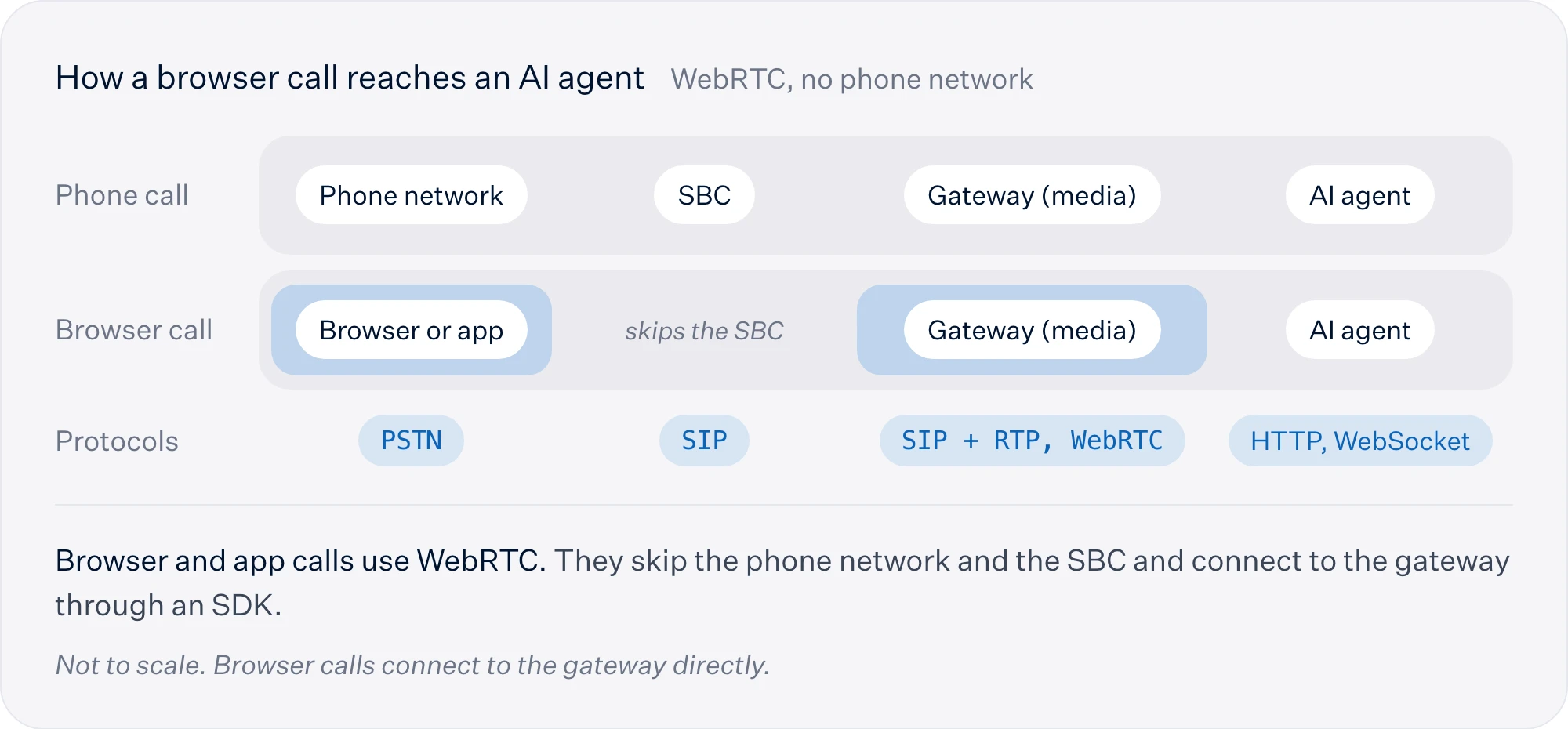
WebRTC carries calls that start in a website or app instead of on the phone network, such as a "talk to us" button on a web page. The browser captures microphone audio and sends it to a gateway, which passes it to the AI and returns the agent's speech. Browser calls skip the phone network and the session border controller.
Retell AI provides its own WebRTC SDK for browser calls. See the web call documentation.
WebRTC vs SIP
| WebRTC | SIP | |
|---|---|---|
| Used for | Browser and app calls | Phone system and carrier calls |
| What it defines | Media transport and encryption | Call signaling |
| Signaling | Supplied by the application | SIP itself |
| Entry point in a voice AI platform | The gateway, directly | A session border controller, then the gateway |
Frequently asked questions
Is WebRTC only for video?
No. It carries audio, video, and data. AI voice agents use the audio part.
Can a WebRTC call reach a phone number?
Yes, through a gateway that connects WebRTC to SIP and the phone network.
Is WebRTC encrypted?
Yes. Media encryption is required by the standard.
Related terms and reading
Security & compliance for regulated deployments
How Retell handles audits, data retention and access control.
Further Reading
Related terms
Table of contents