Barge-in is when a caller starts speaking while a voice agent or IVR is still talking, and the system stops to listen. It lets callers cut a long menu or answer short, correct a mistake, or answer before the agent finishes its sentence, the way people do in normal conversation.
The term comes from IVR systems, where barge-in let callers say or press their choice without waiting for the whole menu. In AI voice agents, it is part of turn-taking: the agent has to tell a real interruption apart from background noise, a cough or a short "mm-hm".
Why does barge-in matter?
Without barge-in, a caller who already knows the answer has to sit through the agent's full sentence, and a caller who hears a wrong detail cannot correct it until the agent stops. Both make the call slower and more frustrating.
Too much sensitivity causes the opposite problem. If any background sound stops the agent, it cuts itself off mid-sentence in a noisy car or office, and the conversation stalls.
How do AI voice agents handle barge-in?
The agent listens while it speaks. Voice activity detection picks up the caller's speech, and the agent decides whether it is an interruption worth stopping for.
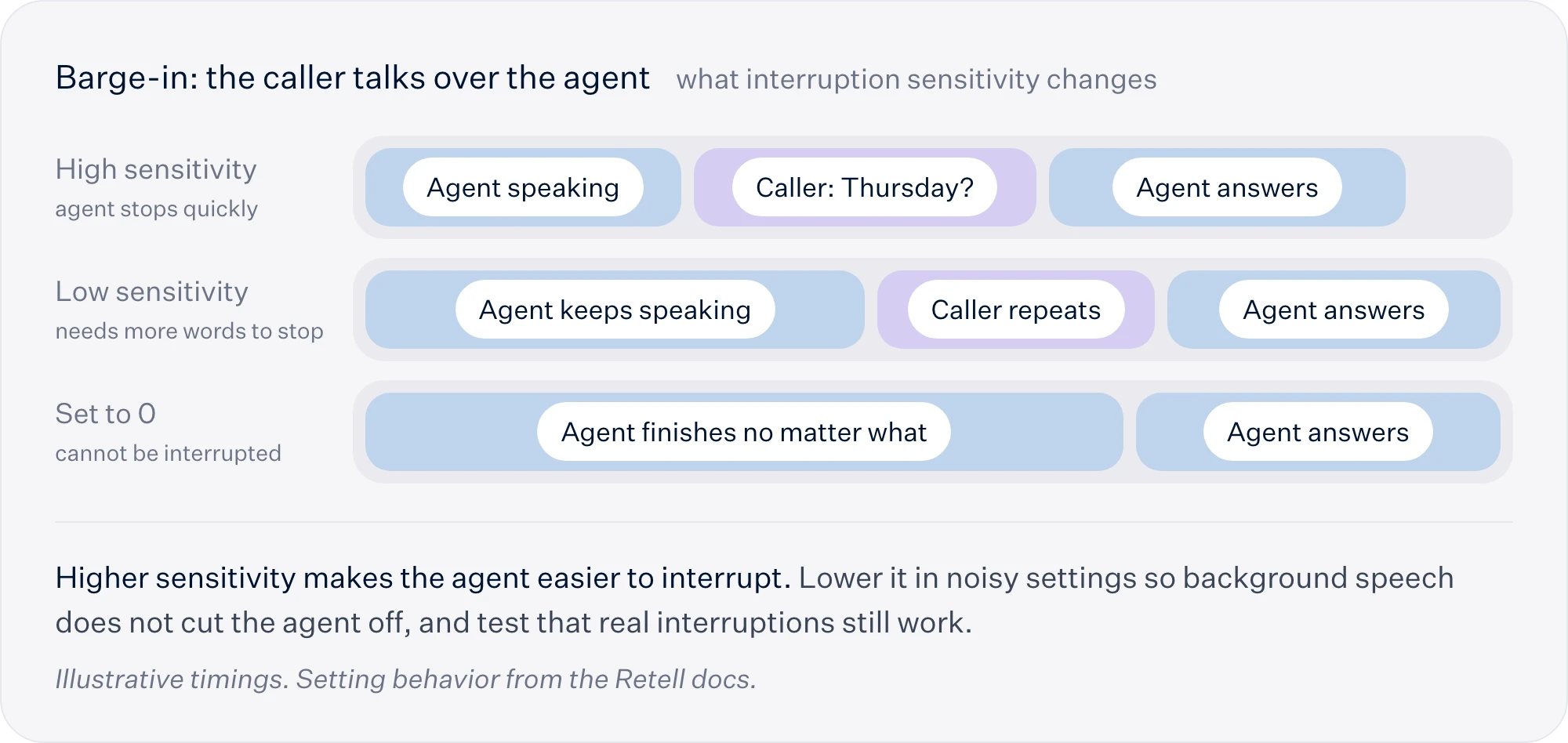
In Retell, that decision is set by Interruption Sensitivity, a value from 0 to 1 in the agent's speech settings (docs):
- Higher values make the agent easier to interrupt.
- Lower values require the caller to speak longer or say more words before the agent stops.
- At 0, the caller cannot interrupt the agent at all.
The API defaults to 1 when the setting is left out, and new blank agents created in the dashboard start at 0.9.
How should you set it?
Start high for quiet, conversational calls, where callers expect to cut in. Lower it step by step for callers in noisy places, such as drivers, warehouses or busy shops, and test with real background noise to make sure callers can still interrupt on purpose. Short acknowledgments from the caller are a different case: the agent can make its own small sounds while the caller talks, which is backchanneling.
Barge-in vs dead air
Barge-in is about two people talking at once. Dead air is the opposite: nobody talking. Both are turn-taking problems, and a well-tuned agent avoids both.
Frequently asked questions
What does barge-in mean on a phone call?
Barge-in means the caller can start talking while the automated system is still speaking, and the system stops to listen instead of making the caller wait.
Is barge-in the same as interruption sensitivity?
Barge-in is the behavior. Interruption sensitivity is the setting that controls it: how easily the caller's speech makes the agent stop.
Why does my voice agent stop talking for no reason?
Usually because background speech or noise is being treated as an interruption. Lower the interruption sensitivity a step at a time, turn on noise reduction, and test with realistic noise.
Can you turn off barge-in?
Yes. In Retell, setting interruption sensitivity to 0 means the caller cannot interrupt the agent. Use it sparingly, for example for a required disclosure, because callers find it frustrating on ordinary turns.
Related terms and reading
Security & compliance for regulated deployments
How Retell handles audits, data retention and access control.
Further Reading
Related terms
Table of contents