Dead air is a stretch of silence on a call when neither the caller nor the agent is speaking, usually because the agent is waiting on information. In contact centers, it is the pause a customer sits through while a human agent searches a system or an AI voice agent waits for a tool call to return.
The term comes from broadcasting, where it means an unplanned gap with no sound going out. CX Today describes contact center dead air as "a period of silence during an interaction, where the customer is left waiting while the agent looks for information, deals with a slow system, or thinks of what to say next" (source).
What causes dead air on a call?
The causes differ between human and AI agents, but most come back to waiting for data.
| Human agent | AI voice agent | |
|---|---|---|
| Looking up information | Searching a CRM, knowledge base or order system | A tool call to an API, database or scheduling system |
| Slow systems | Slow or poorly indexed search tools | A slow endpoint, large responses, timeouts and retries |
| Not knowing what to say | An unfamiliar question or a gap in training | A slow model response, often from a long prompt |
| Technical faults | One-way audio or a dropped connection | The same |
Call Centre Helper notes that dead air "is often the result of slow search systems or poorly indexed systems that advisors struggle to navigate" (source). AI voice agents have the same problem in a different form: the slow system is whatever the agent's tool calls depend on.
Why does dead air matter?
Callers read silence as a problem. They say "hello?", repeat themselves, or hang up because they think the line dropped. On an AI call, a caller who repeats the question during a lookup can also end up talking over the answer when it arrives. And because silence makes every call longer, it adds to average handle time whether or not the caller notices.
How do you reduce dead air?
For human agents, contact centers usually train agents to say what they are doing ("let me pull up your account"), improve search tools, and use speech analytics to find long silences.
For AI voice agents, there are four levers, in order:
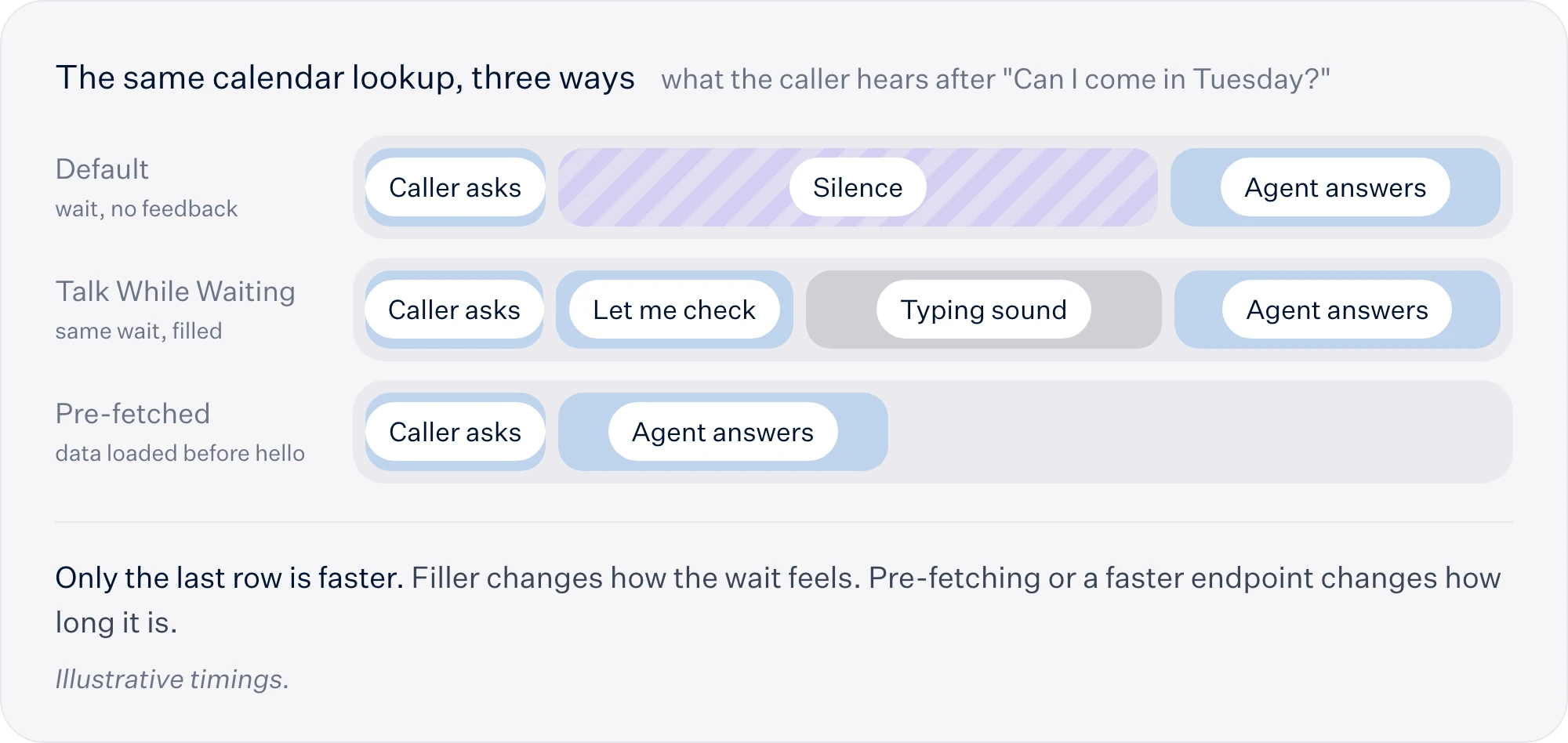
- Remove the lookup: load caller data before the call starts, for example through an inbound call webhook.
- Run it in the background: let tools the next sentence does not depend on, such as CRM logging, run while the conversation continues.
- Make it faster: return only the fields the agent needs and set a realistic timeout.
- Cover the wait: have the agent say a short line or play a typing sound while the tool runs.
The full guide is how to fix dead air in AI voice agents.
What if the caller goes quiet?
Dead air can come from the caller's side too, for example when they step away or are reading something. In Retell, the agent can prompt the caller after a set stretch of silence. The reminder trigger defaults to 10 seconds, and the number of reminders defaults to one (API reference).
Dead air vs latency
Latency in a voice agent usually means the time from when the caller stops talking to when the agent starts. Dead air is broader: any silence in the conversation, whatever its cause. A voice agent can have low latency on ordinary turns and still produce long dead air during tool calls. Retell's end-to-end latency metric excludes turns where the agent only runs tool calls, so dead air from slow tools has to be measured separately.
Frequently asked questions
What is dead air in a call center?
Dead air is silence on a call when neither the customer nor the agent is speaking, most often while the agent searches for information or waits on a slow system.
How long is too long for dead air?
There is no single standard. Contact center guidance focuses less on a number and more on whether the caller knows why it is quiet: a silence the agent explains is easier to sit through than one the caller did not expect.
Why do AI voice agents have dead air?
Usually because the agent is waiting for a tool call, such as a calendar or account lookup, to return before it can answer. The language model and voice are rarely the cause.
How do you fix dead air in an AI voice agent?
Pre-fetch data the agent will need, run tools it does not need right away in the background, make slow endpoints faster, and use a short waiting message or typing sound for the waits that remain.
Related terms and reading
Security & compliance for regulated deployments
How Retell handles audits, data retention and access control.
Further Reading
Related terms
Table of contents