Hold time is the time a caller spends on hold during a call, after an agent has answered, usually while the agent looks something up, checks with a colleague or transfers the call. Average hold time is the total hold time across calls divided by the number of calls.
Hold time is different from queue time. Queue time is the wait before anyone answers, measured by average speed of answer. Hold time happens in the middle of a conversation that has already started.
How do you calculate average hold time?
Average hold time = total hold time ÷ number of calls handled.
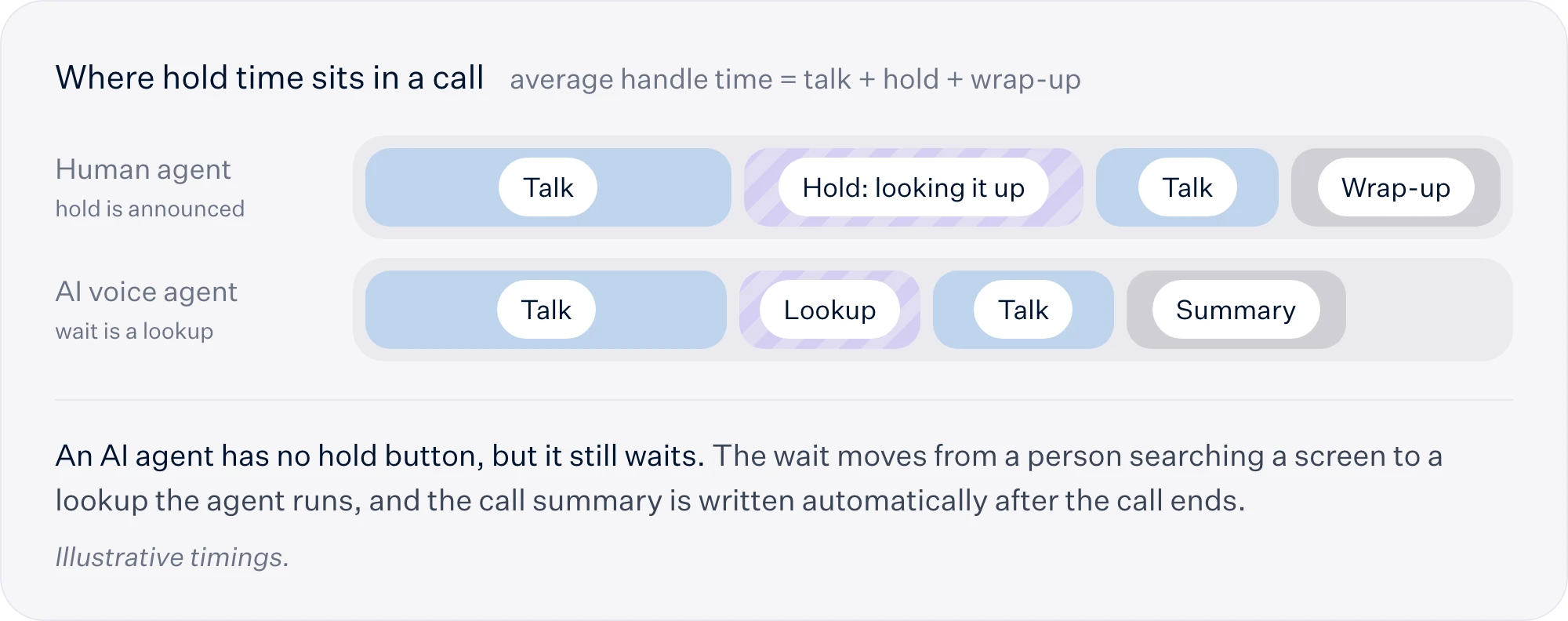
Hold time is one of three parts of average handle time (AHT): talk time + hold time + wrap-up time (call center metrics). Track the worst cases as well as the average, since a few very long holds can hide behind a healthy average.
Why does hold time matter?
Callers on hold are more likely to hang up, which shows up in the call abandonment rate. Long holds also make calls longer, which needs more staff for the same volume. Most hold time comes from the same place: an agent waiting on a slow system or hunting for information.
Hold time vs dead air
Hold time is a wait the agent announces, usually with hold music or a message. Dead air is silence the caller was not warned about. Both come from waiting on information, but unannounced silence makes callers wonder if the line dropped.
How do AI voice agents change hold time?
An AI voice agent does not put callers on hold in the usual sense, but it can still make them wait while it looks something up through a tool call. The fixes are the same ideas as for human agents: load the caller's data before the call starts, make the lookup faster, and tell the caller what is happening while they wait. The full guide is how to fix dead air in AI voice agents.
After the call, a voice agent writes its own summary, so there is no manual wrap-up time on AI-handled calls.
Frequently asked questions
What is a good average hold time?
It depends on the industry and the type of call. Compare against your own history and similar call types, and watch the longest holds as well as the average.
What is the difference between hold time and wait time?
Wait time usually means the time before an agent answers, in the queue. Hold time is time spent on hold after an agent has answered.
Does hold time count toward average handle time?
Yes. Average handle time is talk time plus hold time plus wrap-up time.
Related terms and reading
Security & compliance for regulated deployments
How Retell handles audits, data retention and access control.
Further Reading
Related terms
Table of contents